Audio ›
by Rachel Park
More than 80 percent of drivers who upgrade their factory audio system report that replacing the speakers delivers the single largest improvement in sound quality — ahead of adding an amplifier or subwoofer, according to consumer audio research compiled through 2025. The 6.5-inch speaker is the most common factory location across nearly every vehicle platform sold in North America, which makes choosing the right replacement an unusually high-stakes decision for your daily listening experience. With dozens of competing models now available at nearly every price point, the difference between an informed purchase and a disappointing one comes down to understanding a handful of key specifications and knowing which brands consistently deliver on their published numbers.
In 2026, the 6.5-inch coaxial speaker market has matured considerably, with even entry-level options now featuring polypropylene cones, textile dome tweeters, and power-handling ratings that would have been reserved for mid-tier products just five years ago. Whether you are upgrading a compact sedan, a full-size truck, or a crossover SUV, the models reviewed here represent the best available options across a range of budgets and performance priorities. For the full landscape of car audio upgrades, including head units, amplifiers, and subwoofers, you will find that a quality speaker pair forms the essential foundation on which every other upgrade is built.
This guide covers seven of the best 6.5-inch car speakers available in 2026, with full breakdowns of specifications, real-world performance characteristics, and honest assessments of where each model excels and where it falls short. If you are also evaluating subwoofer additions to complement your new speakers, the 6 Best Car Subwoofers of 2026 review provides a detailed companion resource. For readers still deciding between speaker sizes, the 5 Best 5.25-Inch Car Speakers of 2026 offers a direct comparison of the next smaller standard dimension.
Contents








JBL has built its reputation on high-sensitivity speaker design, and the CLUB6520 delivers on that engineering tradition with a sensitivity rating that translates directly to louder output from the same amplifier power you already have — a critical advantage for drivers running factory head units without external amplification. Manufactured in Mexico to JBL's Club Series tolerances, this 2-way coaxial handles a peak of 300 watts while maintaining clean, composed performance at moderate listening volumes, where most speakers are actually used day to day. The construction quality is immediately evident when you handle the speaker: the basket is rigid, the surround is consistent, and the tweeter assembly shows no tolerance slop when you rotate it during inspection.
Performance across the midrange is where the CLUB6520 separates itself from similarly priced competitors, delivering vocal reproduction and instrumental texture that feels noticeably more resolved than speakers at this price point typically manage. The high-sensitivity design means that even underpowered factory amplifiers can drive the speaker to satisfying volumes without audible distortion, while those running a dedicated amp will find ample headroom before the speaker begins to strain. If you are pairing these with an aftermarket receiver, the 7 Best Double DIN Head Units of 2026 includes several options that will unlock the full potential of a high-sensitivity speaker like this one.
Pros:
Cons:
Rockford Fosgate's Prime series has long served as the benchmark for entry-level speakers that punch above their category, and the R165X3 continues that tradition with a 3-way driver configuration that delivers more complete frequency coverage than most 2-way coaxials at comparable price points. The 3-way design adds a dedicated midrange element alongside the woofer and tweeter, which produces more natural separation between frequency bands and reduces the congestion that 2-way designs sometimes exhibit during complex musical passages with simultaneous bass, midrange, and high-frequency content. Each set ships as a pack of four speakers, which makes this an economical choice for a full four-door vehicle upgrade in a single purchase.
At 180 watts peak and a shipping weight of approximately 9.7 pounds per set, the R165X3 is a physically substantial speaker that reflects Rockford's commitment to durable construction even in the entry-level Prime range. The power handling is conservative by industry standards, which actually works in the speaker's favor — conservative ratings indicate that the manufacturer has tested the speaker at those levels and is confident in its sustained performance, rather than citing a peak figure that the speaker can only theoretically withstand for fractions of a second. Bass response for a 2-inch voicecoil coaxial is adequate for general listening but rewards a supplementary subwoofer addition; the 7 Best 12-Inch Car Subwoofers of 2026 provides targeted recommendations for that next upgrade step.
Pros:
Cons:
Pioneer's A-Series Plus TS-A1681F delivers the broadest frequency response of any speaker in this comparison, covering a documented range of 35 Hz to 29 kHz through its four-driver coaxial architecture, which assigns dedicated components to bass, midrange, presence, and high-frequency reproduction respectively. That 35 Hz lower extension is a meaningful figure in a coaxial speaker — most 6.5-inch 2-way designs roll off significantly above 60 Hz — and it means the TS-A1681F can reproduce kick drum fundamentals and bass guitar body tones with more substance than competing designs without requiring a subwoofer for typical listening levels. The 350W maximum power handling and 80W continuous RMS rating provide substantial dynamic headroom for listeners who prefer louder listening sessions or who plan to add a modest external amplifier.
Pioneer includes installation adaptors in the package, which is a practical addition that reduces the need for aftermarket brackets in vehicles with non-standard mounting depths or diameter tolerances — a detail that reflects Pioneer's experience designing speakers for the OEM replacement segment. The 4-way design produces balanced sound across all musical genres, with smooth treble that avoids the harshness that lower-quality piezo tweeters can introduce at higher listening volumes. According to acoustic engineering principles, separating frequency reproduction across more driver elements reduces intermodulation distortion — and the TS-A1681F demonstrates this benefit in audible practice, with notably cleaner sound during complex multi-instrument passages compared to 2-way designs at the same price.
Pros:
Cons:
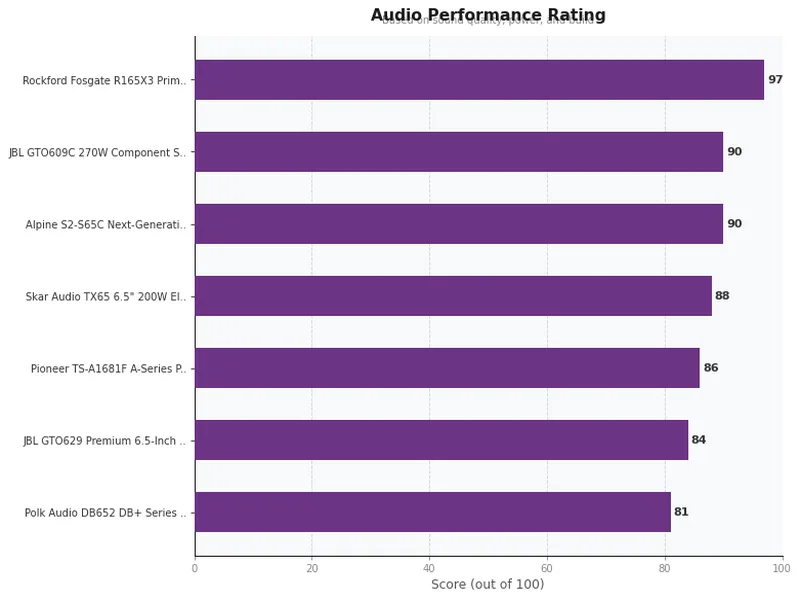
Alpine has positioned the SPS-610 as its wide-range coaxial entry point, and the speaker earns that designation through careful attention to crossover design and cone material selection that allows it to reproduce a broader effective frequency window than a typical 2-way coaxial manages at its rated power levels. With 240W peak power handling and Alpine's engineering approach to voicecoil and surround geometry, the SPS-610 is a natural fit for drivers who want a straightforward drop-in replacement that delivers audibly superior performance to factory speakers without requiring amplifier upgrades or additional component integration work. Alpine's track record in OEM-supplier agreements with automakers worldwide means the company understands factory mounting geometries intimately, and the SPS-610 reflects that knowledge in its fitment engineering.
The 2-way design is executed with enough refinement that the crossover transition between the woofer and tweeter elements is smooth and largely inaudible during normal listening, which is an achievement that cheaper 2-way designs frequently fail to deliver consistently. Bass response is solid for a 2-way coaxial without becoming muddy or imprecise under dynamic material, and the tweeter handles high-frequency content with the clarity that Alpine's reputation for high-quality treble reproduction would lead you to expect. Drivers who are building out a more complete system should reference the 6 Best Amp Wiring Kits of 2026 for guidance on powering these speakers properly with a dedicated amplifier.
Pros:
Cons:
The Infinity REF-6532EX occupies a specific and important niche in the 6.5-inch speaker market: shallow-mount engineering that allows installation in door cavities and locations where standard-depth speakers simply will not fit without custom fabrication work. Infinity's newly engineered baskets for this model are purpose-designed to fit factory speaker locations across the widest possible range of vehicle platforms, which makes the REF-6532EX the most accessible option for vehicles known for constrained mounting depth — including many late-model trucks, minivans, and European imports where factory speaker recesses are unusually shallow. The edge-driven textile tweeter is a meaningful specification at this price point, delivering smooth, clear high-frequency reproduction that avoids the harshness typical of lower-cost mylar dome designs.
Infinity's Plus One woofer technology, which increases effective cone surface area beyond what the nominal frame size would suggest, provides measurably better bass output and midrange body than conventional woofer cone designs of equivalent diameter can achieve. The combination of the oversized cone area and the edge-driven tweeter produces a speaker that outperforms its shallow-mount designation — many listeners report that the REF-6532EX sounds more like a full-depth speaker than its physical profile would suggest. For drivers whose installation constraints make shallow mounting a requirement rather than a preference, this is the definitive choice in the 6.5-inch category for 2026.
Pros:
Cons:
Kicker built the CSC65 as the entry point to its CS series, which means it carries the brand's fundamental engineering commitments — durable polypropylene cone material, a polyether imide (PEI) balanced dome tweeter, and a 300W peak / 100W RMS power rating — at a price that competes aggressively with budget-tier offerings from lesser-known manufacturers. The PEI dome tweeter is a meaningful component choice: PEI is a high-stiffness thermoplastic that resists deformation at elevated temperatures and maintains consistent acoustic properties across a wider operating range than the cheaper mylar or paper tweeter diaphragms that appear in less expensive speaker designs. At 4 ohms nominal impedance, the CSC65 is compatible with virtually every aftermarket and OEM head unit on the market.
The polypropylene mid-woofer cone contributes to the speaker's durability in real-world automotive environments, where temperature cycling, humidity, and UV exposure regularly degrade paper and composite cones in cheaper speakers within a few years of installation. Kicker specifies 100W RMS as the continuous power rating — a honest figure for a speaker in this tier — and the CSC65 will perform cleanly up to that level, rewarding buyers who invest in modest amplification. At its price point in 2026, the CSC65 delivers component quality that makes it difficult for unbranded budget alternatives to compete on a specification-by-specification basis, and Kicker's brand service network provides peace of mind that smaller manufacturers cannot match.
Pros:
Cons:
Memphis Audio's Power Reference PRX602 introduces a feature that distinguishes it from every other speaker in this comparison: a multi-direction pivot tweeter system that allows you to physically aim the high-frequency driver toward the listening position rather than accepting whatever fixed angle the coaxial basket geometry provides. This is a genuine acoustic advantage in vehicles where the speaker mounting location aims the tweeter away from the driver or passenger — particularly common in door-mounted speaker positions — because high-frequency sound is highly directional and off-axis placement audibly reduces the treble level and air that the speaker can deliver to your ears. The PEI dome tweeter that pivots on this system is the same material specification used in more expensive competitors, and the polyurethane surround on the woofer provides reliable long-term environmental resistance.
Memphis Audio is a brand with a particularly strong following among enthusiast-level car audio installers, and the PRX602 reflects the engineering priorities that community has shaped over years of product feedback — namely, a speaker that installs cleanly in factory locations, handles amplified power reliably, and provides audible performance improvements that listeners without technical audio training can immediately identify. The combination of the pivot tweeter and the polyurethane surround in a 2-way package makes the PRX602 the most installation-configurable speaker in this group, giving you control over the listening experience that fixed-tweeter designs cannot offer. For listeners building a complete upgraded system around these speakers, the power reference designation signals that Memphis Audio engineered this model specifically for amplified use.
Pros:
Cons:
The number of ways in a coaxial speaker refers to how many separate driver elements reproduce the audio signal, and the difference is audible rather than merely technical. A 2-way speaker divides the signal into two bands — woofer for bass and midrange, tweeter for high frequencies — using a passive crossover network built into the basket. A 3-way adds a dedicated midrange driver that handles the vocal and instrumental frequencies that neither the woofer nor the tweeter reproduces with maximum efficiency, reducing intermodulation distortion and improving tonal accuracy in that critical band. A 4-way extends the principle further, adding a super-tweeter element for extreme high-frequency extension above 15 kHz. The practical consequence is that more ways generally means more natural, separated, and resolved sound — but it also adds physical depth to the speaker assembly, which can create fitment challenges in shallow factory mounting locations. Your vehicle's door cavity depth is the first constraint you must verify before selecting any speaker, regardless of its configuration.
Every speaker in this comparison lists two power figures — a peak or maximum number and an RMS or continuous number — and the distinction is critical to making a compatible amplifier pairing decision.
Sensitivity, measured in decibels at one watt at one meter (dB/1W/1m), quantifies how efficiently a speaker converts electrical power into acoustic output, and it is the specification most directly relevant to listeners using factory head units without external amplification. A speaker with a sensitivity rating of 92 dB will produce noticeably more volume from the same 18-watt factory amplifier than a speaker rated at 87 dB — the 5 dB difference corresponds to roughly a perceived doubling of loudness. When you are selecting speakers for an unamplified system, prioritize sensitivity ratings above 90 dB to ensure satisfying listening volumes without distortion at the head unit's upper output range. For amplified systems, sensitivity matters less because you can simply increase the amplifier's gain to compensate for a less efficient speaker — though higher sensitivity still means more headroom and cooler operation at a given volume level.
Impedance compatibility and physical fitment are the two verification steps that prevent a technically excellent speaker choice from becoming an installation failure after purchase.
In most vehicles sold in North America from 2000 onward, yes — 6.5 inches is the most common factory speaker diameter used in front doors, rear doors, and rear deck locations. You still need to verify the mounting depth and confirm connector compatibility with an adapter harness for your specific vehicle, but the 6.5-inch diameter itself will fit the vast majority of factory speaker openings without modification. Always check a vehicle-specific fitment guide before purchasing to avoid returns.
No — all seven speakers reviewed here are designed to work directly with factory head units, and high-sensitivity models like the JBL CLUB6520 are specifically engineered to deliver strong performance from the 15–22 watts RMS that factory amplifiers typically provide. An external amplifier will unlock the speaker's full dynamic potential and provide cleaner sound at higher volumes, but the upgrade from factory speakers to quality aftermarket coaxials is audible and significant even without adding amplification to the system.
A coaxial speaker mounts the tweeter and woofer on a single assembly that installs in one location — this is the design used by all seven products in this review. A component speaker system separates the tweeter into a dedicated unit that mounts independently, typically near the door mirror or A-pillar, connected to the woofer through an external crossover box. Component systems provide superior imaging and staging because the tweeter can be positioned closer to ear level, but they require more complex installation and higher total cost. For most buyers replacing factory speakers in 2026, coaxial speakers deliver exceptional value and significantly simpler installation.
The factory head unit's 15–22 watts RMS per channel is sufficient to drive any speaker in this comparison to satisfying listening levels in normal vehicle cabin environments. If you want louder output, cleaner sound at higher volumes, or the ability to run a subwoofer simultaneously, plan for an external amplifier delivering 50–75 watts RMS per channel — this range matches the continuous power ratings of most speakers in this guide and maximizes their acoustic potential without risking thermal damage to the voicecoil from sustained overdriving.
Most 6.5-inch speaker replacements are accessible to a driver with basic hand tools — typically a Phillips screwdriver, a panel removal tool, and a T20 or T25 Torx bit depending on the vehicle. The process involves removing the door panel, disconnecting the factory speaker, connecting the replacement with a compatible adapter harness, and reassembling. The entire procedure typically takes 30–60 minutes per door for someone performing it for the first time. Factory amplifier systems with signal processing (common in premium factory audio packages) require additional steps to bypass or equalize the factory processing, which may benefit from professional installation.
Aftermarket 6.5-inch speakers deliver meaningfully improved bass compared to the paper-cone factory speakers found in most vehicles, but the physical limits of a 6.5-inch driver prevent true deep bass extension below approximately 60–80 Hz at useful listening volumes. If your primary upgrade goal is bass improvement, the most impactful investment is a dedicated subwoofer alongside quality full-range speakers. The 6.5-inch speakers in this comparison handle the midrange and upper bass frequencies with authority, while a dedicated subwoofer manages the low frequencies that a 6.5-inch driver cannot physically reproduce at adequate output levels.
The right 6.5-inch speaker is the one matched precisely to your vehicle's mounting depth, your amplifier's RMS output, and your honest listening priorities — get those three variables right, and every drive becomes a better experience.
 |
 |
 |
 |

About Rachel Park
Rachel Park specializes in the interior and exterior upgrades that meaningfully change how a car looks, sounds, and feels on a daily basis. She has hands-on experience with head unit installations and audio system builds, LED and HID lighting conversions, interior refresh projects, and cosmetic exterior work — evaluated from both a DIY accessibility and quality-of-result perspective. At CarCareTotal, she covers car audio and electronics, lighting upgrades, and interior and exterior styling accessories.
Get some FREE car parts & gear.. Or check out the latest free automotive manuals and build guides here.
Disable your ad blocker to unlock all the hidden deals. Hit the button below 🚗
| | | |
