by Marcus Chen
The ARCAN 3-Ton Aluminum Low Profile Floor Jack (Model A20019) is our top pick for 2026 — it hits the sweet spot of lightweight aluminum construction, impressive 3-ton capacity, and a 3.75-inch minimum height that actually fits under most passenger vehicles. If you need a reliable floor jack that won't wear you out on the driveway, start here.
Picking the right floor jack matters more than most people realize. A jack that's too tall can't slide under your vehicle. A jack that's too weak puts you in a dangerous situation. And a jack built with cheap materials will let you down right when you need it most. Whether you're doing a quick tire swap, checking your brake pads, or pulling off a full oil change, the right floor jack makes the job faster and safer. If you're also working on other maintenance items like wheel bearing greases, having quality lifting equipment in your garage is part of the whole package.
For 2026, we evaluated seven of the most popular floor jacks on the market — ranging from lightweight aluminum models for everyday use to heavy-duty steel jacks built for trucks and SUVs. We looked at lift range, weight capacity, build quality, ease of use, and value. Here's what you need to know before you buy.
Contents
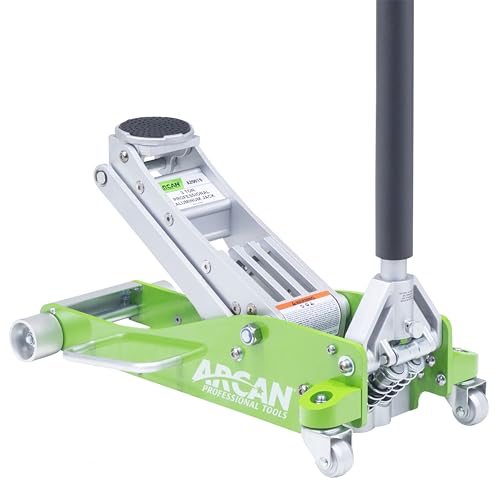






The ARCAN A20019 is the floor jack most home mechanics should buy in 2026. Full stop. It weighs significantly less than comparable steel jacks — aluminum construction is a real-world advantage when you're dragging it in and out of a tight garage or loading it into a truck bed. The 3.75-inch minimum height gets you under most passenger cars and crossovers without any struggle, and the maximum height of 18 inches covers a wide range of service needs. The quick-rise mechanism means the saddle climbs fast to meet the load point, so you're not pumping 15 times just to get contact.
At 3 tons (6,000 lbs.), this jack handles the full range of passenger vehicles, light trucks, and SUVs. The build quality is noticeably premium — joints are tight, the hydraulic action is smooth, and it rolls easily on polished concrete. If you've been using a cheap imported jack that drifts or feels spongy under load, the ARCAN will feel like a completely different tool. It's not the cheapest option on this list, but it's the one most likely to still be working perfectly five years from now.
The only real trade-off is the 18-inch maximum lift height, which may limit you if you regularly work on lifted trucks. For standard vehicles, that's plenty. This is our clear number-one recommendation.
Pros:
Cons:
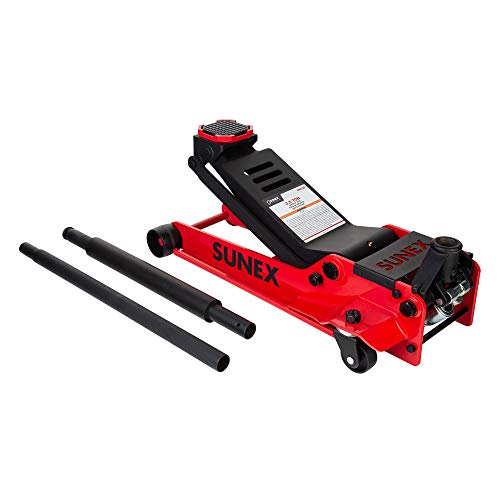
If you need maximum capacity and you're not worried about weight, the Sunex 66035SJ is the jack to buy. At 3.5 tons (7,000 lbs.), it's the highest-rated jack on this list, and it's built for serious service work. Sunex went all-in on the hydraulic system here — upgraded power unit seals and high-performance hydraulic fluid are designed for long-term reliability, not just initial impressions. The Rapid-Rise dual pump piston technology means the saddle gets to contact fast, which matters when you're doing multiple lifts in a single work session.
Steel construction gives this jack an inherent strength advantage over aluminum. The tradeoff is weight — this thing is heavy, and you'll feel it when maneuvering around a tight garage. That said, the build is solid and stable under load, which is exactly what you want when 7,000 pounds of vehicle is resting on it. The low-profile design still lets it slide under most vehicles without issue.
This is the jack for the serious weekend warrior or the small shop owner who wants professional-grade equipment at a consumer price. If you're regularly working on trucks, vans, or larger SUVs, the extra half-ton of capacity gives you real peace of mind.
Pros:
Cons:
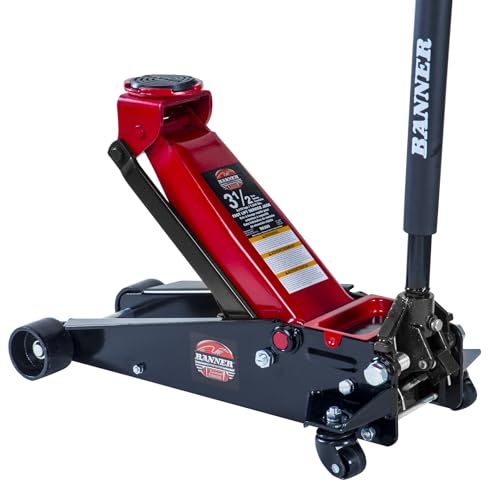
The Blackhawk B6350 earns its "Fast Lift" label. This jack is designed for speed — the fast-lift mechanism reduces the number of handle strokes needed to raise a vehicle, and in practice, you'll notice the difference immediately. When you're changing tires in a parking lot or knocking out a quick brake job, that time savings adds up. The 3.5-ton capacity matches the Sunex at 7,000 lbs., and the 4-inch swivel saddle makes positioning straightforward even in tight spots.
Safety is clearly a priority in this design. The built-in internal safety valve prevents overloading the jack, and the vent plug ensures safe hydraulic operation. The swivel saddle isn't just a convenience feature — it helps you find the proper jack point quickly and reduces the risk of slippage under load. At 28.5 inches long and 13.75 inches wide, it's a full-sized service jack, so don't expect it to store in a compact space.
The Blackhawk name carries weight in the professional tool space, and this jack reflects that reputation. It's built to last, designed for safety, and engineered for speed. If you do a lot of repetitive lifting work, this is the one that will save your arms over time.
Pros:
Cons:
Not everyone needs a 3.5-ton professional-grade jack. If you drive a standard passenger car, do your own oil changes, and want a reliable jack without spending a lot, the Pro-Lift F-767 is the honest answer. At 2-ton capacity, it covers everything from compact sedans to mid-size cars comfortably. The extra-low profile reaches a minimum height of 3.375 inches — impressive for a budget-tier jack — and it extends to 15 inches, which is sufficient for most routine maintenance tasks.
The solid steel construction and safety release valve are the features that matter most at this price point. Pro-Lift also includes a patented bypass device that prevents over-pumping — an important safety feature that some cheap jacks skip entirely. This isn't a jack for your truck or SUV, and it's not what you want if you're regularly doing heavy suspension work. But for everyday passenger car maintenance, it gets the job done without drama.
If budget is the main concern and you drive something in the 2-ton range, buy this one. You won't get the speed of the Blackhawk or the aluminum lightness of the ARCAN, but you'll have a safe, functional floor jack that handles standard jobs without complaint. That's worth something.
Pros:
Cons:
This is a different kind of tool than the other ARCAN on this list. The A20016 trades some of its big brother's aluminum lightness for steel construction and a dramatically extended lift range: 2.75 inches minimum height all the way up to 24 inches maximum. That 24-inch ceiling is a significant number — it gives you enough clearance for serious under-vehicle work that the standard-reach jacks simply can't match. Dual pump pistons bring the saddle up quickly, just like the aluminum model, so you're not sacrificing speed for reach.
The 2-ton (4,000 lb.) capacity is the limiting factor here. This jack is ideal for passenger cars and standard sedans — it's not the right tool for full-size trucks or heavy SUVs. But for the right application — say, a sports car or a lifted sedan that needs genuine height — this jack's 24-inch max makes it uniquely useful. This is a specialty pick, not a general-purpose one.
If you've ever been frustrated because your current jack can't get a vehicle high enough for comfortable work, the A20016 solves that problem. It's a well-engineered jack with a clear purpose, and it delivers on that purpose reliably. Pair it with a good set of jack stands for safe extended work sessions — proper jack stand usage is non-negotiable any time you're working under a vehicle.
Pros:
Cons:
Husky has built a strong reputation in the tool space, and the 3-Ton Low Profile Floor Jack shows why. The dual-pump quick lift is the headline feature — it's genuinely fast, reducing the number of pumps needed to raise a vehicle to a noticeably small count. If you've used a single-pump jack before, going back is painful. The 3-1/8-inch minimum height slides cleanly under most cars and trucks, and the 19-3/4-inch maximum gives you solid coverage for standard service work.
The rear swivel caster wheels are a thoughtful design touch. Positioning a heavy floor jack under a vehicle without good wheels is a wrestling match. The Husky rolls smoothly and steers predictably, which makes getting to the right jack point much easier — especially on uneven garage floors. At 6,000 lbs. capacity, this jack covers the full range of cars, trucks, and SUVs you're likely to work on. This is especially relevant if you're also doing tire and wheel work — something you'll appreciate if you've ever dealt with a stripped lug nut on a vehicle that won't stay stable on a cheap jack.
For truck and SUV owners specifically, this is the jack to buy in 2026. The combination of 3-ton capacity, fast lift, and easy maneuverability hits every checkbox that matters for larger vehicle maintenance. Well designed, well built, well priced.
Pros:
Cons:
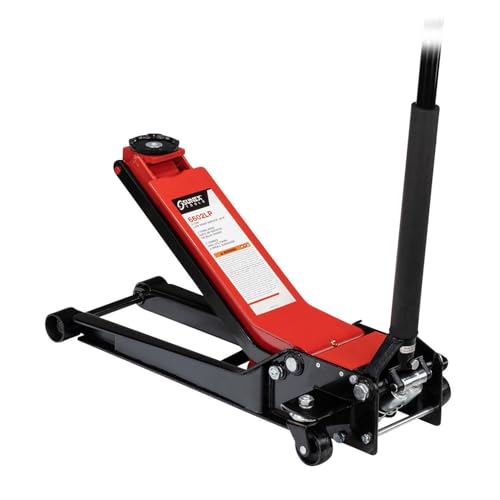
If you own a sports car, exotic, or anything that sits aggressively low to the ground, this is the jack you need. The SUNEX 6602LP has a 2.75-inch minimum height — one of the lowest entry points available on any production floor jack. Getting that nose under a slammed sports car without scraping the splitter or air dam is exactly what this tool is engineered to do. Rapid-rise technology with dual pump pistons means it reaches full height in roughly 6.5 pumps. That's fast by any standard.
The 24-inch maximum height makes this jack surprisingly versatile despite its ultra-low starting point. It's not just a sports car tool — it handles pickups and SUVs at the high end of its range too. The steel construction is solid and the hydraulic system from Sunex is well-regarded in the professional community. For owners of lowered vehicles who have been struggling to find a jack that actually fits, this is the definitive answer in 2026.
The 2-ton weight limit keeps it out of the heavy-duty category. If your vehicle tips over 4,000 lbs., look at the Sunex 66035SJ or the Blackhawk B6350 instead. But for the sports car and exotic crowd, this jack is the right tool for the job — and Sunex backs it with the kind of build quality that makes it worth the investment. You'll also want to address any oil leaks before getting under your car, since a good floor jack makes that inspection much easier.
Pros:
Cons:

Before you buy, get clear on what your specific situation requires. The best floor jack for a Civic owner is not the best floor jack for someone who runs a full-size truck. Here are the factors that actually matter.
This is the non-negotiable starting point. Your jack's weight rating must exceed half your vehicle's total curb weight — you're only lifting one end at a time, but you need margin for safety. Here's a quick reference:
Never cut corners on capacity. An overloaded jack doesn't fail slowly — it fails suddenly. Check your vehicle's curb weight in the owner's manual or door placard before buying.
Minimum height determines whether the jack can even slide under your vehicle. Maximum height determines how much working room you get once it's up.
Don't just look at the product name — check the actual spec sheet. "Low profile" means different things to different manufacturers.
This trade-off comes down to portability vs. durability for your specific use case.
If you're doing light to moderate maintenance on passenger vehicles and moving the jack in and out of a car trunk or storage cabinet, aluminum is the better choice. If you're working in a dedicated shop space on trucks, steel makes more sense.
All the jacks on this list use hydraulic mechanisms, but the pump design varies significantly.
If you're doing multiple lifts per session — rotating tires, for example — dual-pump or fast-lift mechanisms are worth the extra cost. Your arms will thank you. This is also relevant if you're working on wheels and tires regularly, where multiple jack cycles per job are the norm.
A floor jack is a horizontal hydraulic device that rolls under a vehicle and lifts using a long arm — it's stable, easy to position, and the standard choice for home garages. A bottle jack stands vertically and is more compact, making it better for field use or tight spaces where a floor jack can't fit. For routine home maintenance, a floor jack is almost always the right tool. Bottle jacks are typically reserved for emergencies or specialized applications like lifting RVs or heavy equipment.
Yes, always. A floor jack is a lifting tool, not a support tool. Hydraulic systems can fail — seals leak, pressure drops, valves malfunction. If you're working under a vehicle for any length of time, the vehicle must be supported by jack stands rated for its weight. Lower the vehicle onto the stands after lifting. Never rely on a floor jack alone to hold a vehicle while you're underneath it. This is the most important safety rule in the garage.
Your vehicle's owner's manual will show the manufacturer-designated jack points — typically reinforced areas on the frame or pinch welds. On most sedans and crossovers, these are located just behind the front wheels and just ahead of the rear wheels. Many modern vehicles have specific notched pinch weld areas designed to accept the saddle. Using the wrong jack point can damage the vehicle's rocker panels, floor pan, or suspension components. When in doubt, check the manual first.
A good rule is to buy a jack with at least 75% of your vehicle's total curb weight as capacity — but a full 3-ton jack is the practical minimum for most households in 2026. Even if your car weighs only 3,000 lbs., a 3-ton jack gives you room to work on multiple vehicles and a comfortable safety margin. If you own a truck or large SUV that weighs over 5,000 lbs., step up to 3.5 tons. Matching capacity exactly to vehicle weight leaves no margin for error.
You should always use a floor jack on a flat, level, hard surface — concrete or asphalt are ideal. Using a jack on gravel, dirt, or significantly uneven surfaces creates instability risks. If you must work on a slope, chock the wheels on all sides before lifting and ensure the vehicle is in park (or in gear for manual transmissions). On soft ground, place a large, flat board under the jack's base to distribute the load and prevent sinking. Safety first — no shortcut is worth the risk of a vehicle falling.
Most quality floor jacks are low-maintenance, but a few habits will extend their life significantly. Keep the jack clean and free of debris — dirt in the hydraulic ports causes premature wear. Lubricate the moving parts (wheels, arm pivot points) with grease or oil annually. Check the hydraulic fluid level every year or if the jack starts to feel spongy or doesn't hold height. Store the jack with the release valve closed and saddle in the lowered position. Don't leave it in environments with extreme temperature swings, which can degrade hydraulic seals over time.
 |
 |
 |
 |

About Marcus Chen
Marcus Chen has over twelve years of hands-on experience modifying cars across a range of platforms — from commuter builds to track-focused setups — with deep expertise in suspension tuning, wheel and tire fitment, and performance upgrades that improve driving dynamics without sacrificing day-to-day reliability. He has worked with both bolt-on and engineered modifications and brings a methodical, results-focused approach to evaluating performance parts. At CarCareTotal, he covers performance upgrades, suspension and handling, and wheel, tire, and drivetrain modifications.
Get some FREE car parts & gear.. Or check out the latest free automotive manuals and build guides here.
Disable your ad blocker to unlock all the hidden deals. Hit the button below 🚗
| | | |
