by Sarah Whitfield
The ABS light on your dashboard means your vehicle has detected a fault in the anti-lock braking system. This system prevents wheel lockup during hard braking, allowing you to maintain steering control on slippery roads. When the warning illuminates, your ABS may be disabled — meaning you could lose that critical safety assist in an emergency stop. If you've also noticed a sensor-related alert, our guide on the tire pressure sensor fault covers another common dashboard warning that often appears alongside ABS issues.
Understanding the seven most common causes — and knowing how to reset the light — can save you money and keep you safe. Let's get into it.
Contents
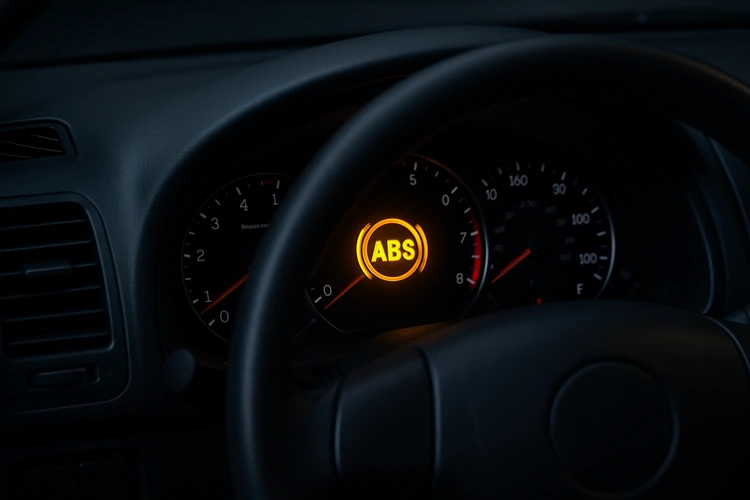
The anti-lock braking system uses speed sensors at each wheel to monitor rotation. During heavy braking, if a wheel decelerates faster than the others, the ABS module pulses brake pressure on that wheel to prevent lockup. The warning light — typically the letters "ABS" inside a circle — lights up briefly on every startup as part of a self-check. If it stays on or returns while driving, the system has stored a fault code.
With the ABS light on, your conventional brakes still function normally. The difference is that in a panic stop, wheels may lock and cause skidding. On wet or icy roads, this significantly increases stopping distance and reduces steering control — which is why the fault should not be ignored.
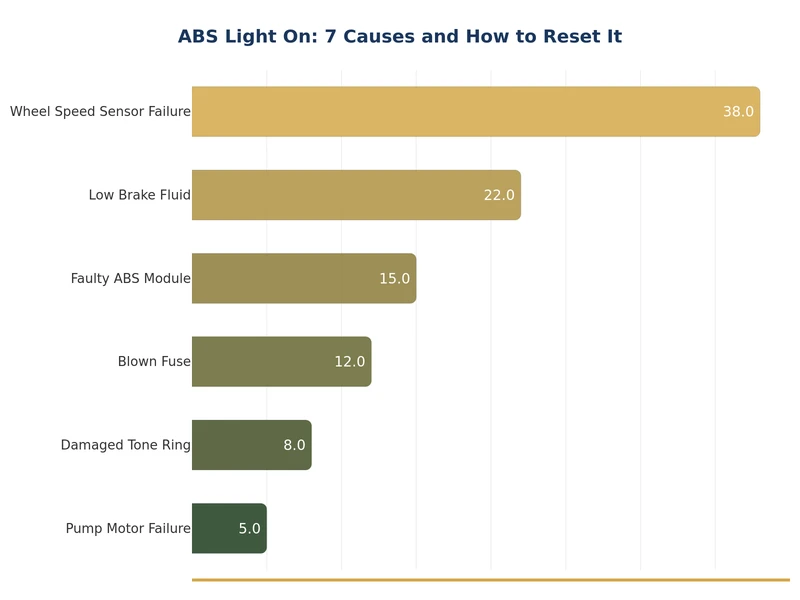
This is the most frequent cause. Each wheel has a speed sensor that continuously feeds data to the ABS module. Dirt buildup, corrosion, or physical damage to the sensor or its wiring causes incorrect readings. When a sensor fails, the module detects a discrepancy and triggers the warning light. This is typically an inexpensive fix — the sensor itself usually costs $20–$100.
The ABS depends on hydraulic pressure from brake fluid to function. If fluid drops below the minimum level — due to a leak or worn-down brake pads — the system may flag a fault. Always check and top up your brake fluid as a first step when this warning appears alongside a soft or spongy brake pedal.
The ABS module has dedicated fuses that can fail due to power surges, water intrusion, or age. A blown fuse cuts power to the module entirely, triggering the light. Checking the fuse box is free and takes under five minutes — always start here before pursuing more expensive diagnostics.
The control module is the computer that processes sensor data and activates the ABS during a skid event. Corrosion, water damage, or internal component failure can cause it to malfunction. A failed module often triggers both the ABS light and the traction control warning simultaneously. Replacement typically requires programming to your vehicle's VIN.
The reluctor ring is a toothed metal ring on the wheel hub or axle shaft that the speed sensor reads as it spins. Rust, cracks, or missing teeth create erratic signals that confuse the ABS module. This type of damage is more common on older vehicles and those frequently driven on unpaved roads.
The ABS hydraulic pump and solenoid valves modulate brake pressure during an ABS activation event. A failing pump or stuck valve will prevent the system from working correctly and will trigger the warning light. This is one of the more costly repairs, often ranging from $300 to $1,000 depending on the vehicle.
Chafed wires, corroded connectors, or loose plugs anywhere in the ABS circuit can produce intermittent or permanent faults. Heat cycling and vibration degrade wiring insulation over time, especially near wheels and the undercarriage. If your ABS light comes and goes, wiring is a strong suspect.
| Cause | Common Symptom | Typical Repair Cost | DIY Friendly? |
|---|---|---|---|
| Faulty Wheel Speed Sensor | ABS light on, traction control light | $80–$200 | Yes |
| Low Brake Fluid | Soft pedal, brake warning light | $10–$30 (fluid) | Yes |
| Blown ABS Fuse | ABS light on, system inactive | $5–$15 | Yes |
| Damaged ABS Module | Multiple warning lights, no ABS | $300–$800 | No |
| Damaged Reluctor Ring | Intermittent ABS light | $100–$300 | Moderate |
| Hydraulic Pump Failure | ABS light, reduced braking feel | $300–$1,000 | No |
| Wiring / Connector Issues | Intermittent warning light | $50–$400 | Moderate |
The fastest way to identify the fault is with an OBD-II scanner that reads ABS-specific codes (C-codes). Standard cheap scanners only read engine codes — make sure yours supports ABS. Plug into the OBD-II port under the driver-side dash, navigate to the ABS system menu, and record the fault code before clearing it. The code will point directly to the affected wheel or component.
Without a scanner, start with a visual check: inspect each wheel speed sensor and harness for damage, dirt, or rust. Check the brake fluid reservoir for correct level. Open the fuse box and visually inspect — or test with a multimeter — the ABS fuse. If you've also noticed a brake pedal that sinks to the floor, that points strongly to a hydraulic issue that's likely triggering the ABS fault as well.
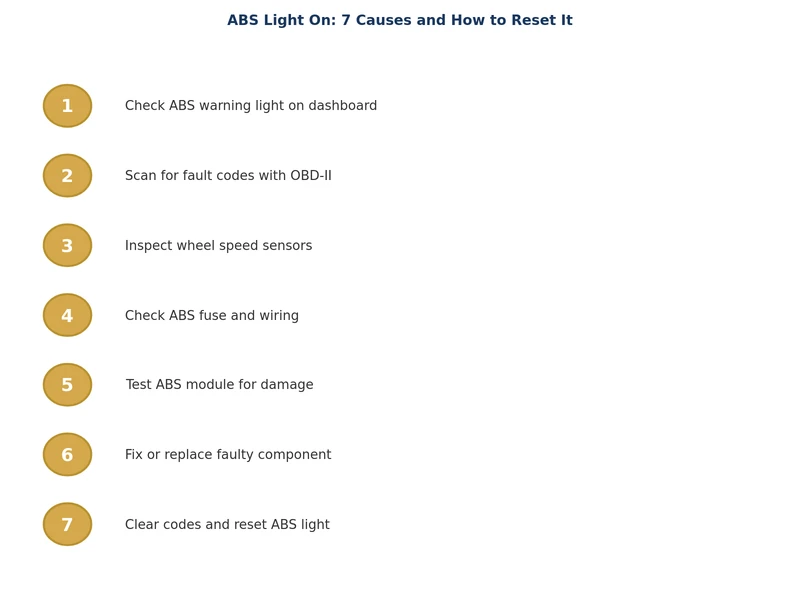
Fixing the underlying fault will usually turn off the light automatically once you drive the vehicle. If it doesn't clear on its own, follow these steps:
Never clear a code without repairing the problem. The light will return immediately if the fault is still active. Diagnose and repair before attempting any reset.
Use an OBD-II scanner with ABS code support. Go to the ABS system menu, select "Clear Codes," and confirm. Start the engine and take a short drive — if the repair was successful, the light will stay off.
On some older vehicles, disconnecting the negative battery terminal for 15–30 minutes can clear stored codes. This also resets your radio presets and other electronics. It does not work on modern vehicles with non-volatile module memory, and should only be used as a last resort after repairing the fault.
Your conventional brakes remain fully operational, so short-distance driving is generally acceptable. However, you should:
Exception: if both the ABS light and the red brake warning light are on at the same time, stop driving immediately. This combination indicates a broader braking system failure. Similarly, if your stability system is also flagging an alert, read our guide on the Check VSC System warning — ABS faults frequently trigger related traction and stability control warnings at the same time.
Seek professional help in any of these situations:
Simpler fixes like a wheel speed sensor or fuse are well within reach for most DIYers with basic tools. More complex repairs — especially those involving the ABS module — require professional equipment and software to complete correctly.
Yes, your standard brakes still work. However, your ABS may be disabled, meaning wheels could lock during a hard stop. Avoid driving in poor conditions and get it diagnosed promptly.
Sometimes. If the fault was intermittent — such as a temporarily dirty sensor — the light may clear after the next drive cycle. If a real fault is present, the light will stay on until the problem is fixed and the code is cleared.
It depends entirely on the cause. A fuse costs a few dollars, a wheel speed sensor typically runs $80–$200 all-in, while an ABS module replacement can cost $300–$800 or more depending on the vehicle.
Yes. Low brake fluid reduces hydraulic pressure, which can trigger the ABS system to log a fault. Check the reservoir and top up if needed, then see if the light clears. If fluid is low due to a leak, that leak must be repaired first.
No — your base braking system operates independently of the ABS. You will still be able to brake normally. What you lose is the anti-lock intervention that prevents wheel lockup during emergency braking.
On some older vehicles, disconnecting the negative battery terminal for 15–30 minutes may clear the code. On modern vehicles this usually doesn't work. The most reliable method is an OBD-II scanner with ABS code support after the underlying fault has been repaired.
 |
 |
 |
 |

About Sarah Whitfield
Sarah Whitfield is a diagnostics and troubleshooting specialist who spent ten years as an ASE-certified technician before joining the editorial team. She specializes in OBD-II analysis, electrical gremlins, and the kind of intermittent problems that make most owners give up.


Get some FREE car parts & gear.. Or check out the latest free automotive manuals and build guides here.
Disable your ad blocker to unlock all the hidden deals. Hit the button below 🚗
| | | |
