by Sarah Whitfield
You are navigating a rain-slicked intersection when the vehicle ahead stops without warning. You apply the brakes firmly, expecting the familiar rhythmic pulsing of the anti-lock braking system (ABS) engaging beneath your foot, but the wheels lock and the car skids forward before coming to a halt. That brief, alarming experience is often the first indication that something has gone wrong with your ABS.
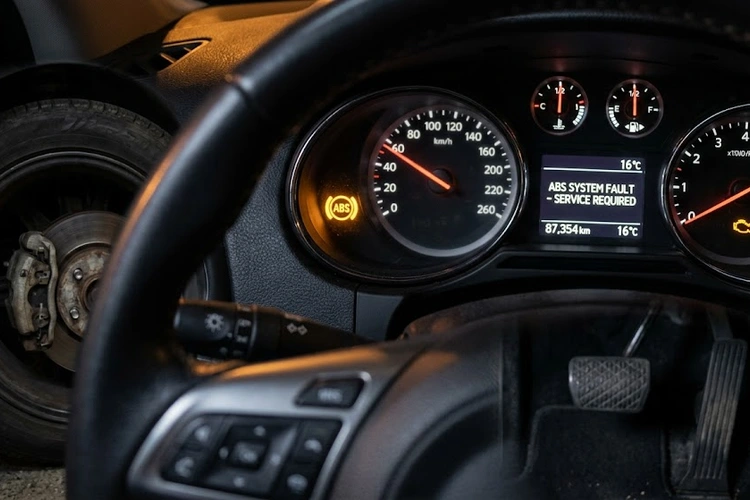
ABS not working symptoms range from a simple warning light on the dashboard to full wheel lockup during an emergency stop, and identifying them early can be the difference between a close call and a serious collision. The ABS is designed to prevent your wheels from locking up during hard braking, which allows you to maintain steering control and stop within a shorter distance on slippery or wet surfaces. When this system fails, your standard brakes still function, but your protection in the most critical moments is significantly reduced. If you have also noticed that your brake pedal goes to the floor with unusual ease, the two conditions may share an underlying hydraulic cause that warrants prompt attention from a qualified technician.
Contents
The anti-lock braking system uses sensors positioned at each wheel to monitor rotational speed, then modulates brake pressure dozens of times per second to prevent lockup. When any component within this system stops functioning correctly, the effects become noticeable in several distinct ways, and some of them are easy to overlook during ordinary driving.
The most immediate and reliable indicator of ABS not working symptoms is the ABS warning light on your instrument cluster. This amber or red light typically illuminates when the vehicle's onboard diagnostic system detects a fault within the ABS circuit, and it may come on at startup and remain lit rather than extinguishing after a few seconds. In many vehicles, the traction control light — often labeled TCS or TC — will also illuminate alongside the ABS light, because both systems draw rotational data from the same set of wheel speed sensors. You should not ignore this light, even if the vehicle feels normal during routine driving at lower speeds.
When the ABS is functioning correctly, you should feel a rapid, rhythmic pulsation through the brake pedal during a hard stop — this is the system cycling brake pressure on and off at high speed to maintain wheel rotation. If your ABS is not working, the wheels can lock up completely during an emergency stop, causing the tires to skid against the pavement rather than roll in a controlled manner. The consequences of this include longer stopping distances, an inability to steer around an obstacle while braking, and flat spots worn into the tire tread where rubber has been abraded away.
Warning: Wheel lockup on a wet or icy surface without ABS functioning can cause you to lose directional control entirely — have the system inspected as soon as possible if you notice skidding during what should be a controlled stop.
Some drivers report a change in brake pedal character after the ABS warning light appears — either an unusual firmness at the top of the pedal travel or, in other cases, a softness that was not present before. A vehicle that previously provided noticeable pulsation feedback during a hard stop will feel completely smooth and unresponsive if the ABS has been disabled, and this absence of the characteristic cycling sensation is itself one of the clearest ABS not working symptoms you can detect from the driver's seat without any tools.
ABS failure does not always originate from a single catastrophic event. In many cases the problem develops gradually through corrosion, electrical wear, or physical damage that accumulates over many miles of driving. Understanding the most common failure points allows you to participate more meaningfully in the diagnostic conversation with your technician and to evaluate repair estimates with greater confidence.
Wheel speed sensors — small electromagnetic or Hall-effect devices mounted near each wheel hub or bearing — are responsible for transmitting real-time rotational data to the ABS control module. These sensors sit close to the road surface and are exposed continuously to water, road debris, brake dust, and temperature fluctuations, all of which can cause corrosion or physical damage over time. A faulty sensor produces inaccurate readings or no signal at all, which prompts the control module to deactivate the ABS as a protective measure. Because wheel speed sensors also supply data to the vehicle's speedometer circuit, a failing sensor may simultaneously produce erratic instrument behavior — a connection explored further in our guide on speedometer bouncing or erratic behavior.
Pro Tip: Before replacing a wheel speed sensor, clean the sensor tip and the reluctor ring (the toothed metal ring the sensor reads) with a wire brush — corrosion buildup alone can generate fault codes without any actual component failure requiring replacement.
The ABS control module — also referred to as the EBCM, or Electronic Brake Control Module — is the computer that processes incoming sensor data and commands the hydraulic actuator to modulate pressure at individual wheels. This module can fail due to water ingress through a compromised seal, voltage spikes from the electrical system, or gradual circuit degradation that occurs with age and heat cycling. When the module fails, the entire ABS becomes inoperative and the warning light illuminates. Module replacement tends to fall at the higher end of the ABS repair cost spectrum, which is addressed in the cost section below.
The ABS hydraulic unit — a pump and solenoid valve assembly — depends on adequate brake fluid pressure to build and release pressure rapidly at each wheel. If your brake fluid level is low or there is air trapped in the lines, the hydraulic unit cannot operate with the speed and precision the system requires. Low brake fluid also frequently indicates a leak somewhere in the braking circuit, which may simultaneously produce a soft or spongy pedal feel. Problems with the brake master cylinder, the component that generates overall hydraulic pressure throughout the system, can similarly degrade ABS performance, and our article on brake master cylinder symptoms covers that intersection in greater detail.
A failed ABS does not eliminate your ability to stop the vehicle — your standard hydraulic brakes will still function and bring the car to a halt. However, the level of risk you are accepting by continuing to drive varies considerably depending on the conditions around you and the exact nature of the fault that has been detected.
In these circumstances, most drivers can operate the vehicle with acceptable safety, provided they allow additional following distance, drive at a reduced speed, and remain especially attentive to road conditions ahead of them.
Warning: If both the ABS and the standard brake warning lights are illuminated at the same time, treat this as a brake system emergency and avoid operating the vehicle until a qualified technician has identified and corrected the underlying cause.
Accurate diagnosis is the foundation of a cost-effective repair. Replacing components based on assumptions rather than fault code data can add hundreds of dollars in unnecessary parts and labor to a job that may have had a straightforward solution. A systematic approach using the right diagnostic tools is always the more prudent path.
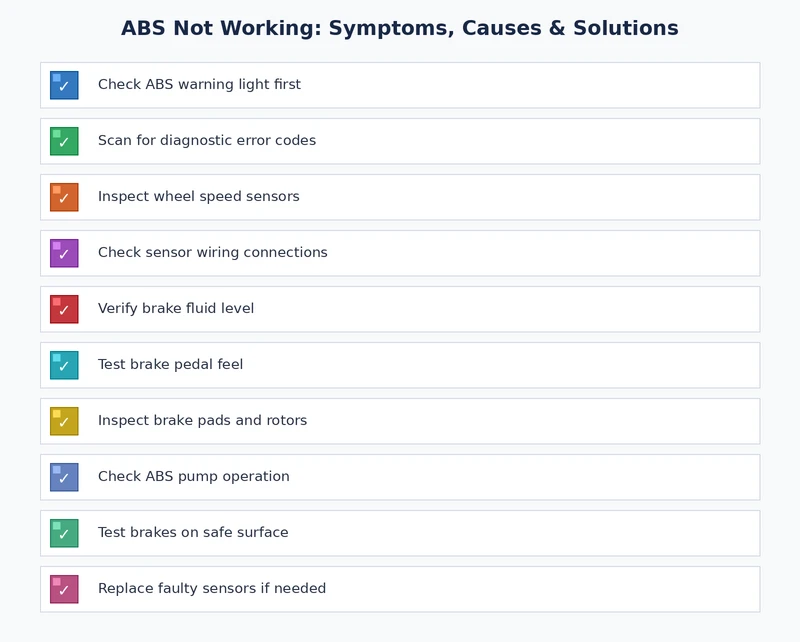
A basic OBD-II scanner may not retrieve ABS-specific fault codes — you will typically need a scanner that supports enhanced chassis diagnostics. ABS codes begin with the letter "C" and will identify the affected circuit, whether that is a specific wheel speed sensor channel, the control module, the hydraulic pump relay, or another component within the system. Reading these codes before any disassembly prevents unnecessary parts replacement and gives your technician a precise starting point. Many auto parts retailers offer free code reading services, and some will loan out enhanced scanners to customers at no charge.
Once the fault code has been retrieved and verified, the repair path typically follows one of several established routes depending on which component the diagnostic data has identified:
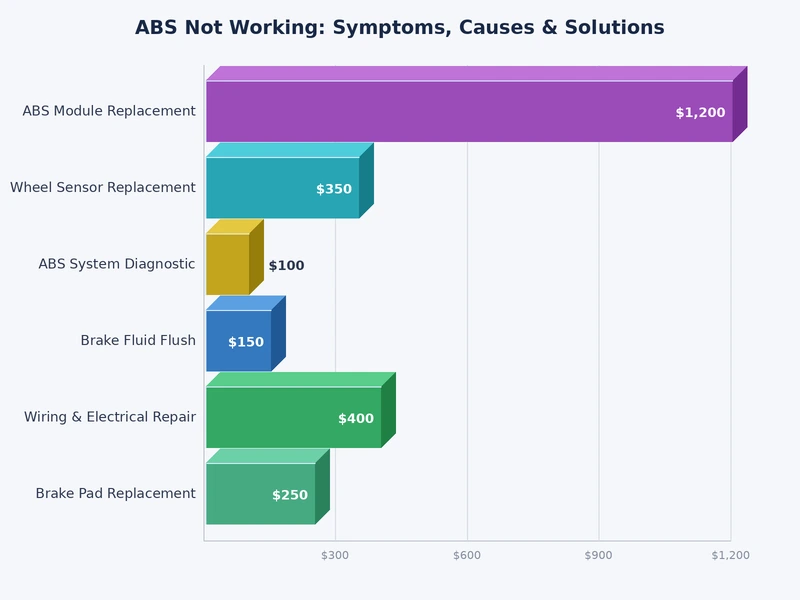
ABS repair costs vary substantially depending on which component has failed, the make and model of your vehicle, and whether you choose professional installation or attempt the repair yourself. The table below provides general estimates for the most commonly replaced components in a failing ABS.
| Component | Parts Cost | Labor Cost | Total Estimate |
|---|---|---|---|
| ABS Fuse or Relay | $5 – $20 | $0 – $50 | $5 – $70 |
| Wheel Speed Sensor | $20 – $100 | $50 – $100 | $70 – $200 |
| Reluctor Ring | $15 – $60 | $50 – $150 | $65 – $210 |
| ABS Hydraulic Unit | $150 – $600 | $100 – $200 | $250 – $800 |
| ABS Control Module (EBCM) | $200 – $800 | $100 – $300 | $300 – $1,100 |
Wheel speed sensor replacement and fuse inspection are repairs that a mechanically confident vehicle owner can perform at home using basic hand tools and a service manual. Sensor harnesses are typically keyed and color-coded to prevent incorrect installation, and the procedure rarely requires specialized equipment beyond a torque wrench and a scan tool to clear the fault code afterward. However, control module replacement and hydraulic unit work are a different matter, because these repairs require specialized programming tools and careful brake bleeding procedures. Air left in the brake lines after hydraulic unit work can significantly reduce stopping power and represents a safety risk that outweighs the savings from avoiding professional labor in those specific cases.
It is also worth noting that remanufactured ABS modules are available at a lower cost than new units from many online suppliers, and certain specialty shops offer module repair and reprogramming as an alternative to outright replacement. Obtaining two or three repair estimates before committing to any major ABS work is a reasonable approach to ensuring you receive a fair price, particularly for the more expensive hydraulic and electronic components.
In most cases you can drive carefully with only the ABS warning light illuminated, because your standard hydraulic brakes will still bring the vehicle to a stop. You should, however, avoid driving in wet, icy, or slippery conditions and have the system diagnosed promptly, since ABS protection matters most during emergency stops on low-traction surfaces.
Yes — a faulty wheel speed sensor is one of the most common causes of ABS failure. When the sensor sends no signal or an erratic signal, the ABS control module disables the system as a precaution. Replacing or cleaning the affected sensor and its reluctor ring typically restores normal ABS function.
When ABS is not working, a hard stop will feel smooth rather than pulsating — the system's characteristic rapid pedal feedback disappears entirely. In severe cases the wheels lock up and the tires skid, producing a scrubbing sound and a loss of steering response that would not occur if the ABS were functioning correctly.
You can clear ABS fault codes with an enhanced OBD-II scanner, but the warning light will return as soon as the vehicle's diagnostic system detects the same fault again on the next drive cycle. Clearing the code without repairing the underlying component does not restore ABS function and may give a false sense that the problem has been resolved.
Your ABS exists precisely for the moments when stopping normally is no longer an option — keeping it in working order is not optional maintenance, it is a commitment to your own safety and the safety of every driver sharing the road with you.
 |
 |
 |
 |

About Sarah Whitfield
Sarah Whitfield is a diagnostics and troubleshooting specialist who spent ten years as an ASE-certified technician before joining the editorial team. She specializes in OBD-II analysis, electrical gremlins, and the kind of intermittent problems that make most owners give up.
Get some FREE car parts & gear.. Or check out the latest free automotive manuals and build guides here.
Disable your ad blocker to unlock all the hidden deals. Hit the button below 🚗
| | | |
