by Sarah Whitfield
Has anyone ever looked down at the instrument panel to find every single gauge frozen or completely dead? When all dashboard gauges not working becomes the problem a driver is staring at, the situation feels alarming but almost always has a fixable cause. Our team traces most complete cluster failures back to three common culprits: a blown fuse, a corroded ground wire, or a faulty cluster module. These three causes account for the vast majority of complete dashboard failures our team has investigated and repaired across dozens of vehicles.
Most people immediately assume the worst — a failing alternator, a fried engine computer, a catastrophic short — but our experience paints a very different picture. A single blown fuse costing under two dollars often explains why every gauge on the panel went dark at the same moment. Understanding the range of causes, from that cheap fuse fix to a full cluster replacement, helps most drivers solve this problem without overspending on parts or diagnostics.
Related electrical failures like a car radio not working often trace back to the same blown fuse or ground fault that killed the gauges. Our team recommends checking both complaints at the same time to avoid duplicate diagnostic work and catch the root cause in a single inspection.

Contents
A systematic diagnostic approach saves most drivers significant time and money during a complete cluster failure. Our team always starts with the simplest and cheapest checks before considering any expensive component replacements, and that sequence matters more than most people realize.
The instrument cluster fuse is the first thing our team checks whenever all dashboard gauges stop working simultaneously. A single blown fuse can explain the entire failure instantly, and replacing it costs under two dollars. Most vehicles carry two fuse boxes — one under the hood and one beneath the dashboard on the driver's side. The relevant fuse is typically labeled "INST CLUSTER," "GAUGES," or "METER" in the owner's manual fuse diagram. Our team also checks fuses labeled "BCM" (body control module) or "IPC" (instrument panel cluster), since those can cut gauge power on certain vehicle architectures.
A corroded or loose ground strap is one of the most overlooked causes of complete gauge failure, and our team finds this issue especially common on vehicles more than eight years old. The ground wire runs from the back of the instrument cluster to a bolt on the vehicle chassis. When corrosion builds up at that mounting point, the cluster loses its voltage reference and the entire panel goes dark. Cleaning the connection with a wire brush and applying dielectric grease (a moisture-repelling protective paste) often restores full gauge function without any parts cost at all. Our team considers this the second most valuable check after the fuse, precisely because so many drivers skip it entirely.
The multi-pin connector that plugs into the rear of the instrument cluster can develop backed-out terminals or corrosion over time. Our team has seen this cause intermittent or complete gauge failures on higher-mileage vehicles across a wide range of makes and models. Unplugging the connector, inspecting each terminal for green corrosion or bent pins, and reseating it firmly is a fifteen-minute task that costs nothing if the connector itself is undamaged. Our team uses a small pick tool to gently push back any terminal that has slipped out of its housing, which sometimes resolves the failure immediately without any parts replacement.
Several widely held assumptions lead drivers to spend money on the wrong repairs when all dashboard gauges go dark. Our team considers clearing up these misconceptions an essential first step in any honest discussion of the problem.
A failing alternator (the component that recharges the battery while the engine runs) is the most common first guess when all gauges die, but our experience shows this is rarely the primary culprit in a clean cluster failure. A true alternator problem almost always triggers a battery warning light before gauges fail entirely. The car also typically struggles to run or stalls outright, which helps rule out the alternator when those symptoms are absent. According to the Wikipedia article on automotive instrument clusters, modern digital clusters are independent electronic assemblies that can fail without any involvement from the charging system.
Our team always recommends scanning for stored fault codes before replacing any component — a two-minute OBD-II scan can identify the exact failed circuit and prevent costly guesswork entirely.
Our team draws a firm distinction between one gauge failing and all dashboard gauges not working at the same moment. A single gauge problem — a fuel gauge stuck on empty, for example — almost always traces back to one specific bad sensor. A completely dead cluster, by contrast, almost always points to a shared power supply issue, a ground fault, or a failed cluster module. Keeping this distinction in mind prevents the common and expensive mistake of replacing sensors one by one when the real culprit is a two-dollar fuse.
Similar logic applies to cases like one headlight not working while the rest of the electrical system seems fine. Modern vehicles compartmentalize their circuits in ways that make isolated failures look confusing until the underlying wiring layout is mapped out and understood.
Several interventions can restore gauge function without any specialized equipment. Our team considers these the best starting points for anyone facing a sudden, complete cluster failure and wondering where to begin.
Disconnecting the negative battery terminal for about ten minutes and then reconnecting it performs a soft reset of the car's electrical system. This clears temporary glitches in the BCM that can cause all gauges to stop working without any underlying hardware damage. Our team has seen this simple procedure fix the problem entirely on several occasions, particularly after a recent battery swap or after a vehicle sat unused for an extended period. The process costs nothing and takes roughly fifteen minutes, making it one of the most practical first steps available to most drivers. After reconnecting, the cluster may need a short drive cycle to fully re-initialize all gauge readings to their correct positions.
Plugging a basic OBD-II scanner into the diagnostic port beneath the steering column takes under five minutes and produces immediate, actionable results. Our team treats this as one of the highest-value quick wins because it converts a vague electrical mystery into a specific fault code. Problems flagged alongside gauge failures — like a tire pressure sensor fault — can reveal a CAN bus (the vehicle's internal communication network) fault that is disrupting multiple systems at once. That distinction changes the entire repair approach and can save a significant amount of money compared to replacing components based on guesswork alone.
Prevention consistently costs less than repair, and our team's observations across a wide range of electrical diagnoses point to specific maintenance habits that help drivers avoid instrument cluster failures before they develop.
A healthy battery is the single most important foundation for reliable gauge operation over the life of a vehicle. Voltage fluctuations and deep discharge cycles stress the cluster's internal microcontrollers over time and can eventually cause permanent damage to the module. Our team recommends having the battery and charging system tested at every oil change — most auto parts stores provide this service at no charge. Corroded battery terminals restrict current flow and introduce voltage spikes that are a consistent contributor to gauge problems on older vehicles. Cleaning them with a baking soda solution every two years is a simple and highly effective preventive measure.
Events like a check engine light appearing after an oil change are a reminder that electrical disturbances during routine maintenance can affect gauge behavior in unexpected ways. Our team suggests double-checking all underhood connectors after any service visit to catch any inadvertent disconnections before they cause a cluster complaint.
When fuse replacements, ground cleaning, and battery resets have all failed to restore the gauges, our team considers that a strong signal of internal cluster failure requiring professional diagnosis. A shop with a bi-directional scanner can command individual gauges to sweep their full ranges, which definitively confirms whether the cluster module is alive or completely dead. Our team also recommends professional evaluation when gauge failure coincides with other unexplained symptoms, such as a car stalling at a traffic light. Multiple simultaneous failures can indicate a deeper ECU or communication network fault that requires advanced equipment to trace accurately and repair correctly.
Laying out the most common repair approaches side by side helps most drivers choose the right path without guessing. Our team finds this comparison especially useful for anyone deciding between a DIY fix and a shop visit on a vehicle with a complete gauge blackout.
Several of the most frequent causes of all dashboard gauges not working are genuinely within reach for anyone comfortable with basic hand tools. Fuse replacement, ground strap cleaning, battery resets, and OBD-II scanning are all low-risk tasks that require no specialized training. Our team also notes that a faulty VSS (vehicle speed sensor) can sometimes knock out multiple gauges on older vehicles, and a replacement part typically costs between $25 and $80. A bad VSS often shares symptoms with a car shaking at low speed, so it is worth investigating both problems at the same time when both are present.
| Cause | DIY Difficulty | Estimated Cost | Tools Required |
|---|---|---|---|
| Blown instrument fuse | Very easy | $1–$5 | Fuse puller, owner's manual |
| Corroded ground strap | Easy | $0–$15 | Wire brush, dielectric grease, socket set |
| Loose harness connector | Easy | $0 | Pick tool, trim removal tools |
| BCM software glitch | Very easy | $0 | Battery wrench for disconnect reset |
| Faulty vehicle speed sensor (VSS) | Moderate | $25–$80 | Socket set, OBD-II scanner |
| Failed instrument cluster module | Difficult | $150–$800+ | Trim tools, bi-directional scanner |
| BCM failure or reprogramming | Not DIY | $300–$1,200 | Dealer or shop software required |
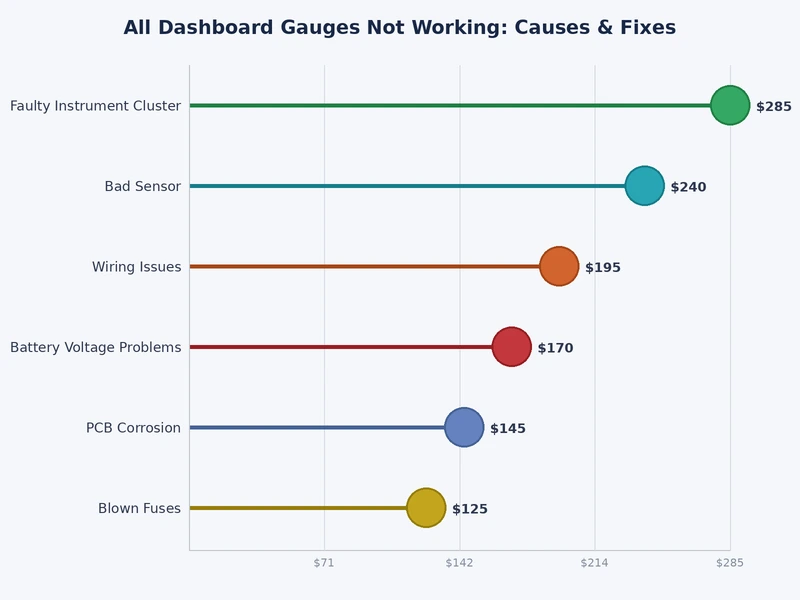
Instrument cluster replacement, BCM reprogramming, and CAN bus fault diagnosis all require specialized software and hardware that fall firmly outside the typical home garage setup. Our team considers professional involvement the right call whenever home diagnostics fail to identify a clear and specific cause. A replacement cluster typically runs between $150 and $800 in parts depending on the vehicle, with labor adding another $100 to $300 at most independent shops. That investment is considerably less painful when the root cause has already been confirmed through a proper diagnostic scan rather than estimated from symptoms alone.
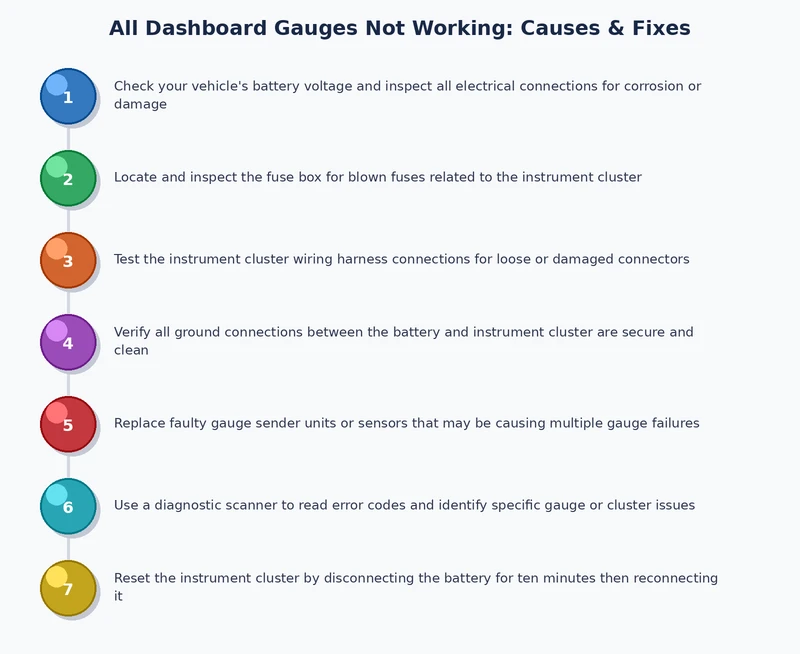
A severely weakened battery can cause all dashboard gauges not working by supplying insufficient voltage to power the instrument cluster, and our team sees this happen most often during cold weather when battery capacity drops sharply. Testing the battery with a load tester at any auto parts store is the quickest and cheapest way to rule this out as a contributing factor before moving to more complex diagnostics.
Our team strongly advises against driving any significant distance when all dashboard gauges are down, because the driver loses visibility into critical readings like engine temperature, oil pressure, and vehicle speed simultaneously. An undetected overheating event or sudden drop in oil pressure can cause severe and expensive engine damage within just a few minutes of the problem developing while the vehicle is in motion.
Repair costs vary widely based on the root cause — a blown fuse costs under five dollars and takes minutes to swap, while a full instrument cluster replacement can run between $250 and $1,100 including labor, and BCM reprogramming at a dealership can add several hundred dollars on top of parts costs depending on the make and model of the vehicle involved.
When all dashboard gauges go dark at once, the fix is almost always found in the fuse box or at a ground connection — and that discovery costs almost nothing to make.
 |
 |
 |
 |

About Sarah Whitfield
Sarah Whitfield is a diagnostics and troubleshooting specialist who spent ten years as an ASE-certified technician before joining the editorial team. She specializes in OBD-II analysis, electrical gremlins, and the kind of intermittent problems that make most owners give up.
Get some FREE car parts & gear.. Or check out the latest free automotive manuals and build guides here.
Disable your ad blocker to unlock all the hidden deals. Hit the button below 🚗
| | | |
