by Diego Ramirez
When temperatures drop and roads turn slick, one question matters more than almost any other: should you stick with all-season vs winter tires, or make the switch? The tire you choose directly affects how your car accelerates, steers, and stops in cold, wet, or snowy conditions. Most drivers default to all-season tires year-round, but that convenience comes with real trade-offs when the mercury falls below freezing. This guide breaks down everything you need to know to make the right call for your climate, driving habits, and budget.
Before diving into the comparison, it helps to understand that both tire types are engineered for specific temperature ranges and road conditions. Neither is universally superior — the right choice depends on where you live and how severe your winters actually are. If you want to get the most out of whichever tires you choose, check out our guide on how to extend the life of your car tires for maintenance tips that apply to both types.
Contents
All-season tires are designed to handle a broad range of conditions — dry roads, light rain, and light snow — without requiring a seasonal swap. They sit between summer performance tires and dedicated winter tires, offering a compromise that suits the majority of drivers in moderate climates.
All-season tires use a harder rubber compound that holds its shape across a wide temperature range — typically from about 7°C (45°F) and above. The tread pattern usually features circumferential grooves to channel water and moderate siping for light traction in snow. However, the compound becomes noticeably stiffer as temperatures fall below freezing, reducing grip precisely when you need it most.
If you're unsure which tires are currently on your car, learning how to read tire numbers and sidewall markings will help you decode the size, load rating, and speed rating stamped on the sidewall.
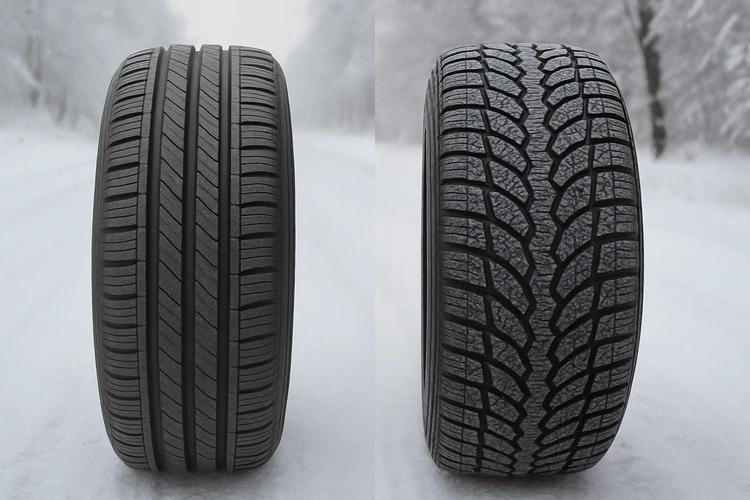
Winter tires — sometimes called snow tires — are purpose-built for cold weather. They are not just for blizzards. The core advantage is their soft rubber compound, which stays pliable at low temperatures, maintaining contact and friction with the road surface even on bare cold pavement.
The rubber compound in a winter tire is formulated with higher silica content, keeping it flexible below 7°C (45°F). According to Wikipedia's overview of winter tires, the tread depth is significantly greater than all-season tires, and thousands of tiny cuts called sipes create edges that bite into snow and ice. The tread blocks are also more widely spaced to evacuate slush and prevent packing.
The 7°C (45°F) rule is widely used: once average daily temperatures consistently fall below that threshold, winter tires outperform all-season tires — even on dry roads — simply because the rubber compound is working as intended. If your region regularly sees ice, packed snow, or heavy snowfall, winter tires are not optional; they are a safety requirement.
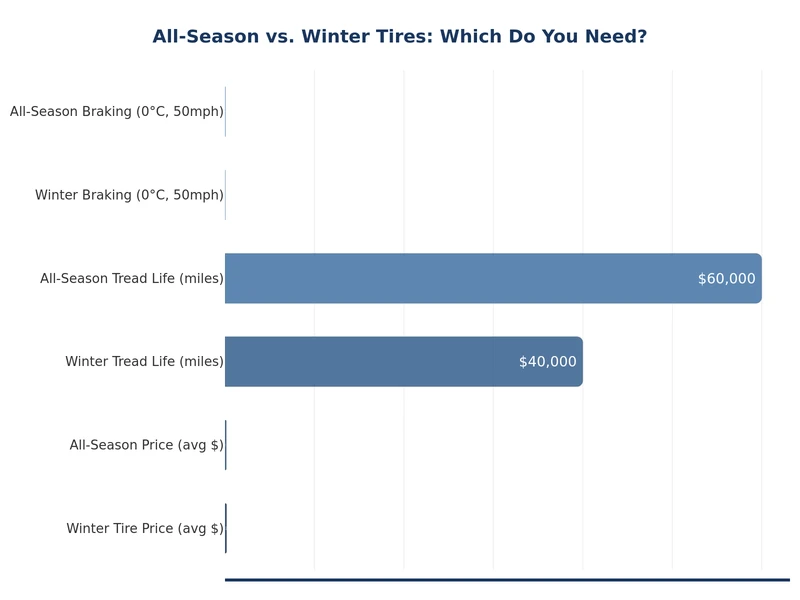
The differences between these two tire types go beyond tread pattern. Rubber chemistry, temperature performance, tread depth, and braking distance all diverge significantly once conditions turn cold.
| Factor | All-Season Tires | Winter Tires |
|---|---|---|
| Optimal temperature range | 7°C (45°F) and above | Below 7°C (45°F) |
| Rubber compound | Harder, stiffer in cold | Soft, flexible in cold |
| Tread depth (new) | 8–9 mm | 9–11 mm |
| Siping | Moderate | Extensive |
| Wet braking (warm temps) | Excellent | Good |
| Ice braking | Poor | Excellent |
| Snow traction | Adequate (light snow) | Superior |
| Dry handling (warm temps) | Excellent | Reduced |
| Tread wear rate (summer use) | Normal | Accelerated |
| Cost (set of 4) | $400–$800 | $500–$1,000+ |
The braking distance gap is where the data becomes hard to ignore. Independent tests consistently show that winter tires stop 25–40% shorter than all-season tires on ice at 0°C (32°F). At highway speeds, that difference can be the length of a car or more.
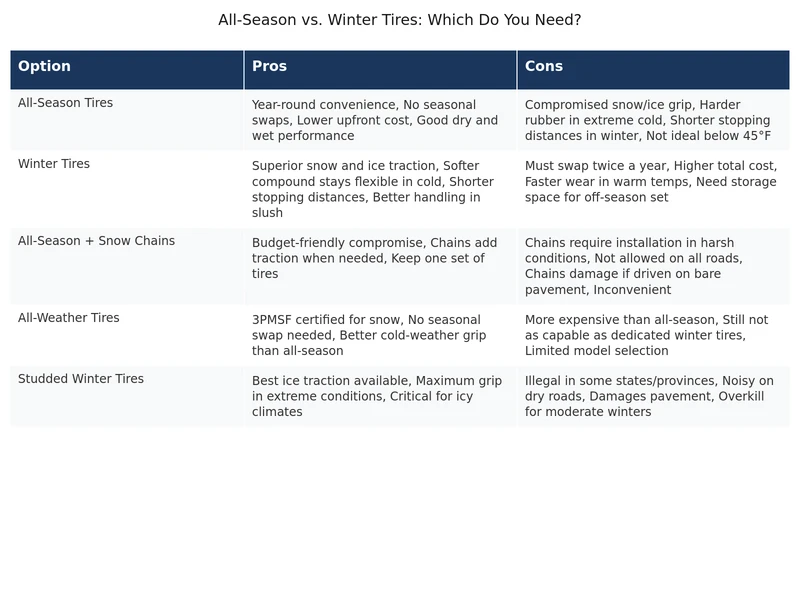
The honest answer depends on your local climate, not on marketing claims. Here is how to think through the decision.
If you live in an area where winters are mostly rainy and cold but not frequently icy or snowy — think coastal regions, the American South, or much of the UK — all-season tires are likely sufficient. Occasional light snow does not justify the cost and hassle of a seasonal swap, provided you drive cautiously and the roads are treated promptly. All-season tires marked with the M+S (Mud and Snow) designation provide a baseline level of winter competence.
If your winters regularly bring ice, freezing rain, heavy snowfall, or sustained sub-freezing temperatures, dedicated winter tires are the safer choice — full stop. This includes most of Canada, the northern US states, Scandinavia, alpine regions, and mountainous areas anywhere. A set of winter tires mounted on a separate set of steel wheels can actually be cost-neutral over time: your all-season tires last twice as long because they spend half the year in storage.
AWD and 4WD systems help you accelerate in snow, but they do nothing to improve cornering or braking traction — those depend entirely on your tires. A front-wheel-drive car on winter tires will stop shorter on ice than an AWD vehicle on all-season tires.
Timing your seasonal swap correctly maximizes both safety and tire lifespan. Install winter tires when average daily temperatures consistently drop below 7°C (45°F), and swap back to all-season or summer tires when temperatures reliably rise above that threshold in spring. Leaving winter tires on through summer accelerates wear significantly due to the soft compound.
Proper off-season storage is just as important as the swap itself. Tires stored incorrectly — in direct sunlight, near ozone sources like electric motors, or in areas with extreme temperature swings — degrade faster. For a complete walkthrough of best practices, see our guide on how to store tires properly, which covers vertical vs. horizontal stacking, tire bags, and ideal storage conditions.
While you have your tires off for the seasonal swap, it is also a good moment to inspect for slow leaks. A tire that consistently loses a few PSI over weeks may have a nail or valve stem issue — our guide on how to fix a slow tire leak walks through diagnosis and repair options.
The all-season vs winter tires debate comes down to a simple rule: match your tire to your climate. All-season tires are a smart, convenient choice for drivers in moderate climates who see little to no ice. Winter tires are a genuine safety upgrade for anyone who faces regular sub-freezing temperatures, ice, or heavy snow.
If you are on the fence, consider your worst-case driving scenario from last winter. If you found yourself white-knuckling through icy intersections or getting stuck in a few inches of snow, winter tires will make a measurable difference. If winters are mostly wet and chilly but not extreme, quality all-season tires and careful driving will serve you well.
Whichever tires you choose, regular rotation, proper inflation, and correct storage will give you the best performance and the longest tread life possible.
All-season tires are adequate for mild winters with occasional light snow and temperatures that rarely fall below freezing. In climates with regular ice, heavy snow, or sustained sub-freezing temperatures, they fall short compared to dedicated winter tires, particularly in braking distance on ice.
The standard guideline is 7°C (45°F). Below that threshold, the rubber compound in all-season tires becomes stiffer and loses grip, while winter tire compounds are specifically engineered to stay soft and flexible. Switch when your average daily temperatures consistently fall below that mark in autumn.
Technically yes, but it is not recommended. Winter tires wear much faster in warm temperatures because their soft compound is not designed for hot pavement. Running them through summer also reduces dry-road handling and fuel efficiency. They are built for cold conditions and should be swapped out once spring arrives.
AWD and 4WD improve traction when accelerating, but they do not improve steering response or braking on ice and snow — those depend entirely on your tires. An AWD vehicle on all-season tires will still stop longer on ice than a front-wheel-drive car fitted with proper winter tires.
A quality set of winter tires typically lasts 4–6 seasons when used only during cold months and stored correctly in the off-season. Tread depth is the key indicator: replace winter tires when tread falls below 4–5 mm, as performance in snow degrades noticeably before the legal wear limit of 1.6 mm is reached.
The M+S (Mud and Snow) symbol is a self-certification by manufacturers indicating the tire meets a basic tread pattern standard. The three-peak mountain snowflake (3PMSF) symbol means the tire was independently tested and certified to meet a specific snow traction performance threshold — it is the more meaningful indicator for genuine winter capability.
 |
 |
 |
 |

About Diego Ramirez
Diego Ramirez is a maintenance and care specialist who has been wrenching on cars since he was sixteen. He focuses on fluid changes, preventive care routines, paint protection, and the small habits that turn a five-year-old car into a fifteen-year-old car.


Get some FREE car parts & gear.. Or check out the latest free automotive manuals and build guides here.
Disable your ad blocker to unlock all the hidden deals. Hit the button below 🚗
| | | |
