by Sarah Whitfield
Studies by automotive repair networks indicate that alternator-related failures account for approximately 17 percent of all roadside breakdowns attributed to electrical system faults, making timely identification of auditory warning signs a matter of genuine operational urgency. Alternator whining noise is among the most diagnostically informative symptoms the charging system produces, yet it is routinely dismissed as inconsequential until the battery discharges completely and the vehicle becomes inoperable. The alternator's internal architecture — rotor windings, stator coils, a rectifier bridge, and a voltage regulator — creates multiple distinct failure points, each of which manifests acoustically in a recognizable pattern. Technicians familiar with the full spectrum of bad alternator symptoms recognize that auditory cues frequently precede measurable electrical deterioration by hundreds of operating hours, making them the earliest and most actionable diagnostic data available to a working technician.
Effective diagnosis requires separating the acoustic signature of genuine alternator whining noise from the broader auditory environment of a running engine — a task that demands systematic methodology rather than speculative component substitution. Understanding which mechanical and electrical failures produce which specific sounds, then correlating those sounds with measurable electrical parameters, produces confident diagnoses that reduce unnecessary parts expenditure and prevent the escalating damage that deferred repairs invariably cause.
Contents
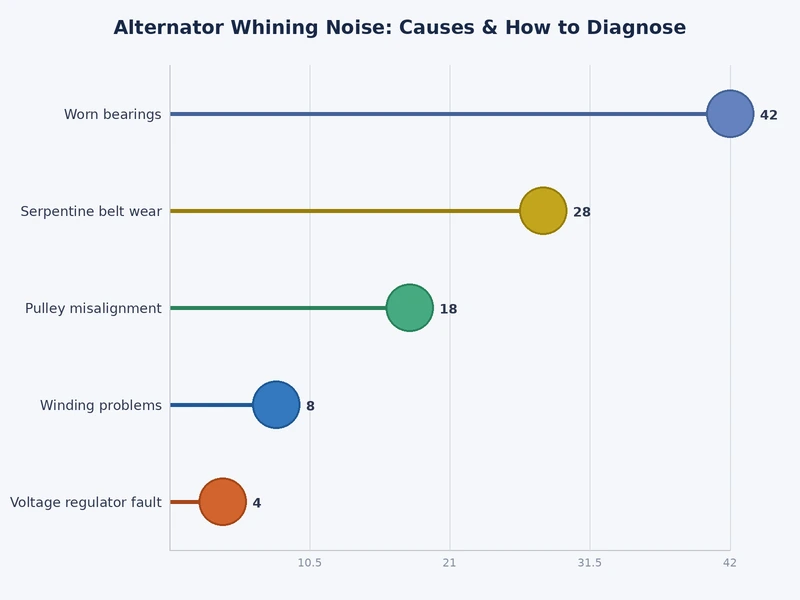
The alternator operates on the principle of electromagnetic induction: a rotating magnetic rotor spins within a stationary stator, inducing alternating current that the rectifier bridge converts to direct current for the vehicle's electrical bus. At correct operating temperatures and proper belt tension, this process is acoustically quiet. As internal components wear, however, the harmonics of the electromagnetic cycle translate into audible whining that tracks engine speed with diagnostic precision. The alternator's rotor is supported by two bearing assemblies — one at the drive end and one at the slip-ring end — and degradation in either assembly is among the most prevalent causes of alternator whining noise, producing a tone that rises and falls in direct proportion to crankshaft RPM rather than road speed. This RPM-dependence is the single most reliable acoustic signature for differentiating alternator whining from drivetrain or exhaust resonances.
According to the automotive alternator article on Wikipedia, modern Lundell claw-pole designs concentrate magnetic flux in configurations that increase mechanical loading on bearing assemblies, accelerating wear in vehicles with sustained high electrical demands — a population that includes tow vehicles, emergency response units, and platforms equipped with extensive aftermarket electrical accessories.
A second, acoustically distinct cause of alternator whining noise originates within the rectifier bridge. When one or more diodes fail — either as open circuits or short circuits — the three-phase alternating current is incompletely rectified, leaving an AC ripple superimposed on the DC output. This ripple corrupts the vehicle's electrical bus, producing flickering lights, erratic instrument readings, and interference patterns in audio systems, while simultaneously generating a characteristic high-frequency whine audible within the cabin. A failing rectifier diode does not produce the same smooth mechanical tone as a deteriorating bearing; instead, the sound carries a buzzing quality that persists even as mechanical load on the alternator changes. Vehicles experiencing sustained rectifier dysfunction frequently develop a swollen car battery caused by chronic overcharging episodes, providing a secondary visual indicator that complements the acoustic presentation and narrows the diagnosis considerably.
Accurate diagnosis demands separating alternator whining noise from the broader acoustic environment present under the hood of a running engine. Serpentine belt squeal manifests as a sharp, intermittent screech that typically appears at cold start or during abrupt electrical load transitions — air conditioning compressor engagement being the most common trigger — whereas alternator bearing whining is steady and proportional to RPM throughout the operating range. A seized or worn belt tensioner introduces a rhythmic rattle or chirp at idle that attenuates at elevated RPM, a pattern distinctly different from the smooth, speed-correlated tone of alternator bearing deterioration. Power-steering pump whine, another frequent source of diagnostic confusion, presents exclusively during active steering input and is entirely absent at straight-line cruise; alternator noise is independent of steering angle and road speed entirely. Technicians who have systematically worked through timing chain noise symptoms recognize a directly analogous discipline: each candidate noise source must be eliminated methodically rather than through speculative component replacement, because misattribution leads to both unnecessary expenditure and unresolved failure.
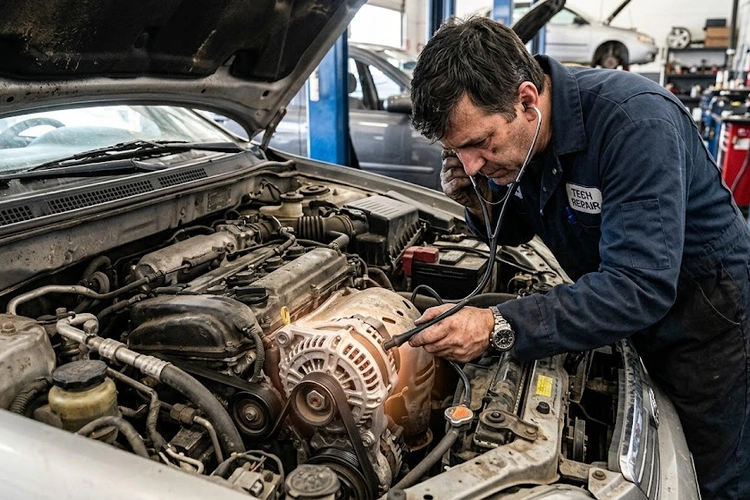
A mechanic's stethoscope or a length of vacuum hose used as an acoustic probe localizes whining to the alternator body within seconds, eliminating the need for disassembly or speculative component removal during initial assessment.
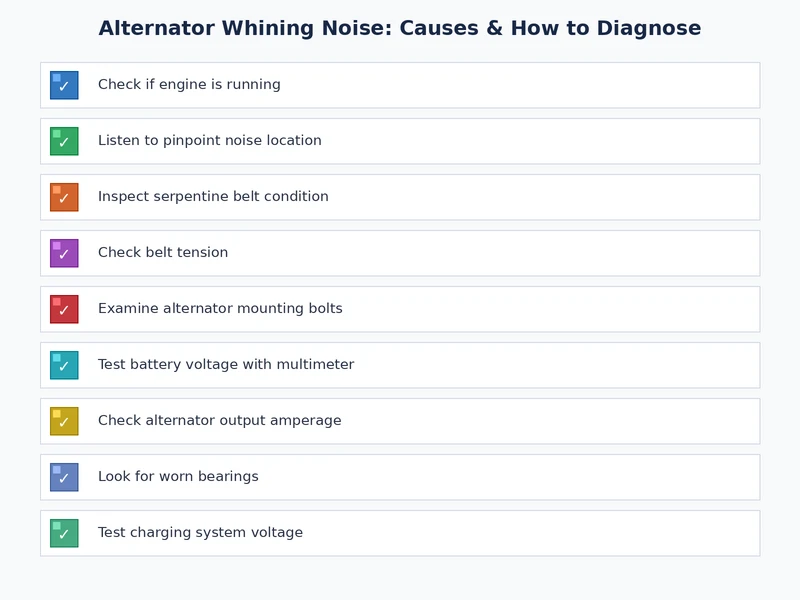
The most reliable field test for alternator whining noise is the RPM correlation test, conducted with the vehicle stationary and the parking brake engaged. The engine is revved from idle to approximately 2,500 RPM while the technician monitors pitch; if the whining rises and falls in precise synchrony with throttle input, the alternator or its belt drive system is the confirmed noise source. The test must be performed under both minimum electrical load — all accessories deactivated — and maximum electrical load — headlights, blower motor at maximum, rear defroster, and any heated accessories all active simultaneously — because alternator whining noise from a failing rectifier or voltage regulator intensifies measurably under heavy current demand, while mechanical bearing noise remains largely constant regardless of the instantaneous electrical draw on the system.
Systematic diagnosis begins with a baseline auditory assessment conducted at full operating temperature, since thermal expansion affects bearing clearances and electrical resistance in ways that alter noise character substantially. The engine is stabilized at 1,500 RPM while an assistant cycles electrical loads on and off in sequence. The technician notes whether noise intensity correlates with electrical demand — indicating a rectifier or voltage regulator fault — or remains constant across load levels, indicating a mechanical bearing fault. This single observation determines the entire subsequent diagnostic path and prevents the common error of replacing a serviceable alternator because a worn belt tensioner was overlooked during the preliminary assessment.
Electrical testing follows acoustic assessment in every properly sequenced diagnostic procedure. A digital multimeter placed across the battery terminals should read between 13.8 and 14.7 volts at 1,500 RPM under moderate electrical load; readings below 13.5 V indicate undercharging, while readings above 14.9 V implicate the voltage regulator directly. To test for rectifier-induced AC ripple, the multimeter is switched to AC voltage mode at the same battery terminals: any reading exceeding 0.5 V AC confirms diode failure and directly correlates with the buzzing component of alternator whining noise. A failed voltage regulator, beyond generating charging faults, frequently triggers no-start conditions in high-temperature environments where thermal stress compounds the existing electrical fault. An oscilloscope provides the most precise ripple characterization, displaying waveform morphology that distinguishes a single failed diode from multiple simultaneous failures — information that guides the decision between targeted rectifier bridge replacement and full alternator replacement.
| Fault Type | Acoustic Character | RPM Response | Load Response | AC Ripple |
|---|---|---|---|---|
| Drive-end bearing failure | Smooth whine or growl | Direct — rises with RPM | Constant | <0.2 V |
| Slip-ring bearing failure | Smooth whine, higher pitch | Direct — rises with RPM | Constant | <0.2 V |
| Rectifier diode failure | Buzzing, electrical quality | Moderate correlation | Intensifies under load | >0.5 V |
| Voltage regulator fault | Fluctuating whine | Variable | Intensifies under load | 0.3–0.8 V |
| Belt or tensioner slip | Screech or intermittent chirp | Load-triggered, not linear | Intensifies with load | <0.2 V |
Several alternator whining noise presentations indicate impending catastrophic failure and preclude safe continued vehicle operation. A grinding quality superimposed on the whine signals terminal bearing collapse — a condition that risks seizing the alternator, snapping the serpentine belt, and disabling all belt-driven accessories simultaneously, including the power steering pump and coolant pump. Alternator whining accompanied by battery warning light illumination, headlights that dim noticeably at idle, or visible cracking and fraying of the serpentine belt requires immediate service rather than scheduled monitoring. Electrical instability from a severely degraded alternator can corrupt engine management module data, generate spurious diagnostic fault codes, and — in vehicles with sensitive electronic control units — produce faults that persist after the alternator is replaced, necessitating module reinitialization at additional cost that could have been avoided entirely with earlier intervention.
Drivers who observe alternator whining noise coinciding with other electrical anomalies — such as high beams failing to operate at full intensity or power seats losing positional memory between drive cycles — are observing a systematic voltage deficit across multiple circuits, not isolated component failures. These correlated symptoms accelerate the diagnostic timeline from monitored to urgent without exception.
A faint, consistent whine present only during the first ninety seconds of cold-start operation that resolves completely as the engine reaches operating temperature may reflect temporary bearing lubrication lag in high-mileage units operated in cold climates. This presentation warrants inspection at the next scheduled service interval rather than immediate roadside intervention, provided that charging voltage remains within specification and no battery warning indicators are active during the monitoring period. Short-term observation is categorically not appropriate when the noise is progressive — when each successive driving session produces earlier onset or greater intensity — because progressive alternator whining noise invariably indicates accelerating component degradation that will not self-correct under any operating conditions.
The economic calculus of alternator service depends on the specific failure mode identified during diagnosis, the vehicle's accumulated mileage, and prevailing local labor rates. Bearing replacement, when performed by a specialist rebuilder, is cost-effective only when the stator, rotor, and rectifier bridge are individually confirmed serviceable — a determination that requires complete alternator disassembly and bench testing. Rectifier bridge replacement alone — appropriate for isolated diode failure without mechanical bearing involvement — is substantially less expensive than full unit replacement and restores correct output without the risk of receiving a defective remanufactured unit from the aftermarket supply chain. Full alternator replacement remains the standard recommendation for units exceeding 120,000 miles or presenting multiple simultaneous failure modes, because the labor cost of repeated component-level repairs on a high-mileage unit quickly approaches full replacement cost. A complete alternator failure that discharges the battery to the point of cell damage introduces replacement battery costs of $120 to $250, an outcome entirely preventable through timely diagnosis of alternator whining noise at its earliest presentation.
| Service Type | Parts Cost | Labor Cost | Total Estimate |
|---|---|---|---|
| Bearing replacement (rebuild) | $45–$95 | $80–$120 | $125–$215 |
| Rectifier bridge replacement | $60–$130 | $80–$150 | $140–$280 |
| Voltage regulator replacement | $25–$75 | $60–$100 | $85–$175 |
| Full replacement (remanufactured) | $120–$280 | $100–$180 | $220–$460 |
| Full replacement (OEM/new) | $250–$550 | $100–$250 | $350–$800 |
Accurate diagnosis of alternator whining noise requires a controlled acoustic environment. Highway-speed diagnosis is unreliable because wind noise, road surface resonance, and exhaust harmonics mask the relatively subtle tones of early-stage alternator deterioration; a quiet workshop with the vehicle stationary at full operating temperature provides the most reproducible diagnostic conditions. A digital multimeter with AC voltage capability and a resolution of at least 0.01 V is sufficient for ripple testing in the majority of applications; oscilloscope analysis is reserved for cases where ripple magnitude falls near the 0.5 V diagnostic threshold, or where waveform morphology is needed to distinguish single-diode from multi-diode failure with precision. Belt tension and condition must be verified before any conclusion is drawn about the alternator itself, because a slipping serpentine belt under electrical load produces a whine that tracks current demand — an acoustic pattern nearly indistinguishable from rectifier-induced noise — but resolves entirely with belt and tensioner service. A P0300 random misfire code appearing alongside charging system anomalies warrants alternator ripple testing before any ignition component replacement, since voltage instability corrupts coil driver signals in ways that produce genuine combustion misfires unrelated to spark plug or coil condition.
Technicians who document noise onset conditions systematically — cold versus warm start, electrical load active versus inactive, idle versus 2,500 RPM — build a reproducible diagnostic picture that withstands the variability of intermittent faults. Alternator whining noise that disappears when the hood is raised, altering cabin acoustic resonance, is particularly deceptive; systematic documentation prevents premature clearance of a unit that will re-exhibit symptoms under normal enclosed operating conditions within days. Pattern recognition accumulated across multiple vehicles of the same platform produces reliable predictions about which specific component is most likely to have failed, reducing diagnosis time on subsequent identical presentations and improving first-time repair rates on high-volume service operations.
The service life of an alternator's bearing assemblies is directly proportional to the radial load imposed by the serpentine belt throughout its operating life. Belt tension within the specification published in the vehicle's factory service manual is therefore the single most impactful maintenance practice for bearing longevity, because overtensioned belts increase bearing radial load by 30 to 50 percent relative to specification and accelerate wear at a proportional rate. Belt condition inspection at every engine oil change interval, combined with automatic tensioner replacement at the manufacturer's recommended mileage, substantially reduces premature alternator whining noise onset across all vehicle operating conditions and climates.
Electrical load management represents the second critical axis of long-term alternator health. Aftermarket accessories — high-power audio amplifiers, auxiliary lighting arrays, accessory compressors, and electric winches — impose sustained current demands that exceed original design parameters and thermal envelopes. Vehicles equipped with such accessories require upgraded alternators rated for the additional continuous load; operating a standard-rated unit at or above its design ceiling continuously elevates internal temperatures, degrades rectifier diode lifespan measurably, and accelerates bearing grease breakdown through repeated thermal cycling. Selecting an alternator with a rated output at least 20 percent above the vehicle's measured peak electrical demand provides a thermal buffer that extends component lifespan substantially beyond baseline expectations.
Following any charging system repair, a structured post-service verification protocol confirms that the repair has resolved both the noise and the underlying electrical fault. The protocol mirrors the initial diagnostic sequence: RPM correlation test at 1,500 RPM, voltage measurement under full electrical load, and AC ripple measurement at the battery terminals. A replacement alternator producing AC ripple readings above 0.3 V warrants return inspection before the vehicle is released from service, as defective remanufactured units exist in the aftermarket supply chain at a measurable rate that experienced shop managers account for in their parts-sourcing decisions. Thermal cycling — operating the vehicle through at least two complete cold-start and full warm-up cycles following installation — exposes latent bearing noise absent from a cold or insufficiently warmed unit, providing a final quality confirmation before the repair is considered complete and closed.
Alternator whining noise most commonly originates from worn bearing assemblies at the drive end or slip-ring end of the rotor, or from a failing rectifier bridge diode that allows AC ripple onto the DC output circuit. Bearing-induced whining tracks engine RPM directly and remains constant under load, while rectifier-induced whining intensifies as electrical demand increases. Belt tension problems can also produce a similar acoustic signature by causing the drive pulley to slip intermittently under high-current conditions.
Short-distance driving may be acceptable when the noise is faint, occurs only at cold start, and charging voltage remains between 13.8 and 14.7 volts with no warning indicators active. A whining noise accompanied by battery warning illumination, headlights that dim at idle, or a grinding quality superimposed on the whine indicates imminent failure and renders the vehicle unsafe for continued operation until the alternator is serviced or replaced by a qualified technician.
The RPM correlation test provides the most reliable differentiation: alternator bearing whining rises and falls smoothly with engine speed regardless of steering input or air conditioning state, while belt noise typically appears as an intermittent screech or chirp triggered by specific electrical load transitions — compressor engagement or cold-start pulley slip. A mechanic's stethoscope applied directly to the alternator housing confirms acoustic localization conclusively without disassembly.
Repair costs range from approximately $85 to $215 for an isolated bearing replacement performed by a rebuild specialist, up to $350 to $800 for full OEM alternator replacement at a dealership. Remanufactured alternators represent the most cost-effective full-replacement option at $220 to $460 installed, provided the supplier carries a minimum 12-month unlimited-mileage warranty. Component-level repairs — rectifier bridge or voltage regulator replacement only — fall in the $85 to $280 range depending on parts cost and local labor rates.
Alternator whining noise is never merely noise — it is the charging system communicating component failure in the only language available to it, and every mile driven without a methodical response is a mile closer to a preventable and entirely avoidable roadside breakdown.
 |
 |
 |
 |

About Sarah Whitfield
Sarah Whitfield is a diagnostics and troubleshooting specialist who spent ten years as an ASE-certified technician before joining the editorial team. She specializes in OBD-II analysis, electrical gremlins, and the kind of intermittent problems that make most owners give up.
Get some FREE car parts & gear.. Or check out the latest free automotive manuals and build guides here.
Disable your ad blocker to unlock all the hidden deals. Hit the button below 🚗
| | | |
