by Marcus Chen
A friend of our team bought a used 2015 Jetta a few years back. He put 90,000 miles on it, changed the oil on schedule, and sold it without a single engine repair. That story stuck with us. But our team has also tracked the opposite — DSG (Direct Shift Gearbox) shuddering at 40,000 miles, ignition coil failures out of nowhere, and electrical gremlins that drain wallets fast. So are Volkswagen Jetta reliable cars? Our team reviewed owner data, repair records, and service histories across multiple model years to give a straight, honest answer.
The Jetta has a complicated reputation — and it's earned parts of it. Understanding which years and systems cause trouble is the key to making a smart decision. Our team also reviewed the Volkswagen Jetta's complete model history to put modern reliability numbers in proper context.
Contents
Owner forums and repair databases tell a consistent story. The Jetta's problems cluster around specific systems — not random failures. Here's what our team encounters most frequently:
These issues don't affect every Jetta. But anyone buying used should inspect these systems closely before making a commitment.
Reliability isn't the Jetta's only story. Our team consistently finds genuine praise in several areas that matter to daily drivers:
Most Jetta problems are predictable. That's actually good news — predictable means preventable with the right habits in place.
Pro insight: Most Jetta reliability complaints trace directly to deferred maintenance, not fundamental design flaws. Staying on schedule changes the entire ownership experience.
The Jetta rewards disciplined maintenance more than most compact sedans in its class. Using the wrong oil or skipping a DSG service can trigger expensive cascading repairs. Here's the schedule our team follows and recommends:
Keeping up with oil health is especially critical on the Jetta's turbocharged engines. If the oil pressure light comes on, stopping the car immediately prevents damage that runs into thousands of dollars.
Beyond scheduled maintenance, high-mileage Jettas show wear in predictable locations. Our team watches these closely on any Jetta approaching six figures on the odometer:
The Jetta delivers genuine value in the right hands. Our team finds it's a strong match when:
The Jetta is the wrong pick in other situations. Our team advises against it when:
Warning: A Jetta purchased without verifiable service records is a serious financial risk — unknown DSG or oil change history often means expensive damage has already occurred.
Our team has seen these five targeted steps prevent the overwhelming majority of Jetta reliability complaints:
A few low-cost upgrades pay significant dividends on aging Jettas:
The Jetta handles city and suburban driving exceptionally well. Its compact footprint makes parking straightforward in tight urban environments. The turbocharged engines deliver strong low-end torque (pulling power at low RPMs) in stop-and-go conditions. Fuel economy stays competitive even in heavy traffic.
Most long-term commuters in our network report Jettas reaching 150,000+ miles with consistent service. The ride is composed and comfortable — a daily driver that doesn't wear on drivers mentally or physically over time. For anyone spending 60 or more minutes a day behind the wheel, the Jetta's interior refinement and driving character make a genuine, daily difference compared to more utilitarian compact sedans.
Weekend road trips are another strong use case. The Jetta's highway ride is planted and quiet. Rear-seat legroom beats most competitors in the class. Trunk space is generous for a compact sedan.
Used Jettas offer strong value per dollar. A clean 2018–2020 model with under 60,000 miles typically costs less than a comparable Honda Civic or Toyota Corolla with similar mileage. Parts availability is broad — VW has strong dealer and aftermarket support across North America, which keeps repair costs manageable.
Annual maintenance costs average around $630 — higher than Japanese compact rivals but significantly lower than other German brands like BMW or Mercedes. Using an independent VW specialist rather than a franchised dealer for routine service cuts that figure substantially without sacrificing quality. The Jetta's cost-of-entry advantage over its rivals helps offset the slightly higher running costs over a typical ownership period.
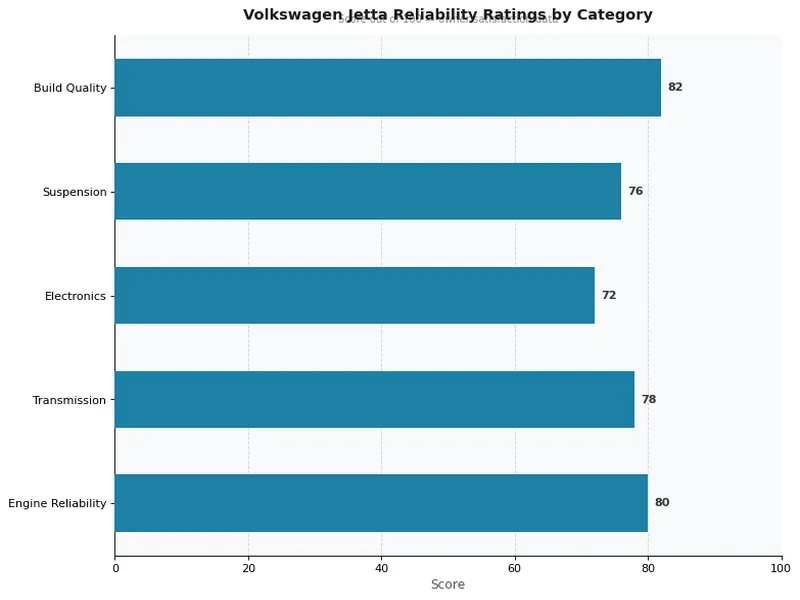
Our team puts the Jetta's reliability numbers in honest context against its two most common rivals:
| Category | VW Jetta | Honda Civic | Toyota Corolla |
|---|---|---|---|
| Overall Reliability Score | 3.5 / 5 | 4.5 / 5 | 4.5 / 5 |
| Average Annual Repair Cost | $630 | $368 | $362 |
| Severe Repair Probability | 12% | 10% | 8% |
| Interior Quality | Excellent | Good | Good |
| Driving Dynamics | Excellent | Good | Average |
| Typical Lifespan (well maintained) | 150,000–200,000 mi | 200,000–250,000 mi | 200,000–300,000 mi |
The Jetta trails the Civic and Corolla on raw reliability scores and annual costs. It leads on driving dynamics, interior refinement, and cabin space. That trade-off defines what the Jetta is: a driver's car that demands more active ownership than its Japanese rivals — but rewards that attention with a more engaging experience.
Our in-depth breakdown in the Volkswagen Jetta vs Mazda 3 comparison covers this matchup fully. The short version: the Mazda 3 edges the Jetta on reliability scores and total ownership costs. The Jetta wins on interior space, rear-seat legroom, and highway comfort. Both are strong compact sedans — the final decision comes down to which trade-off matters more.
This generalization is partly true — and largely outdated. Yes, some Jetta repairs run higher than Japanese rivals. But the gap has narrowed substantially on post-2018 models. Routine maintenance costs are directly comparable to most compact sedans in the class. Common repairs — ignition coil packs, thermostat housings, window regulators — typically cost under $300 at a reputable independent shop.
The "expensive to fix" reputation mostly belongs to neglected Jettas. Owners who defer oil changes, skip DSG service, or ignore early warning signs create expensive problems that never had to happen. Properly maintained Jettas are not the money pits that popular opinion suggests — and the gap between a maintained and unmaintained example is wider on the Jetta than on most other compact sedans.
This is simply false. The seventh-generation Jetta (2019 onward) represents a genuine reliability improvement over earlier models. VW simplified the powertrain, addressed the DSG issues that plagued 2011–2014 models, improved electrical system consistency, and tightened overall build quality. Both Consumer Reports and J.D. Power recorded measurable improvements — the seventh-gen Jetta now scores above average in predicted reliability, which is a real turnaround from the troubled middle years of the model's history.
For broader context on VW reliability across models, our look at Volkswagen Passats is useful. The Passat and Jetta share platform history and several common failure modes — comparing the two helps paint a full picture of where VW has made genuine progress and where caution still applies.
The 2019 and newer seventh-generation Jetta earns the best reliability marks. VW addressed the DSG shuddering and electrical issues that troubled earlier generations in this redesign. Among older models, the 2016–2018 facelift years also hold up well when service records are documented and complete.
A well-maintained Jetta consistently reaches 150,000 to 200,000 miles. Some owners report 250,000+ miles on models that received every scheduled oil change, DSG service, and timely component replacement. Longevity on the Jetta depends almost entirely on how closely the maintenance schedule is followed throughout ownership.
Average annual maintenance costs run around $630 — higher than the Toyota Corolla or Honda Civic, but significantly lower than most other German brands. Using a trusted independent VW specialist rather than a franchised dealer for routine service cuts that number substantially without sacrificing the quality of work.
 |
 |
 |
 |

About Marcus Chen
Marcus Chen has over twelve years of hands-on experience modifying cars across a range of platforms — from commuter builds to track-focused setups — with deep expertise in suspension tuning, wheel and tire fitment, and performance upgrades that improve driving dynamics without sacrificing day-to-day reliability. He has worked with both bolt-on and engineered modifications and brings a methodical, results-focused approach to evaluating performance parts. At CarCareTotal, he covers performance upgrades, suspension and handling, and wheel, tire, and drivetrain modifications.
Get some FREE car parts & gear.. Or check out the latest free automotive manuals and build guides here.
Disable your ad blocker to unlock all the hidden deals. Hit the button below 🚗
| | | |
