by Sarah Whitfield
Nearly 40 percent of new vehicles sold in North America now come equipped with all-wheel drive, which makes the AWD system fault warning one of the most frequently misunderstood dashboard alerts our team encounters in the shop. Most drivers assume the worst the moment that light appears, picturing catastrophic repair bills and tow trucks, but our experience points to a handful of common, fixable culprits in the majority of cases. This guide covers what triggers an AWD system fault, how to diagnose it systematically, what realistic repairs look like, and how to keep the system running trouble-free for the long haul.

Contents
The all-wheel drive system is a tightly integrated network of sensors, actuators, transfer cases, and differentials working together to distribute torque across all four wheels whenever traction conditions demand it. Modern AWD setups — whether full-time, part-time, or electronically controlled on-demand — rely on a central control module that monitors wheel speed sensors, throttle position, and steering angle to make split-second torque distribution decisions in real time. According to the National Highway Traffic Safety Administration, drivetrain control systems have become significantly more complex over the past two decades, with late-model vehicles often running dedicated AWD modules that operate independently from the main powertrain control unit.
When any sensor input or actuator response falls outside the module's expected parameters, the system flags an AWD system fault and illuminates the warning indicator on the instrument cluster. The warning itself doesn't point to a single specific failure — it's a category of fault, much like how a check engine light can mean anything from a loose gas cap to a failing sensor. Our team has seen AWD fault codes triggered by something as benign as mismatched tire sizes and as serious as a seized transfer case, which is precisely why a disciplined diagnostic approach matters before committing to any repair estimate.
Wheel speed sensors are the single most common trigger for an AWD system fault in our experience, and they also happen to be among the more straightforward components to address. Each wheel carries a sensor that reports rotational speed to the AWD control module, and any sensor sending an erratic or absent signal — due to corrosion, physical damage, or a contaminated reluctor ring — will instantly generate a fault code. Our team consistently finds that cleaning or replacing a single wheel speed sensor resolves the warning in a meaningful share of diagnostic visits, making this the logical first place to look. When an AWD fault shows up alongside vibration through the chassis during cornering, our team also recommends reviewing the causes detailed in the guide on car shaking when turning, since CV joint and driveshaft issues frequently trigger both complaints at once.
Transfer case and differential problems occupy the more serious end of the AWD fault spectrum and tend to carry heavier repair costs as a result. Low or degraded transfer case fluid is something our team treats as a first-line check, because overheated fluid loses its protective properties and causes internal wear that the module detects and flags almost immediately. A worn clutch pack inside the rear differential on electronically controlled AWD systems is another frequent offender, particularly in vehicles beyond 80,000 miles that haven't had differential fluid services done on a consistent schedule.
The first step our team takes with any AWD system fault is pulling the stored diagnostic trouble codes with an OBD-II scanner capable of accessing ABS and AWD control module data — a standard entry-level reader won't always communicate with these secondary modules, so a bidirectional scan tool is genuinely worth having. Codes in the C-series chassis range and U-series network communication range are the most common outputs, and each points toward a specific subsystem, whether that's a wheel speed sensor circuit, a transfer case motor, or a communication failure between control modules.
Once the codes are in hand, our team follows a structured approach: verify whether the fault is currently active rather than stored from a previous event, inspect the most likely physical component identified by the code, and test the sensor or actuator with a multimeter before ordering parts. Replacing components based solely on codes without confirming the circuit behavior is a reliable way to spend money on parts that don't fix anything. For AWD faults linked to broader powertrain warning clusters, our team also finds the symptom breakdown in the reduced engine power warning guide useful for ruling out overlapping causes before narrowing the diagnosis.
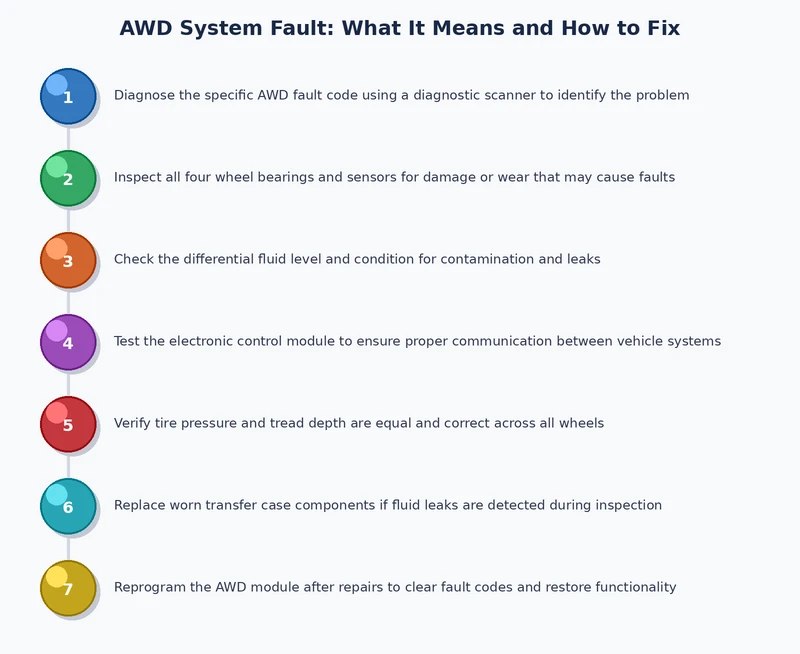
Fluid maintenance is the single most impactful preventive measure against recurring AWD system faults, and it's also one of the most neglected items in the average service schedule. Transfer case fluid and rear differential fluid should be replaced every 30,000 to 60,000 miles depending on the manufacturer's specification, and our team recommends erring toward the shorter interval for vehicles that do any towing, frequent off-road driving, or consistent hauling. Using the manufacturer-specified fluid type is non-negotiable — substituting a generic fluid in a limited-slip or electronically controlled differential causes immediate clutch chatter and can generate AWD fault codes within a few hundred miles.
Running four tires of identical brand, model, and tread depth is a functional requirement for AWD systems, not merely a preference, and our team treats mismatched tires as a likely AWD fault contributor whenever we see uneven wear at intake. Even a half-inch difference in circumference between tires causes the AWD module to detect a persistent wheel speed discrepancy, which over time can trigger an AWD system fault and cause premature wear on the transfer case clutch packs. Our team's strong recommendation is to replace all four tires simultaneously and maintain a rotation interval of every 5,000 to 7,500 miles without exception. Drivers also dealing with unusual handling changes alongside the AWD warning may find our analysis of heavy steering causes worth reading, as suspension and drivetrain problems frequently compound each other.
Repair costs for an AWD system fault vary considerably depending on the root cause, and our team has compiled realistic ranges based on current market pricing across the most common repair scenarios.
| Component / Repair | DIY Parts Cost | Shop Total (Parts + Labor) |
|---|---|---|
| Wheel speed sensor replacement | $15 – $60 | $100 – $250 |
| AWD module reset / reprogram | N/A | $75 – $175 |
| Transfer case fluid service | $30 – $65 | $100 – $220 |
| Transfer case motor / actuator | $80 – $320 | $250 – $650 |
| Transfer case replacement | $400 – $1,200 | $1,500 – $3,500 |
| Rear differential rebuild | $200 – $650 | $800 – $2,500 |
Any AWD fault repair above $1,500 warrants getting at least two independent estimates and a clear, itemized explanation of what failed and why before authorizing the work — our team holds this as a firm policy. On older vehicles approaching 150,000 miles, a failed transfer case can push the total repair cost dangerously close to the vehicle's actual market value, and the honest advice in that scenario is to weigh a repair investment against a trade-in or replacement seriously rather than reflexively authorizing the fix.
In most cases the vehicle remains driveable in a degraded two-wheel-drive mode, but our team recommends addressing the fault promptly rather than ignoring it. Continued driving with an active AWD system fault can accelerate wear on the transfer case and differentials, turning a minor sensor repair into a significantly more expensive mechanical failure.
Absolutely, and our team sees this more often than most people expect. Even replacing just one tire while leaving three worn tires in place creates enough circumference difference to generate persistent wheel speed errors, which the AWD module logs as a fault. The fix is straightforward: match all four tires to the same spec and the warning typically clears on its own after a short drive.
Some faults clear automatically once the underlying problem is resolved and the module confirms normal sensor readings across a few drive cycles. Others store a permanent code that requires a scan tool to manually clear. Our team always recommends using a scanner to confirm the code is gone after completing a repair, rather than assuming the light will go out on its own.
Our team recommends a 30,000 to 45,000 mile service interval for most AWD vehicles, with shorter intervals for vehicles used for towing or frequent city driving. The manufacturer's specified fluid type is mandatory — off-spec fluid in an electronically controlled AWD system is one of the fastest ways to generate a fault code and damage internal clutch components.
The warning terminology differs across manufacturers, but the underlying diagnostic approach is essentially the same for both AWD and 4WD systems. Both rely on wheel speed sensors, transfer case actuators, and dedicated control modules that flag faults when sensor data falls outside calibrated thresholds. Our team uses the same structured code-pull-and-verify process regardless of whether the system is labeled AWD or 4WD.
 |
 |
 |
 |

About Sarah Whitfield
Sarah Whitfield is a diagnostics and troubleshooting specialist who spent ten years as an ASE-certified technician before joining the editorial team. She specializes in OBD-II analysis, electrical gremlins, and the kind of intermittent problems that make most owners give up.
Get some FREE car parts & gear.. Or check out the latest free automotive manuals and build guides here.
Disable your ad blocker to unlock all the hidden deals. Hit the button below 🚗
| | | |
