by Sarah Whitfield
Has a battery warning light ever appeared out of nowhere during an otherwise ordinary drive? That moment of dread has a cause — and more often than not, the battery itself is innocent. Bad alternator symptoms are the real culprit, and recognizing them early is what separates a minor repair bill from a full roadside breakdown. Our team has diagnosed enough failing charging systems to know that the signs are almost always there before the car goes dark — most people just don't know what to look for.
The alternator converts mechanical energy from the engine into the electrical power that keeps the battery charged and every onboard system running. According to the Wikipedia overview of automotive alternators, a typical unit produces between 13.5 and 14.8 volts at idle — anything outside that range signals trouble. When that output starts to degrade, the symptoms ripple across the dashboard, the lights, the accessories, and eventually the engine itself. This guide covers all seven warning signs, explains how to test the alternator at home, and breaks down what replacement actually costs.
Contents
The first step in solving a charging system problem is knowing exactly what to look for. These seven bad alternator symptoms cover the full spectrum of failure patterns — from the subtle early warnings to the hard stops that leave a car stranded.
Most modern vehicles display a battery-shaped icon or an "ALT" or "GEN" indicator the moment alternator output drops below the threshold the ECU expects. This light doesn't mean the battery is dead — it means the charging system is underperforming. Some vehicles go further and display the actual system voltage on the instrument cluster, which makes it easier to track degradation over time. The light comes on before anything else fails, which makes it the most actionable early warning on this list.
Headlights and interior lights that grow dim at idle and brighten when the engine revs are a textbook sign of a failing alternator. The alternator produces more current at higher RPM, so lights that change intensity in step with engine speed point directly at a charging problem rather than a burned-out bulb. Most people first notice this at night when the difference in brightness is impossible to ignore.
A battery that drains overnight — even after a recent replacement — is often the victim of an alternator that can't replenish what the electrical system consumes. Our team regularly sees cases where drivers replace the battery, get a few weeks of normal operation, and then watch the problem return. The alternator was always the root cause. This situation also raises the question of battery health, and our team recommends reviewing how much a car battery costs to understand whether both components need addressing at once.
A failing alternator bearing or a worn drive belt produces a grinding, whining, or squealing sound that changes pitch with engine speed. The noise can be easy to confuse with other belt-driven accessories, but the giveaway is correlation with electrical load. Turning on the headlights, air conditioning, or rear defroster while listening for a change in pitch narrows the source quickly. Bearing failure in particular produces a harsh growling tone that worsens as the alternator heats up.
Power windows that move slower than usual, a radio that resets without warning, a climate control panel that behaves erratically — these are all signs that the vehicle's electrical system isn't receiving stable, consistent voltage. The alternator's built-in voltage regulator is responsible for smooth output. When regulation becomes inconsistent, every device drawing power pays a price. Accessories are often the first systems to show the strain because they run on the marginal power the alternator produces above the engine's base demand.
The ignition system needs steady voltage to fire spark plugs reliably. A weak alternator that can't sustain adequate output makes starting sluggish and can cause stalling at low RPM when idling in traffic. These symptoms overlap significantly with ignition system failures, and our team recommends checking for symptoms of a bad ignition coil before drawing conclusions — both components can fail simultaneously in high-mileage vehicles.
An overloaded or internally shorted alternator runs extremely hot. That heat attacks the insulation on surrounding wires and the rubber serpentine belt that drives the alternator pulley, producing a sharp burning smell that's unmistakable once experienced. This is among the most urgent bad alternator symptoms. Continued operation risks melting wiring harnesses and, in rare cases, an underhood fire. When this smell appears, the diagnosis process should move immediately.
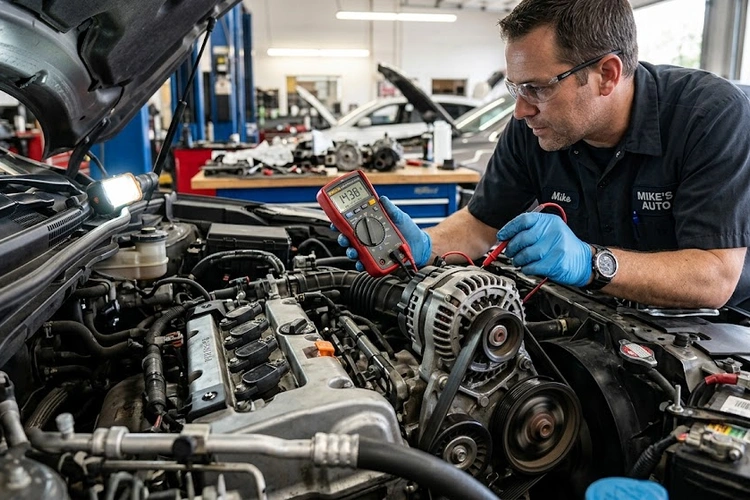
Accurate diagnosis prevents the cost and frustration of replacing parts that don't need replacing. Our team relies on two instruments to chase down bad alternator symptoms with confidence.
A digital multimeter is the single most important electrical diagnostic tool in any shop or garage. Our team uses units that read to two decimal places in DC voltage mode — enough precision to catch a voltage regulator that's drifting. The key measurements are resting battery voltage with the engine off and charging voltage with the engine running and accessories loaded. Any multimeter in the $20–$60 range from a reputable brand handles this task without issue.
A dedicated battery and alternator load tester applies a controlled current draw and measures system response — catching intermittent failures that a simple voltage reading at idle might miss entirely. Professional-grade units cost $100–$200, but most major auto parts retailers offer free charging system tests using the same equipment. For anyone who regularly works on their own vehicles, owning a load tester is an investment that pays for itself quickly.
The two-step testing process our team follows takes less than ten minutes and produces a clear answer in almost every case.
With the engine off, place the multimeter probes on the battery terminals — red to positive, black to negative. A healthy, fully charged battery reads between 12.4 and 12.7 volts. Anything below 12.2 volts indicates a battery that's been chronically undercharged, which immediately puts the alternator under suspicion. This baseline reading is critical — without it, the second measurement loses context.
Start the engine and take the measurement again. Voltage should climb to the 13.5–14.8 volt range. Then switch on the headlights, air conditioning, and rear defroster simultaneously to simulate a real electrical load. The voltage should hold. A drop below 13 volts under full load confirms the alternator is not keeping pace with demand. If the engine is also hard to start or stalling, cross-referencing with a guide to a car that won't start with no click helps rule out starter motor and battery cable issues before focusing exclusively on the alternator.
Most people never think about their alternator until it fails. Our team has found that a handful of consistent habits push service life well past the average replacement interval of 80,000 to 150,000 miles.
Running aftermarket audio amplifiers, high-draw LED light bars, or winch motors on a factory alternator pushes it past its design rating. Factory units are typically rated between 90 and 150 amps — enough for stock systems with margin to spare, but not for heavily modified vehicles. Matching electrical demand to the alternator's rated output, or upgrading to a high-output unit when accessories are added, is the most direct way to prevent premature wear.
The serpentine belt drives the alternator pulley. A belt that's glazed, cracked, or tensioned incorrectly causes the alternator to slip, overheat, and wear out its bearings faster than normal. Inspecting the belt every 30,000 miles as part of routine maintenance is a simple, low-cost step that protects a much more expensive component. Our team treats belt inspection with the same priority as monitoring low transmission fluid symptoms — both are easy to overlook until the damage is already done.
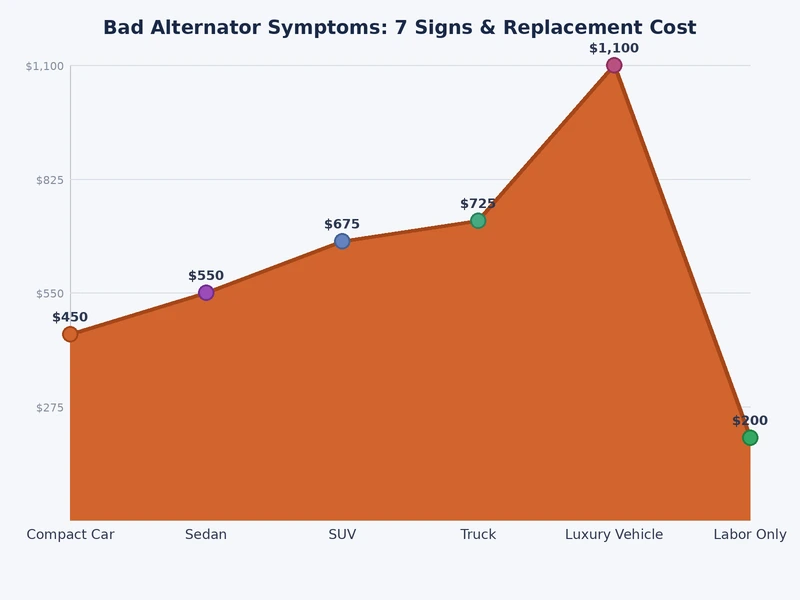
Replacement costs vary considerably depending on the vehicle, the type of alternator chosen, and whether the work is done at an independent shop or a dealership. Here's a realistic breakdown based on what our team consistently sees across common makes and models.
Remanufactured alternators for high-volume vehicles — Honda Civics, Toyota Camrys, Ford F-150s — typically cost between $80 and $250 from reputable suppliers. New OEM units run $250 to $600. High-output alternators for trucks or heavily accessorized vehicles push past $400 even for remanufactured units. Brand matters: Denso, Bosch, and Remy consistently deliver quality that justifies the slight premium over no-name units.
Labor ranges from $75 to $200 for most front-wheel-drive economy and midsize cars, where the alternator sits near the top of the engine and is straightforward to access. Vehicles with tight engine bays, alternators mounted low on the block, or units requiring subframe removal — common on many European models — push labor well past $300. The table below gives a realistic picture across common vehicle categories.
| Vehicle Type | Parts Cost | Labor Cost | Total Estimate |
|---|---|---|---|
| Economy sedan (Civic, Corolla) | $80–$200 | $75–$150 | $155–$350 |
| Midsize sedan (Camry, Accord) | $100–$250 | $100–$175 | $200–$425 |
| Full-size truck (F-150, Silverado) | $120–$300 | $100–$200 | $220–$500 |
| Midsize SUV (RAV4, CR-V) | $100–$275 | $100–$200 | $200–$475 |
| European luxury (BMW, Audi, Mercedes) | $250–$600 | $200–$400 | $450–$1,000 |
Choosing between a new and a remanufactured alternator is one of the first decisions that comes up after a confirmed diagnosis. Each option has distinct trade-offs that make one better suited to specific situations.
A brand-new OEM or premium aftermarket alternator contains all original-specification components and typically carries a one- to three-year warranty. A remanufactured unit has been disassembled, cleaned, and rebuilt with new brushes, bearings, rectifiers, and diodes. When sourced from a reputable rebuilder like Bosch or Denso, the performance difference between new and rebuilt is negligible for everyday driving. The rebuild process also includes a full output test before shipping, which new units from lower-tier aftermarket brands don't always get.
Remanufactured alternators cost 30 to 50 percent less than new units for the same application. The savings come from reusing the aluminum housing and core components rather than casting and machining new ones — it's a sound value proposition, not a compromise. For most vehicles, remanufactured is the recommendation our team makes first. New OEM units make sense for vehicles still under a powertrain warranty or when the original failure was catastrophic enough to compromise the core.
Bad alternator symptoms don't always lead to the alternator. Several other components produce nearly identical warning signs, and chasing the wrong one wastes both time and money.
A failing battery and a failing alternator produce overlapping symptoms — dim lights, difficult starting, warning lights on the dash. The voltage test under load resolves the ambiguity cleanly. If the alternator outputs 13.5 to 14.8 volts under load but the battery still won't hold a charge overnight, the battery is the failure point. If voltage collapses below 13 volts when accessories are switched on, the alternator can't keep up. Testing both components takes fifteen minutes and eliminates all guesswork.
Corroded battery terminals, a loose or broken ground strap, or a failing external voltage regulator — in vehicles where that's a separate component — all create symptoms that look exactly like alternator failure. Our team inspects the full wiring harness, all ground points, and the battery cable condition before condemning any major component. A clean, tight electrical system is the foundation of accurate diagnosis and prevents the frustration of replacing a functioning alternator because a $2 ground connection was overlooked.
Most alternators last between 80,000 and 150,000 miles under normal operating conditions. Vehicles with heavy electrical loads — aftermarket audio systems, winches, or auxiliary lighting — tend to wear alternators faster because the unit runs closer to its maximum output rating for extended periods.
A car can run briefly on battery power alone — typically 20 to 60 minutes depending on battery state of charge and electrical load — but once the battery is depleted, the engine shuts down completely. Our team strongly advises against driving with a confirmed bad alternator, as the electrical system can fail without warning.
The most common causes are worn brushes from high mileage, bearing failure from heat or contamination, diode failure from voltage spikes, and overload from excessive aftermarket electrical accessories. Short-trip driving that never fully charges the battery also places constant strain on the alternator by keeping it in a high-output state.
It is not safe. A failing alternator can cut power to critical systems — including the ignition, power steering on electrically assisted systems, and safety electronics — without warning. Our team recommends diagnosing and resolving the issue before putting additional miles on the vehicle.
On most domestic and Japanese vehicles, replacement takes one to two hours. European vehicles with tight engine bays or complex accessory drive layouts can take three to four hours. Shops with the vehicle on a lift and the right tools typically complete the job in a single appointment.
A failing alternator that undercharges the battery accelerates sulfation — the buildup of lead sulfate crystals on the battery plates — which permanently reduces capacity. An alternator that overcharges, which happens when the voltage regulator fails high, can boil the electrolyte and warp the plates. Both failure modes destroy the battery over time, which is why our team always tests both components together.
 |
 |
 |
 |

About Sarah Whitfield
Sarah Whitfield is a diagnostics and troubleshooting specialist who spent ten years as an ASE-certified technician before joining the editorial team. She specializes in OBD-II analysis, electrical gremlins, and the kind of intermittent problems that make most owners give up.
Get some FREE car parts & gear.. Or check out the latest free automotive manuals and build guides here.
Disable your ad blocker to unlock all the hidden deals. Hit the button below 🚗
| | | |
