by Sarah Whitfield
Nearly 1 in 4 vehicles inspected at U.S. repair shops carries at least one worn suspension component — and bad ball joint symptoms are among the most frequently overlooked early warnings. Ball joints (the ball-and-socket pivot points connecting the steering knuckle to the control arm) endure thousands of stress cycles per mile. Our team has watched these parts go from a faint clunk to complete wheel separation within a few hundred miles. Identifying the signs early is one of the most important things anyone can do for long-term vehicle safety. For a broader look at related repair topics, our car maintenance and repair guides cover suspension, steering, brakes, and drivetrain problems.
Contents
Ball joint problems rarely announce themselves with a single dramatic event. Our team consistently sees the same pattern: small, easy-to-dismiss signs that build gradually into serious safety concerns. Below are the most reliable indicators encountered during inspections.
A hollow clunking or popping sound from the front suspension is the most common early sign. The noise tends to appear when:
The sound often worsens in cold weather. Low temperatures stiffen the grease inside the joint and increase play. Our experience shows that a clunk heard specifically during slow parking-lot turns is one of the earliest and most reliable indicators of a ball joint wearing down.
When a grinding noise accompanies the clunk, that changes the diagnostic picture. Our detailed breakdown of grinding noise when turning helps separate ball joint wear from other common culprits like wheel bearings and CV joints.
A worn ball joint introduces play (looseness) into the steering system. Common handling complaints include:
Most drivers first describe this as the car simply "not feeling right." It is worth noting that heavy or stiff steering can also accompany a failing ball joint — this happens when the joint begins to bind rather than wearing loose, which is less common but more immediately concerning.
A loose ball joint allows the wheel to shift its camber angle (the inward or outward tilt of the tire viewed from the front) unpredictably. This creates abnormal one-sided wear on the tread. Most drivers don't notice this until the tire is significantly worn, but a routine tire rotation catches it early. Anyone experiencing shaking when turning alongside uneven wear should treat both symptoms as part of the same suspension inspection rather than two separate issues.
Ball joints don't fail randomly. Our team sees consistent patterns in what accelerates wear. Understanding these root causes helps set realistic maintenance expectations and catch problems before they become dangerous.
Most OEM (original equipment manufacturer) ball joints are rated for 70,000 to 150,000 miles under normal conditions. Age matters independently of mileage — rubber boots dry out and crack over time, even on low-mileage vehicles. Once the boot cracks, dirt and moisture enter the joint while grease escapes, and wear accelerates rapidly from that point.
Driving environment has a major impact on how quickly ball joints wear. The following conditions consistently shorten lifespan in our experience:
According to NHTSA vehicle safety data, suspension component failures contribute to a significant number of annual road accidents — making proactive inspection a straightforward and worthwhile habit.
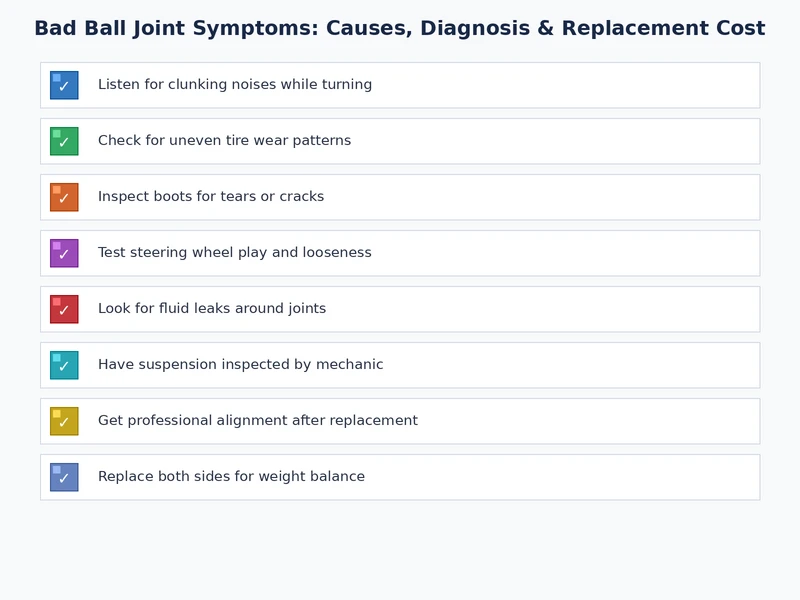
A proper initial diagnosis doesn't require a lift or specialized equipment. Our team uses this consistent sequence for first-pass evaluations before moving to precision measurement.
A visual inspection alone cannot confirm internal joint wear, but it quickly identifies obvious failures and prioritizes which joints need further testing. A cracked boot with surrounding grease spray often condemns a joint without further testing needed.
This is the standard field test used in shops and during home inspections:
Most manufacturers specify a maximum allowable play of 0.050 inches (about 1.3 mm) for loaded (compression-type) ball joints. A dial indicator — a precision measuring tool clipped to the joint assembly — gives a far more accurate reading than hand-feel alone. For borderline cases, our team never relies on feel without a dial measurement to back it up.
Safety note: A ball joint showing visible play greater than 1/4 inch should be treated as an immediate safety hazard. Our team's standard practice is to remove the vehicle from service until the joint is replaced — no exceptions.
Some conditions require acting without delay. Our team treats these as non-negotiable triggers for immediate replacement:
Ball joint failure is not a gradual, manageable decline like a worn brake pad. Once a joint loses structural integrity, complete separation is possible with little additional warning. At highway speed, wheel separation is catastrophic. This is not a component where waiting is a reasonable risk management strategy.
Not every ball joint showing early symptoms requires an emergency visit. A "monitor and schedule" approach is reasonable when:
Even under these conditions, re-inspection every 3,000–5,000 miles is the minimum appropriate interval. Monitoring is a temporary strategy with a defined end point — not indefinite deferral.
Ball joint replacement is a moderately demanding DIY task. The following tools cover most front lower ball joint replacements:
Most auto parts stores offer ball joint press kits as free loaners with a deposit return. Renting is the practical choice for anyone doing a one-time repair rather than purchasing a tool used rarely.
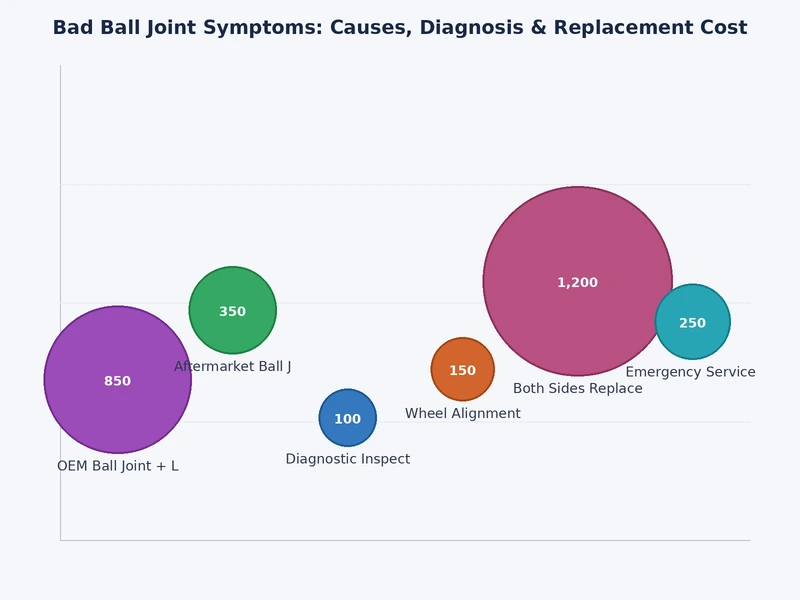
Costs vary significantly by vehicle type, joint location, and shop type. Our team compiled typical ranges across common repair scenarios:
| Service | Parts Cost | Labor Cost | Total Estimate |
|---|---|---|---|
| Single lower ball joint — economy/compact car | $20–$60 | $80–$150 | $100–$210 |
| Single lower ball joint — truck or SUV | $40–$120 | $150–$300 | $190–$420 |
| Upper ball joint (where separate) | $30–$100 | $100–$250 | $130–$350 |
| Both lower ball joints — front axle | $60–$200 | $250–$500 | $310–$700 |
| Control arm + ball joint assembly replacement | $100–$350 | $200–$450 | $300–$800 |
On many modern vehicles, the ball joint is pressed directly into the control arm and cannot be replaced separately without a press. In those cases, replacing the entire control arm assembly is often more economical than pressing in a new joint — especially when shop labor rates are high and the control arm bushings are also aging.
Several persistent misconceptions circulate around ball joint diagnosis and replacement. Our team encounters these regularly — and they lead to unnecessary repairs or, worse, ignored problems.
This is the most common misdiagnosis our team sees. A clunking noise from the front suspension has many potential sources that are far more common than ball joint failure:
A thorough shake test and visual inspection are necessary before condemning a ball joint. Replacing a healthy joint wastes money and leaves the real problem unresolved — and still clunking.
This rule makes practical sense for shocks and struts, which degrade symmetrically over time. Ball joints are different. Our team's consistent recommendation: replace what is worn and confirmed out of spec. If only one joint measures beyond allowable play, replacing that joint alone is the correct call. The caveat is economic — if both joints show similar wear and the labor overlap is substantial (as it often is on trucks and body-on-frame vehicles), replacing both during the same visit is worth considering. But there is no safety mandate to replace a serviceable joint simply because its counterpart failed.
Many modern vehicles use sealed (non-greaseable) ball joints — maintenance is not an option on those. For vehicles with greaseable joints, our recommended service intervals:
Grease selection matters. Most greaseable ball joints specify NLGI #2 (National Lubricating Grease Institute Grade 2) chassis grease. Overfilling is a real risk — it can rupture the boot from the inside. Stopping when the grease gun meets slight resistance is the correct practice. A torn boot from overfilling achieves the opposite of the intended goal.
No maintenance practice eliminates ball joint wear entirely — it is a wear item by design. But our team consistently sees greaseable joints on well-maintained vehicles outlast sealed joints on neglected ones by a wide margin. Boot integrity and grease condition are the two most predictive indicators of remaining joint life.
This depends entirely on severity. A joint with minimal, in-spec play and an intact boot can often be monitored for a short defined period with frequent re-checks. A joint with visible play, a torn boot, grinding noise, or worsening symptoms should not be driven. Our team's firm threshold: any joint showing play greater than 1/4 inch warrants removing the vehicle from service immediately, regardless of how minor the noise seems.
Most drivers describe a clunking or knocking sensation from the front end, particularly pronounced over bumps or during low-speed turns. Steering may feel vague or drift on straight roads. At highway speeds, a shimmy or vibration through the steering wheel is common. In advanced cases, the vehicle may pull sharply to one side under braking — a sign the joint has significant play and the wheel geometry is shifting dynamically.
Yes. A worn ball joint allows the wheel's camber angle to shift unpredictably, placing abnormal load on one edge of the tire tread. The resulting wear pattern is typically one-sided — the inner or outer edge of the tread wears significantly faster than the rest. Our team recommends treating diagonal or edge-heavy wear as a prompt for a full suspension inspection, not just a tire replacement.
Yes, when only one joint is confirmed out of specification. Our team's position is straightforward: replace what is worn, not what is nearby. The exception is when both joints show comparable wear and the labor overlap makes a second replacement economically sensible. There is no safety requirement to replace a joint that tests within spec simply because the opposite joint failed.
Most manufacturers specify a maximum of 0.050 inches (approximately 1.3 mm) of play for loaded (compression-type) ball joints. Unloaded or tension-type joints have different specifications that vary by vehicle. A dial indicator mounted to the joint assembly is the only reliable way to measure accurately — hand-feel is inconsistent and unreliable for borderline cases. When in doubt, professional measurement takes precedence.
Complete failure causes the wheel and hub assembly to separate from the control arm. At low speeds this results in sudden loss of steering and the vehicle corner dropping to the road surface. At highway speeds the outcome is typically catastrophic, often triggering a rollover. The severity of complete failure is precisely why early bad ball joint symptoms should never be treated as a low-priority issue.
Our team hears this consistently from drivers in northern climates. Cold temperatures thicken the grease inside the joint and cause metal components to contract slightly, both of which amplify noise and perceived looseness. Symptoms that seem to quiet down as the vehicle warms up are not a sign that the joint is healthy — it simply means the grease has softened temporarily. The underlying wear remains, and cold-weather masking should not be mistaken for improvement.
Bad ball joint symptoms are not the kind of warning signs that benefit from a wait-and-see approach. Our team recommends that anyone noticing a front-end clunk, vague steering, or unexplained tire wear schedule a full suspension inspection promptly. A mechanic with a dial indicator can confirm or rule out ball joint wear in minutes, and getting ahead of the problem before the joint reaches critical failure is always the safer and more economical path forward.
 |
 |
 |
 |

About Sarah Whitfield
Sarah Whitfield is a diagnostics and troubleshooting specialist who spent ten years as an ASE-certified technician before joining the editorial team. She specializes in OBD-II analysis, electrical gremlins, and the kind of intermittent problems that make most owners give up.
Get some FREE car parts & gear.. Or check out the latest free automotive manuals and build guides here.
Disable your ad blocker to unlock all the hidden deals. Hit the button below 🚗
| | | |
