by Sarah Whitfield
Your vehicle sat idling in the driveway one morning, and you noticed something was distinctly wrong — a faint gasoline odor drifting into the cabin, an unsteady idle that had not been there the week before, and a fuel economy figure that had quietly declined by nearly three miles per gallon over the past two months. You assumed the issue would resolve itself, but it did not. What you were experiencing were textbook bad fuel injector symptoms, and identifying them at that stage is often the difference between a straightforward service and a significant engine repair bill.
Fuel injectors are precision electromechanical valves responsible for atomizing fuel into the combustion chamber at precisely the moment and quantity the engine control unit demands. When they begin to fail — whether through progressive clogging, internal leakage, or electrical fault — the consequences ripple through every system that depends on clean, consistent combustion. A rough idle that deteriorates into misfires, escalating fuel consumption, and eventually hard starting are the characteristic progression of injector decline. If you have already noticed symptoms such as an engine that shakes at idle, the injector system deserves immediate diagnostic attention, as this symptom frequently points to a per-cylinder fuel-air imbalance that a failing injector produces.
This guide examines all seven warning signs in clinical detail, walks you through proven diagnostic methods, addresses the most persistent myths in the field, and provides a clear cost breakdown for both cleaning and full replacement — so you can make an informed decision rather than an expensive one.
Contents
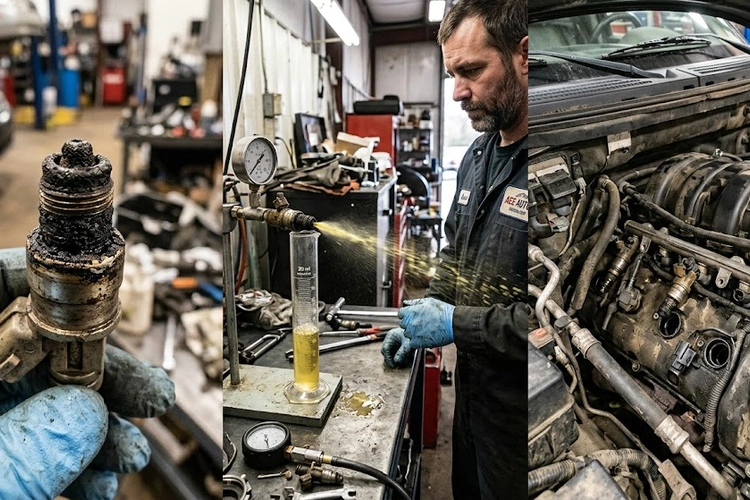
A fuel injector is a solenoid-operated valve that receives a precisely timed electrical pulse from the engine control module and opens for a calculated duration — measured in milliseconds — to deliver an atomized fuel spray directly into the intake port or combustion chamber. The spray angle, droplet size, and injection timing are engineered to maximize combustion efficiency and minimize unburned hydrocarbons per cycle. A deviation of even five percent in fuel delivery volume per cylinder is sufficient to trigger a detectable imbalance in engine operation, which explains why injectors are so frequently the first component to surface as a drivability complaint.
Deposit accumulation is the dominant failure mode, driven by the thermal cycling of hot fuel through a narrow orifice during every combustion event. Low-quality fuel with inadequate detergent additives accelerates this process dramatically. Internal O-ring degradation leads to external leakage, most pronounced at the injector body-to-manifold interface. Electrical failures — open or shorted solenoid windings — are less common but immediately produce a dead misfire on the affected cylinder. Extended service intervals on the fuel filter are a significant contributing factor, because particulate contamination scores the injector's needle valve seat over accumulated mileage. The diagnostic relationship between injector health and fuel system maintenance is why a failing injector and a deteriorating fuel filter so frequently present as a diagnostic pair requiring simultaneous attention.
A cylinder starved of fuel — or one receiving an inconsistent fuel pulse — will fire weakly or not at all, producing the characteristic rough, loping idle that defines early injector failure. The ECM logs misfire events on the affected cylinder, and the roughness intensifies when the engine is cold and injection duration is at its highest demand. You may notice the engine hunting between RPM values rather than settling at a stable idle speed. This symptom alone accounts for the majority of injector-related workshop visits, and the full spectrum of rough idle causes is broad enough that injector testing must be part of any systematic diagnostic sequence for this complaint.
Warning: A persistent rough idle accompanied by a fuel smell inside the cabin is a fire hazard — do not delay diagnosis, as a leaking injector can allow raw fuel to contact hot exhaust components under the hood.
A leaking injector that dribbles fuel into the cylinder after the engine shuts off creates a flooded condition at the next start attempt. Conversely, a completely blocked injector deprives its cylinder of fuel entirely, leaving the engine with insufficient combustion events to achieve ignition. Cold-start difficulty is a particularly telling indicator, because cold starts demand a precisely enriched injection duration that a compromised injector cannot deliver with adequate consistency to bring the engine to operating temperature reliably.
When an injector sticks partially open, it delivers excess fuel that cannot be fully combusted, and the ECM compensates by adjusting fuel trim parameters while still logging the efficiency loss. A leaking injector reduces combustion efficiency because unburned fuel exits through the exhaust rather than converting to mechanical energy. A documented drop of ten percent or more in fuel economy over a short mileage interval — without changes to driving conditions or climate — is a strong indicator of injector-related fuel waste that demands investigation rather than acceptance.
When you apply throttle and the engine hesitates, stumbles, or surges rather than accelerating smoothly, the injector's inability to scale fuel delivery proportionally with the ECM's command is the most likely mechanical explanation. This symptom is particularly pronounced at partial throttle openings and during transitions from light to heavy load — the operating conditions that demand the most accurate injector response. It should not be conflated with throttle position sensor faults, though both can produce symptoms that feel nearly identical from the driver's seat without diagnostic confirmation.
External injector leakage — typically at the O-ring seals on the injector body — allows raw fuel to escape into the engine bay where it immediately volatilizes, producing the characteristic gasoline odor that most drivers notice first at cold start after the vehicle has been sitting overnight. If you detect this smell inside the cabin through the HVAC fresh air intake, the leak has reached a volume serious enough to warrant immediate shutdown of the vehicle and a diagnostic inspection before any further operation is attempted.
The OBD-II system monitors injector circuit voltage, fuel trim corrections, and individual cylinder misfire rates continuously. A failing injector typically generates P0300-series misfire codes — P0301 through P0308 corresponding to each cylinder — alongside fuel trim codes such as P0171 (system lean, bank one) when the injector is clogged, or P0172 (system rich) when it is leaking. Injector circuit codes P0201 through P0208 indicate a confirmed electrical fault on the respective injector driver circuit, which is a distinct failure mode from a mechanically clogged injector and requires a different diagnostic approach.
An injector that delivers excess fuel or misfires consistently elevates hydrocarbon and carbon monoxide emissions to levels that exceed regulatory thresholds and produce an immediate inspection failure. If your vehicle fails a state-mandated emissions test without an obvious exhaust system failure, a compromised injector is the correct starting point for diagnosis. Unburned fuel passing through the catalytic converter at high concentration also accelerates converter degradation, compounding the total repair cost significantly if the injector fault remains unaddressed through multiple drive cycles.
The most costly mistake you can make is attributing an occasional misfire, a slight idle roughness, or a marginal decrease in fuel economy to normal engine aging and postponing diagnosis indefinitely. Injector failure is progressive — a partially clogged injector that produces a minor idle complaint at 60,000 miles will be a dead cylinder at 75,000 miles if left unaddressed. The cost of professional ultrasonic injector cleaning is approximately one-fifth the cost of injector replacement, and cleaning is only viable when the internal components remain structurally intact. Every mile of delay eliminates the less expensive resolution from your available options.
Not all fuel system cleaners are injector-safe. Solvent-based additives marketed for carburetor cleaning can degrade the rubber O-rings and internal polymer components of modern high-impedance injectors, accelerating the very deterioration you are attempting to reverse. The correct additive for a fuel injection system is a polyether amine (PEA) or polyisobutylene amine (PIBA) detergent formulation, applied at the concentration and service interval specified on the product label. Using generic hardware-store solvents at arbitrary concentrations is not a cleaning procedure — it is controlled damage applied to a precision component.
A professional-grade OBD-II scanner with live data capability is your primary injector diagnostic instrument, and it should be your first tool before any component is removed from the vehicle. Short-term and long-term fuel trim values reveal whether the engine is running lean or rich on a per-bank basis, with corrections beyond ±10% indicating a significant fuel delivery deviation that narrows the fault to a specific injector or injector bank. Misfire counters in live data mode allow you to identify exactly which cylinder is firing intermittently without disassembly. If your scanner supports injector duty cycle monitoring, a duty cycle that diverges from adjacent cylinders by more than eight to ten percent indicates that specific injector is not delivering the commanded fuel volume under current engine load conditions.
A fuel pressure gauge connected to the Schrader valve on the fuel rail confirms that system pressure meets specification — typically 35 to 65 PSI for port injection, substantially higher for GDI applications — and, critically, holds that pressure after the engine is shut off. A pressure drop exceeding five PSI within five minutes of shutdown indicates an injector that is not sealing fully when commanded closed, which points directly to a leaking unit. A noid light — a compact LED test tool that inserts into the injector harness connector — confirms that the ECM is delivering the correct electrical pulse to each injector, isolating electrical faults from mechanical clogging without requiring fuel rail removal.
Fuel system additives are a maintenance tool, not a repair instrument. A moderately fouled injector — one that has never received a cleaning additive and has accumulated mild varnish deposits over 30,000 miles of service — responds measurably well to PEA-based treatment added at the correct concentration. An injector with a hardened carbon crust around the pintle seat, a damaged needle valve surface, or a corroded solenoid winding will not be restored by any additive formulation regardless of concentration or number of treatments applied. Using additives as a substitute for professional diagnosis delays the correct repair and risks progressive damage to the catalytic converter and oxygen sensors from the underlying combustion fault.
Gasoline direct injection engines, which now dominate the passenger vehicle market, are actually more susceptible to intake valve carbon deposits than port injection systems, because the injector's fuel spray no longer washes the intake valves clean during each induction cycle. GDI injectors operate at pressures exceeding 2,000 PSI, placing substantially higher mechanical stress on every component in the high-pressure fuel path, from the cam-driven pump through the injector needle and seat. Modern vehicles benefit from improved injector materials and tighter manufacturing tolerances, but they are not exempt from deposit accumulation, O-ring degradation, and solenoid wear — and GDI systems introduce failure modes that port injection vehicles never experience.
Pro insight: On GDI engines, walnut shell blasting of the intake valves at 40,000 to 60,000 miles removes carbon deposits that mimic injector symptoms — always rule out valve deposits before condemning the injector on a direct-injection application.
The balance rate test, accessible through a bidirectional scan tool on most modern vehicles, commands the ECM to disable each injector sequentially for a brief interval while the tool monitors the resulting RPM drop on each cylinder. A cylinder served by a properly functioning injector produces a significant RPM drop when its fuel supply is interrupted, because the engine loses a meaningful combustion contribution. A cylinder whose injector is already delivering inadequate fuel produces a minimal or negligible RPM drop — because the engine was already compensating for that cylinder's weak contribution through fuel trim corrections. This test localizes the fault to a specific cylinder without requiring fuel rail disassembly or any component removal.
With the injector removed from the vehicle, a digital multimeter measures solenoid winding resistance as the definitive electrical test. High-impedance injectors — the standard in most passenger car applications — should read between 12 and 17 ohms; low-impedance performance units read 2 to 5 ohms. Any reading outside specification confirms electrical failure and mandates replacement rather than cleaning. Bench-testing the removed injector on a purpose-built flow bench — or sending it to an injector specialist — reveals spray pattern symmetry, flow volume per pulse width, and leak-down rate at operating pressure. A healthy injector produces a fine, symmetrical cone spray; a clogged unit streams, dribbles, or concentrates fuel on one side of the spray axis.
The decision between cleaning and replacing a fuel injector depends on the severity of the confirmed fault, the vehicle's mileage, and the cost differential for your specific application. The table below presents the key decision factors side by side to eliminate ambiguity from this choice.
| Factor | Professional Cleaning | Full Replacement |
|---|---|---|
| Typical cost per injector | $15–$25 (off-car ultrasonic) | $30–$200+ (part only) |
| Labor cost | $50–$100 (removal and reinstall) | $100–$350+ (varies by engine access) |
| Best for | Deposit clogging, light varnish accumulation | Electrical fault, damaged needle seat, external leak |
| Expected longevity after service | 30,000–50,000 miles with quality fuel | Full OEM service life, 100,000+ miles |
| DIY viable? | Partially, with fuel rail cleaner kits | Yes, with proper tools and a factory procedure |
| Recommended mileage threshold | Under 100,000 miles, first-time fault | High mileage or confirmed component damage |
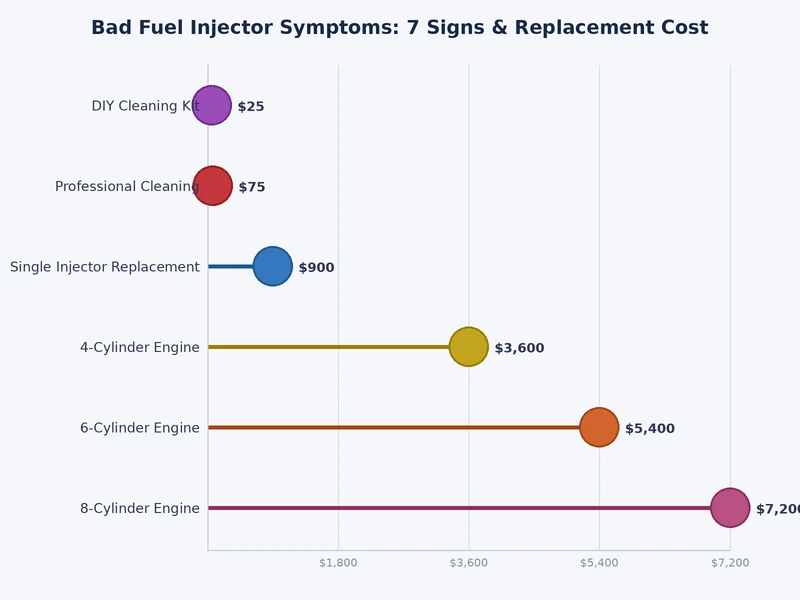
For a compact or midsize sedan with a port injection system and straightforward manifold access, a single OEM-specification replacement injector costs between $30 and $80, and total labor runs $100 to $200 at a standard shop rate. Performance vehicles, European imports, and GDI applications with limited under-hood access carry parts costs of $100 to $300 per injector, with labor charges reaching $400 to $600 for a complete set replacement. Replacing all injectors as a matched set — rather than only the confirmed failed unit — is the correct approach at high mileage, because remaining injectors at comparable accumulated wear will fail in sequence, repeating the labor cost of fuel rail removal within a short mileage interval.
The single most impactful maintenance decision you can make for injector longevity is consistently using TOP TIER certified gasoline, which meets the industry-defined minimum detergent additive specification established by a coalition of major automakers. Non-TOP TIER fuel produces injector and intake valve deposit accumulation at measurably higher rates over equivalent mileage in independent testing, and the cumulative effect over 50,000 miles is substantial. The fuel filter must be replaced strictly according to the manufacturer's scheduled interval, not extended, because a partially clogged filter reduces fuel rail pressure and forces each injector to operate at reduced delivery volume — generating excess internal heat that accelerates needle valve and seat wear beyond what normal service produces.
Professional off-car ultrasonic injector cleaning at 60,000-mile intervals is the most effective preventive maintenance action available for vehicles operating on port injection systems, and the cost-to-benefit ratio is unambiguously favorable compared to the alternative of reactive replacement. Running the fuel tank to near-empty repeatedly — rather than maintaining a level above one-quarter tank — increases thermal cycling stress on the in-tank fuel pump, which also supplies pressurized fuel to the injectors, and measurably shortens the fuel delivery system's overall service life. Consistent maintenance of the complete fuel system, from tank to injector tip, is the most reliable path to avoiding the full spectrum of bad fuel injector symptoms described in this guide.
Replacing injectors on a port injection system is a legitimate task for a mechanically proficient home technician who possesses the correct tools and a factory-level repair procedure for the specific vehicle. You will need to depressurize the fuel rail safely before loosening any fittings, remove the fuel rail as an assembly without tearing the upper injector O-rings, extract each injector cleanly, install new units with fresh O-rings lubricated with a film of clean engine oil, and verify system pressure and leak-down after reassembly before the first start attempt. The procedure on a four-cylinder engine with accessible manifold routing typically requires two to three hours and produces no special disposal requirements beyond a small quantity of residual fuel absorbed into shop rags.
GDI high-pressure injectors operating at 2,000 PSI or higher require a technician equipped with the correct fuel rail depressurization sequence and precise torque specifications for the high-pressure pump inlet fittings — deviation from specification risks a catastrophic high-pressure fuel leak at the first start. Any vehicle where injector access requires removing coolant lines, vacuum actuators, and multiple ancillary components creates compounding opportunities to introduce additional faults during disassembly that a home technician is not positioned to diagnose quickly. If your diagnostic protocol has not definitively confirmed which injector has failed — or if the stored codes suggest a wiring harness or ECM driver fault rather than a mechanical injector issue — investing in professional diagnosis before purchasing replacement parts is the economically rational first step.
A failing fuel pump affects all cylinders simultaneously, producing a uniform loss of power and hard starting across the full RPM range. A bad injector causes a cylinder-specific misfire with a rough idle and P030X codes on one or two cylinders. A fuel pressure test resolves the question definitively — a pump fault produces low rail pressure under load, while injector faults present with normal system pressure alongside a localized cylinder misfire pattern.
You should not operate the vehicle beyond what is necessary to reach a qualified repair facility. A leaking injector introduces raw fuel into the engine oil and exhaust system, accelerating internal wear and presenting a genuine fire risk. A persistently misfiring cylinder sends unburned fuel into the catalytic converter at high concentration, raising converter operating temperature to levels that can permanently destroy the substrate within a very short driving period, adding converter replacement to your repair bill.
Under normal operating conditions with quality fuel and proper maintenance, fuel injectors are engineered to last the service life of the vehicle — 100,000 to 150,000 miles in most applications. Vehicles operated on low-quality fuel, with deferred fuel filter service, or with frequent cold starts in severe stop-and-go conditions experience deposit accumulation significantly earlier and may require professional cleaning by 60,000 miles to maintain correct fuel delivery volume.
A rough idle combined with a check engine light displaying P030X misfire codes on one or more specific cylinders is the most frequently reported presentation of fuel injector failure across all vehicle platforms. This combination of a noticeable drivability symptom and a confirming diagnostic code makes the injector the highest-priority diagnostic suspect in any initial assessment of idle quality complaints.
A PEA-based injector cleaner can restore measurable flow rates on a moderately clogged injector that has accumulated varnish deposits through extended service without maintenance. It will not repair a mechanically damaged needle seat, a failed solenoid winding, or a cracked injector body. It will also not improve an injector that has already reached the threshold of triggering consistent misfire codes, as that degree of restriction requires ultrasonic cleaning under controlled bench conditions or outright replacement to resolve.
At mileage above 100,000 miles, replacing all injectors as a matched set is the correct approach. Remaining injectors have accumulated equivalent wear and will fail in sequence within the next 20,000 to 30,000 miles, requiring a repeat of the fuel rail removal procedure and its associated labor cost. Below 80,000 miles with no other cylinders showing symptoms, replacing only the confirmed failed unit is a reasonable and cost-effective decision.
The most common codes are P0300 for random or multiple cylinder misfires, P0301 through P0308 for specific cylinder misfires corresponding to cylinder number, P0171 and P0172 for bank-specific lean and rich fuel trim deviations, and injector circuit codes P0201 through P0208 for electrical faults on the respective cylinder's injector driver. A lean code on a specific bank combined with a matching misfire code on one cylinder within that bank is a near-definitive diagnostic picture for a clogged injector.
A gasoline direct injection injector operates at 1,800 to 2,500 PSI compared to 35 to 65 PSI for a port unit, and it delivers fuel directly into the combustion chamber rather than the intake port. Diagnostically, GDI injectors require a high-pressure pump performance test in addition to standard injector circuit checks, and the symptom of intake valve carbon buildup — which closely mimics injector clogging symptoms — must be methodically ruled out before condemning the injector itself on any direct-injection application.
 |
 |
 |
 |

About Sarah Whitfield
Sarah Whitfield is a diagnostics and troubleshooting specialist who spent ten years as an ASE-certified technician before joining the editorial team. She specializes in OBD-II analysis, electrical gremlins, and the kind of intermittent problems that make most owners give up.
Get some FREE car parts & gear.. Or check out the latest free automotive manuals and build guides here.
Disable your ad blocker to unlock all the hidden deals. Hit the button below 🚗
| | | |
