by Sarah Whitfield
A failing fuel pump accounts for roughly 10 percent of all no-start complaints that reach independent repair shops — and most drivers never see it coming until they're stranded. You rely on your fuel pump every time you turn the key, and when it starts to degrade, it sends warning signals well before it quits entirely. Learning to spot bad fuel pump symptoms early keeps you off the shoulder and out of an expensive tow situation. This guide walks through all seven major signs, explains how to run a proper diagnosis at home, and lays out what replacement actually costs.
The fuel pump is a high-wear component that most drivers treat as an afterthought — until it fails. Unlike a check engine light triggered by a sensor, a dying pump often works intermittently for weeks before stopping entirely. That window is your opportunity. Catch it early and you control the timing and the cost.
Contents
Your fuel pump lives inside the fuel tank on virtually every modern vehicle. It's an electric motor with an impeller that draws fuel from the tank and pushes it through the fuel lines to the injectors at a controlled pressure — typically between 35 and 65 PSI depending on the system. The pump runs constantly while the engine is on, which means it logs the same hours as your engine. On a 100,000-mile vehicle, that pump has been spinning nonstop for years. Wear is inevitable.
The pump also relies on gasoline itself for cooling and lubrication. Running your tank consistently below a quarter full shortens pump life significantly. Fuel acts as a heat sink — without adequate fuel surrounding the pump motor, heat builds and degrades the brushes and windings faster than normal operating conditions.
Contaminated fuel accelerates wear faster than anything else. Tank sediment, rust particles, and water intrusion clog the pump strainer and force the motor to work harder. Ethanol-blended fuels absorb moisture from the air, which introduces water into the system over time. According to Wikipedia's overview of fuel pump design, electric in-tank pumps are highly susceptible to overheating when fuel levels drop too low — a direct confirmation of what technicians see in the field daily. Poor fuel quality from discount stations is another underappreciated factor. Stick with top-tier rated fuel and your pump will last significantly longer.
This is the most dramatic symptom. You turn the key, the engine cranks, but it won't fire — or it takes several attempts before catching. A healthy pump primes the fuel rail within two seconds of the ignition cycling to the "on" position before cranking begins. A weak pump fails to build adequate rail pressure during that priming window. The engine cranks on an air-fuel mixture that's too lean to combust. On a warm engine, residual pressure may allow a start — but on a cold start with overnight pressure bleed-down, the symptom is unmistakable.
Your engine demands maximum fuel flow during hard acceleration, towing, or climbing steep grades. A pump operating at 60 to 70 percent capacity handles light-load driving fine but can't sustain adequate pressure when demand spikes. The result is a stall at exactly the worst moment — merging onto a highway, pulling a trailer uphill, or accelerating hard through an intersection. If your engine stalls under load but restarts easily after a few minutes of rest, suspect a pump that's thermally shutting down. Once it cools, it works again — temporarily.
Reduced fuel pressure causes lean combustion. Lean combustion produces less power. It's that direct. You'll notice a flat spot when you press the accelerator — the engine hesitates before responding, or it never builds revs the way it should. This symptom overlaps with several other causes, so read through this guide to why your car hesitates when accelerating before replacing the pump. Lean misfires from low fuel pressure can also generate detonation — you'll find the full breakdown in this guide to engine knocking noise causes.
A healthy fuel pump produces a faint hum — audible only if you listen closely with the ignition on but the engine off. A failing pump produces a distinct high-pitched whine from the rear of the vehicle. The sound intensifies under hard acceleration and when the tank is below a quarter full. Don't confuse this with a normal pump hum. The abnormal whine has a strained, fluctuating quality. Record it with your phone and compare it to known-good pump audio online — the difference is obvious once you hear it.
Pro tip: Cycle the ignition to "on" without cranking — a healthy pump hums briefly for about 2 seconds, then goes quiet; a dying one whines, stutters, or stays completely silent.
A pump delivering inconsistent pressure forces the ECU to compensate by enriching the fuel mixture. More fuel injected per cycle means worse mpg. You'll notice this as a gradual increase in fill-up frequency — not a dramatic overnight drop, but a steady degradation over weeks. If your fuel economy has declined 10 to 15 percent with no other explanation, fuel delivery is a legitimate suspect. Check your fuel trim values with a scan tool — long-term fuel trim above +10 percent means the ECU is compensating for a lean condition caused by insufficient pump pressure.
Highway cruising demands steady, sustained fuel flow. A weak pump may handle low-load city driving without issue but struggle to maintain pressure at high RPM. The result is a random, intermittent sputter at 65 to 75 mph — the engine momentarily drops power, then recovers. This symptom is frequently misdiagnosed as an ignition problem or bad fuel. If your engine sputters specifically at highway speed and clears up in city driving, the pump is the prime suspect. Our full guide to car sputtering when accelerating covers the additional causes that overlap with this symptom.
An erratic idle — where engine RPM fluctuates at a stop without any input from the accelerator — points to inconsistent fuel pressure delivery. The pump oscillates between adequate and inadequate output, causing the engine to hunt for a stable idle. Engine surge at constant highway speed is the same phenomenon at higher load. The ECU can compensate for minor pressure variation, but when swings are large enough, idle quality suffers visibly. If your tachometer bounces at a red light, don't overlook the pump.
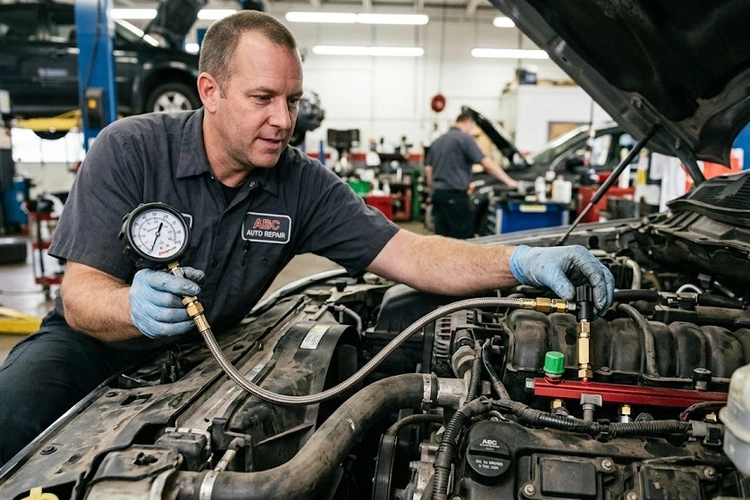
You need three things: a fuel pressure gauge with the correct adapter for your vehicle's Schrader valve, a scan tool capable of reading live fuel trim data, and a digital multimeter for checking pump voltage at the connector harness. The pressure gauge is the non-negotiable item — everything else provides supporting data. Before condemning the pump, rule out a clogged fuel filter. A severely restricted filter creates nearly identical symptoms. If your filter hasn't been replaced in 30,000 miles or more, change it first and retest. Review the full list of bad fuel filter symptoms to determine whether the filter is actually the culprit before touching the pump.
Static pressure — measured with the engine off and pump freshly primed — must hold steady for at least five minutes after ignition cycles off. Rapid bleed-down points to a leaking pump check valve, leaking injector, or failed pressure regulator. Running pressure at idle must fall within the manufacturer's specification for your system. Here are the typical ranges by fuel system type:
| Fuel System Type | Idle Pressure (PSI) | WOT Pressure (PSI) | Static Hold Requirement |
|---|---|---|---|
| Port Injection — Returnless | 55–65 | 55–65 | Hold 5+ minutes |
| Port Injection — Return Style | 35–45 | 40–50 | Hold 5+ minutes |
| Direct Injection — Low Pressure Side | 50–80 | 50–80 | Hold 2+ minutes |
| Turbocharged GDI | 65–90 | 65–90 | Hold 2+ minutes |
If your measured pressure reads 10 PSI or more below spec at idle, the pump is weak. If pressure is within spec at idle but drops sharply under wide-open throttle, the pump motor lacks capacity to sustain high-demand flow — a classic sign of a pump that's wearing out but not yet completely dead.
Fuel pump replacement sits in the mid-range repair category. Parts alone run $150 to $400 for most domestic and Asian-market vehicles. European makes trend toward the high end — $300 to $600 for OEM-equivalent quality. Labor adds $150 to $350, depending on whether the tank must be dropped or if the pump is accessible through a service panel in the trunk floor. Total repair cost typically lands between $300 and $750 for a standard sedan. Trucks and SUVs cost more due to larger tank configurations. If the fuel sending unit is worn — they're often sold as a combined assembly — budget toward the top of that range.
Avoid the cheapest aftermarket pumps. Quality varies enormously below the $80 price point. Stick with established brands — Delphi, Bosch, Carter, Denso — and you'll get a pump that actually lasts the expected service interval. Premature failure within 12 months is a documented and common outcome with discount sourcing. After any fuel system repair, keep your oil pressure warning light guide nearby — disturbed sensor harnesses during tank-drop service occasionally trigger unrelated warning lights on the first restart.
Keep your tank above a quarter full at all times. This single habit has more measurable impact on pump longevity than any other maintenance practice. Use top-tier rated gasoline when possible — the detergent packages reduce tank sediment accumulation and keep the pump strainer cleaner over the long haul. Replace your fuel filter on schedule, or every 30,000 miles if your owner's manual doesn't specify an interval. A clean filter reduces back-pressure on the pump motor and prevents it from working harder than necessary under normal operating conditions.
If you're storing a vehicle for more than 60 days, treat the fuel with a stabilizer. Ethanol-blended fuel degrades quickly in storage and leaves varnish deposits that clog the pump inlet strainer. And if you hear any whining from the tank or notice intermittent hesitation during acceleration, don't defer the diagnosis. The window between "starting to fail" and "completely dead" can close in a matter of days under hard driving conditions.
Swap the filter first — it's cheaper and the symptoms overlap almost entirely. A clogged filter creates the same pressure drop as a weak pump. If replacing the filter doesn't resolve your symptoms and fuel pressure is still below spec on a gauge test, the pump itself is the source. A fuel pressure test is the definitive way to separate the two.
You can — until you can't. A failing pump often works intermittently, but you risk being stranded with no warning. Driving in this condition also stresses the pump motor further, accelerating failure. If you've confirmed a weak pump, schedule the repair immediately rather than gambling on how many more starts you have left.
A failing fuel pump produces a high-pitched whine or buzzing from the rear of the vehicle, near the fuel tank. The sound is distinct from the normal brief hum you hear when cycling the ignition. It tends to worsen under hard acceleration and when the fuel level is low. If the pump is making no sound at all during the ignition-on priming cycle, it may have already failed completely.
Most OEM fuel pumps last between 100,000 and 150,000 miles under normal operating conditions. Consistently running the tank low, using low-quality fuel, or driving in extreme heat shortens that lifespan considerably. Aftermarket replacement pumps from quality brands typically carry a 1- to 2-year warranty and should last a comparable mileage if properly installed and maintained.
Yes, but indirectly. A weak pump causes lean fuel trims that the ECU eventually flags — you'll typically see P0087 (fuel rail pressure too low), P0171 (system too lean bank 1), or P0174 (system too lean bank 2). These codes don't point directly to the pump, but combined with the physical symptoms described above, they confirm the fuel delivery system is the problem area to investigate.
Your fuel pump doesn't fail without warning — it fails because the warnings went ignored.
 |
 |
 |
 |

About Sarah Whitfield
Sarah Whitfield is a diagnostics and troubleshooting specialist who spent ten years as an ASE-certified technician before joining the editorial team. She specializes in OBD-II analysis, electrical gremlins, and the kind of intermittent problems that make most owners give up.
Get some FREE car parts & gear.. Or check out the latest free automotive manuals and build guides here.
Disable your ad blocker to unlock all the hidden deals. Hit the button below 🚗
| | | |
