by Sarah Whitfield
Has the car started shaking at idle, or is there a hard clunk every time the transmission shifts into gear? Those are textbook bad motor mount symptoms — and they almost always get worse if ignored. The good news: these symptoms are diagnosable without a lift, and replacement is affordable when caught early.
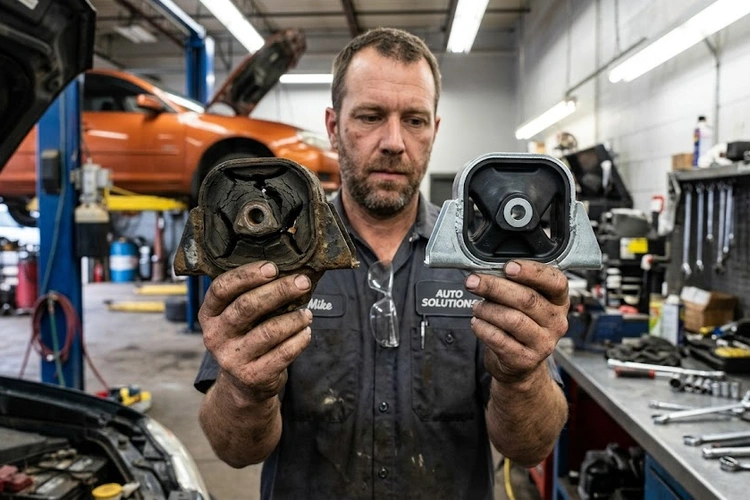
Motor mounts (also called engine mounts) are rubber-and-metal brackets that bolt the engine to the vehicle's frame. Their job is to absorb vibration and prevent the engine from moving under load. When the rubber cracks or the hydraulic fluid leaks out, the engine rocks freely. That movement puts stress on everything connected to it — hoses, wiring harnesses, exhaust components, and more. Knowing what to look for can save a significant amount of money. For a full reference, this guide on bad motor mount symptoms covers the topic in depth.
Contents
Bad motor mounts announce themselves clearly — if the driver knows what to feel and listen for. The symptoms fall into three categories: vibration, noise, and visible engine movement. Severely worn mounts often produce all three at once.
The most common complaint is a strong, abnormal vibration felt throughout the cabin. Healthy mounts isolate engine vibration almost completely. A failed mount transmits it directly into the body. The steering wheel, seat, and dashboard shake in ways that feel noticeably different from normal road vibration.
The timing of the shaking matters for diagnosis. If it peaks at idle and smooths out above 2,000 RPM, a misfire or fuel issue is more likely — see this breakdown of engine surging at idle causes for comparison. If shaking worsens under hard acceleration or load — such as climbing a hill or pulling a trailer — a motor mount is the stronger suspect. Drivers who notice the car shakes when turning may actually be dealing with a mount that shifts the engine under lateral load, not a suspension component.
A failed motor mount produces a distinctive clunk when shifting from Park to Drive or Reverse. It also clunks during hard acceleration, sudden braking, and gear changes. The sound comes from the engine reaching its physical limit of travel and striking the chassis through a degraded rubber buffer — essentially metal hitting metal.
These clunks are easy to confuse with suspension issues. The key diagnostic is when the noise occurs. Suspension-related knocking noises over bumps happen on rough roads regardless of throttle input. Motor mount clunks happen during gear changes and throttle transitions — on perfectly smooth pavement.
Pro tip: With the hood open and a helper in the driver's seat, watch the engine while they shift from Park to Drive with the foot on the brake. A healthy engine barely flinches. An engine lurching an inch or more has at least one failed mount.
On a severely worn mount, the engine physically rocks under load. This movement stresses every flexible component attached to the engine block — radiator hoses, coolant lines, the throttle cable or electronic harness, and the exhaust flex pipe. When a mount collapses completely, the engine can contact the firewall or other chassis components, causing additional damage quickly.
Unusual tension on the gear shifter linkage is another overlooked sign. Drivers who suddenly notice a loose or wobbly gear shifter — with no prior history of shifter problems — should inspect the motor mounts, as engine movement can alter the geometry of the shift linkage on some platforms.
Motor mounts don't fail suddenly. They degrade slowly over thousands of miles. Understanding the two main failure modes makes it easier to set realistic inspection schedules.
Most motor mounts consist of a rubber block bonded between two metal plates. The rubber absorbs vibration. Over time, heat cycling, ozone exposure, and physical stress cause the rubber to crack, harden, and compress. Once cracked, it can no longer isolate the engine's movement from the chassis.
Oil contamination accelerates this significantly. Any engine with a history of leaks — valve cover, oil pan, or front main seal — will expose the nearby mount to oil that aggressively degrades rubber. A vehicle with 80,000 miles and chronic leaks may have worse mounts than one with 130,000 clean miles. Regular engine bay cleaning and prompt leak repairs directly extend mount life. According to Wikipedia's overview of engine mounts, the rubber compound formula varies by manufacturer — some degrade far faster than others under oil exposure.
Higher-end vehicles use hydraulic mounts (also called fluid-filled mounts). These contain a glycol-based fluid inside a sealed chamber that provides additional vibration damping. When the internal membrane tears, the fluid leaks out. The mount feels solid initially, but the damping effect disappears.
Hydraulic mounts cost more to replace — sometimes twice as much as rubber mounts — but they also last longer in normal conditions. A leaking hydraulic mount sometimes drips onto the exhaust, causing a burning smell. That's worth distinguishing from a coolant or oil leak before chasing the wrong diagnosis.
The total cost of replacing motor mounts depends on the vehicle, how many mounts need replacement, and whether the work goes to a shop or is done at home. Most passenger cars have two to four mounts.
Rubber motor mounts for domestic and Japanese vehicles run from $25 to $150 per mount for aftermarket parts. OEM (original equipment manufacturer) parts typically run $80 to $250 each. Hydraulic mounts start around $100 and can exceed $300 for European luxury vehicles.
Labor is the larger variable. Some mounts are straightforward — two bolts, easily accessible. Others require removing the intake manifold, engine cradle, or transmission crossmember. Labor ranges from $150 to $400 per mount at independent shops. Dealerships charge more. The table below summarizes typical total costs by vehicle type.
| Vehicle Type | Mount Type | Parts (per mount) | Labor (per mount) | Total Estimate |
|---|---|---|---|---|
| Economy / compact car | Rubber | $25–$80 | $80–$150 | $105–$230 |
| Midsize sedan / SUV | Rubber | $50–$150 | $120–$250 | $170–$400 |
| Truck / large SUV | Rubber | $60–$180 | $150–$350 | $210–$530 |
| European luxury vehicle | Hydraulic | $150–$350 | $200–$450 | $350–$800 |
| Performance / sports car | Solid / poly | $80–$220 | $200–$400 | $280–$620 |
Warning: Always replace motor mounts in pairs at minimum. Installing one new mount next to a collapsed old one transfers full load to the new part and shortens its life dramatically.
Several persistent myths cause drivers to delay motor mount repairs longer than they should. Both of the following are wrong — and acting on them has real consequences.
This is the most common and most expensive mistake. A single failed mount shifts the entire load to the remaining mounts. They wear faster as a result. More critically, a fully collapsed mount allows the engine to contact the firewall or chassis components under hard braking or acceleration. That contact can crack engine brackets, damage the AC compressor, and bend exhaust piping. Drivers who develop a grinding noise when turning after ignoring a known bad mount often discover the engine has been contacting the frame or suspension on one side.
The diagnosis-to-repair delay should be measured in days, not months. A vehicle showing bad motor mount symptoms is not safe to drive hard until the mounts are replaced.
Motor mount replacement ranges from genuinely simple to genuinely difficult depending on the vehicle. On some compact cars, a front mount can be replaced with basic hand tools in under an hour. On transversely mounted four-cylinder engines in tight engine bays, the job requires supporting the engine with a floor jack and wooden block, removing the air intake, and navigating limited clearance. On trucks with solid-mount designs, it is often one of the easier suspension-adjacent jobs on the vehicle.
The myth is the assumption that it is always easy. Research the specific vehicle's procedure before purchasing parts. If the repair requires removing a subframe, it belongs in a shop.
Motor mounts are wear items — they will eventually need replacement. But the gap between "eventually" and "soon" is largely within the driver's control.
Aggressive driving is the fastest way to destroy motor mounts. Hard acceleration from a stop repeatedly slams the engine against the mounts' travel limits. Rapid gear changes do the same. Over time, this compresses and tears the rubber far faster than steady highway driving.
The following habits specifically shorten motor mount life:
None of these are catastrophic in isolation. Cumulatively, they cut mount life by a third or more.
Motor mounts are often overlooked during routine maintenance because they don't have a set replacement interval in most owner's manuals. A visual inspection at every oil change costs nothing and takes thirty seconds. Look for:
Any of these signs warrants a proper load test — watching for engine movement while a helper applies throttle in gear with the brakes held. This is the most reliable field check available without specialized tools.
Insider note: Mechanics often spot failed motor mounts during unrelated work — timing belt changes, oil pan gasket replacements, and AC compressor swaps all require partial engine access. Ask the shop to check mount condition whenever the engine bay is opened for a major job.
Once bad motor mount symptoms are confirmed, the remaining decision is whether to tackle replacement independently or hand it off to a shop — and how to ensure the work is done correctly either way.
DIY replacement makes sense on vehicles where the mount is accessible with standard tools and the procedure doesn't require specialized alignment or subframe removal. The savings are real — labor often costs more than the part. The risk is also real: improperly supporting the engine during mount removal can damage oil pan corners, wiring, or the engine crossmember.
Professional replacement is the right call when:
For most straightforward rubber mount replacements on common platforms, a competent home mechanic can complete the job in two to four hours. The tools required are typically a floor jack, jack stands, a torque wrench, and a basic socket set.
When bringing a vehicle in for suspected motor mount issues, precise symptom descriptions help the technician prioritize the inspection. Note exactly when the clunk or vibration occurs — on gear shifts, during hard acceleration, or at idle only. Mention whether the symptoms started suddenly or progressed gradually. A gradual onset strongly suggests wear rather than impact damage. Provide any recent history of engine leaks or undercarriage impacts.
A reputable shop will perform a load test before quoting a replacement. Any shop that quotes motor mount replacement solely on the driver's symptom description — without a physical inspection — deserves skepticism.
Bad motor mount symptoms are among the easier serious car problems to catch early — the shaking and clunking are hard to miss once they start. The mistake most drivers make is waiting. A failed mount costs $150 to $500 to fix. The collateral damage from a fully collapsed mount — bent brackets, cracked exhaust, stressed wiring — can easily triple that figure. Anyone noticing unusual vibration, hard clunks during gear changes, or visible engine rocking should get the mounts inspected this week, not next month.
 |
 |
 |
 |

About Sarah Whitfield
Sarah Whitfield is a diagnostics and troubleshooting specialist who spent ten years as an ASE-certified technician before joining the editorial team. She specializes in OBD-II analysis, electrical gremlins, and the kind of intermittent problems that make most owners give up.
Get some FREE car parts & gear.. Or check out the latest free automotive manuals and build guides here.
Disable your ad blocker to unlock all the hidden deals. Hit the button below 🚗
| | | |
