by Sarah Whitfield
Your neighbor mentioned his car was running rich for weeks before he finally pulled a code. It turned out to be a dead upstream O2 sensor — a $180 fix he let drag into a $900 catalytic converter replacement. Don't make the same mistake.
Bad O2 sensor symptoms show up gradually. They start subtle — a slight drop in fuel economy, an occasional rough idle — then snowball into misfires, failed emissions tests, and expensive secondary damage. Catching them early is the difference between a quick fix and a major repair bill.
The oxygen sensor sits in your exhaust stream and reports the air-fuel ratio to your ECU in real time. When it fails, the ECU compensates blindly, running the engine too rich or too lean. You feel it in performance, you see it at the pump, and eventually you'll need to reset the check engine light once you've made the repair. This guide covers every symptom, how to diagnose the problem yourself, what replacement costs, and the mistakes that turn a minor repair into a costly ordeal.

Contents
Not every failing O2 sensor announces itself loudly. Some sensors die slowly, drifting out of spec over months. Others quit cold and throw a code immediately. Either way, the symptoms follow a predictable pattern once you know what to look for.
The first thing most drivers notice is reduced fuel economy. Your MPG drops noticeably — sometimes 15 to 30 percent — because the ECU is no longer getting accurate feedback on the combustion process. Instead of maintaining stoichiometric combustion at a 14.7:1 air-fuel ratio, the engine drifts rich or lean and burns more fuel for the same output. You're paying for wasted combustion at every fill-up.
Rough idling is next. The engine stumbles at stoplights or surges unpredictably at low throttle. You may also feel hesitation under acceleration, particularly during light throttle transitions, as the ECU fights to hold proper fuel delivery without a reliable signal. In severe cases, you'll see dark exhaust under load — a sign of a dangerously rich running condition. That's worth cross-referencing with a breakdown of exhaust smoke colors and what each one means, since the color and density of the smoke tells you a lot about what's happening in the combustion chamber.
Failed emissions tests are another hard consequence. A degraded O2 sensor lets unburned hydrocarbons and carbon monoxide spike far beyond legal thresholds. You won't pass a smog check with a dead upstream sensor.
Plug in an OBD-II scanner and you'll typically find one or more of these DTCs alongside the bad O2 sensor symptoms you're seeing behind the wheel:
| DTC Code | Description | Most Likely Cause |
|---|---|---|
| P0131 | O2 Sensor Low Voltage — Bank 1, Sensor 1 | Lean condition or dead sensor element |
| P0132 | O2 Sensor High Voltage — Bank 1, Sensor 1 | Rich condition or contaminated sensor tip |
| P0133 | O2 Sensor Slow Response — Bank 1, Sensor 1 | Worn or aging sensor element |
| P0136 | O2 Sensor Circuit Malfunction — Bank 1, Sensor 2 | Downstream sensor failure or open circuit |
| P0141 | O2 Sensor Heater Circuit Malfunction | Blown fuse or failed heater element |
| P0420 | Catalyst System Efficiency Below Threshold | Failing catalytic converter or bad downstream O2 sensor |
P0420 is the one that gets expensive fast. It's frequently misdiagnosed as a dead catalytic converter when the downstream O2 sensor is actually the culprit. A new cat runs $800 to $1,500 on most vehicles. Confirm sensor function before you spend that money.
Pulling a code is step one. Confirming that the O2 sensor is genuinely the root cause is step two — and that's where most DIYers rush ahead and order parts they don't need.
Connect a scan tool that supports live data streaming. Navigate to the O2 sensor PID for the circuit flagged in your DTC. A healthy upstream sensor oscillates rapidly between 0.1V and 0.9V — roughly 8 to 10 cycles per second at normal operating temperature. That voltage swing is the sensor cycling through lean and rich readings as the ECU makes real-time fuel corrections.
A stuck voltage tells you everything. If the sensor is flat-lining at 0.45V, pinned high near 0.9V, or stuck low near 0.1V, the sensor has failed. A slow, sluggish sweep — fewer than four cycles per second — points to a worn sensor that's losing responsiveness. That's the classic P0133 pattern. The sensor is still alive, but it's no longer fast enough to support proper closed-loop fuel control. It will fail completely soon.
Backprobe the signal wire with a digital multimeter as a secondary confirmation. This rules out wiring faults and connector corrosion, which can mimic sensor failure on your scanner without the sensor itself being bad. A corroded connector is a $5 fix. Don't skip this step.
Pull your freeze frame data and check short-term and long-term fuel trim values alongside your DTC. A failing upstream O2 sensor forces the ECU to make large corrections to maintain driveable combustion. Long-term fuel trim (LTFT) values beyond plus or minus 10 percent are a warning. Beyond plus or minus 15 percent, the ECU is working hard to compensate for consistently bad sensor data — and your engine is not running efficiently.
Elevated fuel trims also appear with failing fuel injectors and pressure regulators, so don't order an O2 sensor on fuel trim data alone. Confirm with live O2 voltage switching. If the sensor voltage is cycling correctly and your fuel trims are still off, the sensor is not your primary problem. Follow the fuel system next.
Knowing the codes is one thing. Recognizing bad O2 sensor symptoms in actual day-to-day driving is another. Here's how these failures present in real-world conditions — not just on a scan tool screen.
You've been running the same commute for months. Your fuel economy has been consistent. Then suddenly your fill-ups come more often. You're not driving differently. Traffic hasn't changed. But your car is burning noticeably more fuel per mile than it was two months ago.
This is the most common real-world presentation of a failing upstream O2 sensor. The ECU loses closed-loop fuel control and falls back on a richer open-loop fuel map. You're paying for wasted combustion at every fill-up without knowing why. The longer you drive in this state, the more soot accumulates on the downstream sensor and inside the catalytic converter. A sensor that would have cost you $60 and 45 minutes now contributes to converter failure that costs ten times that.
The O2 sensor takes 30 to 60 seconds to reach operating temperature from a cold start. During that window, the ECU runs open-loop by default — that's normal. A healthy sensor comes online quickly and transitions the engine into closed-loop operation. A failing sensor, particularly one with a degraded heater element, delays that transition significantly or fails to achieve it at all.
You'll notice the engine hunting for idle in the first minute or so, or a stumble when you first pull away from a cold start. These symptoms are easy to dismiss as normal winter behavior, but they're worth tracking. If they persist past full warm-up, your O2 sensor is a strong candidate. The EPA identifies O2 sensor failure as one of the leading causes of excess vehicle emissions — and cold-start behavior is often the first sign a sensor is failing before it fully dies.
Not every borderline O2 sensor reading demands an immediate parts run. Read the situation before you act.
Replace the sensor immediately if your LTFT is consistently beyond plus or minus 15 percent, if you have a confirmed P0420 that points to the downstream sensor rather than the converter, or if live data shows the upstream sensor has stopped switching entirely. A dead upstream sensor in closed-loop driving conditions actively damages your catalytic converter by flooding it with unburned fuel. Every additional day you drive with a confirmed failed upstream sensor is wear on a component that costs significantly more to replace. If you're also seeing other sensor-related codes alongside bad O2 sensor symptoms, cross-check your findings against camshaft position sensor failure symptoms — multiple simultaneous codes sometimes point to a wiring harness or ground fault rather than individual component failures.
If the sensor is borderline — still cycling but slowly, with LTFT sitting between plus or minus 10 and 15 percent — you have a short window. Order the correct part, schedule the job within the week, and avoid sustained high-load driving in the meantime. Don't treat this as permission to ignore the issue. A sluggish sensor becomes a dead sensor, and every mile driven rich accelerates catalytic converter degradation.
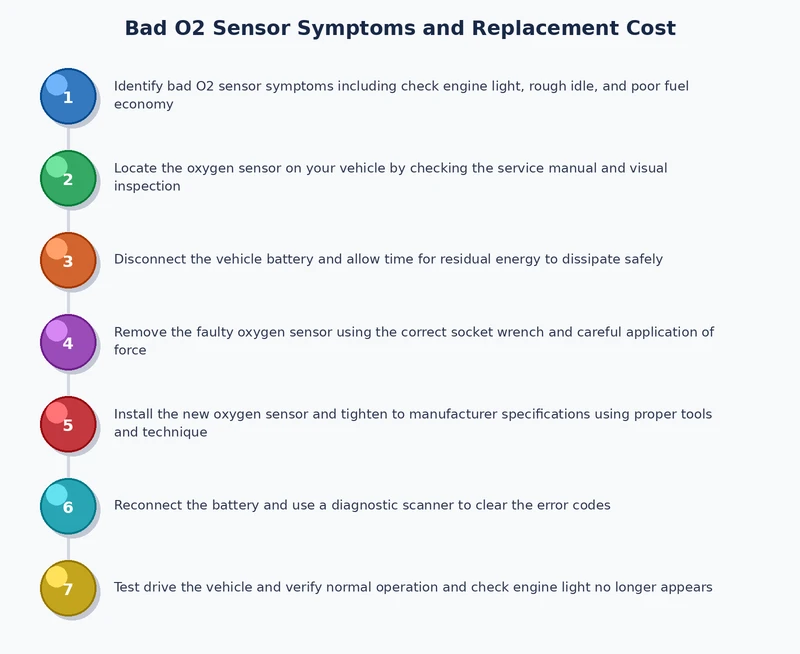
This repair looks simple on paper. Most of the time it is — but a few recurring mistakes consistently turn a $150 job into a multi-stage diagnostic ordeal.
Most vehicles carry two to four O2 sensors. The DTC you pulled tells you exactly which circuit flagged. Bank 1 Sensor 1 is the upstream sensor on the same side as cylinder number one. Bank 1 Sensor 2 is downstream, after the catalytic converter. On V6 and V8 engines, Bank 1 and Bank 2 are on opposite cylinder banks — confirm which side holds cylinder one in your factory service manual before ordering anything.
Replacing all sensors "just to be safe" is a waste of money on a vehicle with a known single failure. Save that logic for a high-mileage vehicle undergoing a full exhaust service where all sensors are near end of life simultaneously. Otherwise, fix what's broken and verify the repair cleared all codes before spending on additional parts.
O2 sensors don't fail in a vacuum. Coolant leaking into the combustion chamber coats the sensor tip with silicate deposits. Oil consumption fouls it with carbon. Running excessively rich from a leaking injector or failed MAP sensor degrades a sensor in under 30,000 miles. If you replace the sensor without addressing the underlying condition, the new sensor fails early — and you're back to diagnosing bad O2 sensor symptoms six months from now.
After installing the replacement, clear the DTCs and drive two complete warm-up cycles. Confirm fuel trims normalize to within plus or minus 5 percent. If they don't, the sensor failure was a symptom, not the root cause. Keep digging into the fuel and ignition systems before calling the job done.
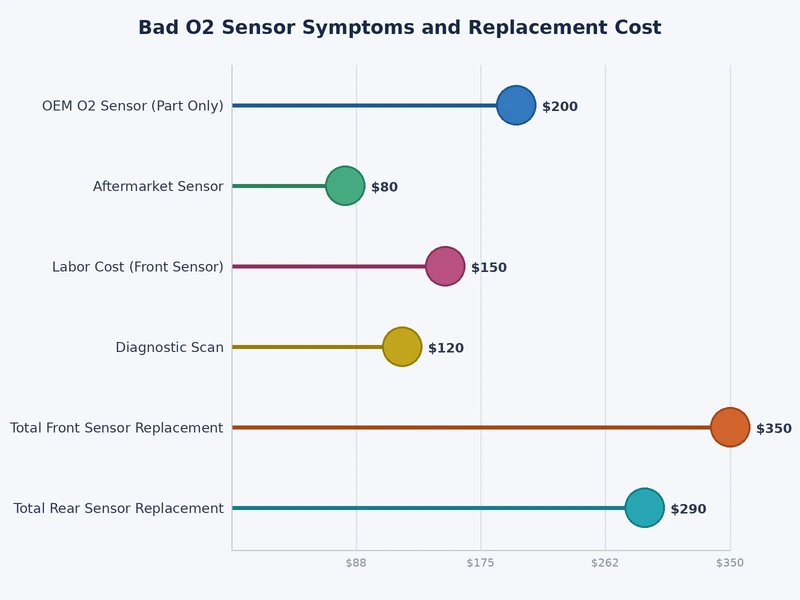
This is one of the more affordable repairs on a modern vehicle — but the cost range is wide depending on sensor location, vehicle platform, and who does the work.
Labor is the biggest variable. An easily accessible upstream sensor on a four-cylinder engine takes 20 minutes with the right socket. A downstream sensor on a V8 with a corroded bung can take two hours and require cutting and re-welding the bung itself. If you're doing this yourself, invest in a dedicated O2 sensor socket — the slotted kind that accommodates the wire harness — and soak the bung in penetrating oil the night before. Attempting to remove a seized sensor with an open-end wrench strips the threads and creates a job that's now beyond a basic DIY repair.
For most mainstream vehicles, a reputable aftermarket sensor from Bosch, Denso, or NGK performs on par with the factory original. These manufacturers supply original equipment to the automakers anyway — you're often getting the same sensor in different packaging at a lower price.
Generic no-name sensors from unknown brands are where the problems start. They read inaccurately, fail faster, and can cause the ECU to make incorrect fuel corrections even after a fresh installation. You end up chasing bad O2 sensor symptoms with a brand-new sensor in place because the sensor itself is reporting bad data. Stick to Bosch, Denso, or NGK. Match the connector type exactly — don't adapt or splice unless there's no alternative. And confirm the wiring harness reaches the new sensor without tension before finalizing the installation.
You can drive for days to a few weeks without the vehicle becoming undriveable. But every mile on a failed upstream sensor puts stress on your catalytic converter. The rich mixture from open-loop operation pumps excess hydrocarbons into the cat, degrading it rapidly. Fix it within a week if at all possible — the sensor repair is cheap, the converter replacement is not.
Indirectly, yes. A severely rich or lean condition caused by a failing O2 sensor washes cylinder walls, fouls spark plugs, and creates incomplete combustion events that register as misfires on your scanner. Those misfire codes are secondary symptoms. Address the O2 sensor first, clear all codes, and recheck. In many cases the misfire codes disappear once proper fuel control is restored.
In most cases, yes — and you'll notice it immediately after the ECU relearns closed-loop fuel control. Fuel trims normalize, combustion efficiency improves, and the engine stops burning excess fuel trying to compensate for bad sensor data. Many drivers see a 10 to 20 percent improvement in MPG after replacing a confirmed failed upstream O2 sensor, especially after extended rich-running periods.
Bad O2 sensor symptoms don't resolve on their own — they compound into more expensive problems the longer you wait. If your scanner is showing voltage anomalies, your fuel economy has slipped, or your check engine light has been on for more than a few days, pull the code today and confirm what you're dealing with. A $60 sensor and an hour of your time now prevents a $1,000 catalytic converter replacement later — and that's a trade worth making every time.
 |
 |
 |
 |

About Sarah Whitfield
Sarah Whitfield is a diagnostics and troubleshooting specialist who spent ten years as an ASE-certified technician before joining the editorial team. She specializes in OBD-II analysis, electrical gremlins, and the kind of intermittent problems that make most owners give up.
Get some FREE car parts & gear.. Or check out the latest free automotive manuals and build guides here.
Disable your ad blocker to unlock all the hidden deals. Hit the button below 🚗
| | | |
