by Sarah Whitfield
Studies show that worn spark plugs can reduce fuel efficiency by up to 30%, yet most drivers overlook bad spark plug symptoms until the engine's performance has deteriorated far beyond what a simple plug swap can quietly fix. These small ceramic-and-metal components fire thousands of times per minute under extreme heat and pressure, and when they begin to fail, the ripple effects touch nearly every aspect of how an engine runs. Recognizing the warning signs early separates a $20–$80 plug replacement from a multi-hundred-dollar repair bill covering damaged catalytic converters, burnt ignition coils, or fouled fuel injectors.
Spark plug degradation is gradual. Carbon deposits accumulate on the insulator nose, electrode gaps widen beyond specification, and ceramic insulators develop micro-cracks under years of thermal cycling. The symptoms surface slowly, which makes them easy to rationalize away as minor quirks. Those quirks are the engine communicating a worsening condition that compounds with every mile driven.
Contents
Engines communicate distress in patterns, and bad spark plug symptoms follow a recognizable sequence. The signs rarely announce themselves all at once — they layer in over weeks or months, each one slightly worse than the last. Learning to recognize the earliest indicators prevents a maintenance task from becoming a mechanical crisis.
A misfire occurs when a spark plug fails to ignite the air-fuel mixture inside its cylinder. The engine stumbles, vibrates unevenly, and the check engine light typically illuminates with codes between P0300 and P0312 — each code pointing to a specific misfiring cylinder. Rough idle is the most immediate and unmistakable symptom. Sitting at a stoplight, the vehicle shakes with an irregular, choppy rhythm that healthy engines simply do not produce. Modern OBD-II systems log misfire counts per cylinder in real time, which makes identifying the offending plug a direct process rather than a guessing game.
Drivers who notice rough running alongside an illuminated dashboard warning should review what the check gauges light means in combination with other fault indicators. Misfires rarely travel alone — they tend to trigger secondary warnings as the engine management system responds to combustion anomalies.
A single misfiring cylinder dumps raw, unburned fuel directly into the exhaust stream — that concentrated hydrocarbon load can overheat and permanently destroy a catalytic converter within just a few hundred miles of continued driving.
Worn plugs produce weak or inconsistent sparks, leaving fuel partially combusted in the cylinder. The practical result is an engine that hesitates under throttle, struggles to maintain highway speed, and delivers a flat, unresponsive feeling when accelerating from a stop. Many drivers describe it as pushing through mud. This power loss is measurable — spark plugs are responsible for the controlled combustion event that converts chemical energy into mechanical force, and degraded plugs compromise that conversion at every stroke of every cylinder.
A vehicle that won't rev past a certain RPM under load often traces back to ignition components before any other system. When the combustion event is weak or mistimed, the engine management system limits output to protect itself, and rev ceilings appear that were never there before.
Fuel economy drops measurably when combustion is incomplete. A sudden drop in fuel economy — even 10 to 15 percent — is an objective signal that the combustion cycle has been compromised. Tracking consumption over several fill-ups provides hard data to confirm the trend before it deepens into something costlier.
Cold-start problems are a hallmark of severely worn spark plugs. A fouled or over-gapped plug struggles to generate the high-voltage arc needed to ignite a cold, dense air-fuel mixture. The engine cranks longer than normal, fires with a rough cough, and in some cases refuses to start without several attempts. A car that stalls when slowing down or decelerating can share the same root cause — plugs too degraded to sustain combustion at the low RPM and minimal throttle inputs that deceleration demands.
Backfiring is a more severe symptom that appears as plug condition worsens. When unburned fuel ignites in the exhaust manifold rather than inside the cylinder, the result is a sharp pop or bang from the tailpipe. A thorough look at car backfiring causes consistently places ignition failure — including spark plug breakdown — among the primary triggers alongside timing faults and air-fuel mixture issues.
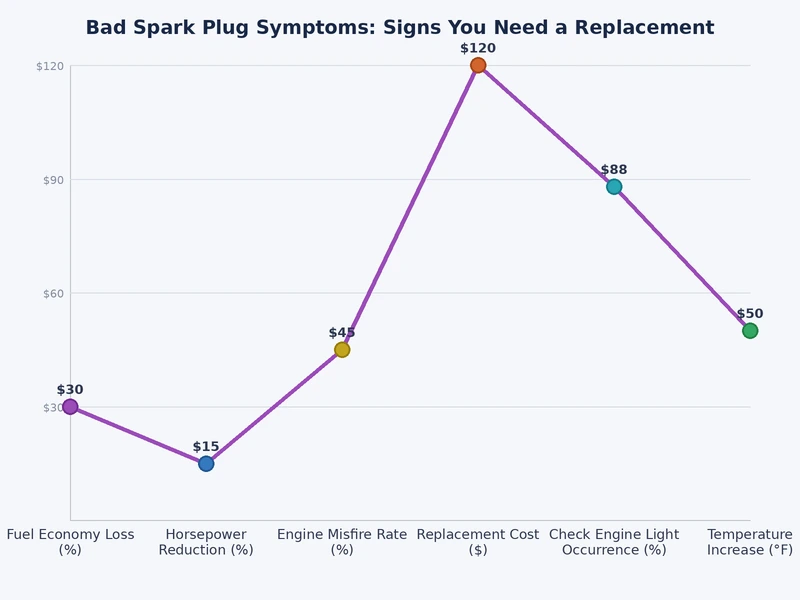
The economics of spark plug maintenance are straightforward: timely replacement costs almost nothing relative to the cascading damage that deferred maintenance creates. Every mile driven on failing plugs narrows the gap between a quick parts purchase and a repair order with multiple line items.
| Plug Type | Cost Per Plug | Typical Lifespan | DIY Labor | Shop Labor (4-cyl) |
|---|---|---|---|---|
| Copper | $2–$8 | 20,000–30,000 mi | 45–90 min | $60–$120 |
| Platinum | $8–$20 | 60,000–80,000 mi | 45–90 min | $80–$150 |
| Iridium | $15–$35 | 100,000–120,000 mi | 45–90 min | $80–$180 |
| Double Platinum | $12–$28 | 80,000–100,000 mi | 45–90 min | $80–$160 |
For a four-cylinder engine, a complete DIY iridium plug replacement runs $60–$140 in parts. A shop adds $80–$180 in labor. Compare that figure to a catalytic converter replacement — typically $800–$2,500 depending on vehicle and part origin — and the financial logic of addressing bad spark plug symptoms early becomes impossible to argue against.
Misfiring cylinders send raw, unburned hydrocarbons through the exhaust. The catalytic converter, designed to process fully combusted gases, overheats rapidly under this fuel load and can fail permanently after sustained misfire events. Ignition coils work harder to compensate for degraded plug resistance and burn out prematurely — coil replacements run $60–$200 each, plus labor. Oxygen sensors generate false readings from incomplete combustion, producing secondary fault codes that complicate diagnosis and may trigger unnecessary parts replacement.
Engines experiencing prolonged ignition failure often develop surging behavior as the ECU hunts for a stable fuel trim. Drivers dealing with engine surging at idle may be observing the downstream effects of plug neglect rather than a primary fuel system fault. A reduced engine power warning appearing alongside rough running signals that the engine management system has already detected combustion faults serious enough to limit output — at that point, multiple systems are compromised simultaneously.
Proper diagnosis before reaching for a wrench prevents unnecessary parts replacement. A methodical approach — electronic diagnostics first, visual inspection second — narrows the fault efficiently and builds confidence before committing to a repair.
An OBD-II scanner is the starting point for any serious ignition diagnosis. Entry-level models read and clear fault codes for under $30; professional-grade scanners display live misfire counts per cylinder in real time. Armed with a cylinder-specific misfire code, locating the offending plug is direct work. A digital multimeter measures ignition coil primary and secondary resistance — coil failure mimics plug failure closely and is worth ruling out before replacing perfectly serviceable plugs. A bore scope or compact inspection camera allows a mechanic to visually assess plug condition through the boot opening on engines with deep-set or coil-on-plug configurations, potentially saving the time of a full removal just to confirm suspicion.
The replacement itself requires a spark plug socket — typically 5/8" or 13/16" depending on plug size — a torque wrench, a ratchet, and an extension bar long enough to reach recessed plug wells. Anti-seize compound applied to plug threads prevents bonding to aluminum heads, which at high torque can strip threads and convert a $30 job into a helicoil repair costing several hundred dollars. Dielectric grease applied inside the coil boot seals the connection from moisture and simplifies future removal. A gap tool — either a wire feeler gauge or a stepped coin-type gauge — confirms the gap matches the OEM specification before installation.
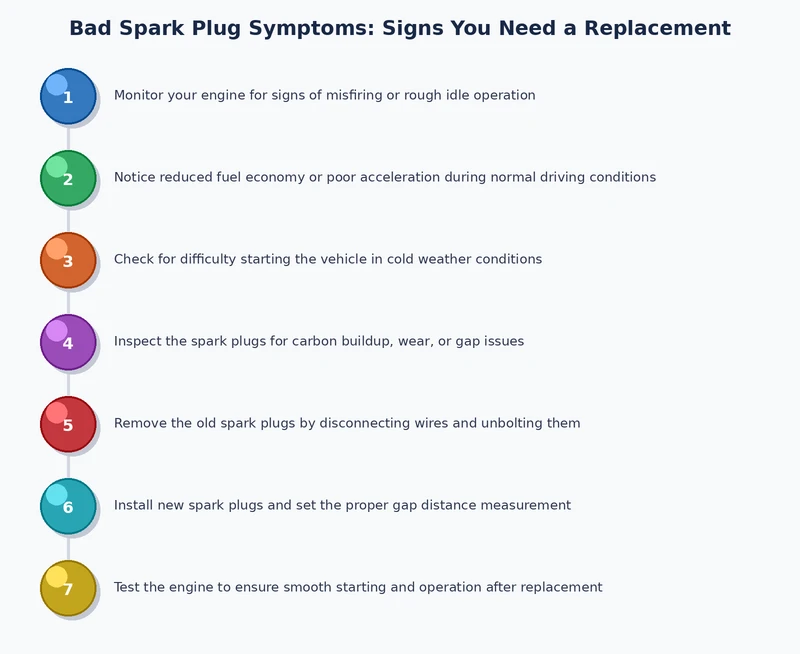
A DIY spark plug replacement is well within reach for any driver with basic mechanical confidence and the right tools. The process is consistent across most naturally aspirated engines, though turbocharged and direct-injection applications may involve tighter clearances and higher torque specifications that warrant a service manual review first.
Allow the engine to cool completely before beginning — a minimum of 30 minutes after shutdown, longer after hard driving. Hot aluminum threads strip under far less force than cold ones, and burned hands on a hot exhaust manifold are an entirely avoidable complication. Gather all tools and the correct replacement plugs — confirmed against the vehicle's VIN or OEM part number — before removing anything. Replacing all plugs as a complete set is best practice. Mixing old and new plugs creates uneven combustion events across cylinders and can recreate the rough running symptoms that triggered the job in the first place.
Working one cylinder at a time prevents mixing up coil-on-plug connectors or ignition leads. Disconnect the coil or wire, remove the old plug, and immediately inspect the electrode and insulator nose before setting it aside. Heavy black carbon buildup indicates rich running or oil fouling. White, blistered, or eroded ceramic points to lean conditions or sustained overheating. A plug at the end of normal service life shows a light gray or tan deposit with a visible but moderate electrode wear pattern.
After completing the installation, reconnect all coils, clear any stored fault codes with the OBD-II scanner, and run the engine for five minutes at idle. A smooth idle with no misfires and no returning fault codes confirms a successful replacement. If rough running persists after fresh plugs, the diagnosis shifts to ignition coils, fuel injectors, or a compression test to evaluate ring and valve sealing.
Copper plugs typically need replacement every 20,000–30,000 miles. Platinum plugs last 60,000–80,000 miles, and iridium plugs are rated for 100,000–120,000 miles. The vehicle's owner's manual specifies the correct interval based on the factory-installed plug type and engine design.
Yes, but at a cost. A misfiring cylinder forces the remaining cylinders to compensate, increasing wear across the entire engine, spiking fuel consumption, and pushing unburned hydrocarbons into the exhaust where they can destroy the catalytic converter. Continued driving with a confirmed bad plug accelerates costly secondary damage that far exceeds the cost of the plug itself.
A failing plug typically shows heavy black carbon buildup on the insulator nose from rich running or oil fouling, white or blistered ceramic from lean conditions or overheating, a cracked insulator, or an electrode gap visibly wider than the OEM specification. Any of these conditions warrant immediate replacement rather than cleaning and reinstallation.
New plugs restore the combustion efficiency the engine was engineered to deliver. Most drivers notice sharper throttle response, a smoother idle, improved cold starts, and measurably better fuel economy after replacing a worn set — especially on vehicles that have exceeded the manufacturer's recommended replacement interval.
For most naturally aspirated four- and six-cylinder engines, yes. The job requires basic hand tools, a torque wrench, and approximately 45–90 minutes. Turbocharged engines, V8s with deep plug wells, and direct-injection applications can be more involved due to clearance constraints and precise torque requirements. When access is limited or confidence is low, a professional shop handles the replacement at relatively modest cost given the part and labor involved.
Spark plugs cost almost nothing to replace on schedule — the damage from ignoring them costs everything.
 |
 |
 |
 |

About Sarah Whitfield
Sarah Whitfield is a diagnostics and troubleshooting specialist who spent ten years as an ASE-certified technician before joining the editorial team. She specializes in OBD-II analysis, electrical gremlins, and the kind of intermittent problems that make most owners give up.
Get some FREE car parts & gear.. Or check out the latest free automotive manuals and build guides here.
Disable your ad blocker to unlock all the hidden deals. Hit the button below 🚗
| | | |
