Bad Strut Mount Symptoms and Replacement Cost

by Sarah Whitfield

Is that persistent clunking sound from the front of the vehicle a minor inconvenience, or is the suspension system sending a serious warning? Bad strut mount symptoms often begin as barely noticeable vibrations and odd noises, yet they signal a deteriorating component that degrades ride quality, steering precision, and tire longevity if left unresolved. Our team has compiled this comprehensive guide — drawing on extensive hands-on troubleshooting experience — to help anyone identify, diagnose, and resolve strut mount problems before they compound into costlier repairs.

The strut mount (also called a top mount or strut bearing plate) is a rubber-and-metal assembly that connects the top of the strut to the vehicle's chassis. It absorbs road shock, permits controlled rotation during steering, and isolates vibration from the cabin. When the rubber degrades or the bearing seizes, the entire suspension system suffers, and the symptoms become impossible to ignore.
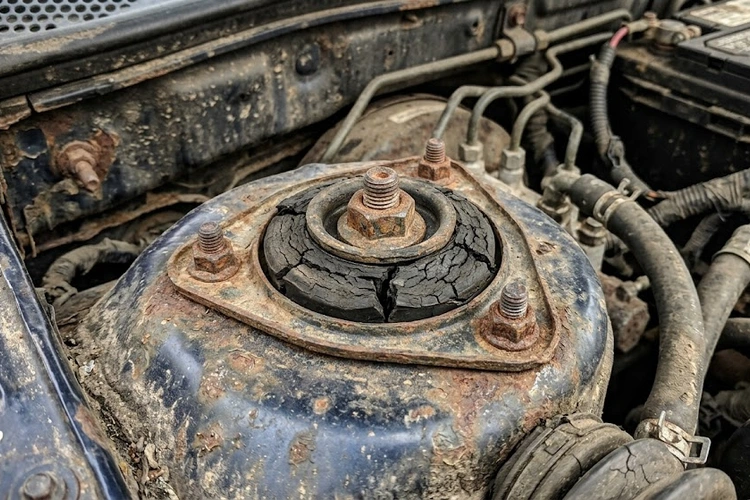
Worn strut mount showing rubber degradation and bearing wear consistent with bad strut mount symptoms
Figure 1 — A worn strut mount displaying typical rubber deterioration and bearing damage that produces clunking, creaking, and steering instability.
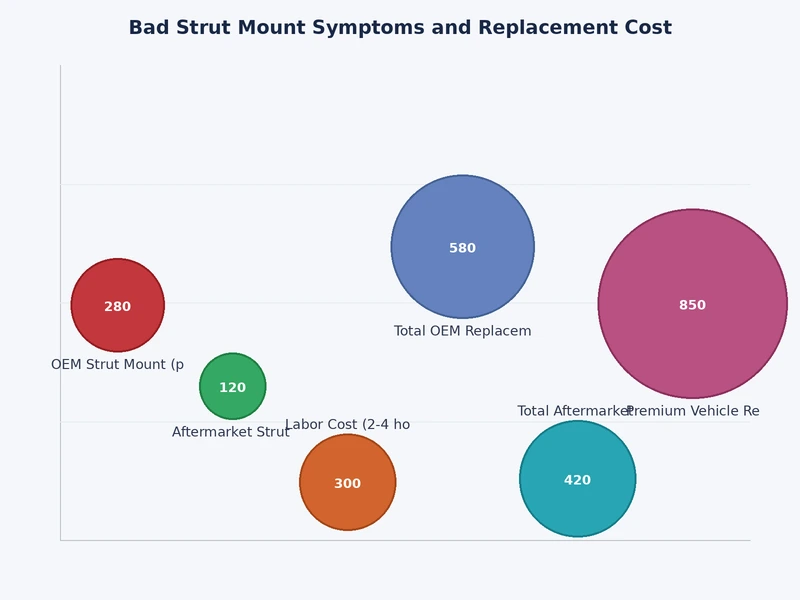
Bar chart comparing bad strut mount symptoms by reported frequency and severity across vehicle types
Figure 2 — Frequency and severity comparison of the most common bad strut mount symptoms reported across popular vehicle makes and model years.

What a Strut Mount Does and Why It Wears Out

The Role of the Strut Mount in the Suspension System

According to Wikipedia's overview of the MacPherson strut — the most common strut design in modern passenger vehicles — the strut mount is positioned at the very top of the strut assembly, where it bears the full vertical load of the vehicle's weight and all dynamic forces generated during cornering, braking, and acceleration. It performs three distinct functions simultaneously within the suspension system:

  • Structural anchoring: The mount fastens the strut assembly firmly to the chassis tower, preventing unwanted lateral movement of the entire strut under load.
  • Rotational bearing: An internal bearing plate allows the strut to rotate freely when the steering wheel is turned, without transmitting torsional stress directly into the chassis metal.
  • Vibration isolation: A vulcanized rubber bushing (a flexible ring of specially formulated rubber compound) absorbs road shock and blocks metal-to-metal contact, keeping the cabin quiet and the ride smooth.

Common Causes of Premature Wear

Strut mounts do not fail without cause. Several specific factors accelerate degradation well beyond the normal service lifespan:

  • Age and mileage: Rubber compounds harden and crack after prolonged exposure to heat, cold, and ozone — typically after 75,000 to 150,000 miles of service life.
  • Rough road conditions: Frequent driving on potholed or unpaved surfaces places repeated high-impact loads on the mount, tearing and compressing the rubber bushing at an accelerated rate.
  • Fluid contamination: Oil leaks from the engine or power steering rack can chemically attack the rubber bushing and cause it to soften and separate well before its expected service interval.
  • Bearing corrosion: In regions where road salt is used during winter, the steel bearing plate corrodes and loses smooth rotation, producing binding and grinding during steering maneuvers that further accelerate wear.

Pro Insight: Our team recommends inspecting strut mounts every time struts or shock absorbers are replaced — the labor overlap makes it highly cost-effective to address both components within a single service visit rather than returning within a year for a separate mount replacement.

Recognizing Bad Strut Mount Symptoms on the Road

Noise-Based Symptoms

Noise is almost always the first indication that a strut mount is deteriorating. The specific character of each sound provides diagnostic clues about which internal element is failing first:

  • Clunking or thudding over bumps: A hollow, repetitive clunk when crossing speed bumps or rough pavement indicates that the rubber bushing has torn or separated, allowing metal components to knock against each other at the top of each suspension stroke.
  • Creaking or squeaking during steering: A dry, rhythmic creak that appears when turning the steering wheel at low speeds — particularly in parking lots or driveways — points to a dry or corroded bearing plate within the mount assembly.
  • Metallic rattling over rough pavement: A loose, rapid rattle distinct from the lower clunking sound can indicate that the top nut securing the strut rod to the mount has loosened as the rubber compresses unevenly over time.

Similar noise patterns appear in other suspension and body components, so our team recommends cross-referencing these sounds with our analysis of what causes unusual noises while driving to rule out competing diagnoses before proceeding with strut mount work.

Handling and Stability Symptoms

As strut mount deterioration advances, steering response and vehicle dynamics degrade in measurable ways that extend well beyond noise alone:

  • Steering wander or drift: The vehicle drifts to one side without deliberate steering input, because a failed mount allows the strut to shift its resting position, disturbing the alignment geometry and caster angle.
  • Vibration through the steering wheel: Road vibrations that the rubber bushing once absorbed now travel directly through the strut rod into the steering column and wheel rim, especially at highway speeds.
  • Increased body roll in corners: When the mount loses its ability to hold the strut firmly in place, the chassis moves more freely relative to the wheel during cornering, increasing lean and reducing driver confidence.
  • Shuddering during acceleration: In front-wheel-drive vehicles especially, a failing front strut mount amplifies driveline vibrations through the chassis. Our team has documented this pattern in detail in our guide on why a car shakes when put in drive.

Warning: Ignoring handling deterioration caused by bad strut mount symptoms is particularly dangerous in emergency avoidance situations, where precise and immediate steering response is critical to preventing a collision.

Visual and Physical Indicators

A visual inspection of the strut tower area — accessible from under the hood on most front-strut vehicles — can confirm what the road symptoms suggest:

  • Visible cracks, tears, or complete separation in the rubber bushing surrounding the mount body
  • Heavy rust streaking or surface corrosion across the bearing plate and its retaining hardware
  • The strut rod sitting visibly off-center within the mount's rubber boot, indicating structural collapse
  • Cupped or uneven tire wear patterns — a direct consequence of alignment shifts caused by mount failure, and a pattern our team also documents in our coverage of why tires wear unevenly

How to Diagnose a Failing Strut Mount

Step-by-Step Inspection Process

Our team follows this structured diagnostic sequence when investigating bad strut mount symptoms on any vehicle platform:

  1. Controlled road test: Drive over a known speed bump or rough surface at low speed with the windows fully down, isolating any clunking or creaking sounds to a specific corner of the vehicle.
  2. Static bounce test: With the vehicle parked on level ground, press firmly down on each corner and release sharply. A single controlled rebound is normal; continued oscillation or a clunk at the top of the rebound stroke indicates a worn mount or shock absorber.
  3. Under-hood rubber inspection: Open the hood and locate the strut tower caps — the circular metal covers at the top of each front wheel well. Inspect the rubber bushing around each mount for cracking, hardening, compression set, or visible separation.
  4. Steering sweep test: With the vehicle parked and running, slowly rotate the steering wheel from full lock to full lock while a second person rests a hand lightly on the strut tower. Any grinding, clicking, or binding felt through the metal confirms bearing plate failure within the mount.
  5. Elevated inspection: With the vehicle safely raised on jack stands, inspect each strut mount from below for rust staining on the bearing plate and confirm that the strut rod remains plumb and centered within the mount housing.

Our team also recommends inspecting the brake hardware during this process, because brake system issues can mimic suspension noises in ways that complicate diagnosis. The guide on brake booster failure symptoms covers several overlapping noise patterns worth eliminating before attributing the issue to the strut mount.

Symptom Comparison by Severity

Symptom Likely Failure Stage Urgency Level Related Component to Inspect
Mild clunk over bumps Early rubber cracking Low — monitor closely Strut shock absorber body
Creaking on steering input Bearing plate drying or corroding Medium — schedule inspection Tie rod ends, ball joints
Steering wander or pull Rubber bushing separation High — inspect immediately Wheel alignment, wheel bearing
Strong vibration through steering wheel Full mount collapse or bearing seizure Urgent — do not delay Complete strut assembly, CV axle
Uneven or cupped tire wear Advanced alignment shift from failed mount High — alignment required Alignment angles, tire rotation schedule
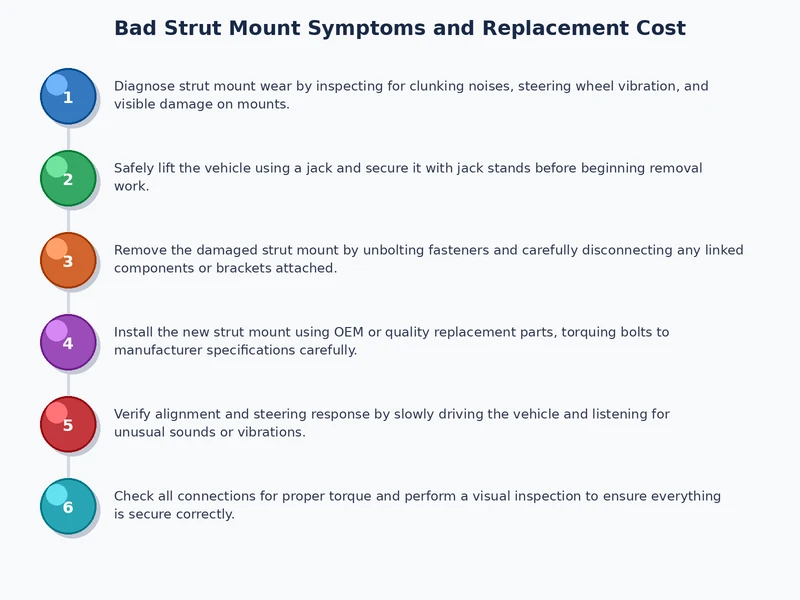
Step-by-step process diagram for diagnosing bad strut mount symptoms using bounce test and steering sweep
Figure 3 — A step-by-step visual overview of the strut mount diagnostic process, from road testing through the steering sweep and elevated physical inspection.

Replacement Costs and What the Repair Involves

Average Cost Breakdown

Strut mount replacement costs vary based on the vehicle make, whether the entire strut assembly is replaced simultaneously, and labor rates within the region. Our team has compiled representative cost ranges based on current repair data across independent shops and dealership service centers:

  • Mount only (parts): $25–$90 per corner for quality aftermarket units; $60–$180 per corner for OEM-specification parts.
  • Labor: $80–$160 per corner at an independent shop; $120–$250 per corner at a dealership service center.
  • Complete strut assembly replacement: $250–$500 per corner, parts and labor combined, when the strut itself is replaced alongside the mount in a single operation.
  • Four-wheel alignment (required after any strut work): $75–$125, and our team considers it non-negotiable for restoring proper handling geometry and preventing accelerated tire wear.

The total cost for a single strut mount replacement — mount, labor, and alignment — typically falls between $200 and $450 per corner. Replacing both front mounts together, which is the most common scenario, ranges from $350 to $850 depending on the vehicle and repair facility chosen.

Cost-Saving Tip: Our team consistently finds that replacing strut mounts in axle pairs — both fronts or both rears in the same visit — reduces total labor cost by 30 to 40 percent compared to addressing each side separately on two different service appointments.

OEM Versus Aftermarket Options

The choice between original equipment manufacturer (OEM) parts and aftermarket alternatives involves trade-offs that our team evaluates carefully based on the vehicle's age, mileage, and intended use:

  • OEM mounts: Manufactured to the exact specification of the original part, OEM mounts deliver a precise fit and rubber compound quality that matches the factory ride characteristics. They cost 40 to 80 percent more than quality aftermarket equivalents, but they offer the most predictable service life.
  • Aftermarket mounts: Quality varies significantly across brands. Reputable manufacturers such as Monroe, KYB, and Moog produce strut mounts that meet or exceed OEM specifications at a lower cost, while lower-tier brands often use inferior rubber that fails prematurely under repeated high-load conditions.
  • Complete quick-strut assemblies: Pre-assembled units that combine the mount, coil spring, and shock absorber into one component eliminate the need for a spring compressor tool during installation, reduce labor time substantially, and are often the most cost-effective solution on vehicles past 100,000 miles.

For vehicles with fewer than 80,000 miles and healthy strut absorbers, our team generally recommends a quality aftermarket mount alongside the existing hardware. For higher-mileage vehicles, complete strut assembly replacement prevents a return visit within a short window. The same cost-versus-longevity framework applies when evaluating related suspension and brake components — a discipline our team also applies when reviewing bad wheel cylinder symptoms and replacement costs.

Frequently Asked Questions

How long does a strut mount typically last before it needs replacement?

Most strut mounts last between 75,000 and 150,000 miles under normal driving conditions. Our team observes that vehicles operated in regions with heavy road salt use or regularly driven on rough or unpaved roads often require replacement significantly earlier, sometimes as early as 50,000 miles due to accelerated rubber and bearing degradation.

Can a vehicle be driven safely with a confirmed strut mount failure?

Our team strongly advises against extended driving once a strut mount failure is confirmed. While a short, slow trip to a repair facility is generally manageable, a fully collapsed mount can produce sudden shifts in steering geometry that compromise vehicle control — particularly during emergency maneuvers or at highway speeds where reaction time is minimal.

Will a bad strut mount cause a vehicle to fail a safety inspection?

In most jurisdictions, a severely deteriorated strut mount — particularly one exhibiting visible rubber separation or a seized bearing that causes binding during the steering sweep test — will result in a failed safety inspection, as examiners classify it as a direct safety defect affecting both steering response and suspension integrity.

Key Takeaways

  • Bad strut mount symptoms — clunking over bumps, creaking during low-speed steering, wander, and uneven tire wear — are early warnings of a component failure that worsens rapidly if left unaddressed.
  • A structured diagnostic approach using the static bounce test, under-hood rubber inspection, and steering sweep test identifies strut mount failure with high confidence before secondary damage to tires and alignment occurs.
  • Replacement costs typically range from $200 to $450 per corner including a mandatory alignment, and replacing both sides on the same axle simultaneously reduces total labor cost by 30 to 40 percent.
  • Selecting quality aftermarket or OEM mounts and always performing a post-installation wheel alignment ensures the repair fully restores safe handling and protects tire longevity over the long term.

About Sarah Whitfield

Sarah Whitfield is a diagnostics and troubleshooting specialist who spent ten years as an ASE-certified technician before joining the editorial team. She specializes in OBD-II analysis, electrical gremlins, and the kind of intermittent problems that make most owners give up.

Get some FREE car parts & gear.. Or check out the latest free automotive manuals and build guides here.

Disable your ad blocker to unlock all the hidden deals. Hit the button below 🚗