by Sarah Whitfield
Last spring, our team spent three days chasing a clunking noise on a 2015 Honda CR-V. We replaced the sway bar links, checked the ball joints, even pulled the axle shaft. The culprit was a single blown rear strut we'd walked right past. Bad strut symptoms can be subtle early on — and surprisingly easy to confuse with other suspension problems.
Struts are structural suspension components that combine a spring and shock absorber into one unit. They support the vehicle's weight, control body movement, and keep tires in firm contact with the road. When they wear out, the effects show up in braking, steering, and tire life all at once. Our team has diagnosed hundreds of strut failures across a wide range of vehicles. This guide covers the 7 most reliable bad strut symptoms, how to separate strut failure from look-alike problems, and what our team does before any strut goes on the lift. It's part of our ongoing suspension and car care guide series at CarCareTotal.
Contents
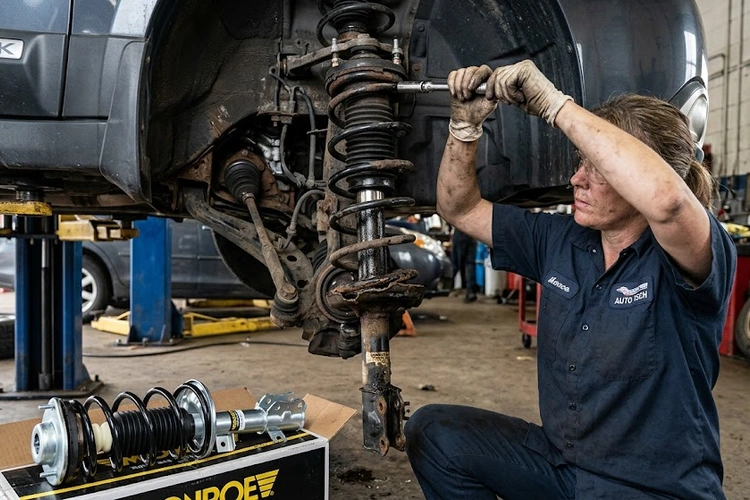
Many drivers use "struts" and "shock absorbers" as if they mean the same thing. They don't.
That structural role is what makes strut failure more serious than a worn shock. Struts carry real load. A failed strut doesn't just hurt ride quality — it affects steering geometry, alignment, and braking balance simultaneously.
Several other suspension parts produce symptoms nearly identical to strut failure. Our team always rules these out before condemning the struts:
Misdiagnosis is the most expensive mistake in suspension work. Spending an hour eliminating other causes before touching the struts saves real money — and avoids the frustration of replacing parts that weren't the problem.
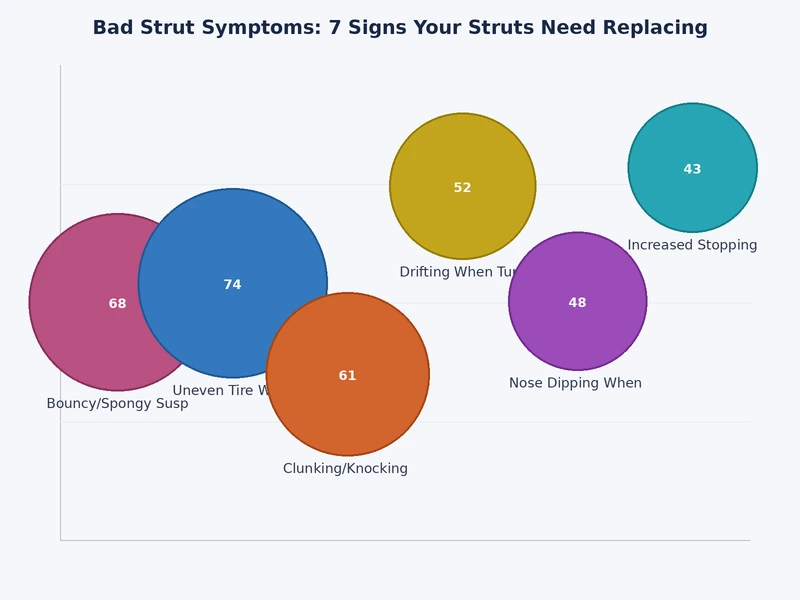
This is the most common complaint our team hears. A healthy strut dampens each suspension movement — the body rises once and settles immediately. A worn strut has lost its damping ability. The vehicle bounces two or three times over each bump before the body settles, like a boat on choppy water.
The problem compounds gradually. Most drivers adjust to a slightly rougher ride week by week and don't realize how far from normal things have drifted until the bounce test makes it obvious.
Worn front struts can't resist the forward weight transfer that happens during hard braking. The nose dips sharply. That pitch shifts almost all braking load to the front tires, reduces rear-wheel braking effectiveness, and stretches stopping distances. Our team has measured stopping distance increases of 10–20% on vehicles with significantly worn front struts.
This is a safety-critical symptom — not a comfort issue. It warrants immediate attention.
Struts keep tires pressed flat and evenly against the road. A worn strut allows the tire to bounce slightly with each rotation instead of maintaining consistent contact. That micro-bounce creates a wear pattern called cupping (also called scalloping) — alternating high and low spots across the tread face.
Cupped tires also generate a rhythmic droning hum at highway speeds that most drivers misdiagnose as a failing wheel bearing. Running a hand across the tread reveals the wave pattern immediately. Installing new tires without replacing the struts produces the same cupping within 10,000 miles.
A worn strut mount — the bearing assembly at the top of the strut that connects to the chassis — produces a distinct clunk when turning the steering wheel at low speed. The noise worsens on cold mornings as the dried-out bearing stiffens. Some mounts fail so completely that a grinding sensation is felt through the steering wheel during turns.
Our guide on grinding noise when turning lists worn strut mounts as one of the primary causes — a fact that surprises many drivers who assume the noise comes from the drivetrain. A strut body that has completely bottomed out also produces a single loud thud over large bumps, as the suspension hits its hard stop with nothing left to cushion the impact.
Because front struts act as the steering pivot point, worn struts directly affect steering precision. The most common steering-related bad strut symptoms our team sees:
If the steering also feels stiff or heavy, that often points to a separate issue in the power steering system. Our guide on why steering feels heavy covers those causes in full. With strut wear, the steering typically feels loose and imprecise rather than stiff.
Struts contain hydraulic fluid that creates the damping force. When the internal piston seal fails, that fluid escapes and becomes visible as an oily film or dark streak running down the outside of the strut body. This is one of the most definitive bad strut symptoms our team finds during inspection.
Healthy struts resist the lateral lean that happens during cornering. Worn struts allow the vehicle body to tip excessively into turns, which shifts weight off the inside tires and reduces grip at the contact patch. The vehicle feels unstable and unpredictable through curves — especially at freeway ramp speeds.
This symptom often pairs with the handling issues covered in our guide on why cars shake when turning. When both appear together, a full suspension inspection makes more sense than chasing a single component.
| Symptom | Typical Location | Safety Risk | Urgency |
|---|---|---|---|
| Bouncy or rough ride | Any corner | Moderate | Address soon |
| Nose-dive under braking | Front struts | High | Immediate |
| Cupped tire wear | Any corner | Moderate | Address soon |
| Clunking or knocking | Strut mount | Moderate | Address soon |
| Steering instability | Front struts | High | Immediate |
| Fluid leak on strut body | Any corner | High | Immediate |
| Excessive body roll | Front and rear | High | Address soon |
These findings confirm strut failure specifically — not a different part producing a similar symptom:
Our team always works through this list before pricing out a strut replacement:
The practical rule: if the bounce test passes and there's no visible leak on the strut body, investigate these components first. Struts are not the cheapest place to start guessing.
The bounce test is the fastest field check for strut condition. No tools or lift required — anyone can run it in a parking lot.
Our team runs this test on all four corners in sequence. A single failed corner stands out clearly compared to the others. Testing front-to-rear also reveals whether one axle is significantly worse than the other, which helps prioritize replacement timing.
After the bounce test, a visual check under the vehicle confirms what the test suggested. Equipment needed: floor jack, two jack stands, a flashlight.
Replacing struts requires a spring compressor to safely separate the coil spring from the strut body. That tool stores significant mechanical energy and causes serious injury when misused. Most home mechanics are better off leaving the swap itself to a qualified shop once the diagnosis is confirmed.
Worn struts also affect fuel economy in a way most drivers never connect. Increased suspension movement raises rolling resistance and aerodynamic drag at highway speeds. Our analysis of sudden fuel economy drops consistently includes suspension wear as an overlooked contributor — particularly on high-mileage vehicles that have never had strut service.
Most struts last between 50,000 and 100,000 miles. NHTSA vehicle inspection data shows that suspension component condition varies significantly based on real-world use patterns. The biggest factors in strut lifespan:
Highway commuters on smooth pavement regularly reach the high end of that mileage range without issues. Urban drivers navigating deteriorated city streets frequently see strut failure before 60,000 miles. Both groups benefit from starting visual inspections at 50,000 miles rather than waiting for symptoms to appear.
Struts are sealed units — there's no fluid to top up or internal filter to replace. But the right habits slow wear considerably:
Catching bad strut symptoms early prevents expensive secondary damage. A failed front strut pushes abnormal stress onto the tie rods, ball joints, and wheel bearings with every mile driven. A strut replacement addressed early stays a straightforward repair. Left for another 20,000 miles, it often becomes a full front-end rebuild that costs three times as much.
Most struts last between 50,000 and 100,000 miles. Real-world lifespan depends heavily on road conditions, load habits, climate, and driving style. Vehicles driven primarily on rough urban roads often see strut failure before 60,000 miles, while highway commuters on smooth pavement regularly reach the upper end of that range without issues.
Yes — and this is the most safety-critical consequence of worn front struts. Failed struts allow the nose of the vehicle to pitch sharply during hard braking, shifting nearly all braking load to the front tires and reducing rear-wheel braking contribution. Our team has measured stopping distance increases of 10–20% on vehicles with significantly worn front struts.
Bad struts cause a specific tire wear pattern called cupping or scalloping — a series of high and low spots across the tread face. This happens because a worn strut allows the tire to bounce slightly with each rotation instead of maintaining consistent road contact. Installing new tires on a vehicle with bad struts produces the same cupping within 10,000 miles.
Our team always replaces struts in axle pairs — both front or both rear at the same time. Replacing only one side creates an imbalance in damping across the axle, which affects handling stability, braking balance, and tire wear. The cost difference between replacing one and two struts is minor compared to the handling benefit of a balanced axle.
Most shops charge between $250 and $450 per strut, including parts and labor. A complete front axle replacement covering both struts typically runs $500–$900 depending on the vehicle and whether strut mounts and bump stops are replaced at the same time. Delaying replacement increases the total repair cost by causing accelerated wear on tie rods, ball joints, and wheel bearings.
Yes, in two distinct ways. First, cupped tires caused by worn struts generate a rhythmic drumming vibration that increases with speed and transmits through the chassis and wheel. Second, a failed strut mount bearing can produce grinding sensations felt directly through the steering wheel during turns. Both symptoms are worth investigating rather than dismissing as normal road feedback.
Driving on mildly worn struts for a short period before repair is possible, but symptoms like visible fluid leaking from the strut body, nose-dive during braking, or steering instability represent genuine safety risks that warrant prompt attention. Our team recommends scheduling an inspection as soon as two or more bad strut symptoms appear at the same time rather than waiting for the situation to worsen.
Struts fail gradually and quietly — but the moment they matter most is the one where braking distance determines what happens next.
 |
 |
 |
 |

About Sarah Whitfield
Sarah Whitfield is a diagnostics and troubleshooting specialist who spent ten years as an ASE-certified technician before joining the editorial team. She specializes in OBD-II analysis, electrical gremlins, and the kind of intermittent problems that make most owners give up.
Get some FREE car parts & gear.. Or check out the latest free automotive manuals and build guides here.
Disable your ad blocker to unlock all the hidden deals. Hit the button below 🚗
| | | |
