by Sarah Whitfield
A faulty thermostat is identified as the primary cause in roughly 40 percent of all engine overheating incidents diagnosed by ASE-certified technicians. That single component — a wax-pellet valve smaller than your fist — governs the entire thermal management of your engine. When it fails, the consequences escalate from reduced efficiency to catastrophic head gasket failure within miles.
Recognizing bad thermostat symptoms early is one of the most cost-effective decisions you will make as a vehicle owner. The thermostat regulates coolant flow between the engine block and radiator, maintaining the narrow operating temperature band your ECU depends on for fuel trim, ignition timing, and emissions compliance. If your temperature gauge behaves erratically, your heater underperforms, or your fuel economy has dropped without explanation, the thermostat demands immediate attention. For a comprehensive look at all conditions that trigger engine overheating, consult our guide on car overheating causes.
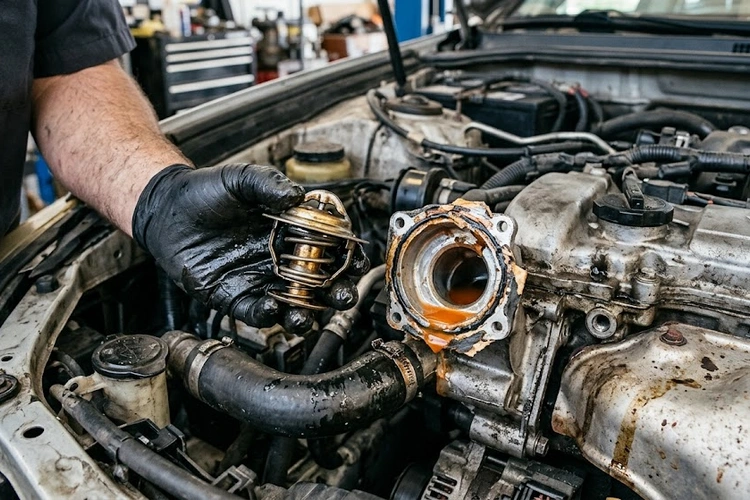
Contents
These six indicators reliably point to thermostat failure across virtually every make and model. Do not dismiss any single symptom as a coincidence — thermal management failures compound rapidly.
The most alarming of all bad thermostat symptoms is a temperature gauge that climbs toward the red zone or spikes suddenly during normal driving. A stuck-closed thermostat prevents coolant from circulating to the radiator, trapping heat inside the engine block. Coolant temperatures can reach 230°F to 250°F within minutes — well above the safe operating range of 195°F to 220°F for most passenger vehicles.
Do not confuse intermittent spiking with a simple low-coolant condition. If your reservoir level is correct and the gauge still climbs, the thermostat is the primary suspect. Pull over immediately when the gauge enters the red zone. Continued operation risks warping the cylinder head, a repair that costs ten times more than a thermostat replacement.
A thermostat stuck in the open position produces the opposite problem: coolant circulates freely at all times, and the engine never reaches optimal operating temperature. Your gauge will hover at the bottom of the normal range or fail to move off the cold mark entirely. This condition — commonly called cold running — is deceptively harmful.
Physical coolant leaks at the thermostat housing or its gasket indicate either a failed housing seal or a warped flange caused by repeated thermal cycling under abnormal temperature stress. You will notice a sweet-smelling residue near the housing, a visible puddle of green or orange fluid beneath the engine after parking, or a steady drop in the coolant reservoir level without any identifiable external cause.
Never top off a coolant leak without identifying its source first — adding fluid to a failing thermostat housing only delays the inevitable and masks the true severity of the leak.
Your cabin heater draws thermal energy from coolant passing through the heater core. When the thermostat sticks open, coolant temperature remains too low to transfer meaningful heat into the passenger compartment. If your heater suddenly delivers lukewarm or cold air at maximum output and the temperature gauge reads low, a stuck-open thermostat is the most probable cause. Rule out a clogged heater core and verify coolant level before purchasing a replacement thermostat.
A documented drop of 10 to 20 percent in fuel economy — without any change in driving habits, load, or fuel grade — frequently traces back to thermostat failure. The ECU calibrates injection duration and ignition timing against coolant temperature data. Both a stuck-closed thermostat producing overheating and a stuck-open thermostat producing a perpetually cold engine corrupt this calibration. Track your mileage over three to five consecutive fill-ups using a trip odometer reset. A sustained decline is a diagnostic signal, not a seasonal fluctuation.
Persistent white exhaust smoke under fully warmed conditions points to coolant combustion inside the cylinders — a downstream consequence of head gasket failure triggered by sustained overheating from a stuck-closed thermostat. Thin white vapor on cold startup is normal condensation. Thick, sweet-smelling white smoke that persists well past warm-up is an emergency requiring immediate shutdown. For a comprehensive breakdown of what each exhaust color diagnosis reveals, see our guide on exhaust smoke colors.
Accurate diagnosis prevents unnecessary parts replacement. Three methods — presented in order of reliability — will confirm thermostat failure before you spend anything on components.
Remove the thermostat from the vehicle and suspend it in a pot of water alongside a calibrated thermometer. Heat the water gradually on a stove. The thermostat valve should begin opening between 180°F and 195°F — the rated temperature stamped on the unit body — and reach full open by 212°F. A valve that does not open at all confirms stuck-closed failure. A valve already open before the water reaches 160°F confirms stuck-open failure. This test costs nothing and delivers a definitive, unambiguous result.
Connect an OBD-II scanner capable of live PID display and monitor the engine coolant temperature (ECT) sensor output. Start from a cold engine and observe the warm-up curve. A healthy thermostat will hold coolant temperature near its rated opening point during steady-speed driving, typically between 195°F and 210°F. Temperature that climbs past 230°F under normal load confirms stuck-closed failure. A plateau at 150°F to 160°F after a full warm-up cycle confirms stuck-open failure. A P0128 fault code stored in the ECU is a near-definitive indicator of a stuck-open thermostat on most OBD-II vehicles.
An OBD-II scanner displaying live ECT data is the single most diagnostic tool for thermostat evaluation — it confirms failure under real driving conditions that a bench test cannot replicate.
With the engine at operating temperature, aim an infrared thermometer at the upper radiator hose. If coolant is flowing freely through an open thermostat, the hose will be hot within four to six minutes of startup at idle. If the hose remains cold well after the engine has warmed, the thermostat is stuck closed and coolant is not reaching the radiator. This method requires no disassembly and takes under ten minutes to execute.
Thermostat replacement is a straightforward DIY procedure on most vehicles, typically requiring under two hours of shop time — or under an hour for an experienced technician on an accessible engine.
Always replace the thermostat gasket or O-ring simultaneously. Reusing a compressed gasket is the leading cause of post-replacement coolant leaks. Purchase a thermostat rated to the OEM specification — do not substitute a lower-temperature aftermarket unit unless you have a specific purpose such as a modified cooling system. Flush and refill with fresh coolant of the correct type for your vehicle: OAT, HOAT, or IAT as specified by the manufacturer. According to the Wikipedia entry on automotive thermostats, the wax-pellet actuator degrades through repeated thermal cycling over time, making proactive replacement at 100,000-mile intervals a sound preventive strategy regardless of visible symptoms.
Not all thermostats fail at equal rates. Specific operating profiles stress the wax-pellet actuator beyond its design service life.
Low-speed urban driving creates extreme thermal cycling. The thermostat opens and closes repeatedly within short intervals as the engine heats during prolonged idle and cools slightly during brief movement. High cycle frequency accelerates wax-pellet fatigue at a measurably faster rate than highway driving. Vehicles operating primarily in dense urban environments typically experience thermostat failure 20 to 30 percent earlier than vehicles with highway-dominated duty cycles. If your commute is predominantly stop-and-go, reduce your replacement interval accordingly.
Sustained operation in ambient temperatures above 100°F places the cooling system under constant pressure, forcing the thermostat to regulate near its maximum rated temperature differential for extended periods. Cold climates introduce the opposite stress: starting in sub-zero conditions exposes the wax pellet to extreme contraction on every cold-start cycle, accelerating material fatigue over time. Both extremes shorten service life measurably. If you regularly operate in either climate, adopt a 60,000-mile proactive replacement interval rather than the standard 100,000-mile guideline.
Vehicles beyond 120,000 miles with the original thermostat carry a statistically elevated failure risk. Coolant degradation — specifically acidic coolant from extended service intervals — corrodes the valve seat and actuator housing, causing erratic partial-open behavior before outright failure. A proactive replacement during a scheduled coolant flush costs under $40 in parts and eliminates a significant failure mode. Compare that cost to the $1,500 to $3,000 head gasket repair it can prevent.
Thermostat replacement is among the most cost-effective repairs in the entire cooling system. The part is inexpensive on virtually every vehicle; labor cost is determined entirely by housing accessibility.
| Vehicle Type | Part Cost | Labor (hrs) | Total — Shop | Total — DIY |
|---|---|---|---|---|
| Economy sedan (4-cyl) | $8 – $25 | 0.5 – 1.0 | $70 – $150 | $15 – $35 |
| Midsize SUV (V6) | $15 – $45 | 1.0 – 1.5 | $120 – $220 | $20 – $60 |
| Full-size truck (V8) | $20 – $60 | 1.0 – 2.0 | $130 – $280 | $25 – $70 |
| Luxury / European import | $40 – $120 | 1.5 – 3.0 | $200 – $500 | $50 – $130 |
| High-performance V8 | $30 – $80 | 1.5 – 2.5 | $175 – $380 | $35 – $90 |
Labor cost is entirely determined by thermostat housing accessibility. On most inline-4 and standard V6 engines, the housing sits at the front of the engine block attached to the upper or lower radiator hose — straightforward access requiring minimal disassembly. On transversely mounted V6 engines and many European luxury vehicles, the thermostat housing sits beneath the intake manifold, accessory drive belt, or coolant pipe assemblies, pushing labor hours to 2.5 or more. Request the flat-rate labor time from the manufacturer's service guide before authorizing any repair. A shop billing three hours for a standard four-cylinder thermostat replacement is overbilling. Verify the number against published data.
Two persistent myths cause vehicle owners to either ignore thermostat failure entirely or misattribute its symptoms to unrelated components. Both cost money.
This is the most damaging misconception in cooling system maintenance. A stuck-open thermostat does not cause overheating, so many owners conclude the vehicle is safe to operate indefinitely. It is not. Chronic cold running degrades catalytic converter substrate, reduces fuel economy by up to 25 percent, increases oil consumption through incomplete combustion, and generates fuel trim codes that mimic symptoms identical to a failing mass air flow sensor — leading technicians toward unnecessary component replacements. For a detailed reference on what a genuine sensor fault looks like by comparison, see our breakdown of mass air flow sensor symptoms.
The stuck-open thermostat is not safe. It is systematically degrading your drivetrain and emissions hardware while your gauge reads entirely normal.
Removing the thermostat entirely to prevent overheating is a documented misconception in amateur automotive maintenance circles. Without a thermostat, coolant flows too rapidly through the radiator to transfer heat efficiently, the engine runs perpetually cold, and the ECU never enters closed-loop operation. The thermostat does not restrict cooling — it optimizes it by ensuring coolant spends adequate time in the radiator. An engine without a thermostat performs worse in every measurable parameter than an engine with a correctly functioning unit of the proper temperature rating.
Removing the thermostat to solve an overheating problem is equivalent to disconnecting your smoke alarm to prevent fires — it eliminates the warning signal while guaranteeing the underlying damage continues unchecked.
Replacing the thermostat resolves the immediate failure. Protecting the cooling system long-term requires a disciplined maintenance schedule built around the components that fail together.
Coolant degrades chemically over time regardless of visible condition. OAT (Organic Acid Technology) coolants — used in most vehicles manufactured after 2000 — maintain inhibitor effectiveness for approximately five years or 150,000 miles under normal operating conditions. HOAT coolants degrade faster, typically requiring replacement at three years or 100,000 miles. Acidic coolant is the primary driver of thermostat housing corrosion, gasket deterioration, and water pump seal failure. A coolant flush eliminates the primary chemical attack vector against your new thermostat. Follow the manufacturer-specified coolant type precisely — mixing OAT and IAT inhibitor chemistries causes inhibitor precipitation, clogging heater core passages and radiator tubes over time.
Your factory temperature gauge is a deliberately damped instrument. Most OEM gauges will display in the normal range until coolant reaches 240°F or higher — well past the threshold for accelerated component wear. An OBD-II Bluetooth adapter paired with a real-time smartphone dashboard gives you live ECT data with 1°F resolution at all times. Set an alert threshold at 220°F. This proactive monitoring approach will catch a developing thermostat failure — or any cooling system anomaly — before your factory gauge moves a single division. The hardware costs under $30 and delivers a level of thermal awareness that no stock instrument cluster provides. Pair this monitoring discipline with the broader preventive practices outlined in our guide on maintaining your vehicle to build a complete preventive care framework.
The six most reliable bad thermostat symptoms are: a temperature gauge climbing toward the red zone, a gauge stuck at cold after warm-up, coolant leaks at the thermostat housing, a heater blowing cold air at maximum output, declining fuel economy without a change in driving habits, and persistent white exhaust smoke under warm conditions. The first two — temperature gauge behavior at opposite extremes — are the most diagnostically specific.
You can drive briefly with a stuck-open thermostat without immediate mechanical danger, but you should not continue long-term. A stuck-closed thermostat requires immediate shutdown to prevent head gasket failure. Neither condition is safe to ignore indefinitely — a stuck-open thermostat causes incremental drivetrain and emissions damage even without triggering any temperature warning on your gauge.
On most inline-4 and standard V6 engines, thermostat replacement takes 45 minutes to 1.5 hours in a professional shop. Transversely mounted engines and European luxury vehicles with buried thermostat housings can require 2.5 to 3 hours due to access constraints. A skilled DIY mechanic on an accessible engine typically completes the job in under an hour.
The thermostat part itself costs $8 to $120 depending on vehicle make and model. Total professional shop cost ranges from approximately $70 for a basic economy sedan to $500 for a luxury import with a difficult housing location. DIY replacement on an accessible engine costs $15 to $90 in total, including a new gasket and a coolant refill.
Use an infrared thermometer aimed at the upper radiator hose after the engine has idled for ten minutes. If the hose remains cold, the thermostat is stuck closed. Use an OBD-II scanner to monitor live ECT data — a plateau at 150°F to 160°F under load after full warm-up confirms stuck-open failure. Scan for a stored P0128 fault code, which is a near-definitive indicator of a stuck-open thermostat on OBD-II vehicles.
A stuck-closed thermostat left unrepaired will cause head gasket failure, warped cylinder heads, and in severe cases a cracked engine block — repairs that cost $1,500 to $5,000. A stuck-open thermostat will progressively degrade fuel economy, accelerate catalytic converter substrate failure, increase oil consumption, and generate persistent fuel trim faults that lead technicians to misdiagnose unrelated components.
Yes, in many cases. A stuck-open thermostat frequently stores fault code P0128 — coolant temperature below thermostat regulating temperature — which is a direct thermostat indication on most OBD-II vehicles. A stuck-closed thermostat may store P0116 (ECT circuit range or performance) or cooling system overtemperature codes depending on the manufacturer. Always retrieve stored fault codes before replacing any component; P0128 alone narrows the diagnosis substantially.
Most passenger vehicle thermostats are rated to begin opening between 180°F and 195°F. The ideal steady-state coolant operating temperature under load is 195°F to 220°F for the majority of modern engines. Temperatures consistently below 180°F after full warm-up confirm a stuck-open failure. Temperatures above 230°F under normal driving conditions confirm a stuck-closed failure requiring immediate attention.
A $20 thermostat replaced proactively is the cheapest insurance policy in automotive maintenance — ignore it, and it will collect on that policy at the cost of your cylinder head.
 |
 |
 |
 |

About Sarah Whitfield
Sarah Whitfield is a diagnostics and troubleshooting specialist who spent ten years as an ASE-certified technician before joining the editorial team. She specializes in OBD-II analysis, electrical gremlins, and the kind of intermittent problems that make most owners give up.
Get some FREE car parts & gear.. Or check out the latest free automotive manuals and build guides here.
Disable your ad blocker to unlock all the hidden deals. Hit the button below 🚗
| | | |
