by Sarah Whitfield
According to the National Highway Traffic Safety Administration, steering and suspension component failures contribute to an estimated 35,000 crashes annually in the United States. Recognizing bad tie rod end symptoms early is the single most effective step toward preventing a dangerous front-end failure. Our team has inspected and replaced well over a thousand tie rod assemblies across sedans, trucks, and SUVs, and one thing stands out consistently: most drivers notice something is off weeks before the component actually fails, but they don't connect the dots in time. The six warning signs covered here are exactly what our team looks for on every front-end inspection — and anyone who knows them is far ahead of the curve. Staying current on routine car care and maintenance is the foundation that makes catching these problems possible.
Tie rod ends are small but structurally critical. They connect the steering rack's inner tie rod to the steering knuckle, translating driver input at the wheel into precise front wheel movement. A worn tie rod end introduces slop, instability, and alignment error into a system that demands precision. The deterioration is rarely sudden — it's gradual, and that's precisely why the early symptoms matter so much.
Contents
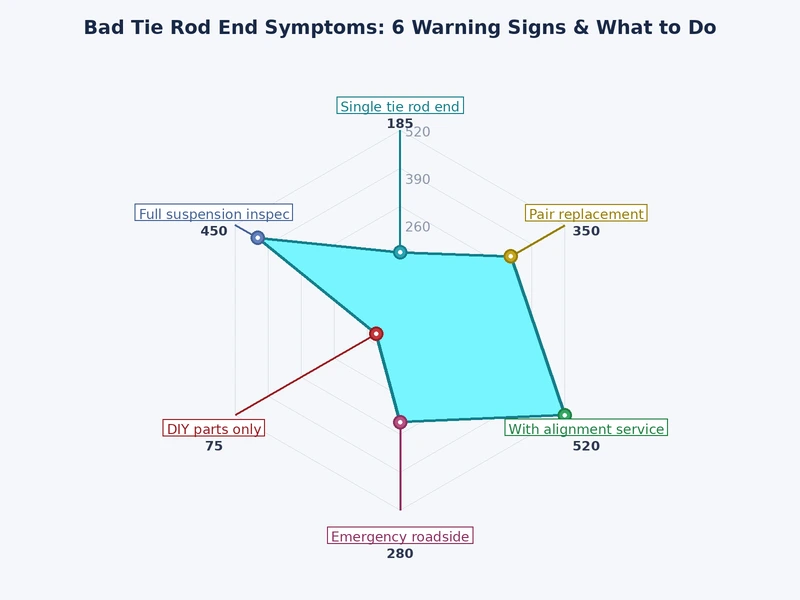
These six warning signs appear in a fairly predictable sequence as a tie rod end degrades. Not every vehicle displays all six — factors like driving conditions, vehicle age, and whether the outer or inner tie rod is affected all shape the pattern. But our team treats any single one of these as sufficient reason for a full front-end inspection. Waiting for multiple symptoms to appear simultaneously is how small repairs become expensive ones.
The most common early indicator is a vibration felt through the steering wheel, typically between 45 and 70 mph. This isn't the high-frequency buzz from an unbalanced wheel — a failing tie rod end produces a more pronounced shimmy with an uneven, pulsing rhythm that worsens as speed increases. Our experience confirms that most drivers first notice it during highway merges or sustained freeway driving, often dismissing it as road surface variation.
Pulling to one side follows. When a tie rod end loses its tight ball joint, it allows the front wheel to toe in or out beyond its alignment specification. The result is a vehicle that consistently drifts toward one side even on a straight, level road. This differs from the mild pull caused by road crown — a tie rod-related pull is persistent and direction-agnostic. When this pulling is accompanied by steering that demands constant effort, the breakdown in our guide on steering feels heavy causes and fixes covers the overlapping diagnostic picture in detail.
Wandering steering — the sense that the vehicle requires constant small corrections to stay in its lane — is the third symptom in this group. It's subtle at first. Most people describe it as the car "floating." Our team finds it most frequently in vehicles with 80,000 or more miles on original front-end components, particularly those driven on rougher roads where cumulative impact loads accelerate joint wear.
A clunking or knocking noise during turning is one of the clearest physical signals of a worn tie rod end. The sound originates from the loose ball-and-socket joint rattling as the steering rack moves. It's most audible during slow parking maneuvers and tight turns. Our team frequently encounters a nearly identical sound from worn ball joints — the full symptom comparison and diagnostic process is in our post on bad ball joint symptoms, causes, and replacement cost. The distinction matters because the repair differs considerably.
In more advanced cases, the clunk transitions into a grinding sensation through the wheel — a symptom that overlaps with what we detail in our guide on car grinding noise when turning. Drivers noticing the vehicle shaking through corners should also cross-reference car shakes when turning to eliminate other front-end contributors before concluding the tie rod is the source.
Uneven tire wear is the silent indicator. It builds slowly and requires a visual check to catch — most people find it only when they rotate their tires or take the vehicle in for service. A worn tie rod end that causes even slight toe misalignment will feather or scallop the inside or outside edge of the tire. Over several thousand miles, the wear pattern becomes unmistakable. Feathered tires from toe misalignment also increase rolling resistance, and our team consistently documents a corresponding fuel efficiency loss consistent with what we analyze in fuel economy suddenly dropped.
Warning: A vehicle with a confirmed worn tie rod end should not be driven at highway speeds. Complete joint separation is rare but does occur — and when it does, steering control is lost instantly with no warning.
As tie rod wear advances, the steering wheel develops noticeable play — a dead zone where turning the wheel produces no corresponding movement from the front wheels. In our experience, anything beyond roughly an inch of play at the wheel rim warrants immediate inspection. Most manufacturers specify far less than that for acceptable function, and even a quarter inch of excess play at the wheel translates to meaningful slop at the front wheels.
Highway instability is the most dangerous expression of advanced tie rod failure. At 65 mph, even small amounts of front-end looseness translate into significant lateral movement. Crosswinds feel amplified. Lane changes feel imprecise and unpredictable. Our team treats any combination of steering play and highway instability as a same-day inspection priority — not something to monitor over the following week.
Tie rod ends don't follow a fixed replacement interval the way belts or filters do, but our team works from a consistent benchmark: a thorough front-end inspection at every 50,000 miles and again at the first sign of any handling change. Most factory tie rod ends are engineered to last between 70,000 and 150,000 miles depending on road quality, driving habits, and whether the vehicle has absorbed significant impact loads from potholes or curb strikes.
Both outer and inner tie rod ends deserve attention during any inspection. The outer is more commonly replaced because it's more exposed to road debris and moisture intrusion. The inner, however, fails as well — and it's frequently overlooked because it sits behind the steering rack boot where visual access is limited without a lift. Our team always inspects both during every front-end service.
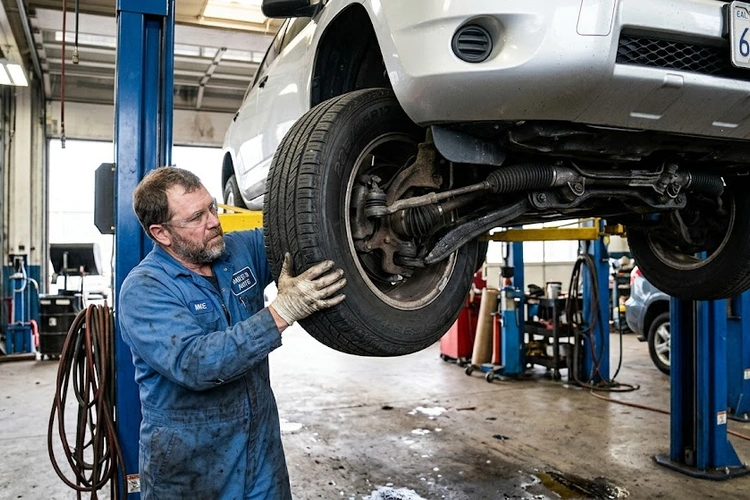
Our team uses a straightforward two-step check on every front-end inspection. First, with the vehicle on level ground and the engine running, we gently rock the steering wheel side to side. Any perceptible play at the wheel rim before the front wheels begin moving is a flag. Second, with the front wheels elevated on a lift or rated jack stands, we grip each tie rod end firmly and push and pull in all directions. A tight, new-condition tie rod end will not move. Any detectable looseness in the joint means replacement is warranted, regardless of mileage.
Checking the rubber boot is equally important. A cracked or torn boot allows road grit and moisture into the joint, dramatically accelerating wear. A boot failure doesn't mean the tie rod end has failed yet, but in our experience it typically predicts failure within 10,000 to 20,000 miles under normal driving conditions. Catching a torn boot early — and replacing the component proactively — is consistently the lower-cost outcome.
The visual boot inspection and the steering play test described above require nothing more than a floor jack, rated jack stands, and a flashlight. Most home mechanics can perform both confidently. The grease fitting check — confirming whether the tie rod end is a serviceable type with a grease zerk or a sealed maintenance-free unit — is also straightforward and worth including at every oil change interval. Sealed units can't be lubricated and rely entirely on their factory grease fill; once the boot tears, their service life drops sharply.
Where at-home assessment falls short is in measuring actual toe values and detecting borderline wear that hasn't yet produced tactile looseness. A tie rod end with a worn bearing surface can cause progressive alignment drift before any perceptible play develops at the joint — and that's undetectable without alignment equipment.
Pro tip: Our team always replaces tie rod ends in axle pairs when one side has failed. Both sides wear at similar rates, and replacing only one side typically means returning within a year to do the other — at full labor cost again.
Any time a tie rod end is replaced, a four-wheel alignment is mandatory — not optional. Adjusting tie rod end position directly changes the toe angle, and without precise alignment afterward, the vehicle will wear tires rapidly and handle unpredictably. This is the step most home repairs skip, and it's the reason our team always pairs tie rod end replacement with an alignment shop visit as part of the same job.
A shop can also perform chassis-ear diagnosis for borderline cases — isolating whether a noise originates from the tie rod end, the ball joint, the stabilizer end link, or the wheel bearing. These components share overlapping symptom profiles, which is why professional confirmation matters before committing to a specific repair. Misdiagnosis here leads to unnecessary parts replacement and continued symptoms.
The symptom overlap between tie rod failure and other front-end problems is significant, and it's where most misdiagnoses originate. Wheel bearing failure produces similar vibration and directional noise. Motor mount wear generates steering shimmy that convincingly mimics tie rod looseness — the full comparison in our bad motor mount symptoms and replacement cost guide is useful for separating those two causes. Worn ball joints, as detailed earlier, produce nearly identical clunking during low-speed turns.
The diagnostic differentiator our team relies on is the jack-stand play test combined with directional awareness. Wheel bearing noise characteristically shifts or changes intensity when the vehicle's steering is turned slightly at highway speed, redistributing lateral load on the hub. Tie rod end looseness is detectable as physical movement at the joint itself regardless of load direction. Ball joint play reveals itself when the wheel hub is pushed and pulled perpendicular to the tie rod's axis. Knowing which axis produces movement tells the diagnostic story precisely.
This is the most consequential error our team encounters. Because the early bad tie rod end symptoms — mild vibration, slight pulling, occasional clunking — are easy to rationalize as normal wear, many owners continue driving on compromised components for months. The joint doesn't degrade at a linear rate. It accelerates. Once the protective boot is gone and the joint is exposed to road contamination, deterioration from detectable looseness to critical play can occur within 10,000 miles.
Our team has inspected vehicles brought in for routine maintenance with tie rod ends so worn that the front wheel had measurable toe change mid-drive. At that stage, tire wear is severe, fuel economy is meaningfully down, and the vehicle is genuinely unsafe. Addressing bad tie rod end symptoms at the first confirmed sign is always the lower-cost, lower-risk path forward.
Highway speeds amplify every characteristic of tie rod wear. The vibration that's barely noticeable at 35 mph becomes impossible to ignore at 65 mph. The wandering sensation that reads as mild imprecision on city streets becomes active instability on the freeway. Our team consistently finds that drivers who do most of their driving at low city speeds tend to have more advanced tie rod wear than they realize — the symptoms are suppressed by lower speeds until they appear suddenly on the highway.
Heavy hauling and trailer towing are particularly revealing scenarios. The additional dynamic load on the front suspension makes any existing looseness in the tie rod joints dramatically more pronounced. Drivers running AWD vehicles who experience unexplained handling irregularities at speed should also consult our AWD system fault guide to rule out drivetrain-related causes before concluding the issue is exclusively steering-related. Our team treats any steering complaint that appeared during or immediately after a towing event as a front-end inspection trigger.
Slow-speed turning concentrates the full articulation range of the tie rod end into a compact maneuver. The clunking noise that bad tie rod end symptoms include is almost always loudest at parking lot speeds — the joint travels through its full arc with relatively little dampening from vehicle momentum. Full-lock turns in either direction at low speed will reveal a worn tie rod end that stays quiet at moderate steering angles under highway conditions.
Road quality is a direct accelerator of tie rod wear. Vehicles regularly driven on rough or potholed surfaces develop joint wear faster than those on smooth pavement. The impact loads transferred through the front wheels into the tie rod end joints accumulate — every pothole hit is a discrete insult to the joint's bearing surface and boot integrity. Our team has seen tie rod ends fail at 60,000 miles on urban fleet vehicles and last beyond 130,000 miles on highway-primary vehicles of the same make and model.
A quality floor jack and a pair of rated jack stands are the minimum requirement for any under-vehicle inspection. Beyond that, a bright flashlight or clip-on work light and a clean rag to wipe down the boot area are all that's needed for the visual check. A large pry bar helps apply controlled force to the tie rod end when assessing joint play with the wheel elevated.
| Tool | Purpose | Phase |
|---|---|---|
| Floor jack + rated jack stands | Safely lift and support the vehicle | Inspection & replacement |
| Flashlight / work light | Visual boot and joint inspection | Inspection only |
| Pry bar | Apply force to check for joint play | Inspection only |
| Tie rod end separator / pickle fork | Separate tie rod taper from steering knuckle | Replacement |
| Torque wrench | Torque castle nut to manufacturer specification | Replacement |
| Locking pliers / pipe wrench | Hold inner tie rod steady during adjustment | Replacement |
| Inner tie rod removal tool | Remove and install inner tie rod end through rack boot | Inner replacement only |
| Alignment machine | Set toe angle precisely after replacement | Post-replacement mandatory |
The tie rod end separator is the essential specialty tool for replacement. Attempting to free a tie rod end from the steering knuckle taper without one risks damaging the boot on adjacent components and rounding the castellated nut. The correct tool makes the removal clean and repeatable. Most auto parts retailers offer this as a loaner tool at no charge, which eliminates any barrier to doing the job correctly.
Inner tie rod end replacement requires an additional specialized socket designed to reach through the steering rack boot and engage the hex section of the inner tie rod. Without it, the job becomes a multi-hour exercise in frustration. With it, the replacement is straightforward. After any tie rod end replacement — inner or outer — the vehicle goes directly to an alignment shop. Our team never skips this step, and anyone who values their tire investment shouldn't either. The alignment corrects the toe angle that the new component's position has changed and restores the precise handling the vehicle was engineered to deliver.
Our team's position is unambiguous: a vehicle with a confirmed bad tie rod end should be driven only as far as the repair shop, and not at highway speeds. The joint can fail progressively or suddenly — while gradual failure gives some advance warning, complete separation can occur without immediate prior escalation. Most professional mechanics treat a severely worn tie rod end as a same-day replacement item, not a condition to monitor over the coming weeks.
The most common sound is a clunking or knocking noise during turning, particularly at low speeds and full steering lock. Some drivers describe it as a metallic knock that pulses in rhythm with the steering input. In more advanced cases, a grinding sensation through the wheel accompanies the audible noise. The symptom is most pronounced during slow parking maneuvers and when the vehicle travels over bumps while simultaneously turning — both situations that put the joint through its full range of motion.
Outer tie rod end replacement typically runs between $100 and $250 per side at a shop, parts and labor included. Inner tie rod ends cost more due to the additional labor involved — typically $150 to $350 per side. A four-wheel alignment, which is mandatory after any tie rod replacement, adds $75 to $150 on top of that. OEM parts generally cost more than quality aftermarket alternatives but tend to offer better longevity, particularly on high-mileage vehicles where the rest of the front-end geometry is already worn.
Our team sees this misdiagnosis regularly. Both conditions produce vibration and directional noise, but the key distinction is how the symptom responds to load. Wheel bearing noise characteristically changes pitch or intensity when the steering is turned slightly left or right at highway speed, because this shifts lateral load across the bearing. Tie rod end looseness, by contrast, is detectable as physical play at the joint itself during a hands-on jack-stand test — load direction doesn't mask it. When the two conditions are genuinely difficult to distinguish by feel alone, a chassis ear confirms the source in minutes.
 |
 |
 |
 |

About Sarah Whitfield
Sarah Whitfield is a diagnostics and troubleshooting specialist who spent ten years as an ASE-certified technician before joining the editorial team. She specializes in OBD-II analysis, electrical gremlins, and the kind of intermittent problems that make most owners give up.
Get some FREE car parts & gear.. Or check out the latest free automotive manuals and build guides here.
Disable your ad blocker to unlock all the hidden deals. Hit the button below 🚗
| | | |
