by Sarah Whitfield
A failing transfer case telegraphs its distress through grinding noises, shifting resistance, and drivetrain vibration long before catastrophic failure sets in. The six most common bad transfer case symptoms — unusual noises, difficulty shifting, drivetrain vibration, fluid leaks, warning lights, and complete 4WD loss — follow a predictable sequence that gives you a clear diagnostic window before the damage compounds into a full drivetrain overhaul. Whether you run a body-on-frame 4x4 or a modern AWD crossover, the transfer case is the torque-splitting hub that routes power between axles, and its failure modes are consistent across platforms. For broader drivetrain context, the car care guides at CarCareTotal cover related systems in depth.

Contents
The transfer case is a secondary gearbox mounted directly behind the primary transmission, splitting output torque between the front and rear driveshafts. According to Wikipedia's entry on transfer cases, the unit divides torque through a chain-drive, gear-drive, or electronically controlled viscous coupling, depending on the design generation. In part-time 4WD systems, you engage it manually through a lever or electronic switch; in full-time AWD architectures, it operates continuously without any driver input whatsoever.
The transfer case carries its own dedicated fluid reservoir in most configurations, separate from the transmission, and that fluid is the single most important variable controlling long-term unit survival. Neglecting it is the most common precursor to every bad transfer case symptom described below, converting what would have been a simple fluid service into a multi-thousand-dollar rebuild.
A grinding sound on engagement or under sustained load is one of the earliest and most reliable bad transfer case symptoms across every drivetrain configuration. The noise originates from worn gear teeth or a stretched transfer case chain that slaps against the housing under load. You will typically hear it most clearly when accelerating from a stop or transitioning from 2H into 4H. If the grinding also arrives with shudder through the floor, the section on driveshaft vibration symptoms provides a complete differential diagnosis for isolating transfer case from u-joint and axle sources.
Resistance or outright refusal to shift between 2H, 4H, and 4L is a definitive indicator of internal mechanical wear or actuator failure inside the unit. In electronically controlled systems, a failed encoder motor or shift fork prevents the case from completing a mode change even when the dash switch registers the command successfully. In mechanical systems, a worn synchronizer or binding shift rail creates firm physical resistance at the lever that grows more pronounced with each engagement cycle. The transfer case is communicating a binding or indexing problem that compounds progressively under continued operation.
Transfer case-induced vibration is speed-sensitive and intensifies linearly as road speed climbs, which distinguishes it from tire-related shimmy that appears at specific resonant frequencies and then dissipates. A worn output shaft bearing or a damaged yoke transmits an oscillating force directly into the driveshaft, producing a rhythmic vibration that grows measurably worse above 45 mph. Because this symptom overlaps so directly with driveshaft vibration from u-joint wear, always check for rotational play at the transfer case output yoke before condemning the shaft itself.
Pro Tip: With the vehicle on a lift, grab the rear driveshaft near the transfer case output yoke and check for rotational play; more than a few degrees of backlash at that specific point confirms internal transfer case wear rather than a driveshaft u-joint problem.
Transfer case fluid is amber to dark brown in color and appears beneath the center of the vehicle, between the transmission and the rear axle centerline. The most common leak points are the front and rear output shaft seals, the input shaft seal where it mates to the transmission, and the drain plug gasket. Low fluid from a slow seal leak accelerates metal-on-metal wear catastrophically, converting a $150 seal replacement into a $2,000 rebuild within a few thousand miles of continued operation under those starvation conditions.
Modern transfer cases use encoder sensors and wheel-speed comparisons to detect engagement failures, communicating faults through dedicated 4WD or AWD warning indicators on the instrument cluster. An AWD system fault code logged alongside a transfer case fluid leak or shifting complaint is a dual-confirmation diagnostic that points directly at the transfer case rather than the ABS module or a driveshaft speed sensor. OBD-II chassis codes in the C0327–C0400 range are the most common transfer case encoder and actuator fault identifiers across domestic and import platforms.
When the transfer case fails to distribute torque to one or both axles, you lose traction in the exact conditions 4WD was engineered to handle. In part-time systems, the front driveshaft stops rotating under load even with 4H selected. In full-time AWD systems, the vehicle behaves as though it is rear-wheel drive regardless of mode selection or road surface conditions. At this terminal stage, the unit has typically sustained bearing failure, catastrophic chain stretch, or a cracked housing — each requiring immediate repair rather than any further deferred service.
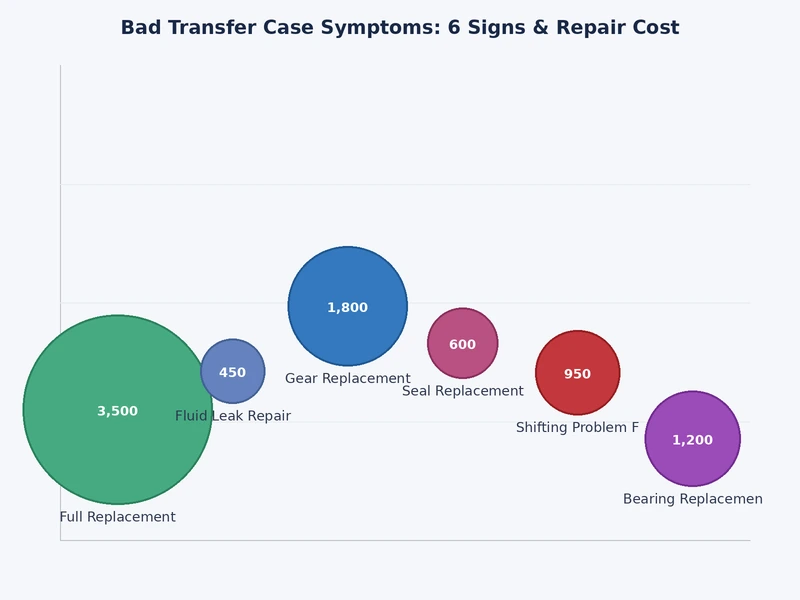
Repair costs scale sharply with how long the underlying failure progressed before diagnosis. A seal replacement caught early costs a fraction of a complete rebuild, and understanding the cost ladder lets you make a financially sound decision when the shop presents your options.
| Repair Type | Parts Cost | Labor Cost | Total Estimate |
|---|---|---|---|
| Fluid Service (drain & fill) | $20–$50 | $40–$80 | $60–$130 |
| Output Shaft Seal Replacement | $15–$40 | $80–$150 | $95–$190 |
| Encoder Motor / Shift Actuator | $80–$250 | $100–$200 | $180–$450 |
| Transfer Case Rebuild | $400–$900 | $500–$1,000 | $900–$1,900 |
| Remanufactured Unit Swap | $600–$1,500 | $400–$800 | $1,000–$2,300 |
| New OEM Unit | $1,200–$3,500 | $400–$800 | $1,600–$4,300 |
Dealer labor typically runs 30–50% higher than independent drivetrain specialty shops for the same operation. For high-mileage vehicles, the remanufactured swap is generally the strongest value proposition when rebuild cost approaches or exceeds 60% of the remanufactured unit price, particularly when the unit carries a matching warranty.
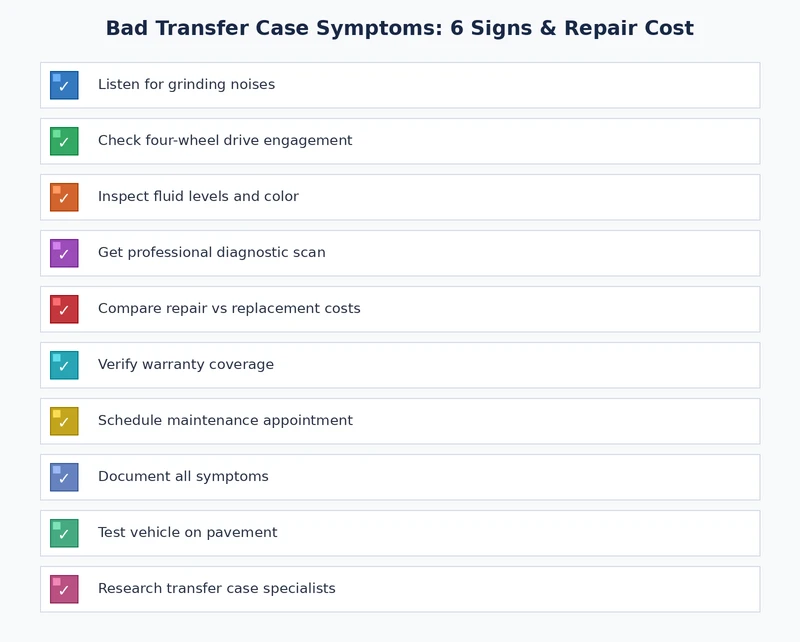
Diagnosis follows a cost-efficient ladder that begins with the simplest, cheapest checks and escalates toward component-level testing only when surface-level inspection fails to confirm the fault conclusively.
Warning: Never shift a part-time 4WD transfer case into 4L above walking speed; doing so loads the shift fork against spinning internal components and can fracture the fork or strip the synchronizer in a single engagement attempt.
Several persistent misconceptions lead drivers to delay repair or attempt ineffective fixes that accelerate damage rather than contain it. Each of the following myths has a measurable cost consequence when acted upon.
The transfer case fluid is the single most decisive maintenance variable in long-term unit survival, and most manufacturers specify a drain-and-fill interval between 30,000 and 60,000 miles under normal conditions, dropping to 15,000 miles for severe-duty use that includes frequent 4WD engagement, trailer towing, or sustained off-road operation on loose terrain.
Consistent fluid and seal maintenance is the most cost-effective long-term strategy available to you, extending transfer case service life well beyond 200,000 miles on properly maintained platforms across every manufacturer's drivetrain lineup.
The six most consistent bad transfer case symptoms are grinding or clunking noises during mode engagement, difficulty shifting between 2H, 4H, and 4L, speed-sensitive drivetrain vibration, fluid leaks beneath the vehicle centerline, illuminated 4WD or AWD warning lights, and complete loss of four-wheel drive engagement under load.
You can cover short distances in two-wheel drive mode if the transfer case has not seized internally, but continued operation accelerates bearing and gear damage rapidly and risks a locked drivetrain at highway speed. Any confirmed transfer case fault warrants immediate diagnosis and repair rather than deferred service.
A remanufactured transfer case swap typically costs between $1,000 and $2,300 including parts and labor at an independent shop. A new OEM unit runs $1,600 to $4,300 depending on platform and whether you use a dealer. Simpler repairs such as output seal replacement cost as little as $95 to $190 total.
Remove the fill plug and examine the fluid on a clean white rag; healthy transfer case fluid is amber to light brown and free of metallic particles or grit. Dark, black, or metallic-flecked fluid confirms significant internal wear and requires immediate fluid service plus a bearing and seal inspection before further mileage accumulates.
The primary causes are fluid neglect leading to bearing starvation, seal failure that introduces moisture and debris contamination, impact damage from off-road rock strikes, and infrequent engagement in part-time systems that allows shift components to corrode and bind from prolonged disuse.
A properly maintained transfer case with regular fluid changes at manufacturer-specified intervals routinely lasts 150,000 to 200,000 miles or beyond. Fluid neglect compresses that service life to under 100,000 miles in severe-duty applications involving frequent towing, off-road use, or sustained 4WD engagement without corresponding service intervals.
A rebuild is worth pursuing when the vehicle's overall condition justifies the investment and the rebuild cost stays below 60% of the remanufactured unit price from a certified supplier. For high-mileage vehicles carrying other deferred maintenance, a remanufactured swap with a full warranty typically delivers better long-term value and lower total cost of ownership.
Yes — grinding noises and drivetrain vibration overlap directly with driveshaft u-joint failure, worn wheel bearings, and differential damage. Isolate the transfer case by checking for rotational play at the output yoke, inspecting fluid condition, and scanning for chassis DTCs before replacing other drivetrain components on a speculative basis.
Bad transfer case symptoms rarely arrive without warning — the diagnostic window between first symptom and catastrophic failure is wide enough to act decisively and cost-effectively if you pay attention to what the drivetrain is telling you. Schedule a fluid inspection and mode-cycle test at the first sign of grinding, shifting resistance, or speed-sensitive vibration, and work with a drivetrain specialist to determine whether a seal repair, rebuild, or remanufactured swap is the right call for your platform and mileage. The transfer case is not a disposable component — give it the same fluid discipline you apply to your transmission, and it will deliver well over 200,000 miles of reliable service.
 |
 |
 |
 |

About Sarah Whitfield
Sarah Whitfield is a diagnostics and troubleshooting specialist who spent ten years as an ASE-certified technician before joining the editorial team. She specializes in OBD-II analysis, electrical gremlins, and the kind of intermittent problems that make most owners give up.
Get some FREE car parts & gear.. Or check out the latest free automotive manuals and build guides here.
Disable your ad blocker to unlock all the hidden deals. Hit the button below 🚗
| | | |
