by Joshua Thomas
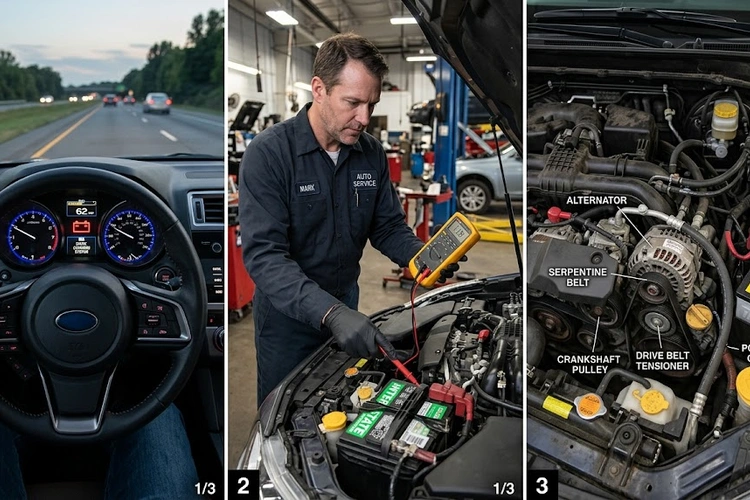
Ever glanced at the dashboard mid-drive and felt that cold jolt when a red battery symbol blinks on? The battery light on while driving is almost never about the battery alone — and that single misconception leads most people straight to the wrong repair.
Our team has diagnosed hundreds of these cases. The honest truth is that the charging system — alternator, serpentine belt, cables, voltage regulator, and battery working together — is what that warning is really flagging. Sometimes the fix is a five-minute cable tightening. Other times the alternator is quietly dying and the car has roughly 20 minutes of electrical life left. Knowing the difference is everything.
In this guide, our team breaks down all 7 causes, clears up the myths that cost most people real money, and walks through a practical diagnosis sequence step by step. We also cover when driving a short distance home is reasonable versus when pulling over immediately is the only safe call.
Contents
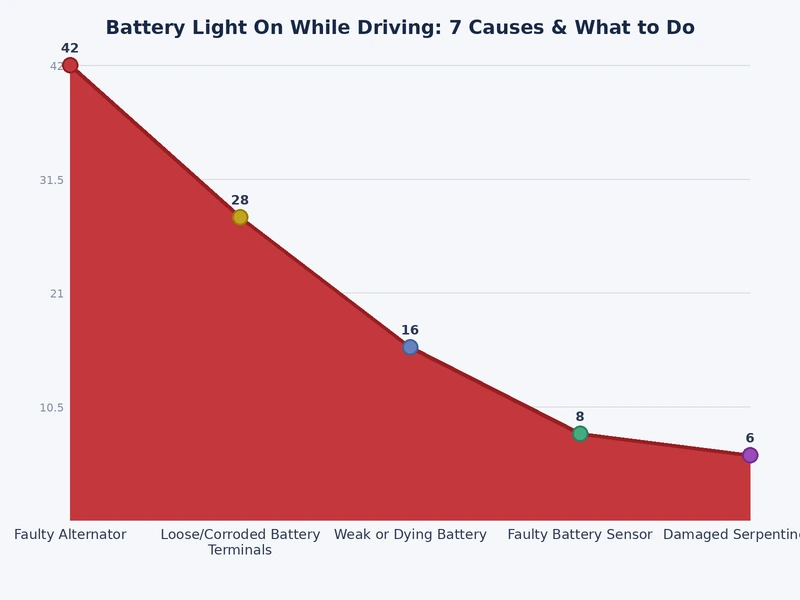
The battery warning light connects to the vehicle’s charging system monitor. When voltage drops outside the normal 13.5–14.7V operating range, the light triggers. Here are the seven causes our team encounters most often, ranked from most to least common.
The alternator is a generator driven by the engine that keeps the battery charged and powers all electrical systems while the car runs. When it fails — and it will eventually, typically between 100,000 and 150,000 miles — the battery starts draining in real time.
Signs of a failing alternator alongside the battery light:
According to Wikipedia’s overview of automotive alternators, a healthy unit produces between 13.5 and 14.8 volts at the battery terminals. Anything below 13V while the engine is running points directly at alternator trouble. This is the single most common cause of the battery light on while driving in our experience.
A battery that can no longer hold a proper charge will drag system voltage low enough to trigger the warning light. This is especially common in batteries over four years old. Cold weather accelerates the decline — a battery that seems fine in summer can struggle badly once temperatures drop.
Our team always recommends a load test (not just a resting voltage check) before condemning a battery. Many auto parts stores perform this for free. A battery that’s still “passing” a basic voltage test can still fail badly under load. For a full breakdown of replacement options and what to budget, see our guide on how much a car battery costs.
Worth noting: a car hard to start when cold is very often the first warning sign of a weakening battery — the warning light may not appear until the situation is more advanced.
Battery cable connections corrode over time. White or blue-green buildup on the terminals creates resistance, which reduces the voltage flowing through the charging circuit. A loose cable does the same thing intermittently — the connection breaks slightly under road vibration, the light flickers on, then seems to resolve itself.
This is one of the cheapest fixes in automotive maintenance. A wire brush, baking soda, and water clean corrosion in under ten minutes. Our team recommends a quick terminal inspection at every oil change as standard practice.
The serpentine belt (the long rubber belt routing around multiple pulleys in the engine bay) drives the alternator. No belt means no alternator output. A worn belt slips under load, reducing charging efficiency. A snapped belt kills output entirely and immediately.
Most serpentine belts last 60,000 to 100,000 miles. Cracks running across the belt width, fraying on the edges, or a glazed (shiny) surface all indicate it’s overdue for replacement. If a burning rubber smell accompanies the battery light, the belt is the prime suspect — our guide on car smells like burning rubber covers exactly what to look and sniff for in the engine bay.
The voltage regulator (the component that controls how much electricity the alternator produces) is built into the alternator in most modern vehicles. When it fails, the alternator either under-charges — not enough voltage, light turns on — or over-charges, which damages the battery and electronics over time.
A faulty regulator is harder to isolate without a scan tool because the symptoms overlap closely with general alternator failure. In practice, replacing the alternator as a complete unit (regulator included) is more cost-effective than sourcing the regulator separately, and that’s the approach our team takes.
Ground straps (short cables connecting the battery negative terminal and the engine block to the vehicle chassis) complete the entire electrical circuit. A corroded or loose ground creates resistance that causes voltage fluctuations throughout the system, which triggers the battery warning light.
Ground issues are frequently overlooked because they’re less visible than a corroded positive terminal. Our team checks all ground strap connections — battery to chassis, engine to firewall — whenever the battery light appears without an obvious cause elsewhere.
Running too many high-draw accessories simultaneously can overwhelm the alternator’s output capacity. Aftermarket stereo systems, powerful LED light bars, winches, and air compressors all pull significant current. When the alternator can’t keep up, voltage sags and the battery light activates.
This pattern is common in trucks and SUVs with aftermarket builds. The fix is either reducing the electrical load or upgrading to a higher-output alternator. If power windows stop working alongside the battery light, the system is almost certainly voltage-starved from excessive load.
Misinformation about this warning light is surprisingly widespread. Our team has seen these myths cost drivers real money — and in some cases leave them stranded in dangerous situations.
This is the most expensive misconception. Most people replace the battery when the warning light appears, only for the light to return within days. That’s because a failing alternator will drain a brand-new battery just as fast as an old one. The correct approach is always to test the complete charging system — alternator, cables, and battery — before replacing anything.
It might — temporarily. A loose cable can reconnect after a bump in the road. A slipping belt may grip better once the engine warms up. But the underlying fault hasn’t resolved itself. Ignoring the battery light on while driving and hoping for the best is one of the fastest routes to a breakdown.
Our team’s rule: a battery warning light that disappears and reappears is more concerning than one that stays on steadily — intermittent faults often signal progressive component failure and are harder to diagnose before they strand someone.
The same principle applies to other dashboard warnings. Our breakdown of check engine light flashing vs. solid explains how intermittent signals frequently indicate more serious underlying faults than a steady glow.
Jump-starting gets the engine running. Nothing more. If the alternator is failing, the battery will drain again within 20 to 60 minutes. Our team has responded to situations where drivers jump-started their car, merged onto the highway, and stalled in traffic when the battery went flat. A jump-start is an emergency measure to reach the nearest shop — never a repair in itself.
Proper diagnosis avoids replacing parts that aren’t broken. Here’s the sequence our team follows, moving from cheapest and simplest to more involved.
A digital multimeter (available at any auto parts store for under $20) gives an immediate snapshot of system health. Here’s what to look for:
With the engine off and cooled, open the hood and locate the serpentine belt. Look for cracks running across the belt width, missing chunks, fraying on the edges, or a glazed surface. Any of these mean replacement is overdue. A belt that’s slipping will often leave fine rubber dust on nearby pulleys and components.
Also check belt tension. The belt should have minimal flex — if it deflects more than about half an inch when pressed firmly with a thumb in the longest unsupported span, the belt tensioner is likely worn and allowing slip.
Most auto parts retailers offer free alternator testing with a dedicated load tester. The device connects to the battery terminals and applies a realistic electrical load while measuring output — far more accurate than a resting voltage reading because it tests the alternator under actual demand conditions.
If alternator output tests weak, replacement as a unit is the standard repair. Rebuilt alternators are widely available and perform reliably — our team has seen consistent results with quality rebuilt units at roughly half the cost of new OEM parts.
When the battery light appears alongside stalling, the situation becomes more urgent. Our guide on car stalls at idle covers overlapping electrical and fueling causes worth ruling out at the same time.
Distinguishing alternator failure from battery failure is the central diagnostic question. The table below captures the key differences our team uses to separate the two.
| Symptom or Test | Failing Alternator | Dead or Weak Battery |
|---|---|---|
| Battery light behavior | On while engine is running | On, may dim slightly at higher RPM |
| Result after jump-start | Car dies again within minutes to an hour | Car runs normally after jump |
| Voltage at idle (running) | Below 13V | 13V or above if alternator is healthy |
| Headlight behavior | Dims progressively while driving | Dim at cold start, normal once running |
| Typical failure point | 100,000–150,000 miles | 3–5 years regardless of mileage |
| Best diagnostic tool | Multimeter + dedicated load tester | Load test (free at most parts stores) |
Most batteries reach end-of-life between three and five years regardless of brand or price tier. Alternators are more mileage-dependent, with most OEM units lasting 100,000 to 150,000 miles before brush wear and bearing fatigue set in. In high-heat climates, both components wear faster — heat is the primary enemy of both lead-acid batteries and alternator internal components. Our team recommends proactive battery replacement approaching the four-year mark rather than waiting for a failure at an inconvenient moment.
Repair costs vary significantly by vehicle make, model, and component accessibility:
For a detailed breakdown including OEM vs. aftermarket options, brand comparisons, and what to expect at dealerships versus independent shops, our guide on how much a car battery costs covers all of it.
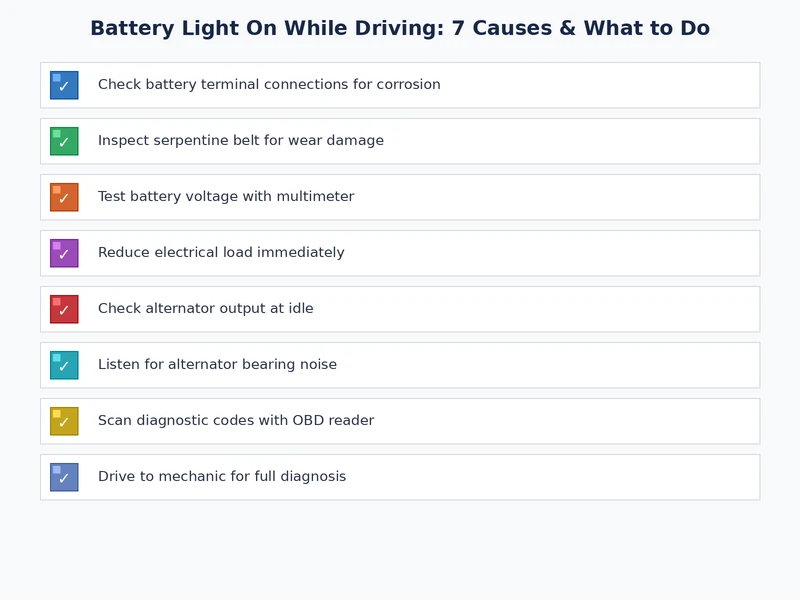
Prevention is consistently cheaper than diagnosis and repair. The charging system is one of the most neglected areas of routine maintenance — and one of the simplest to keep healthy with a few consistent habits.
Our team recommends a quick visual battery inspection every three months. Specifically, look for:
Annual load testing at a parts store keeps most drivers well ahead of unexpected failures. A battery approaching the four-year mark deserves extra scrutiny even if it appears to be functioning normally — proactive replacement is far less disruptive than an unplanned breakdown.
Serpentine belt inspection belongs on the same schedule as coolant and brake fluid checks — every 30,000 miles or at every other oil change. Replacing a belt on a maintenance schedule costs a fraction of emergency repair costs after a snap on a busy road.
Terminal cleaning is a five-minute job. A paste of baking soda and water applied with an old toothbrush neutralizes corrosion effectively. Rinse with clean water, dry thoroughly, and apply a thin coat of dielectric grease or petroleum jelly to both terminals to slow future buildup. Our team treats this as an annual task alongside other under-hood checks.
This is the most urgent practical question when the battery light on while driving first appears. The right answer depends entirely on what else is happening in the car at that moment.
In some situations, covering a limited distance is an acceptable risk:
Even in these scenarios, our team recommends switching off non-essential electrical loads — heated seats, rear window defrost, high-output audio — to reduce strain on the battery reserve while getting to safety.
Pull over and call for a tow without hesitation in any of these situations:
A stalled vehicle in moving traffic is a genuine safety hazard. Our team strongly advises against gambling on reaching a destination when multiple systems are showing signs of failure. The cost of a tow is always lower than the cost of a collision or extended roadside wait in a dangerous location.
It depends on whether the alternator is still producing any output at all. With a completely failed alternator, most vehicles run on battery reserve for 20 to 60 minutes before systems start failing. With a partially working alternator or a minor fault like a loose cable, a car may run for considerably longer. Our team never recommends relying on that window unless the destination is very close and the car is clearly not deteriorating.
Yes, indirectly. A severely sulfated or internally shorted battery forces the alternator to work continuously at maximum output to compensate, which overheats the voltage regulator and wears the brushes prematurely. This failure cycle — weak battery overloading the alternator — is a common pattern in older high-mileage vehicles. Our team always tests both components together rather than in isolation.
An alternator produces less current at low engine speeds. If the unit is marginal, it may charge adequately at highway speeds but fall short at idle, causing voltage to sag and the warning light to trigger. A worn serpentine belt tensioner that allows slipping at low RPM creates the identical pattern and is worth ruling out first since it’s a cheaper fix.
In most vehicles, the battery warning light resets automatically once the charging system returns to normal operating voltage — no scan tool needed to clear it. If the light stays on after a confirmed successful repair, a faulty instrument cluster sensor or a secondary fault code stored in the PCM is worth investigating with a diagnostic scanner.
Based on our team’s experience, yes — especially in vehicles over 80,000 miles. Alternator failure is the leading cause of the battery light on while driving in higher-mileage vehicles. The battery itself is the primary culprit in newer vehicles and those sitting unused for extended periods. Either way, testing both before replacing anything is the correct first move.
 |
 |
 |
 |

About Joshua Thomas
Joshua Thomas just simply loves cars and willing to work on them whenever there's chance... sometimes for free.
He started CarCareTotal back in 2017 from the advices of total strangers who witnessed his amazing skills in car repairs here and there.
His goal with this creation is to help car owners better learn how to maintain and repair their cars; as such, the site would cover alot of areas: troubleshooting, product recommendations, tips & tricks.
Joshua received Bachelor of Science in Mechanical Engineering at San Diego State University.
Get some FREE car parts & gear.. Or check out the latest free automotive manuals and build guides here.
Disable your ad blocker to unlock all the hidden deals. Hit the button below 🚗
| | | |
