Car Care ›
by Diego Ramirez
You walk to your car on a frigid morning, turn the key, and hear nothing but a slow groan. A dead battery strands you faster than almost any other mechanical failure. Selecting the best car battery charger before that moment arrives is one of the smartest investments you can make in vehicle ownership.
Whether you maintain a daily commuter, store a classic seasonally, or manage a small fleet, the right charger eliminates dependence on jump-start cables and roadside assistance. Understanding how much car batteries cost puts the value of prevention in sharp perspective. This guide reviews six top-rated chargers, explains every critical specification, and walks you through the complete charging process.
Contents
Every vehicle owner benefits from having a dedicated charger on hand. Jump-start cables require a second vehicle and a willing stranger. A standalone charger gives you complete, unconditional independence.
Short urban trips are the primary cause of undercharged batteries. Your alternator requires sustained highway speeds to fully replenish a depleted cell. Drivers covering less than 15 minutes per trip accumulate a chronic charge deficit over weeks.
Connecting a smart charger overnight once a month eliminates sulfation buildup — the leading cause of premature battery failure across all vehicle types.
Stored vehicles lose roughly 1% of charge per day through self-discharge alone. A battery stored for three months without maintenance falls below the 12.0V recovery threshold. Below that voltage, sulfation becomes permanent and irreversible — no charger corrects it.
If you store a classic, a convertible, or a recreational vehicle, a maintenance-mode trickle charger is non-negotiable. When you prepare your car for winter storage, connecting a float charger is the single most effective step for spring readiness. Classic car owners face an especially acute need — the full detailing and preservation protocol is covered in our guide on detailing a classic car without causing damage.
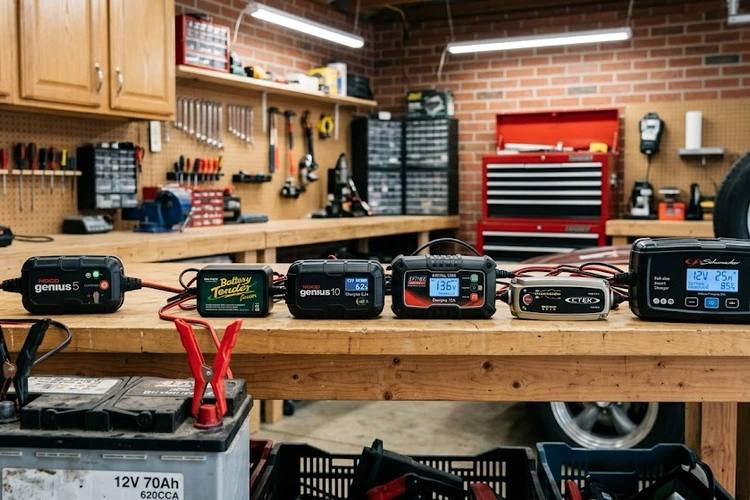
Each charger below was evaluated on output accuracy, multi-stage charging capability, safety protections, ease of use, and overall value. All six handle standard 12V lead-acid chemistry. Compatibility beyond that varies by model.
| Model | Max Output | Battery Types | Maintenance Mode | Best For |
|---|---|---|---|---|
| NOCO Genius10 | 10A | 6V/12V, AGM, Lithium | Yes | Best Overall |
| CTEK MXS 5.0 | 5A | 12V, AGM, Gel | Yes | Best Premium |
| Battery Tender Plus 1.25A | 1.25A | 12V, Flooded, AGM | Yes | Best Maintainer |
| Schumacher SC1280 | 15A | 6V/12V, AGM, Gel, Ca/Ca | Yes | Best for Large Batteries |
| Black+Decker BM3B | 1.5A | 12V, Flooded, AGM | Yes | Best Budget |
| Optima Digital 400 | 4A | 12V, AGM, Spiral-Cell | Yes | Best for AGM |
NOCO Genius10 — Best Overall. The Genius10 delivers 10A output with an eight-step charging algorithm covering desulfation, soft start, bulk, absorption, and float modes. Its 56V repair mode recovers deeply discharged batteries reading as low as 1V — a capability that no competitor at this price matches. Reverse-polarity protection and spark-proof clamps make it safe for users at any experience level.
CTEK MXS 5.0 — Best Premium. CTEK's flagship 12V charger uses patented pulse charging during the maintenance phase to actively condition cell plates and suppress sulfation. Automatic temperature compensation adjusts charge voltage based on ambient conditions — critical in climates with extreme seasonal swings. Build quality is exceptional, and the unit carries a five-year warranty that competitors do not match.
Battery Tender Plus 1.25A — Best Maintainer. This charger excels in long-term storage scenarios. It transitions automatically to float mode at full charge and never overcharges. The 4-pin quick-disconnect harness supports permanent installation in the engine bay, eliminating clamp fumbling every session. No other maintainer at this price point offers comparable connector quality.
Schumacher SC1280 — Best for Large Batteries. Truck, SUV, and marine batteries above 100Ah require higher initial charge currents to reach full saturation efficiently. The SC1280 delivers 15A with full multi-stage automatic control. Its LCD display shows real-time voltage, amperage, and charge percentage — diagnostic data that budget smart chargers consistently omit.
Black+Decker BM3B — Best Budget. At under $25, the BM3B delivers automatic float maintenance with no-frills reliability. It lacks desulfation and forced-start recovery modes. For a healthy battery used seasonally, it performs exactly as required. Do not use it on any battery reading below 3V.
Optima Digital 400 — Best for AGM. AGM and spiral-cell batteries require tighter voltage regulation than flooded cells tolerate. The Optima Digital 400 is factory-tuned for Optima's own REDTOP and YELLOWTOP batteries but handles all AGM chemistry correctly. Its recovery mode restores batteries that standard chargers refuse to recognize.
Pro Tip: Never use a standard lead-acid charger profile on a lithium iron phosphate (LiFePO4) battery. Incorrect chemistry selection causes thermal runaway, which is a serious and potentially irreversible fire hazard.
The distinction between smart and basic chargers matters enormously for long-term battery health. Choosing the wrong type costs you money and risks permanent damage.
A basic trickle charger delivers a constant low current regardless of battery state. This approach works under one narrow condition: the battery is in confirmed good health, and you supervise the entire charge cycle personally. An unattended basic charger on a full battery overcharges the cells, causes excessive gassing, and warps the internal plates.
A multi-stage smart charger monitors battery voltage in real time and adjusts output dynamically throughout the cycle. It applies maximum current during bulk phase, reduces current during absorption, and transitions to a precision pulse-maintenance float that eliminates overcharge risk entirely.
Smart chargers are mandatory in four situations:
The price premium — typically $20–$40 over a basic unit — pays for itself with a single avoided battery replacement.
Matching specifications to your battery's size, chemistry, and use pattern is the foundation of any correct purchasing decision. Ignore any single variable and the charger you select will either underperform or cause damage.
Charge rate is measured in amps. The standard rule: charge at 10% of the battery's cold cranking amp (CCA) rating for the safest full cycle. A 600 CCA battery charges optimally at 6A. Higher amperage shortens charge time but generates more heat and stress on cell plates.
Modern vehicles use four primary battery chemistries. Verifying charger compatibility before purchase is non-negotiable.
Confirm the factory battery specification in your owner's manual before selecting a charger. When you prepare your car for sale, documenting the battery chemistry and providing the correct charger information is a meaningful value-add for prospective buyers.
Warning: Charging a gel-cell battery with a standard AGM charger profile — even once — permanently damages the cell plates and voids the battery's warranty.
Proper technique protects both the battery and your vehicle's sensitive electronics. Follow this sequence every time without deviation.
Before connecting any charger, complete these steps in full:
Connect and charge in this exact order to prevent sparks near the battery terminals:
After charging, verify resting voltage with a multimeter 30 minutes after disconnection. A fully charged 12V battery reads 12.6–12.8V at rest. Anything below 12.4V indicates diminished capacity that warrants further investigation or load testing.
Even with the correct equipment, you will encounter failure modes on occasion. These are the most common issues and their verified solutions.
Smart chargers refuse to begin charging if they detect battery voltage below their recognition threshold — typically 3–6V depending on the model. A battery reading below that threshold is too deeply discharged for a standard charge mode to engage.
A battery that charges fully but loses voltage within 24–48 hours has internal failure — sulfation, a shorted cell, or separator degradation. No charger reverses mechanical failure. Desulfation mode addresses mild sulfation only, not a dead cell. Verify with a dedicated load tester before condemning the battery.
Charge time depends on battery capacity and charger amperage. A standard 50Ah battery charged at 5A requires approximately 10 hours for a complete cycle. At 10A, the same battery charges in approximately five hours. Smart chargers reduce output during the absorption phase, so actual time runs 20–30% longer than simple amp-to-capacity math predicts.
Yes, with a smart charger using automatic float maintenance. Modern smart chargers can remain connected indefinitely without disconnecting the battery. Avoid high-amperage manual chargers while the battery remains connected — voltage spikes above 15V damage the ECU, body control module, and other sensitive electronics throughout the vehicle.
A battery charger delivers sufficient current to restore a depleted battery to full charge. A battery maintainer delivers a small trickle current to offset self-discharge in a battery already at full capacity. Most smart chargers perform both functions automatically through their multi-stage algorithm, transitioning from charge mode to float maintenance without any manual intervention.
Yes. Smart chargers with automatic float mode are specifically designed for indefinite connection. Once the battery reaches full charge, the unit reduces output to a maintenance pulse that prevents both overcharge and sulfation simultaneously. The Battery Tender Plus and CTEK MXS 5.0 are both rated and tested for permanent, unattended connection.
Only chargers with a dedicated boost or engine-start mode can provide the current required for cranking. A standard 5–10A smart charger cannot deliver the 200–600A that a starter motor demands. The Schumacher SC1280 includes a 40A engine-start mode for this purpose. For reliable emergency starting, a dedicated lithium jump starter pack is more appropriate than any standard charger.
A fully charged lead-acid 12V battery at rest reads 12.6–12.8V. A surface charge immediately after disconnecting the charger can temporarily read 13.0–13.2V — this stabilizes within 30 minutes. A resting voltage below 12.4V indicates a battery at 50–75% state of charge. Below 12.0V, active sulfation is already in progress and requires immediate attention.
The best car battery charger for your situation is the one matched precisely to your battery's chemistry, capacity, and use pattern. Select a smart multi-stage unit for anything beyond occasional top-ups, verify chemistry compatibility before purchase, and follow the connection sequence every time. Start with the NOCO Genius10 for a single tool that handles every scenario — or select from the five alternatives above based on your specific battery type and budget. Purchase your charger this week, connect it on your next maintenance day, and eliminate the dead-battery scenario permanently from your schedule.
 |
 |
 |
 |

About Diego Ramirez
Diego Ramirez has been wrenching on cars since his teenage years and has built a deep practical knowledge of automotive maintenance and paint protection through years of hands-on work. He specializes in fluid service intervals, preventive care routines, exterior protection products, and the consistent habits that extend a vehicle's lifespan well beyond average. At CarCareTotal, he covers car care guides, cleaning and detailing products, and exterior maintenance and protection reviews.
Get some FREE car parts & gear.. Or check out the latest free automotive manuals and build guides here.
Disable your ad blocker to unlock all the hidden deals. Hit the button below 🚗
| | | |
