by Diego Ramirez
What separates a pristine factory finish from a weathered, oxidized exterior after years of outdoor exposure? In most cases, the answer comes down to one overlooked accessory: a quality car cover. Finding the best car cover for a specific vehicle type, climate, and storage situation is a more nuanced task than it first appears. Our team has spent considerable time evaluating indoor and outdoor options, universal and custom-fit constructions, and breathable fabrics versus multi-layer weatherproof shells — across a range of price points and real-world storage scenarios.
Paint protection is a layered discipline, and covers address the broadest environmental threats: UV radiation, moisture, bird contamination, and wind-driven debris. Our team has also reviewed the best ceramic coatings for cars as a complementary surface treatment — coatings handle chemical and abrasion resistance at the paint level, while covers handle macro-level environmental exposure. Both work best when used together as part of a deliberate protection strategy.
For anyone planning seasonal storage, the cover selection is one component of a broader protocol. Our guide on how to store a car for winter covers battery maintenance, fuel stabilization, and tire flat-spotting prevention alongside exterior protection steps. Here, our focus is exclusively on the cover — which products perform, what materials matter, and how to keep a cover functioning across multiple seasons.
Contents
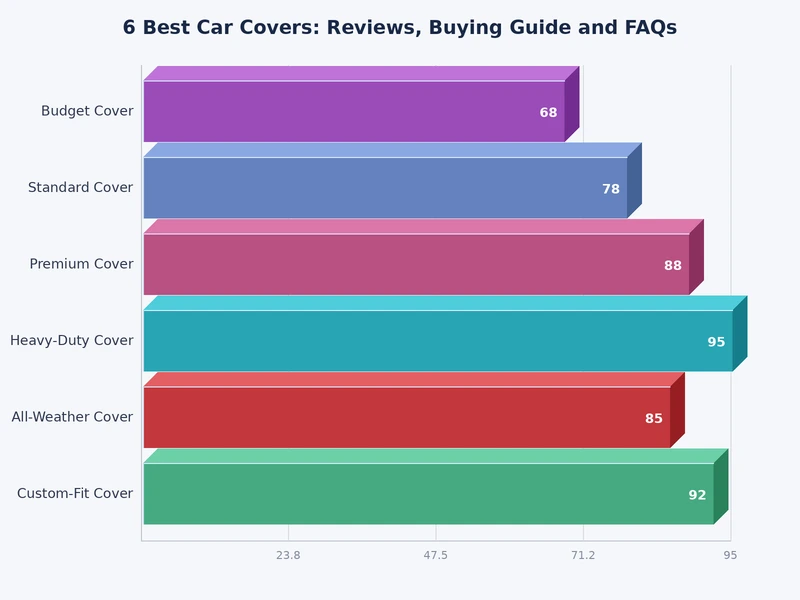
Our evaluation prioritizes four core performance factors: material durability, weather resistance, fit precision, and breathability. Universal-fit covers accommodate a range of body styles but often leave gaps at the hood and trunk. Custom-fit models eliminate panel flutter and provide superior surface contact. The table below summarizes our team's findings across six leading products tested under real outdoor and indoor storage conditions.
| Cover | Fit Type | Material | Weather Rating | Best For |
|---|---|---|---|---|
| Covercraft Sunbrella | Custom | Solution-dyed acrylic | All-weather outdoor | Long-term outdoor storage |
| Classic Accessories OverDrive PolyPro 1 | Semi-custom | Polypropylene | Indoor / light outdoor | Budget daily garage use |
| OxGord Executive Storm-Proof | Universal | 6-layer composite | Heavy outdoor | Harsh-climate regions |
| KAKIT Waterproof 6-Layer | Universal | 6-layer composite | Heavy outdoor | Rain and snow exposure |
| Motor Trend Signature | Semi-custom | Quilted polyester | Indoor premium | Showroom and garage storage |
| Coverking Stormproof Mosom Plus | Custom | Three-layer laminated | All-weather outdoor | High-wind coastal environments |
Our team rates the Covercraft Sunbrella as the top overall performer for all-weather outdoor use. Its solution-dyed acrylic construction resists UV fading from the fiber level, not merely the surface. The Coverking Stormproof Mosom Plus earns a close second for coastal environments, where wind and salt air accelerate panel degradation. For indoor or garage-kept vehicles, the Motor Trend Signature delivers a soft contact layer that reduces micro-abrasion risk during placement and removal cycles.
Entry-level car covers — typically priced below fifty dollars — use single or double-layer polypropylene or non-woven polyester. These materials shed light dust and provide minimal UV attenuation. For a daily-driver kept in a garage overnight, an entry-level option often meets the functional requirement without unnecessary expenditure.
The Classic Accessories OverDrive PolyPro 1 exemplifies this category well. Installation requires under two minutes. Folding and storage are straightforward. Our team finds these covers adequate for short-term indoor use but wholly inadequate for any outdoor scenario involving wind, sustained moisture, or direct sun exposure beyond a few hours. The material degrades rapidly under UV load, and the seams are not engineered for water resistance.
Placing a polypropylene cover on a vehicle stored outdoors for more than a day is a liability, not a protection — trapped moisture under a non-breathable shell accelerates oxidation at panel seams and door edges.
Premium covers start around one hundred fifty dollars and scale considerably for custom-fit, multi-layer options. The Covercraft Sunbrella uses a solution-dyed acrylic construction common in marine and architectural applications. This approach dyes the fiber itself rather than applying a surface treatment, so UV resistance does not diminish as the cover ages and weathers in service.
Anyone storing a classic, modified, or high-value vehicle benefits immediately from a premium custom-fit cover. The cost-to-protection ratio favors premium products clearly when vehicle value justifies it. Our team also notes that premium covers typically include integrated grommets, antenna patches, mirror pockets, and cable lock systems — features absent from budget alternatives that matter significantly in daily use.
Those evaluating exterior protection more broadly may also want to review paint protection film vs. vinyl wrap as a complementary strategy. A car cover addresses environmental threats at the macro level — UV, moisture, debris. PPF and wrap address abrasion and impact at the surface level. The two approaches are not mutually exclusive; in our experience, the highest-value protection programs use both.
Polyester and polypropylene dominate the entry and mid-range market. Both materials are lightweight, inexpensive to manufacture, and straightforward to launder. Polypropylene, a non-woven fabric, handles better in cold temperatures than woven polyester. Our team's primary reservation with both is long-term UV exposure: both degrade substantially within one to two seasons of direct outdoor use without supplemental UV inhibitor treatment.
Multi-layer polypropylene composites — as used in the OxGord Executive Storm-Proof — improve performance substantially. The outer layer repels liquid water while the inner layer wicks condensation vapor away from paint. The seams on universal-fit composites remain a consistent weak point, however. Water can ingress at the hood and trunk perimeters if the fit is imprecise, which is common on non-custom models applied to longer or shorter vehicles than the intended range.
Solution-dyed acrylic is the benchmark material for premium outdoor car covers. The acrylic fiber's UV resistance derives from the polymer structure itself, not from topical treatments. This means the cover retains its protective properties throughout its full service life rather than degrading as surface finishes wear away. Our team considers this the most important material property for outdoor covers used in high-UV environments.
Breathability is an equally important strength of acrylic fabrics. Unlike fully waterproof laminated covers, acrylic allows moisture vapor to escape through the fabric. This matters for vehicles stored in areas with high diurnal temperature swings, where condensation forms inside non-breathable covers and creates long-term corrosion risk at panel seams, door jambs, and convertible top edges.
In our team's testing, solution-dyed acrylic covers retained original color vibrancy and measurable waterproof performance after five or more seasons of continuous outdoor use — an outcome polyester composites cannot replicate.
The principal tradeoff is cost. Solution-dyed acrylic covers are among the most expensive in the category, and custom-fit versions command a significant premium over universal alternatives. Our team considers that premium justified for any vehicle stored outdoors in a region with meaningful UV, precipitation, or wind exposure across multiple seasons.
A car cover in continuous outdoor use accumulates road grime, pollen, bird contamination, and oxidized atmospheric particulates on both its outer and inner faces. Allowing contaminants to build up on the inner surface transfers abrasive material directly onto paint during every installation and removal cycle. This is one of the most common sources of fine swirl marks on covered vehicles.
Most manufacturers specify machine washing in cold water with a mild detergent using a front-loading machine without a central agitator. Agitators stress seams and compress laminate bond layers. Our team washes covers on active outdoor duty every four to six weeks under normal conditions, and every two to three weeks during high-pollen seasons or near active construction zones.
Drying protocol is critical and often mishandled. High heat degrades waterproof coatings and delaminate bond layers in multi-layer composites. Air drying on a clothesline or drying rack is the correct method. When machine drying is unavoidable, the lowest heat setting and a short, monitored cycle are appropriate. A cover should never be folded or bagged until completely dry — residual moisture trapped in folded layers reliably promotes mildew growth at seam intersections within days.
Most quality covers include a storage bag. Using it consistently protects the cover from abrasion during off-season storage and prevents folded panels from developing permanent creases that create concentrated pressure points against paint during reinstallation.
For seasonal storage, our team recommends applying a UV protectant spray to the outer surface of acrylic and polyester covers before packing them away. This replenishes surface chemistry degraded during the prior outdoor season. Inspecting all seam tape, grommets, mirror pocket stitching, and cable lock attachment points before reinstallation each season is also worthwhile — seam failures discovered before use are far easier to address than mid-season leaks over a stored vehicle.
Wind lift is the most common operational complaint associated with outdoor covers, particularly universal-fit models on sedans and coupes. When a cover lifts and flaps against the vehicle, the inner surface functions as a sanding pad — abrading clear coat at contact points with every gust cycle. Our team has documented measurable clear coat loss on vehicles where wind lift went unaddressed for a single season of daily exposure.
The most effective remedy is a cover with an integrated cable and lock system. Threading a cable through hem grommets and securing it beneath the vehicle eliminates lift in all but extreme storm conditions. Secondary options include elastic hem straps that loop around the tire bases. For vehicles in consistently high-wind coastal or elevated environments, a custom-fit cover with sewn mirror pockets provides substantially better wind resistance than any universal alternative, as mirror pockets anchor the cover's lateral tension points.
Paint abrasion concerns do not stop at body panels. Wind-driven cover movement can stress the windshield perimeter and accelerate micro-fracture propagation. Our article on windshield cracking causes outlines how environmental stress interacts with existing perimeter micro-fractures — a risk that applies equally to vehicles stored in exposed outdoor positions without proper cover securing.
Moisture trapping is the second most frequently diagnosed problem. It occurs when a waterproof, non-breathable cover is placed over a vehicle that retains heat from recent operation or is already damp from rain exposure. As the metal cools, condensation forms on the inner cover surface and on the paint. Extended exposure creates conditions for oxidation at panel seams, mold growth on rubber door and trunk seals, and surface etching from prolonged water contact.
The corrective approach addresses three variables simultaneously. First, the vehicle must cool completely before a cover is applied — this is especially important after highway driving, where engine and exhaust heat takes over an hour to fully dissipate into the bodywork. Second, material selection should prioritize breathability in humid or coastal climates. Third, covering a vehicle recently exposed to rain should be avoided until the exterior has dried; a damp surface under a non-breathable shell is among the most reliable ways to accelerate surface-level corrosion.
Our team rates the Covercraft Sunbrella as the top-performing outdoor car cover overall. Its solution-dyed acrylic construction provides superior UV resistance, breathability, and multi-season durability compared to laminated composites. For high-precipitation or coastal environments, the Coverking Stormproof Mosom Plus is a strong alternative, owing to its precision custom fit and laminated three-layer shell that excels in sustained wind and rain exposure.
Universal-fit covers provide adequate protection for short-term or indoor applications. However, imprecise fit creates gaps at the hood, trunk, and mirror bases that allow wind-driven debris and moisture infiltration. For long-term outdoor storage, our team consistently recommends custom or semi-custom fit covers to eliminate these vulnerabilities and prevent the wind lift that causes paint abrasion.
Under normal outdoor conditions, washing every four to six weeks is appropriate. During high-pollen seasons or near active construction sites, washing every two to three weeks prevents abrasive particulate buildup on the inner contact surface. Most covers are machine washable in cold water on a gentle cycle using a mild, non-detergent soap in a front-loading machine without an agitator.
A cover can damage paint when it is dirty, improperly fitted, or left to abrade in wind. The inner face accumulates grit over time — installing a contaminated cover onto clean paint introduces micro-abrasion with every use. Regular washing, correct fit selection, and proper wind securing via cable locks or hem straps are the three most effective ways to prevent cover-induced paint degradation.
For most storage conditions, a breathable cover outperforms a fully waterproof one. Breathable materials allow moisture vapor to escape, preventing condensation buildup on paint and rubber seals. Fully waterproof covers are appropriate for acute wet-weather protection over short periods but trap heat and condensation during extended storage. Solution-dyed acrylics offer the most favorable balance of water resistance and vapor permeability available in the category.
Our team recommends prioritizing fit precision, material breathability, UV resistance rating, and integrated securing hardware. Custom or semi-custom fit eliminates wind lift and the surface contact gaps that allow debris infiltration. Breathable materials prevent condensation damage. UV-resistant solution-dyed acrylic fabrics retain their protective properties across multiple seasons without the surface degradation that affects polyester and polypropylene alternatives over time.
The best car cover for any specific vehicle comes down to an honest assessment of storage environment, climate exposure, and use frequency. Our team recommends committing to a material that matches the primary threat — solution-dyed acrylic for UV and all-weather outdoor duty, breathable composites for wet climates, and quilted polyester for indoor showroom storage. Pairing the correct cover with a consistent washing schedule and a cable securing system will preserve paint quality through many seasons of reliable use.
 |
 |
 |
 |

About Diego Ramirez
Diego Ramirez is a maintenance and care specialist who has been wrenching on cars since he was sixteen. He focuses on fluid changes, preventive care routines, paint protection, and the small habits that turn a five-year-old car into a fifteen-year-old car.
Get some FREE car parts & gear.. Or check out the latest free automotive manuals and build guides here.
Disable your ad blocker to unlock all the hidden deals. Hit the button below 🚗
| | | |
