by Diego Ramirez
The best wheel cleaner dissolves brake dust, iron particles, and road grime on contact — no scrubbing required on most surfaces. If your wheels are coated, chrome-plated, or bare polished aluminum, the formula you choose determines whether you walk away with spotless rims or an etched, stained mess.
This guide reviews six wheel cleaners tested across alloy, chrome, and powder-coated finishes. You'll find a side-by-side comparison, a step-by-step application walkthrough, a cost breakdown by tier, and the mistakes that send wheel finishes to an early grave. For alloy-specific technique, the full process is covered in our guide on how to clean alloy wheels.
Contents
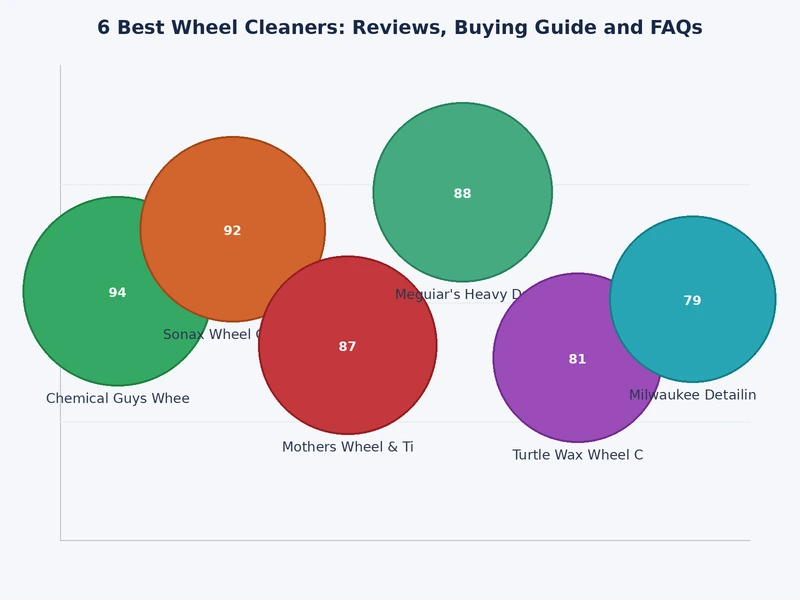
These six products represent the strongest performers across different wheel types and budgets. Each one handles brake dust and iron contamination — the two primary sources of wheel staining — but they differ in pH aggressiveness, dwell sensitivity, and the range of finishes they can safely touch.
| Product | Formula Type | pH Level | Safe For | Best Use Case |
|---|---|---|---|---|
| Meguiar's Hot Rims All Wheel | Non-acid, color-change | ~7 (neutral) | All finishes | Daily drivers, beginners |
| CarPro Iron X | Iron-reactive, mildly acidic | ~3–4 | Coated, painted | Heavy iron decontamination |
| Chemical Guys Diablo | Alkaline, foaming | ~9–10 | Most alloy, painted | Weekly maintenance cleaning |
| Sonax Wheel Cleaner Full Effect | Iron-reactive, neutral-alkaline | ~7–8 | All finishes | Safe deep cleaning, all wheels |
| Adam's Wheel Cleaner | Non-acid, color-change | ~7 | All finishes | Ceramic-coated wheels |
| P21S 100% Biodegradable | Acid-free, gel-based | ~6–7 | All finishes incl. chrome | Chrome, polished, sensitive finishes |
Meguiar's Hot Rims and Adam's Wheel Cleaner are the safest all-rounders — both are pH-neutral and iron-reactive without the risk of over-etching on sensitive clear coats. CarPro Iron X is the most aggressive decontaminant of the group and belongs on wheels with heavy ferrous buildup, not in a routine wash rotation. Sonax Full Effect occupies the most balanced position: mildly alkaline, iron-reactive, and listed by Sonax as approved for all factory wheel finishes without exception.
pH is the most consequential spec on any wheel cleaner label, and most buyers ignore it entirely. Acid-based formulas below pH 4 cut through mineral scale and heavy oxidation fast, but they will etch uncoated aluminum and discolor anodized or polished finishes on contact. Alkaline formulas above pH 9 dissolve organic grease and carbon deposits effectively but strip wax, sealant, and ceramic coating layers with repeated use.
Neutral formulas between pH 6 and 8 work safely across the widest range of finishes. If you run ceramic-coated wheels, a neutral or mildly alkaline formula is the correct specification — strong acids degrade the Si-O bond layer that ceramic coatings depend on for hydrophobic performance. According to Wikipedia's overview of alloy wheel construction, most OEM alloy wheels use a factory clear coat applied directly over bare alloy, making them vulnerable to attack at both ends of the pH scale.
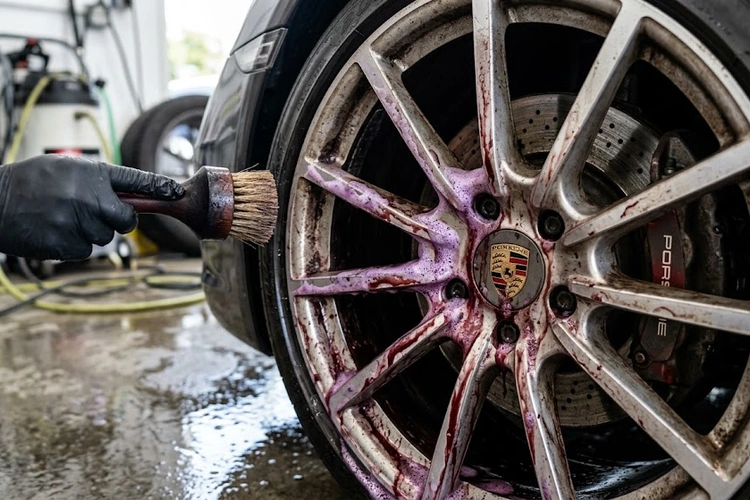
Iron-reactive wheel cleaners contain thioglycolic acid derivatives or similar sulfur compounds that form a colored complex with free iron ions on contact. The result is a purple or reddish bleed visible on the wheel surface — a direct visual indicator of where brake dust contamination is concentrated and whether the chemistry is working. Non-iron-reactive formulas give you no such confirmation.
On heavily contaminated wheels, an iron-reactive formula consistently outperforms a comparably priced non-reactive product in single-pass contamination removal. The color change also tells you when dwell time is complete: once the bleeding slows or stops, the reaction has peaked and the product needs to be rinsed before it begins attacking the substrate instead of the contamination.
Meguiar's Hot Rims, Chemical Guys Diablo, and P21S are consumer-positioned products — ready-to-use, widely available at auto parts retailers, and formulated conservatively enough that an inexperienced user won't immediately damage their wheels on first contact. These products are sold pre-diluted at the correct concentration for direct spray application. Dwell windows are forgiving: 30–60 seconds on lightly contaminated surfaces, up to 3–4 minutes on heavier buildup.
CarPro Iron X and Adam's Wheel Cleaner are detailing-industry staples used in professional shops. Iron X is deployed at 1:3 to 1:5 dilution for maintenance washing and full-strength as a pre-ceramic decontamination step before coating application. Adam's is sold ready-to-use but engineered to be safe on ceramic-coated surfaces — a hard requirement for shops protecting customer investments with products like those reviewed in our best ceramic coating roundup.
Sonax Full Effect is technically a consumer product but performs at professional tier. European detailing studios use it as a standard iron decontaminant before paint correction. The gap between consumer and professional grade is not always formulation strength — it's concentration control, dwell sensitivity, and how much margin for user error the product tolerates.
Never apply wheel cleaner to a hot wheel. Brake rotors and calipers reach 200–400°C under normal city driving. Residual heat from the rotor transfers through the hub and raises the wheel surface temperature significantly. A pH-3 formula that performs safely at ambient temperature will etch a clear-coated surface in under 30 seconds when the wheel is sitting at 60°C. Let the vehicle cool for a minimum of 30 minutes after driving before any chemical contact.
The sequence below applies to all six products reviewed here. Timing windows vary by product and contamination level — always follow the label. The process is consistent:
Wheel cleaner pricing ranges from under $10 for entry-level spray bottles to over $25 for professional iron decontaminants. Cost-per-wash — not sticker price — is the metric that matters. A standard 16 oz bottle covers four wheels per wash at recommended coverage; a 32 oz bottle cuts per-wash cost nearly in half. Here's how the tiers break down:
Budget-tier products are false economy when you're washing coated or polished wheels. A single etched finish costs more to restore — through polishing, re-coating, or refinishing — than a full year's supply of premium cleaner. Pair your wheel care routine with a portable tire inflator for complete wheel bay maintenance between detail sessions.
A wheel cleaner is necessary but not sufficient. The brushes and accessories in your kit determine how much contamination you actually remove per pass and whether you introduce new surface scratches in the process.
Pro tip: After every wheel cleaning session, take 60 seconds to inspect your lug nuts for rust staining or visible swelling — the cleaning process removes contamination that was previously hiding early-stage corrosion. Our breakdown of loose lug nut symptoms covers exactly what to look for before it becomes a safety issue.
Weekly maintenance cleaning with a quality wheel cleaner takes under 10 minutes per vehicle when you're not working against heavy buildup. The key is consistency — never letting contamination accumulate to the point where a single pass can't handle it. These habits deliver the fastest visible results:
Consistency produces better long-term results than irregular deep cleaning. A five-minute wheel wash every week outperforms a 30-minute decontamination session every three months for finish preservation. Brake dust etching doesn't happen overnight — it builds over dozens of heat cycles on unremoved contamination. Interrupt that cycle early and your wheels stay cleaner with less total effort.
Most wheel cleaner damage doesn't come from choosing the wrong product. It comes from using the right product incorrectly. These are the errors that cause permanent finish damage and drive refinishing costs:
For alloy wheels with a factory clear coat, Sonax Wheel Cleaner Full Effect and Meguiar's Hot Rims All Wheel Cleaner are the strongest recommendations. Both are iron-reactive and pH-safe for clear-coated alloy without the risk of etching. Avoid strongly acidic formulas on alloy — pH levels below 4 will attack the clear coat and the bare alloy beneath it if the coating is already compromised.
Yes, but only an acid-free formula. P21S 100% Biodegradable Wheel Cleaner is the industry standard choice for chrome. Acid-based and strongly alkaline wheel cleaners will strip or pit chrome plating with repeated use. If your wheels are chrome-plated steel, a pH-neutral gel formula applied with a soft brush is the safe and effective approach.
Every week for daily-driven vehicles is the correct interval for maintenance cleaning. Brake dust is hot, abrasive, and ferrous — it begins bonding to clear coat within days of deposition. Heavy drivers in urban stop-and-go traffic, or anyone running aggressive brake compounds, should clean wheels at every wash. Monthly cleaning allows contamination to harden to a point where single-pass removal is no longer reliable.
Yes. All six products reviewed here are safe on painted wheel finishes when used within the recommended dwell time. The iron-reactive compounds in products like Sonax Full Effect and CarPro Iron X react with ferrous particles, not with paint or clear coat chemistry. The risk with iron-reactive formulas comes from extended dwell time or application to hot surfaces — not from the iron-reactive compound itself.
Only if the label specifies dilution ratios. CarPro Iron X, for example, is sold as a concentrate intended for 1:3 to 1:5 dilution for maintenance use and full-strength for pre-coating decontamination. Most consumer products like Meguiar's Hot Rims are sold ready-to-use. Using a concentrate at full strength for routine washing increases cost per wash significantly and may exceed the safe chemical exposure for your specific wheel finish.
Wheel cleaners target metallic contamination — brake dust, iron particles, and road grime on hard wheel surfaces. Tire cleaners are alkaline degreasers formulated to remove carbon black residue, road oils, and browning from rubber sidewalls. Using wheel cleaner on tires is generally ineffective. Using tire cleaner on wheels won't address iron contamination. They are complementary products used on adjacent surfaces, not interchangeable ones.
It can if product is left to pool on the caliper surface without being rinsed. Most painted calipers use a heat-resistant enamel that resists short chemical contact, but prolonged exposure to strongly acidic or alkaline formulas causes staining and enamel breakdown. The fix is thorough rinsing — flush runoff off the caliper face immediately after agitating the wheel. Dedicated caliper paint or ceramic caliper coating provides additional chemical resistance for track-driven vehicles.
Pick a wheel cleaner matched to your finish type, commit to a weekly wash schedule, and use the right brushes — those three decisions alone will keep your wheels looking new and prevent the kind of embedded contamination that forces costly refinishing. Start with Meguiar's Hot Rims or Sonax Full Effect if you're new to dedicated wheel care, and step up to CarPro Iron X for seasonal deep decontamination before winter or before a ceramic coating application. Your wheels take the worst beating of any exterior surface on your vehicle — give them the same attention you give your paint.
 |
 |
 |
 |

About Diego Ramirez
Diego Ramirez is a maintenance and care specialist who has been wrenching on cars since he was sixteen. He focuses on fluid changes, preventive care routines, paint protection, and the small habits that turn a five-year-old car into a fifteen-year-old car.
Get some FREE car parts & gear.. Or check out the latest free automotive manuals and build guides here.
Disable your ad blocker to unlock all the hidden deals. Hit the button below 🚗
| | | |
