by Sarah Whitfield
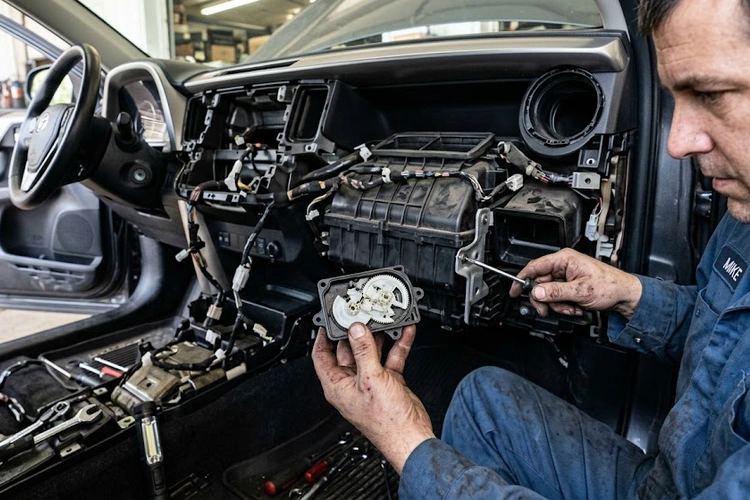
Ever wonder why one side of the cabin blows ice-cold air while the other feels like a furnace? That's one of the most telling blend door actuator symptoms — and it points to a small electric motor most drivers never consider until it quits. The blend door actuator controls a plastic flap (the blend door) inside the HVAC (heating, ventilation, and air conditioning) box. That flap mixes heated engine air with cold AC air to hit the cabin's target temperature. When the actuator fails, the flap gets stuck. Temperature control disappears.
The good news: blend door actuator symptoms follow predictable patterns. Catching them early cuts repair costs sharply — sometimes by hundreds of dollars. This guide covers every major symptom, explains how real shops diagnose the problem, breaks down replacement costs, and identifies the mistakes that turn a simple fix into an expensive ordeal.
Contents
Two categories cover nearly every complaint: temperature problems and noise. Most failing actuators show signs in both before they quit completely.
Temperature stuck at one extreme is the most common report. Turn the dial — nothing changes. Or the system locks at full heat, full cold, or some arbitrary midpoint it refuses to leave.
Noise is often the first clue. Most drivers hear it before they notice any temperature problem.
The typical sound is a repetitive clicking or ticking from behind the dashboard. It usually starts at startup or when adjusting the temperature dial. On startup, the HVAC module runs an actuator self-calibration sweep — a full door travel check. If the actuator can't complete it, the motor keeps retrying, producing that distinct tick-tick-tick pattern.
Grinding or crunching usually means the plastic gears inside the actuator are stripped. The motor spins freely. The door doesn't move.
That dashboard clicking at startup isn't the car warming up — it's the actuator failing its calibration cycle. Address it early before the blend door jams in one position permanently.
Modern vehicles store HVAC fault codes in a separate body control module. A basic OBD-II reader often misses them entirely. Shops use full-system scanners that access body codes — commonly in the B1xxx range on Ford and GM platforms, or within a dedicated HVAC module on Toyota and Honda vehicles.
That said, many actuator failures produce zero codes. Mechanical failures — stripped gears, seized motors — don't always trigger electronic fault flags. The scan is a starting point, not the whole diagnosis.
A technician disconnects the actuator connector and tests voltage at the harness. Voltage present but no actuator response points directly at the actuator. No voltage points to the control module or a wiring harness fault.
Good shops also move the blend door manually with the actuator disconnected. If the door pivots freely, the actuator is the culprit. If the door is stiff or jammed, there's a secondary problem — debris, a cracked door panel, or a broken pivot pin.
HVAC problems are easy to misread. A failed blower motor resistor causes similar climate control symptoms — no airflow at certain speeds, or no airflow at all. Confirm the diagnosis before ordering any parts.
Three components cause most cabin comfort complaints: the blend door actuator, the blower motor resistor, and the heater core. Their symptoms overlap — but the patterns are distinct enough to separate with a careful look. Misidentifying the fault leads to wasted labor time and wrong parts.
| Symptom | Blend Door Actuator | Heater Core | Blower Motor Resistor |
|---|---|---|---|
| Dashboard clicking noise | Yes — very common | No | No |
| No heat on both sides | Possible (door stuck cold) | Yes — primary symptom | No |
| One side hot, one cold | Yes — dual-zone systems | No | No |
| No airflow from vents | No | No | Yes — primary symptom |
| Sweet coolant smell inside | No | Yes — common early sign | No |
| Foggy windshield from inside | No | Yes — coolant mist | No |
| Airflow works, temp doesn't change | Yes — defining trait | Partial | No |
When no heat reaches either side of the cabin, heater core failure symptoms deserve a close look first — especially if there's a sweet smell or a fogging windshield alongside the temperature problem.
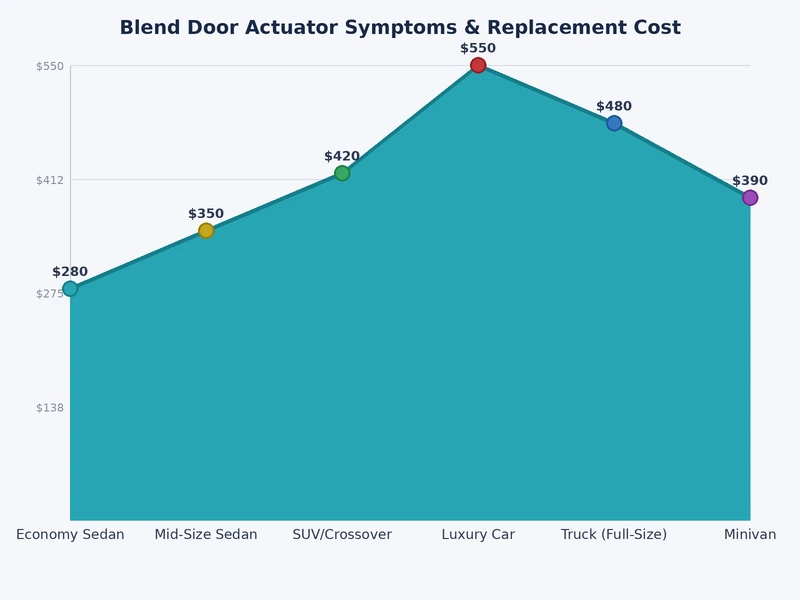
The actuator itself is inexpensive. OEM replacements typically run $25 to $80. Aftermarket parts — Dorman is the most widely trusted brand — cost $15 to $45. The part is not where repair costs spiral.
Labor is the real expense. On most vehicles, the blend door actuator sits deep behind the dashboard. Access requires partial or full dashboard removal. That's careful, time-consuming work with significant variation by vehicle.
Many vehicles have two or three blend door actuators — one for temperature blending, one for mode selection (vent, floor, defrost), sometimes a separate passenger-side unit on dual-zone systems. Each one carries its own labor cost if replacement is needed.
Warning: Saving $30 on a generic actuator is rarely worth it. Cheap plastic gears strip faster, especially in tight dashboards with sustained high heat. Use OEM or Dorman-grade parts.
Myth: "The clicking will stop on its own." It won't. Actuators don't self-heal. The clicking is mechanical failure in progress. Ignoring it means the blend door eventually jams permanently in one position.
Myth: "If the AC blows cold, the actuator is fine." False. The AC compressor and blower motor operate completely independently from the blend door system. Cold air can flow perfectly while the actuator fails — the result is air that can't be warmed at any setting.
Myth: "A new actuator always fixes the problem." Not always. Sometimes the blend door itself is cracked or detached from its pivot pin. A new actuator driving a broken door produces identical symptoms. Always inspect the door before ordering parts.
Myth: "It's always a DIY repair." On certain trucks and SUVs with accessible actuator positions, yes. On compact cars with tightly packaged dashboards, it's genuinely demanding work. Misaligning the blend door during reinstall creates a new set of problems. Know the specific vehicle before committing.
The most expensive mistake is replacing the actuator when the real fault is elsewhere. A $50 part swap wastes $200 in labor if the actual problem is a faulty HVAC control module or a broken door pivot. Full diagnosis before touching parts is non-negotiable.
Many vehicles carry two or three blend door actuators. Driver-side temperature, passenger-side temperature, and mode door actuators are not interchangeable. They look similar and often share part numbers across trim levels — until they don't. Always confirm position and part number against a vehicle-specific repair database before ordering.
A jammed or cracked blend door destroys a new actuator quickly. Always inspect the door's pivot condition and full travel range before installation. If the vehicle is also producing unusual smells through the vents, the car smells diagnostic guide covers mold and debris buildup near the evaporator — a common cause of door resistance that goes unnoticed during a quick actuator swap.
If the AC starts freezing up after a blend door repair, that's a separate refrigerant or airflow restriction issue — not a sign of a faulty actuator install.
Pro tip: Experienced technicians always move the blend door by hand before installing a new actuator. If it doesn't pivot smoothly through its full range, the door itself needs attention — not just the motor.
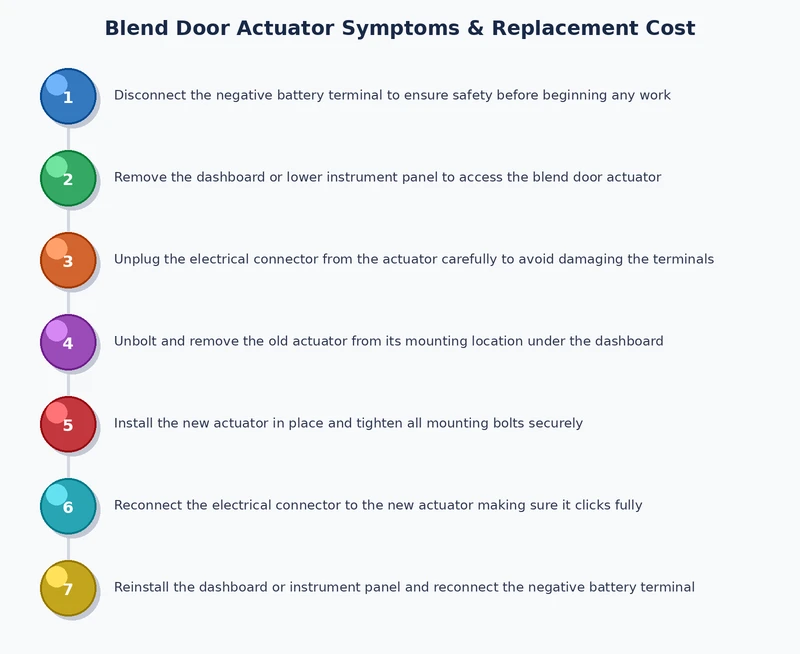
Most actuators require a recalibration cycle after installation. The HVAC module needs to learn the full range of the door's travel. Some vehicles need a scan tool command to trigger it. Others require a specific ignition cycle sequence — usually documented in the factory repair manual. Skip this step and the system may not respond correctly to temperature inputs, producing symptoms that look like another failed actuator.
Blend door actuators are plastic components operating in a hot environment. They wear out. There's no way to maintain an actuator directly. But a few consistent habits extend the overall HVAC system's lifespan:
For a broader understanding of how the blend door fits into the full climate control architecture, the Wikipedia overview of automobile air conditioning is a useful technical reference.
A failing blend door actuator most commonly produces a repetitive clicking or ticking from behind the dashboard. The noise typically happens at startup during the HVAC self-calibration sweep, or when adjusting the temperature dial. Stripped gears produce a grinding or crunching sound rather than clicking.
Yes. A failed blend door actuator does not affect engine operation, braking, or steering. The only consequence is loss of cabin temperature control. In extreme weather conditions, this becomes a serious comfort and safety concern — but it's not a mechanical breakdown requiring an immediate stop.
Most blend door actuators last between 10 and 15 years under normal use. Heat cycles and age degrade the plastic gears over time. Vehicles in hot climates or with heavy HVAC use may see earlier failure. There's no scheduled replacement interval — replace when symptoms appear.
It depends entirely on the vehicle. Some trucks and SUVs have easily accessible actuators that take under an hour to swap. Many passenger cars require partial or full dashboard removal — genuinely difficult work. Check a vehicle-specific forum or factory repair manual before deciding. Misaligning the blend door during reinstall creates new problems.
The blend door eventually jams in one position — usually full hot or full cold. Temperature control becomes impossible. On dual-zone vehicles, one side of the cabin loses all climate regulation. The clicking noise will continue or worsen until the motor burns out entirely.
Disconnect the actuator and try moving the blend door manually. If the door pivots freely through its full range but the actuator doesn't respond to voltage, the actuator is bad. If the door is stiff, jammed, or broken at the pivot, the door itself needs repair — regardless of the actuator's condition.
It affects temperature blending, not cooling power. If the door is stuck in the cold position, the AC appears to work normally but can't be warmed up. If stuck in the hot position, the AC can't cool the cabin. The AC compressor and refrigerant circuit are unaffected by actuator failure.
 |
 |
 |
 |

About Sarah Whitfield
Sarah Whitfield is a diagnostics and troubleshooting specialist who spent ten years as an ASE-certified technician before joining the editorial team. She specializes in OBD-II analysis, electrical gremlins, and the kind of intermittent problems that make most owners give up.
Get some FREE car parts & gear.. Or check out the latest free automotive manuals and build guides here.
Disable your ad blocker to unlock all the hidden deals. Hit the button below 🚗
| | | |
