by Sarah Whitfield
A driver notices sweet-smelling steam rising from the hood at a stoplight. The temperature gauge climbs into the red. By the time the car limps to the shop, the engine has already warped the cylinder head. These are textbook blown head gasket symptoms — and missing them early turns a $1,500 repair into a $5,000 engine overhaul.
Head gasket failure ranks among the most expensive repairs in automotive maintenance. The good news: the warning signs appear well before catastrophic damage sets in. This guide covers all 8 blown head gasket symptoms, walks through at-home diagnosis step by step, and breaks down realistic repair costs — including the most common causes of car overheating that trigger failure in the first place.
Contents
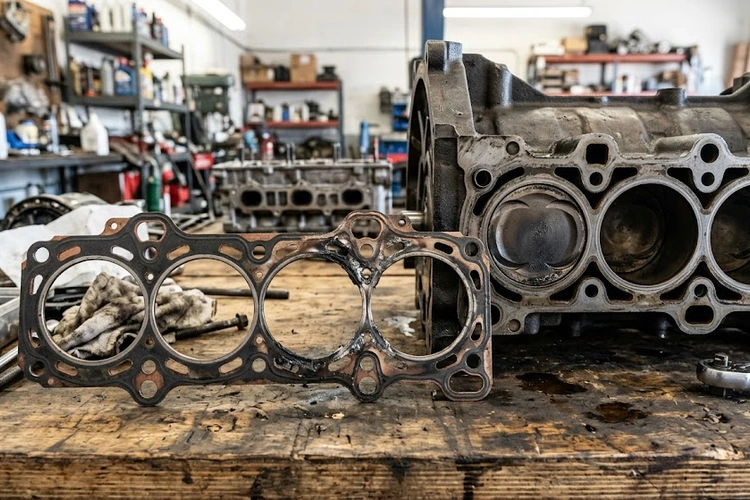
The head gasket sits between the engine block and cylinder head. It seals three separate circuits simultaneously: combustion chambers, coolant passages, and oil galleries. When it works, combustion gases stay in the cylinders, coolant stays in its passages, and oil stays in its channels.
A failed gasket lets these circuits mix. Combustion gases enter the cooling system. Coolant enters the combustion chamber. Oil and coolant contaminate each other. Each scenario causes rapid, compounding damage that escalates with every mile driven.
A failing thermostat is one of the most overlooked triggers. When the thermostat sticks closed, coolant stops circulating, temperatures spike, and the head gasket absorbs the damage. Catching bad thermostat symptoms early prevents a $250 repair from turning into a $2,500 one.
These blown head gasket symptoms range from dramatic to subtle. Some appear together; others surface alone. The more symptoms present simultaneously, the more confident the diagnosis. Each one warrants immediate investigation.
Thick, sweet-smelling white smoke from the exhaust pipe is the most recognizable sign. It differs from normal condensation on cold mornings — this smoke is dense, persistent, and does not clear after the engine reaches operating temperature.
The cause: coolant enters the combustion chamber and burns off as steam. The sweet odor comes from ethylene glycol combustion. Understanding exhaust smoke colors helps distinguish this from blue smoke (burning oil) or black smoke (rich fuel mixture) — both of which point to entirely different failures.
A blown gasket allows combustion gases to pressurize the cooling system. Air pockets form and block coolant flow. The result: rapid, unexplained overheating — even after the thermostat and radiator have been confirmed good.
Pull the dipstick. If the oil looks like a chocolate milkshake — light brown, frothy, or creamy — coolant has entered the oil system through the failed gasket. This is a critical finding that demands immediate engine shutdown.
Coolant-contaminated oil loses lubrication properties within minutes. Bearings, journals, and cam lobes begin wearing almost immediately. This symptom can also indicate a cracked block, but a blown head gasket is the far more common cause.
Warning: Running an engine with milky oil — even for a short drive — risks catastrophic bearing failure. Shut the engine off and have the vehicle towed.
The reverse scenario also occurs. Oil passages that breach into the cooling system deposit oil into the coolant. Look for a brown, oily film floating on top of the coolant or a greasy ring inside the reservoir neck and cap.
This symptom is less dramatic than milky oil but equally serious. Coolant contaminated with oil loses heat transfer efficiency, causing the engine to overheat faster and accelerating further gasket deterioration.
Some head gasket failures blow outward rather than inward. Coolant or oil seeps from the joint between the cylinder head and engine block — visible as wet staining, crusty mineral deposits, or oily residue along the mating seam.
External leaks are easier to spot and typically less catastrophic in the short term. However, they still indicate a compromised seal and will worsen under heat and pressure if left unaddressed. Ignoring them leads to internal failure.
Combustion chamber compression relies on a perfect seal. A blown gasket allows compression to leak between cylinders or escape into the cooling system. The result:
When two adjacent cylinders show equal low compression readings, this strongly suggests inter-cylinder leakage through a failed gasket rather than worn rings or valve issues — a useful diagnostic distinction.
With the engine running, continuous bubbling in the coolant reservoir — observed with the cap removed from a cold, depressurized system — indicates combustion gases entering the cooling system. This is distinct from normal circulation turbulence seen during warm-up.
A combustion leak detector (block tester) with blue reagent fluid confirms this definitively. The solution turns yellow in the presence of hydrocarbons from combustion gas. This test is the most reliable DIY confirmation method available and costs under $40 at most auto parts stores.
If coolant enters the combustion chamber in sufficient volume, a hydrolock event becomes possible. Liquids are incompressible. When a piston attempts to compress a cylinder full of coolant, the connecting rod bends or snaps. This is catastrophic and often requires full engine replacement.
Signs of imminent hydrolock:
Pro Tip: A block tester (combustion leak detector) confirms a blown head gasket faster and more reliably than any other single test — and costs less than an hour of shop labor.
Head gasket failure is not evenly distributed across all engine families. Certain designs carry documented vulnerabilities — some by material choice, some by geometry, some by original equipment specification decisions.
| Engine / Vehicle | Known Issue | Affected Years |
|---|---|---|
| Subaru EJ Series (2.5L) | Multi-layer steel gasket failures; inter-cylinder and external coolant leakage | 1999–2011 |
| GM 2.2L Ecotec (2nd Gen) | External coolant leaks at the head-block junction under normal operating conditions | 2002–2007 |
| Ford 6.0L Power Stroke Diesel | EGR cooler overheating rapidly destroys factory head gaskets; known design flaw | 2003–2007 |
| Chrysler 2.7L V6 | Oil sludge buildup accelerates gasket degradation; oil passages restrict prematurely | 1998–2010 |
| Toyota 22R-E (4-cylinder) | Generally robust; failures occur primarily from sustained overheating events | 1985–1995 |
| Northstar V8 (Cadillac) | Head bolt thread pullout in aluminum block; allows gasket to shift under pressure | 1993–2011 |
Engines pairing aluminum cylinder heads with iron engine blocks carry inherently higher risk. Differential thermal expansion rates stress the gasket sealing surface through every heat cycle over the engine's lifetime. Turbocharged engines face similar challenges due to elevated sustained combustion temperatures.
Once blown head gasket symptoms appear, driver behavior determines whether the repair bill stays manageable or balloons into engine replacement territory. Several common mistakes dramatically shorten the window for affordable repair.
Every minute spent driving an overheating engine warps the cylinder head further. Aluminum heads warp at temperatures that iron blocks tolerate without permanent damage. A warped head requires either resurfacing ($150–$300) or full replacement ($200–$800), adding directly to the total bill.
Bottled stop-leak products (sodium silicate, copper powder, sealer compounds) can temporarily seal minor external weeps. They do not repair internal failures — inter-cylinder leakage, coolant-in-oil contamination, and compression loss are beyond the reach of any stop-leak formulation.
Worse, stop-leak residue clogs radiator passages, heater cores, and water pump impeller ports, creating secondary failures that cost more than the original head gasket repair would have.
Not every blown head gasket symptom demands a roadside stop. Context and severity determine the right response. Misreading the urgency level in either direction causes problems.
In these situations, continuing to drive risks warped heads, spun rod bearings, or a catastrophic hydrolock event. The cost of a tow ($75–$200) is trivial compared to the cost of engine replacement ($4,000–$10,000 or more).
Even in these lower-urgency scenarios, scheduling a professional inspection within one to two days is the correct response. Blown head gaskets do not self-repair. The failure only progresses with continued use and thermal cycling.
Abstract symptoms become easier to recognize when framed against real situations technicians encounter in the shop on a regular basis.
A driver notices the temperature gauge reading slightly above the midpoint for two weeks. No action is taken. On a hot afternoon during highway driving, the gauge spikes to maximum. The driver pulls over after five minutes of red-zone operation. At the shop: warped aluminum head, blown gasket, $2,800 repair. A sticking thermostat was the root cause. Catching the early thermostat symptoms at $200–$300 would have prevented the failure entirely.
An owner tops up the coolant reservoir every few weeks but never finds puddles under the car. No visible leaks. No overheating. No white smoke. Six months pass. The oil dipstick eventually reveals a creamy residue. Internal head gasket failure has been slowly pushing combustion gases into the cooling system the entire time. The coolant disappears because it burns in the combustion chamber. By the time milky oil appears, bearing wear is already in progress.
A head gasket is replaced, but the root cause — a sticking thermostat or partially clogged radiator — goes unaddressed. Within 15,000 miles, the new gasket fails for the same reason. Always replace the thermostat, flush the cooling system, and pressure test the entire circuit after any head gasket repair. Skipping these steps means paying for the same job twice.
Reality: Stop-leak products are designed for minor external seepage. They cannot restore compression, stop coolant-oil cross-contamination, or seal combustion chamber breaches. Relying on them for anything beyond a minor weep delays proper repair while internal damage continues to compound.
Reality: As the engine family table in section 4 shows, some engines blow gaskets well under 100,000 miles due to design characteristics. A single severe overheating event on a relatively new engine blows the head gasket just as effectively as years of high-mileage use. Heat management, not age alone, is the primary factor.
Reality: White smoke on cold starts in low-temperature weather is normal exhaust condensation burning off. A blown gasket produces thick, persistent white smoke with a distinctly sweet smell that continues well after the engine reaches full operating temperature. The complete guide on exhaust smoke colors covers every scenario in detail — misdiagnosing condensation as a gasket failure leads to unnecessary and expensive repairs.
Reality: Small inter-coolant-passage breaches can produce no dramatic symptoms for thousands of miles. Coolant level drops slowly. Power loss is barely perceptible. The first major symptom the owner notices may be milky oil or a sudden overheating event that appears "out of nowhere" — when in reality the failure has been progressing for months.
Head gasket repair is heavily labor-intensive. The cylinder head must be removed, inspected, resurfaced or replaced, and reassembled with precise torque sequences using new TTY head bolts. Labor times range from 5 hours on a simple inline 4-cylinder to 15 or more hours on a V8, V6, or diesel engine.
| Component / Service | Typical Cost Range | Notes |
|---|---|---|
| Head gasket (parts) | $40–$150 | Multi-layer steel gaskets are more expensive but significantly more durable |
| Labor | $500–$2,000 | Inline 4: 5–8 hrs. V6/V8 or diesel: 10–15 hrs. |
| Head resurfacing | $150–$300 | Required whenever warpage is detected during disassembly |
| Head replacement | $200–$800 | Required if warpage exceeds machine shop tolerance limits |
| Timing belt or chain service | $100–$400 | Often performed simultaneously since the engine is already disassembled |
| Coolant flush and thermostat | $100–$250 | Mandatory — skipping this causes repeat gasket failure |
| Total Estimate | $1,000–$3,000 | Turbocharged, diesel, or V-configuration engines frequently exceed $4,000 |
When repair costs exceed 50–70% of the vehicle's current market value, engine replacement or vehicle replacement becomes the financially rational decision. A 15-year-old vehicle at 200,000 miles rarely justifies a $2,800 head gasket repair without a thorough overall condition assessment.
Yes — for a while. The severity of the failure determines how long. A minor external leak may allow continued driving for hundreds of miles before worsening. An internal failure producing milky oil or active overheating demands immediate engine shutdown. Every mile driven with a confirmed internal head gasket failure accelerates bearing wear, head warpage, and total repair cost exponentially.
Most head gasket jobs take one to three days. Labor time ranges from five hours on a simple inline 4-cylinder to fifteen or more hours on a V8 or diesel engine. If the cylinder head requires resurfacing, add one to two days for machine shop turnaround. Many technicians use the downtime to service the timing belt, thermostat, and water pump simultaneously — a cost-effective approach since the engine is already disassembled.
Both can produce identical symptoms: milky oil, coolant loss, overheating, and white exhaust smoke. A cracked block is far less common and far more expensive, typically requiring full engine replacement. The block tester confirms combustion gases in the cooling system but cannot differentiate between a gasket failure and a block crack without physical disassembly and inspection. A qualified technician with a pressure tester can narrow the diagnosis significantly before teardown.
The standard rule: if the repair cost exceeds 50–70% of the vehicle's current market value, replacement becomes the more rational investment. A high-mileage vehicle with solid service records, a clean body, and no other major mechanical issues can justify the repair. A vehicle already displaying multiple other failures generally does not. A full pre-repair inspection by a trusted technician informs the decision before money is spent.
Yes — several of the eight blown head gasket symptoms overlap with other failures. White smoke can result from a cracked intake manifold. Overheating can stem from a bad thermostat, clogged radiator, or failed water pump. Misfires point to ignition, fuel delivery, or valve train issues. This overlap is exactly why a full diagnostic process — compression test, block tester, cooling system pressure test — is essential before authorizing any head gasket repair.
Most reputable shops include a 12-month or 12,000-mile warranty on head gasket repairs as part of their standard labor guarantee. Some engine specialists offer longer coverage. The warranty is only meaningful if the root cause of failure was corrected during the repair. If the overheating trigger — bad thermostat, clogged radiator, failing water pump — is left in place, the replacement gasket will fail again, typically well within the warranty window.
 |
 |
 |
 |

About Sarah Whitfield
Sarah Whitfield is a diagnostics and troubleshooting specialist who spent ten years as an ASE-certified technician before joining the editorial team. She specializes in OBD-II analysis, electrical gremlins, and the kind of intermittent problems that make most owners give up.
Get some FREE car parts & gear.. Or check out the latest free automotive manuals and build guides here.
Disable your ad blocker to unlock all the hidden deals. Hit the button below 🚗
| | | |
