by Sarah Whitfield
What happens when the brakes stop working at 60 mph on a mountain descent? That question has a name: brake fade — and the answer matters more than most drivers ever realize. Brake fade symptoms can appear without warning. One moment the pedal feels normal. The next, it sinks toward the floor and the car barely slows. Our team has seen this happen on steep grades, during track days, and in heavy city traffic after repeated hard stops. The unsettling part is that brake fade often gives subtle signals before it becomes dangerous — and most people miss them entirely.
The good news: brake fade is predictable and almost always preventable. Our experience shows that understanding the root causes is the fastest path to staying safe. Many drivers confuse fade with a brake pedal that goes to the floor — they overlap, but the causes differ. Fade is nearly always heat-related. A floor-level pedal can also stem from fluid leaks, air in the lines, or a failed master cylinder. Knowing the difference keeps a manageable situation from becoming an emergency. This guide covers every angle — what fade looks and feels like, why it happens, how to prevent it, what repairs cost, and exactly when to stop driving.
Contents
Most people don't recognize brake fade until it's already serious. Our team has spent years diagnosing brake complaints, and the pattern is consistent — drivers notice something feels off but assume it's normal variation. It isn't. The following warning signs are specific, identifiable, and worth taking seriously the moment they appear.
A healthy brake pedal feels firm. It resists pressure quickly and produces predictable deceleration. When fade sets in, that resistance disappears. The pedal starts feeling soft — almost like pressing into a sponge rather than a solid surface. Drivers have to push further down before the car slows meaningfully.
This happens for one of two reasons. Either the brake pad compound is overheating and losing its friction properties (friction fade), or the brake fluid is boiling inside the caliper and producing compressible vapor (fluid fade). Both produce a soft pedal. Identifying which type is present changes the fix.
A useful field test: pump the pedal rapidly three or four times. If pressure builds and feel improves, that points toward fluid fade. If pumping produces no change, pad fade is the more likely culprit. Our team also cross-checks for low brake fluid symptoms in these situations — a depleted reservoir drops the fluid level in the caliper and accelerates boiling under heat load.
This is the symptom most people remember once they've experienced it. A sharp, acrid smell — similar to burning hair or a hot electrical component — coming from the wheels is a clear red flag. Our team describes it as unmistakable once recognized. It doesn't smell like exhaust or engine heat. It smells like something that shouldn't be burning, is burning.
The smell is the warning. The smoke means the system is already past a safe operating threshold. If both appear together, the right move is to find a safe place to stop immediately.
This is the most dangerous brake fade symptom and the one that causes accidents. The car takes dramatically longer to stop than normal. Hard brake pressure produces minimal deceleration. The vehicle feels like it's fighting the driver's input rather than responding to it.
According to NHTSA brake safety data, compromised braking performance is a significant contributor to crash severity and rear-end collisions. Our experience confirms this — faded brakes on a highway can double or triple stopping distances compared to normal conditions.
If the brakes smell like burning and the pedal goes soft, treat it as an emergency — pull off the road and allow the system to cool for at least 15 to 20 minutes before attempting to drive again.
Brake fade is not random. It has specific, identifiable causes. Our team breaks the problem into two primary categories: friction fade and fluid fade. Both involve heat. Both degrade stopping power. But they attack different parts of the system and require different responses.
Friction fade happens when the brake pad material overheats and loses its grip on the rotor surface. At high temperatures, the organic binders and friction compounds in the pad break down. In some cases, the pad outgasses — releasing gases that form a thin, slippery film between the pad and rotor face. That film reduces friction dramatically, often within seconds of reaching critical temperature.
Fluid fade — sometimes called vapor lock — happens when brake fluid absorbs enough heat to boil inside the caliper. New brake fluid contains very little moisture. Old fluid, especially fluid that hasn't been changed in several years, absorbs water from the air through micro-permeation in rubber brake hoses. Water lowers the fluid's boiling point significantly. When fluid boils, it produces steam bubbles. Unlike liquid, steam is compressible — which is exactly why the pedal goes spongy.
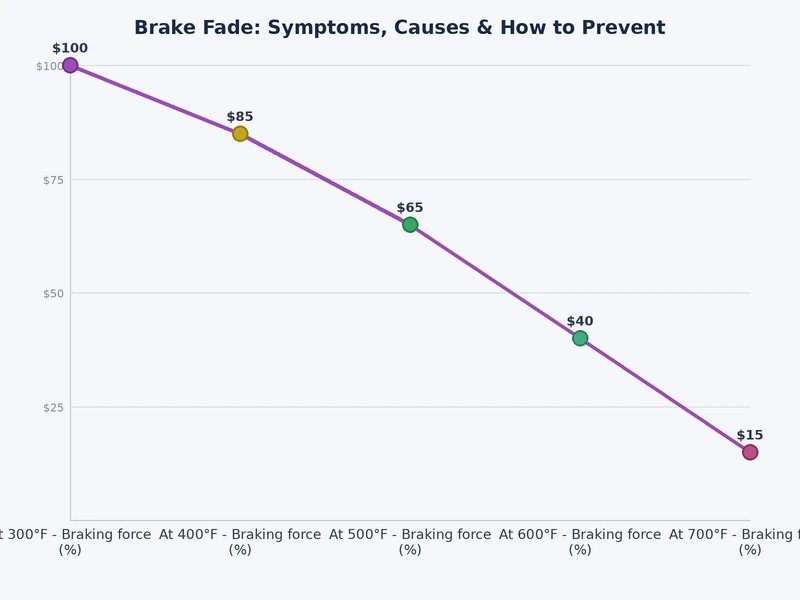
Standard street brake pads operate safely up to around 300–400°F. Quality ceramic pads handle 500–700°F. Semi-metallic performance pads tolerate 700–1,000°F or more. When driving conditions push brake temperatures past a pad's rated threshold, fade happens fast — often within a single extended stop or a short series of hard stops.
Common high-heat scenarios our team sees repeatedly:
Poorly maintained components make all of these scenarios worse. Glazed rotors, compressed pads below minimum thickness, and water-contaminated fluid each lower the threshold at which fade begins. Our team always investigates the full system — not just the pads. A malfunctioning ABS system can cause uneven heat distribution across all four corners, which is why our team checks for ABS system problems whenever fade complaints come in alongside erratic braking behavior.
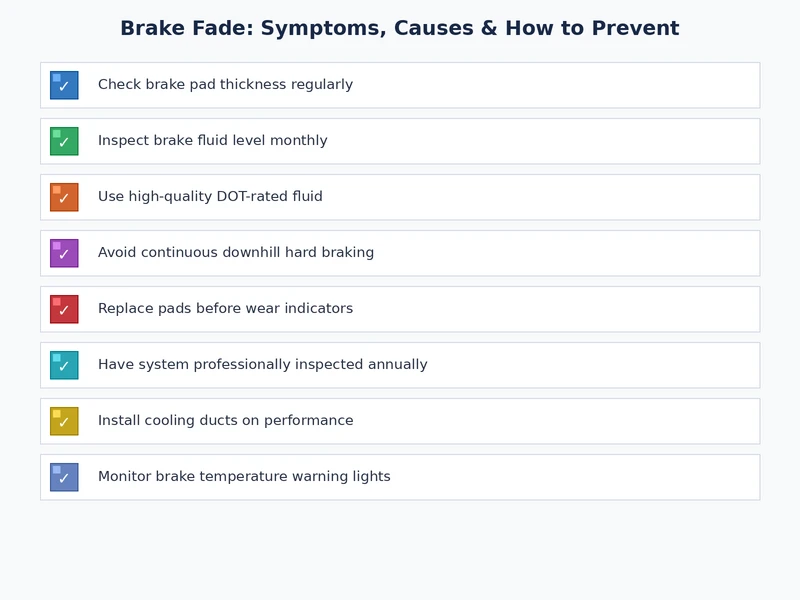
Prevention is far less expensive than repair. Our team follows a consistent protocol for every vehicle that sees heavy braking demands — mountain driving, towing, track days, or simply an older vehicle with unknown maintenance history. These steps address both friction fade and fluid fade at the root.
Bedding (also called break-in) is the single most overlooked step after a brake job. It deposits a uniform transfer layer of pad material onto the rotor surface. Without it, pads run hotter because friction is uneven. They reach their thermal limit faster and fade sooner under heavy use.
Our team runs every fresh pad set through the bedding process before the vehicle leaves. The procedure below works for ceramic and semi-metallic pads on street vehicles:
Different pad compounds have slightly different bedding requirements. Aggressive racing compounds sometimes require a more intensive protocol. Always check the pad manufacturer's specific instructions. The procedure above works for the vast majority of quality street pads.
Mountain road driving is where brake fade claims the most victims. The most effective tool available is engine braking. Downshifting before a long descent keeps the vehicle controlled without continuously loading the brake pads. Our team's protocol for any vehicle on a sustained grade:
Pad selection is the fastest lever available for changing a vehicle's fade resistance. Our team installs and tests brake components across a wide range of vehicles and use cases. The difference between pad types is not subtle — it's the difference between safe and unsafe in demanding conditions.
Three main pad categories cover the vast majority of street and light performance applications. Each has a different heat tolerance, noise profile, rotor wear rate, and cost. Matching the pad to the actual driving demands of the vehicle is essential.
| Pad Type | Fade Threshold | Noise Level | Rotor Wear | Best Application | Price Range (per axle) |
|---|---|---|---|---|---|
| Organic (NAO) | ~300°F | Very Low | Low | Light city use, small cars | $20–$45 |
| Ceramic | ~500–700°F | Very Low | Low–Moderate | Daily drivers, most sedans and SUVs | $40–$100 |
| Semi-Metallic | ~700–1,000°F+ | Moderate–High | Moderate–High | Trucks, towing, performance driving | $35–$90 |
| Performance / Race | 1,200°F+ | High (especially cold) | Very High | Track use only — not for streets | $100–$300+ |
Our team's consistent position: using race compound pads on the street is counterproductive. They don't reach operating temperature during normal driving, which means worse cold-bite performance and accelerated rotor wear with no corresponding benefit in street stopping power. Match the pad to actual use — not to what sounds most impressive on paper.
Once brake fade has damaged components — glazed pads, scored rotors, boiled fluid — repair is unavoidable. Our team breaks costs into clear categories so most people know what to expect before they walk into a shop or order parts online.
Brake pad and rotor replacement sits at the accessible end of DIY automotive work. Most people with basic mechanical experience and a floor jack can complete a pad and rotor swap in two to three hours. Caliper rebuilds, brake line repairs, and master cylinder work are more complex — those are best left to professionals.
Our team's rule: always replace rotors and pads together on the same axle. Placing new pads on glazed or worn rotors is false economy. The friction surface won't mate properly, fade threshold drops, and pads wear unevenly in the first few thousand miles.
Upgrading from stock replacement pads to a quality ceramic or semi-metallic compound typically adds $40–$80 per axle. Upgrading to slotted or cross-drilled rotors adds another $30–$80 per axle over standard replacement units. For most daily drivers, the stock-quality replacement is sufficient. But for vehicles that work harder, the math changes quickly.
Brake fluid is the cheapest upgrade available. A full flush with DOT 4 or DOT 5.1 fluid costs $15–$20 in parts and raises the boiling point by 40–100°F over typical DOT 3. Our team flushes brake fluid on a two-year interval regardless of mileage — moisture contamination happens on a time-based schedule, not a mileage-based one. One more thing: a vehicle that pulls sideways under braking often has one corner with worse fade than the others. Our team frequently diagnoses cases where drivers first noticed the steering wheel pulling to one side when braking — caused by a seized caliper running hot on one side while the other corners cooled normally.
Not every instance of brake fade demands an immediate stop. But some situations are non-negotiable emergencies. Our team's position is clear: when genuinely uncertain, stop. The cost of a brief pull-over is nothing compared to the cost of an accident.
The following conditions mean the vehicle should not continue moving at normal traffic speed. These are hard stops — not "pull off at the next exit" situations. Pull over now.
In these situations, our team's protocol: find a safe shoulder or parking area, activate hazard lights, and wait a minimum of 20 minutes before touching the brakes again. After cooling, test pedal feel carefully at very low speed before re-entering traffic. If the pedal doesn't firm up, call for a tow. Driving a vehicle with genuinely compromised brakes in normal traffic is not an acceptable risk.
Mild fade — slightly higher pedal effort than normal after a long descent, with feel returning quickly after a cooling period — is a different category. If the following conditions are all true, controlled driving to a safe destination is generally acceptable:
Our team's advice for this scenario: drive slowly, leave triple the normal following distance, and avoid any situation requiring hard stops. Route directly to a shop or home. Address the issue before the next drive — mild fade today becomes dangerous fade tomorrow when the system is already weakened. Most people underestimate how quickly a borderline brake system deteriorates under repeated thermal stress.
The earliest brake fade symptoms are a soft or spongy pedal feel and a subtle increase in stopping distance. Most people also detect a faint burning chemical smell before any visible smoke appears. These early signs are easy to dismiss during normal driving — they become unmistakable under sustained heavy braking on grades or after repeated hard stops in quick succession.
Mild fade typically resolves within 10 to 20 minutes of rest with no brake applications. Severe fade involving boiled fluid takes longer and often requires a fluid flush before full performance returns. Our team never recommends resuming normal driving speed until the pedal has fully firmed back up — a spongy pedal after a cooling period means the fluid needs to be changed.
Yes. Severe fade glazes the pad face and the rotor surface, permanently reducing friction coefficient. Rotors can also develop heat cracks or warp from repeated high-temperature fade events. Once glazing is established, replacement is the reliable fix — resurfacing a glazed rotor rarely restores full braking performance, and the issue typically returns quickly under any real braking load.
It makes a substantial difference. DOT 3 fluid has a dry boiling point around 401°F and a wet (moisture-absorbed) boiling point of 284°F. DOT 4 reaches 446°F dry and 311°F wet. DOT 5.1 hits 500°F dry and 356°F wet. For any vehicle used for towing, mountain driving, or spirited driving, upgrading from DOT 3 to DOT 4 or 5.1 is one of the cheapest and most effective fade-prevention steps available. Our team never runs DOT 3 in vehicles with demanding brake requirements.
Not exactly, but fade is a direct warning that failure is approaching. Brake fade means severely reduced stopping performance due to heat — the system still functions, just far below normal. Brake failure means total or near-total loss of stopping ability. Fade is a warning stage, and ignoring repeated fade events consistently shortens the timeline to component failure. Our team treats any confirmed fade incident as a mandatory maintenance trigger.
ABS prevents wheel lockup during hard braking but cannot prevent brake fade. Fade is a thermal problem inside the pad compound and fluid — no electronic system can compensate for material breakdown at the molecular level. During a fade event, ABS may actually activate at lower speeds than normal because the reduced braking torque confuses its wheel-speed sensors. Our team frequently sees fade-related complaints appear alongside unusual ABS behavior for exactly this reason.
The brakes that save a life are the ones maintained before the emergency — not replaced in the aftermath of one.
 |
 |
 |
 |

About Sarah Whitfield
Sarah Whitfield is a diagnostics and troubleshooting specialist who spent ten years as an ASE-certified technician before joining the editorial team. She specializes in OBD-II analysis, electrical gremlins, and the kind of intermittent problems that make most owners give up.
Get some FREE car parts & gear.. Or check out the latest free automotive manuals and build guides here.
Disable your ad blocker to unlock all the hidden deals. Hit the button below 🚗
| | | |
