by Sarah Whitfield
A brake fluid leak is a brake system emergency — not a "schedule it for next week" situation. The most telling brake fluid leak symptoms are a soft or sinking pedal, a clear-to-amber puddle beneath the vehicle, and a reservoir that keeps running low no matter how many times it gets topped off. Our team has diagnosed hundreds of brake failures, and a leaking system is the one fault that demands immediate action above all others.
Brake fluid (the hydraulic fluid that transfers pedal force to the calipers and wheel cylinders) is the lifeblood of the stopping system. When it escapes, braking performance degrades fast — sometimes within a single drive. Many drivers first notice something feels off with the pedal long before spotting any puddle. If the pedal is already soft or mushy, our guide on spongy brake pedal causes covers the full diagnostic breakdown. Here, our team focuses specifically on leak identification, root causes, and the correct steps to take before the situation turns dangerous.
Contents
Hydraulic brake systems rely on an incompressible fluid to multiply pedal force and deliver it to each wheel simultaneously. When the brake pedal is pressed, the master cylinder (the pump at the heart of the system) pushes fluid through a network of steel lines and rubber hoses to the calipers at the front wheels and the wheel cylinders at the rear drum brakes. Even a small loss of fluid volume disrupts this hydraulic chain — the system cannot sustain pressure when there are gaps.
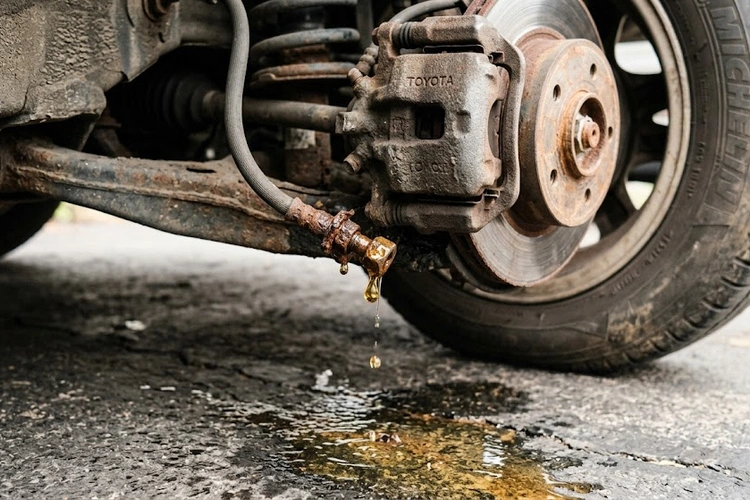
Brake fluid does not evaporate like windshield washer fluid. When the reservoir level drops, fluid is physically leaving the sealed system. Our team has traced leaks to every corner of the brake circuit. The most common escape routes include:
Brake fluid is hygroscopic — it absorbs moisture from the air continuously through microscopic permeation in rubber hoses and reservoir caps. As moisture content climbs, the fluid's boiling point drops, and old moisture-laden fluid accelerates corrosion inside the lines and seals from the inside out. This internal corrosion is what sets the stage for the leaks described above, which is why age alone is a legitimate reason to flush the system.
According to NHTSA, brake system failures are among the leading mechanical contributors to crash fatalities — which is exactly why our team treats any confirmed brake fluid leak as an urgent safety issue, not a routine maintenance deferral.
Pro tip: Most people underestimate how quickly brake fluid absorbs moisture — our team recommends testing the boiling point every two years, not just eyeballing the reservoir level.
Catching brake fluid leak symptoms early separates a $60 seal replacement from a $600 brake line job — or worse, a collision. These five warning signs appear in roughly the order most drivers encounter them, moving from subtle to unmistakable.
The single most reliable indicator of an active brake fluid leak is a pedal that travels farther than normal before resistance builds. As fluid escapes, air enters the hydraulic lines. Air is compressible; brake fluid is not. That compressibility creates a spongy, inconsistent pedal feel with no firm stopping point. In advanced cases, the pedal sinks all the way to the floor under steady pressure — a symptom our team covers in detail in the article on brake pedal goes to floor. Any pedal that was previously firm and has recently become soft warrants same-day inspection.
Modern vehicles monitor reservoir fluid level through a float sensor. When the level drops below the minimum mark, the warning light — amber or red, usually labeled "BRAKE" or showing an exclamation mark inside a circle — activates on the instrument cluster. This is frequently the first electronic alert a driver receives, and it should not be dismissed as a sensor glitch. Our article on brake warning light causes covers every trigger beyond a low reservoir, but a confirmed fluid-level drop always demands physical inspection before the next drive.
Fresh brake fluid is clear to light yellow. Aged fluid darkens to a brownish amber. Both feel slightly oily but are thinner than engine oil and carry no petroleum smell. Puddles appear near the wheels when a caliper or wheel cylinder is leaking, and directly under the engine bay firewall area when the master cylinder is the source. Our team uses a simple blotter test to confirm identity: brake fluid dries with a slightly tacky residue and produces no fuel or oil odor. Location plus texture plus smell narrows down the source in under a minute.
A hydraulic system that has lost fluid volume cannot generate full clamping pressure at the calipers. The result is a measurable increase in stopping distance — most noticeable during emergency braking from highway speeds. This symptom develops gradually, so drivers sometimes attribute it to worn pads rather than a leak. The distinction matters: worn pads produce grinding or squealing noise, while an early-stage fluid leak produces a low-pressure pedal feel with no accompanying noise.
Brake fluid that leaks onto a hot rotor, caliper, or exhaust component burns — producing a sharp, acrid chemical smell distinctly different from the rubber smell of overheated brake pads. This symptom indicates active fluid dripping onto hot surfaces, which presents both a fire risk and an immediate braking hazard. Any time our team encounters this smell after a hard stop, the vehicle goes up on a lift before it moves again. No exceptions.
Not all brake fluids are interchangeable. Using the wrong DOT grade — or mixing incompatible types — is a surprisingly common way to accelerate seal degradation and invite new leaks. The table below summarizes the four main grades our team encounters in modern vehicles, including key compatibility and performance data.
| DOT Grade | Base Chemistry | Dry Boiling Point | Wet Boiling Point | Compatible With | Typical Use |
|---|---|---|---|---|---|
| DOT 3 | Glycol-ether | 205°C (401°F) | 140°C (284°F) | DOT 3, DOT 4, DOT 5.1 | Most older passenger cars |
| DOT 4 | Glycol-ether | 230°C (446°F) | 155°C (311°F) | DOT 3, DOT 4, DOT 5.1 | Modern passenger cars, light trucks |
| DOT 5 | Silicone | 260°C (500°F) | 180°C (356°F) | DOT 5 ONLY | Classic cars, military vehicles |
| DOT 5.1 | Glycol-ether | 260°C (500°F) | 180°C (356°F) | DOT 3, DOT 4, DOT 5.1 | High-performance, ABS-equipped vehicles |
The owner's manual specifies the correct DOT grade for every vehicle, and that specification should be treated as non-negotiable. Most modern passenger cars call for DOT 3 or DOT 4. High-performance vehicles, heavy-duty trucks with frequent towing duties, and motorcycles with high-heat brake systems often require DOT 4 or DOT 5.1. Using a lower-spec fluid in a high-heat application — sustained highway braking, mountain descents, track driving — lowers the effective boiling point and creates a direct path to vapor lock (a condition where fluid boils and creates gas bubbles, causing sudden, complete pedal loss).
DOT 5 is silicone-based. DOT 3, DOT 4, and DOT 5.1 are all glycol-ether-based. These two chemistries do not mix — combining them causes the fluid to gel, which destroys rubber seals and creates internal leaks throughout the system. Our team sees this mistake regularly when owners grab fluid from a hardware store without confirming the label. The number alone is not enough; the chemistry designation matters. DOT 5.1 is glycol-based and fully compatible with DOT 3/4, despite having the same boiling points as DOT 5.
Misinformation about brake fluid leaks is widespread — and some of it is genuinely dangerous. Our team hears the same misconceptions repeatedly, so here are the most persistent myths, corrected with straight facts.
Adding fluid to a low reservoir masks the symptom without addressing the source. The level dropped because fluid physically escaped the sealed system. Repeatedly topping off means the leak continues unchecked, and at some point the system runs dry mid-drive. Our team treats a dropping reservoir as a repair job, not a fill job — always. The only legitimate reason to top off is to maintain safe pedal feel while the vehicle is being driven directly to a shop for immediate repair.
There is no safe threshold for a brake fluid leak. A pinhole in a corroded steel line can open into a full rupture under the pressure spike of emergency braking. Our team has documented vehicles going from "barely weeping at a fitting" to total brake failure in fewer than 20 miles of city driving. Small leaks do not stay small under brake load.
Brake fluid degrades continuously through moisture absorption. Most manufacturers recommend flushing the system every two to three years regardless of mileage. Old, moisture-saturated fluid corrodes lines and seals from the inside out — creating the exact internal conditions that lead to the leaks described throughout this article. Treating brake fluid as a lifetime fill is one of the most reliable ways to eventually face an expensive brake line replacement.
Clear fluids under a vehicle have several sources: water from the AC condenser drain (completely normal, especially in warm weather), power steering fluid (clear when new), and coolant overflow. AC condensate appears under the passenger cabin center, not near wheels. Power steering fluid has a distinct petroleum smell. When in doubt, the blotter-and-smell test resolves the question in seconds — brake fluid leaves a slightly tacky, odorless residue that none of the other fluids replicate.
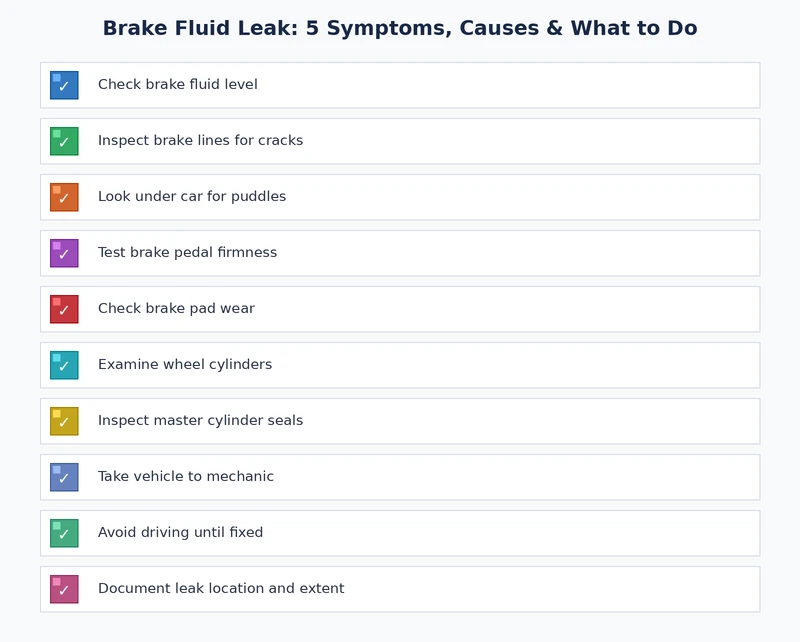
Knowing the brake fluid leak symptoms is only half the equation. The other half is avoiding the common responses that make the situation dramatically worse. These are the four mistakes our team sees most often.
The most costly mistake is treating a known brake fluid leak as a "schedule it for next week" item. Fluid continues to drain, exposed metal components continue to corrode, and driving risk compounds with every mile. Our team's standing protocol: a confirmed brake fluid leak grounds the vehicle until repaired. The repair cost of a corroded wheel cylinder seal is a fraction of the cost of a complete brake line replacement — or the liability of a collision caused by failed brakes.
Some shops flush and bleed the system to restore a firm pedal without first locating and repairing the actual leak point. The pedal firms up temporarily, the driver leaves satisfied, and the leak resumes within days as pressure cycles the system again. Our team's rule: never bleed before sealing. Confirm the source, repair it, then bleed to remove any introduced air.
Brake fluid is a hydraulic medium, not a lubricant. Applying it to sliding caliper pins or caliper hardware damages the rubber boots and seals on contact, inviting new leaks at the exact points where the system depends on those seals to remain dry. Silicone-based brake caliper grease is the correct product for all caliper sliding hardware. It is chemically inert against the rubber components and will not degrade the seals.
A brake fluid leak rarely travels alone. Corroded lines that leak often produce companion symptoms: a pulsating pedal under braking, uneven pad wear detected during tire rotations, or a vehicle that pulls to one side during a stop. Drivers who focus only on refilling the reservoir miss these signals that point directly to the specific leak location and its severity. A thorough diagnosis looks at the whole system, not just the reservoir gauge.
Fresh brake fluid is clear to light yellow and feels slightly oily, thinner than engine oil. As it ages inside the system, it darkens to a brownish amber. Puddles near the wheels or under the engine bay firewall area are the most common locations. The blotter test confirms identity: brake fluid dries with a slightly tacky residue and carries no petroleum or coolant odor.
No. Our team treats a confirmed brake fluid leak as a condition that grounds the vehicle until repaired. There is no minimum safe threshold — a small leak under low-pressure cruising can rupture completely under the pressure spike of emergency braking. The only acceptable drive on a leaking system is a direct, careful trip to a shop for immediate repair.
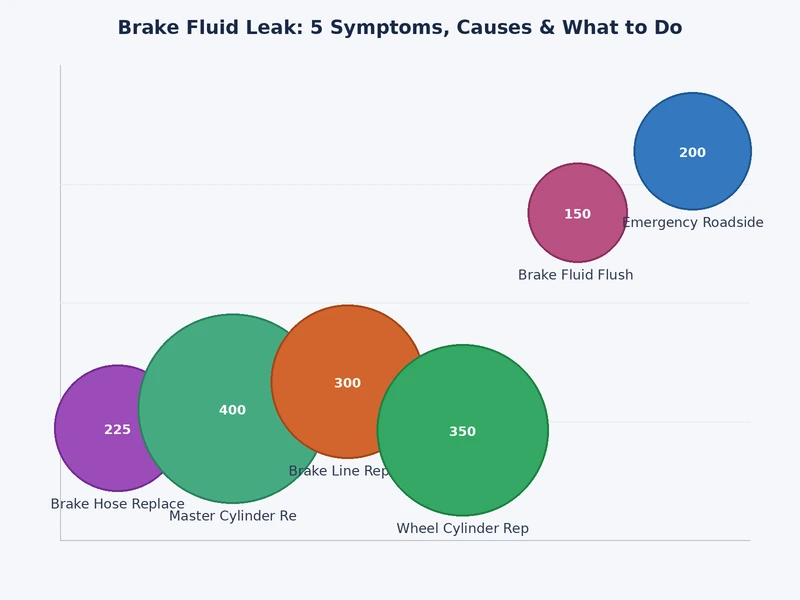
Cost depends entirely on the leak source. A single caliper seal replacement typically runs $80–$150 per corner. A wheel cylinder on a drum-brake axle runs $100–$200. A corroded steel brake line replacement ranges from $150 for a single section to $600 or more for full-vehicle line replacement. A master cylinder replacement runs $200–$450 including labor. Catching the leak early — at the seal stage — produces the lowest repair cost by a wide margin.
Three characteristics distinguish brake fluid from other clear or amber vehicle fluids: location (near wheels or engine bay firewall, not under the cabin center), texture (slightly oily but thinner than engine oil), and smell (no petroleum odor, unlike power steering fluid or engine oil). AC condensate, which is pure water with no residue, is the most common false alarm — it appears under the cabin center and evaporates cleanly without any residue.
No. Brake fluid leaks do not self-seal. A worn seal continues to weep, a corroded line continues to deteriorate, and a loose fitting continues to seep under pressure. The only resolution is physical repair of the leaking component. Some stop-leak additives marketed for brake systems are not recommended by our team — they can contaminate the fluid, damage ABS components, and provide a false sense of security while the underlying failure continues.
Most manufacturers recommend flushing the brake fluid every two to three years regardless of mileage, as the fluid absorbs moisture continuously from the air. Vehicles used in demanding conditions — frequent mountain driving, towing, or track use — benefit from annual checks. A strip test (available at most auto parts stores) measures moisture content and boiling point to give a definitive answer on whether a flush is needed.
Total brake fluid loss results in complete hydraulic failure — the pedal goes straight to the floor with no resistance and the vehicle cannot be slowed using the service brakes. At that point, the only stopping options are the emergency/parking brake and engine braking by downshifting. This is an extremely dangerous situation that our team has documented as a direct cause of accidents. It is the end-stage outcome of ignoring progressive brake fluid leak symptoms.
Not always, but a brake fluid leak is the most common cause and the most urgent one to rule out. Other causes of a soft pedal include air introduced during a previous brake job, a failing master cylinder (internal bypass without an external leak), or severely overheated fluid that has reached its boiling point. Each of these requires professional diagnosis. A soft pedal that was previously firm should never be attributed to normal wear — it signals a hydraulic system that has been compromised.
Brake fluid leak symptoms are the brake system's way of demanding attention before a manageable repair becomes a safety crisis. Our team's recommendation is straightforward: at the first sign of a soft pedal, a dropping reservoir, or any puddle near the wheels, get the vehicle inspected the same day. A licensed mechanic can locate the exact leak point, perform the correct repair, and bleed the system properly — and the cost of that service is nothing compared to what a failed brake system can cost in repairs or consequences. Do not wait on this one.
 |
 |
 |
 |

About Sarah Whitfield
Sarah Whitfield is a diagnostics and troubleshooting specialist who spent ten years as an ASE-certified technician before joining the editorial team. She specializes in OBD-II analysis, electrical gremlins, and the kind of intermittent problems that make most owners give up.
Get some FREE car parts & gear.. Or check out the latest free automotive manuals and build guides here.
Disable your ad blocker to unlock all the hidden deals. Hit the button below 🚗
| | | |
