by Sarah Whitfield
Picture this: a driver pulls up to a red light and the car behind them lays on the horn. A stranger rolls down a window and shouts, "Your brake lights are out!" It is an embarrassing — and dangerous — moment that happens to more drivers than most would expect. The good news is that brake lights not working is one of the most fixable car problems out there.
This guide walks through the six most common causes, a step-by-step diagnostic process, and exactly what it takes to get things working again. According to the National Highway Traffic Safety Administration (NHTSA), brake lamps are classified as required safety equipment on all road-legal vehicles — so this is not a repair to put off.
Contents
Brake lights run on a simple electrical circuit. Every component in that circuit is a potential failure point — which actually makes diagnosis straightforward.
Here is the sequence every time a driver presses the brake pedal:
Break any link in that chain — the switch, fuse, bulb, socket, or ground — and one or all brake lights go dark.
Pro Tip: If only one light is out, the problem is almost always local — bulb or socket. If all lights are out at once, the issue is upstream in the circuit — fuse or brake light switch.
Many vehicles share brake light wiring with tail lights and turn signals. Understanding which functions still work helps narrow down the fault before touching a single tool. Electrical gremlins in cars are rarely random — they follow the circuit, and so should the diagnosis.
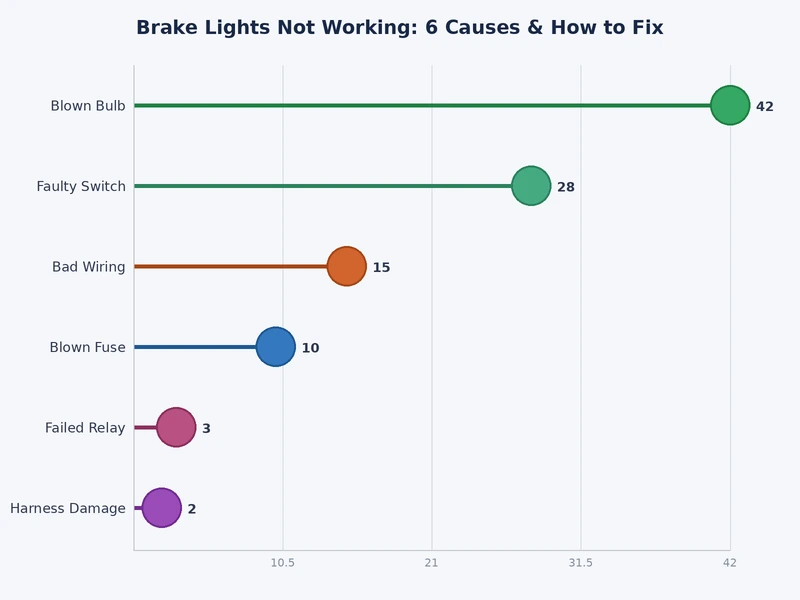
Below are the six most frequent reasons brake lights stop functioning, along with what drivers can expect to spend fixing each one.
| # | Cause | Lights Affected | DIY Parts Cost | Difficulty |
|---|---|---|---|---|
| 1 | Burned-out bulb | One light | $5–$15 | Easy |
| 2 | Blown fuse | All lights | $1–$5 | Easy |
| 3 | Faulty brake light switch | All lights | $20–$50 | Moderate |
| 4 | Corroded socket / damaged wiring | One light | $10–$30 | Moderate |
| 5 | Bad body control module (BCM) | All lights | $300–$600+ | Advanced |
| 6 | Trailer connector short | All lights | $0–$20 | Easy |
This is the single most common cause. Incandescent bulbs have a finite lifespan and eventually burn out. One dead bulb means one brake light is dark while the others work fine.
When all brake lights go dark at once, a blown fuse is a top suspect. The fuse protects the brake light circuit from electrical surges.
The brake light switch sits just above the brake pedal arm. Pressing the pedal physically activates this switch, completing the circuit. A failed or misadjusted switch can prevent all brake lights from illuminating — or keep them on permanently.
Warning: Brake lights stuck in the "on" position will drain the battery overnight and confuse other drivers. This needs immediate attention, not a repair that waits until the weekend.
Moisture, road salt, and age corrode the metal contacts inside bulb sockets. Even a brand-new bulb will not work in a badly corroded socket because the electrical connection is broken.
The body control module (BCM) manages dozens of vehicle functions including exterior lighting. On newer vehicles, a failing BCM can cause complete brake light failure even when the bulbs, fuse, and switch are all in perfect condition.
Vehicles with a hitch have a 4-pin or 7-pin trailer connector. Corrosion or a short in that connector can drag down the entire brake light circuit because it is wired in parallel with the vehicle's lights.
Systematic diagnosis saves time and avoids unnecessary parts purchases. Work through these steps in order.
Tracing an electrical fault is a lot like diagnosing a car door lock not working — the key is ruling out the easiest and cheapest causes first before assuming the worst.
Most brake light repairs are beginner-friendly. A handful of situations genuinely require professional help.
Understanding how multiple warning signs connect is also useful here. For instance, a failing BCM often triggers other dashboard alerts at the same time — see the guide on what the check gauges light means for more on how to interpret overlapping electrical symptoms.
Pro Tip: Before purchasing a brake light switch, search the vehicle's make and model for Technical Service Bulletins (TSBs). Some manufacturers cover faulty switches under extended warranty programs at no charge.
Most brake light failures are predictable. A simple maintenance routine prevents the majority of them.
When all brake lights fail simultaneously, the problem is almost always upstream in the shared circuit. A blown fuse is the first thing to check — it takes less than five minutes and costs almost nothing. If the fuse is intact, test the brake light switch above the pedal. A failed switch cuts power to all brake lights at once. A bad body control module (BCM) is a less common but possible cause on modern vehicles.
Yes, significantly. A faulty brake light switch can disable cruise control, trigger ABS and stability control warnings, prevent the vehicle from shifting out of park (shift interlock), and cause erratic transmission behavior on some models. Replacing a worn switch often resolves several unrelated-seeming symptoms in one repair.
Back the vehicle up close to a garage door, wall, or even a large piece of cardboard and press the brake pedal firmly. The lights will reflect clearly on the surface. Another option is to prop a heavy object against the pedal and walk around to the rear of the vehicle. Many quick-lube shops also check all exterior lights for free during routine oil change visits.
In most places, driving with a non-functioning brake light is a moving traffic violation that can result in a fine or a fix-it citation. Beyond the legal issue, it creates a real rear-end collision hazard for other drivers — particularly in heavy traffic or at night. Most regulations require at least two working brake lights. The repair should happen before the vehicle goes back on the road.
 |
 |
 |
 |

About Sarah Whitfield
Sarah Whitfield is a diagnostics and troubleshooting specialist who spent ten years as an ASE-certified technician before joining the editorial team. She specializes in OBD-II analysis, electrical gremlins, and the kind of intermittent problems that make most owners give up.
Get some FREE car parts & gear.. Or check out the latest free automotive manuals and build guides here.
Disable your ad blocker to unlock all the hidden deals. Hit the button below 🚗
| | | |
