by Sarah Whitfield
Brake pedal pulsating under the foot is almost always caused by warped rotors or uneven brake pad deposits, and the fix ranges from a simple rotor resurface to a full brake job depending on how far the problem has progressed. Most drivers describe the sensation as a rhythmic throbbing felt through the pedal whenever the vehicle decelerates, and our team consistently ranks it among the most common brake complaints at general repair shops.
The pulsation typically grows more pronounced at higher initial speeds and fades during the final few feet of a stop, which is a useful diagnostic clue pointing directly to the rotating components of the brake assembly. When brake pedal pulsating appears alongside steering wheel vibration or unusual brake noise, the combination usually narrows the root cause quickly. Anyone dealing with a brake pedal that sinks toward the floor in addition to pulsation faces a more serious compound problem that warrants same-day inspection rather than a wait-and-see approach.
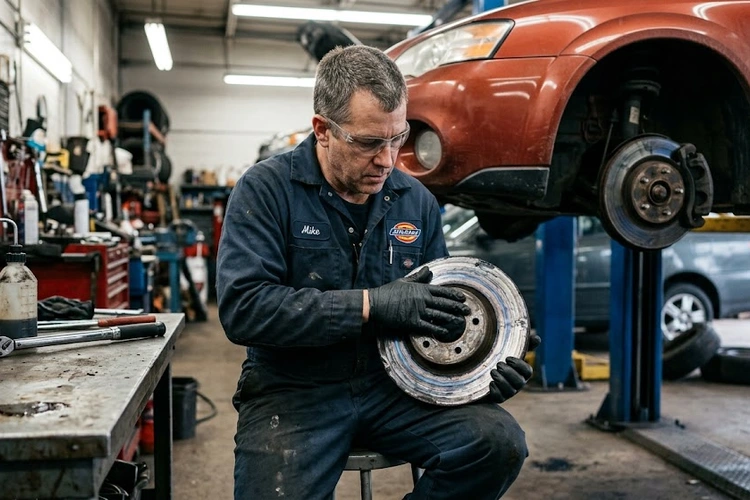
Contents
Normal brake feedback is firm, consistent, and mostly quiet, with only minor vibration during aggressive stops on rough pavement. Brake pedal pulsating is cyclical and synchronized with wheel rotation — the throbbing frequency rises with vehicle speed and decreases as the car slows, which separates a genuine mechanical fault from ordinary road texture feedback. Our team finds this speed-dependent cycling to be the single most reliable identifier because it maps the problem directly to whatever is spinning with the wheel hub.
The disc brake system relies on consistent rotor surface contact with the pad material across the full sweep of the rotor face, so even small thickness variations — sometimes as little as 0.001 inches — can translate into noticeable pedal movement under braking. Our experience shows that front brake problems produce pulsation felt simultaneously through both the steering wheel and the pedal, while rear brake issues often generate pedal pulsation alone, and that distinction helps isolate which axle needs attention first.
Rotors undergo enormous thermal and mechanical stress during normal use, heating and cooling hundreds of times over their service life, and this repeated cycling gradually introduces surface irregularities that compound over time. Our team has measured rotor runout on high-mileage vehicles and found values exceeding 0.005 inches — well past the 0.002-inch threshold where most drivers begin noticing pulsation. The combination of heat, uneven clamping force from partially seized calipers, and repeated hard stops from highway speeds represents the most common recipe for accelerated rotor distortion in everyday driving conditions.
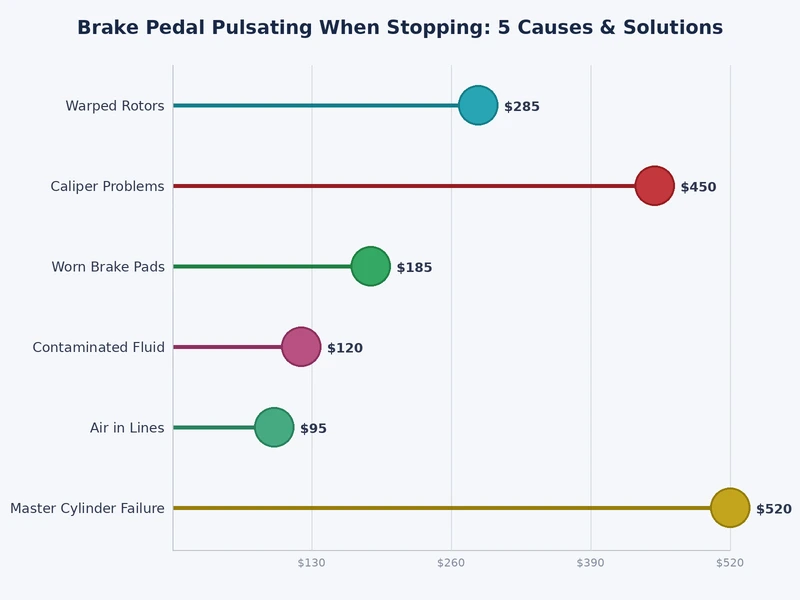
Understanding each cause individually makes it easier to match observed symptoms with the correct repair rather than replacing components arbitrarily and hoping the problem resolves. Our team has organized the five most common causes below, with the distinguishing characteristics that separate one from another.
| Cause | Primary Symptom | Severity | Typical Fix | Avg. Cost |
|---|---|---|---|---|
| Warped / uneven rotors | Pulsation + steering wheel vibration | Moderate | Resurface or replace rotors | $80–$300/axle |
| Brake pad material transfer | Pulsation + intermittent squeal | Mild–Moderate | Machine rotors + new pads | $100–$250/axle |
| Loose wheel bearing | Pulsation + humming noise | High | Replace wheel bearing assembly | $150–$400/corner |
| Stuck brake caliper | Pulsation + pulling + heat smell | High | Rebuild or replace caliper | $120–$350/caliper |
| ABS activation | Rapid pulsation during panic stop only | Normal — no fault | No action needed | $0 |
Rotor warping covers two distinct phenomena: true geometric bending where the rotor disc deflects out of plane, and thickness variation where the rotor wears unevenly and creates alternating high and low spots. Our team has found that true geometric warping is actually less common than thickness variation, though both produce the same characteristic pulsation and require similar remedies in practice. Aggressive braking from high speeds — repeatedly decelerating from highway pace into stop-and-go traffic — accelerates both problems simultaneously and is the most common scenario our team encounters in repair histories.
Every brake pad leaves a thin film of friction material on the rotor surface during normal use, and under ideal conditions this transfer layer is uniform and beneficial. When brakes are applied firmly and then held partially engaged while the rotor continues spinning — a common habit on long downhill grades — pad material smears onto specific zones of the rotor face rather than distributing evenly, creating localized hot spots that drive thickness variation and pulsation. Our team often sees this cause paired with mild rotor glazing, which alters the friction coefficient unevenly around the circumference and compounds the pedal feedback noticeably.
Wheel bearing play allows the hub — and the rotor mounted to it — to wobble slightly during rotation, and that wobble translates directly into brake pedal pulsation as the rotor face alternately presses against and retreats from the stationary pad. Our team treats this as a higher-priority concern than rotor surface issues alone because loose bearings affect vehicle dynamics well beyond braking, including cornering stability and tire wear. A bearing-related pulsation is commonly accompanied by a low growling or humming noise that changes pitch with speed, and those two symptoms together make a fairly reliable diagnosis. Problems like a spongy brake pedal can coexist with bearing play, so inspecting the full wheel assembly during any brake service is a worthwhile habit.
A caliper that doesn't retract fully after release keeps the pad in partial contact with the rotor even between braking events, generating heat and wearing the rotor surface unevenly until pulsation becomes noticeable within just a few thousand miles of service. Our team has documented cases where a single seized slide pin caused the inner pad to wear to bare metal while the outer pad retained most of its friction material — a scenario that creates severe rotor damage in a short time. The symptoms of a stuck brake caliper also include uneven pad wear, vehicle pulling to one side, and a burning smell after moderate driving, all of which help confirm the diagnosis before any disassembly occurs.
Many drivers first encounter brake pedal pulsating during an emergency stop and assume something has failed, but the rapid cycling sensation produced by the anti-lock braking system during a panic stop is entirely intentional. The ABS modulates brake pressure many times per second to prevent wheel lockup, and that modulation produces a strong pulsation through the pedal, sometimes accompanied by a buzzing or grinding sound from the hydraulic pump. Our team consistently advises that pulsation occurring exclusively during hard emergency stops — and never during routine braking — almost certainly indicates normal ABS operation rather than a mechanical fault that requires repair.
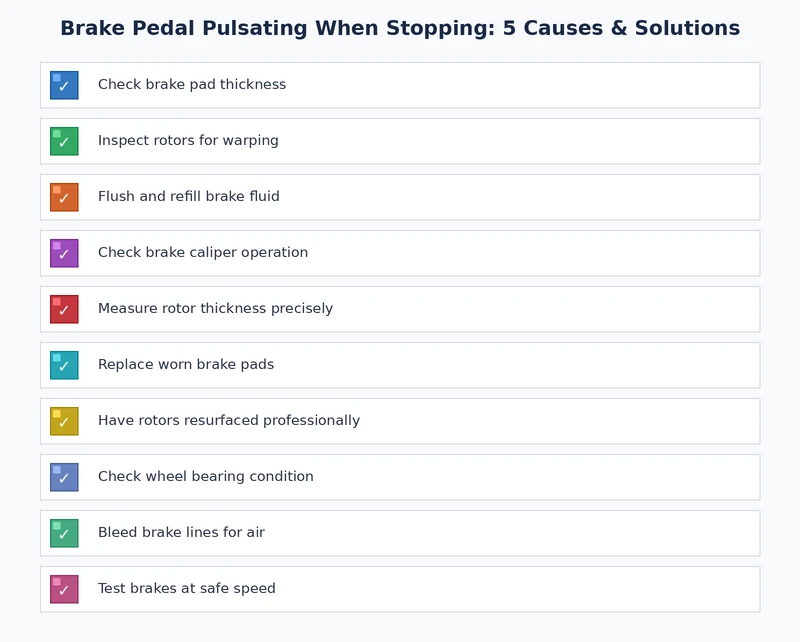
A thorough brake inspection requires modest tooling for most of the diagnostic steps, and our team considers the following items the practical minimum for a systematic evaluation:
Runout measurement involves mounting a dial indicator so its tip contacts the rotor face near the outer edge, then slowly rotating the rotor by hand and recording the total indicated reading across one full revolution. Our team uses 0.002 inches as the practical threshold above which pulsation becomes perceptible to most drivers, though the manufacturer specification for the specific vehicle always takes precedence over general guidelines. Thickness variation is mapped separately by taking micrometer readings at eight equally spaced points around the rotor, with any variation greater than 0.0005 inches worth noting and addressing during the next service at minimum.
Pro tip: Our team always recommends measuring rotor runout with the wheel bearing confirmed in good condition first — a loose bearing adds its own runout to the reading and can make a perfectly serviceable rotor appear out of specification when the real problem sits behind the hub.
Resurfacing — or "turning" — a rotor on a brake lathe removes a thin layer from both faces to eliminate surface variation and restore a consistent friction contact area, and it remains a cost-effective option when the rotor still has adequate thickness above the manufacturer's minimum discard specification. Our team generally recommends resurfacing when thickness variation and runout fall within the range a lathe can correct, but considers full replacement the better value when the rotor is already near minimum thickness or showing heat cracks, because a freshly turned rotor starting close to its discard limit typically requires replacement again within the very next service interval. Premium rotors with drilled or slotted faces do offer improved heat dissipation, and our experience suggests this is genuinely beneficial for drivers who do frequent hard braking, though the difference is marginal compared to a quality standard rotor in typical daily use.
Brake pads should always be replaced or at minimum inspected alongside any rotor work, because installing new rotors against worn or unevenly loaded pads accelerates the development of the same surface irregularities that caused the original problem. Our team applies a thin layer of high-temperature brake lubricant to caliper slide pins and pad backing plates during every brake job to ensure free movement and even pressure distribution across the full pad face, which reduces both uneven wear and the partial contact that creates rotor hot spots. Caliper pistons that retract sluggishly are reconditioned or replaced at this stage, since a caliper that doesn't release cleanly will undermine any amount of quality rotor and pad work done alongside it.
Home mechanics with moderate experience can confidently tackle brake pad replacement, basic rotor inspection, and caliper slide pin lubrication — tasks that address the majority of brake pedal pulsating cases when the root cause is straightforward pad deposits or minor surface wear. Our team considers a complete pad-and-rotor replacement, including slide pin service, to be within reach for anyone comfortable using a floor jack and jack stands, provided replacement rotors arrive pre-machined to specification rather than requiring lathe work, which most modern aftermarket units do. The single most important technique at home is torquing lug nuts in a star pattern to the manufacturer's specification, because uneven tightening is one of the more ironic causes of rotor distortion — introduced during the repair itself.
Wheel bearing replacement, caliper rebuilding, and ABS system diagnostics represent the tier of brake work where professional equipment delivers meaningfully better outcomes, and our team advises against attempting these without the specific tools each job requires. Wheel bearing replacement on modern vehicles often involves pressing a hub-and-bearing assembly into a steering knuckle, and performing that work correctly requires a hydraulic press and precise alignment — improvising risks damaging the replacement bearing during installation and creating the exact runout problem the repair was meant to solve. Brake pedal pulsating that returns within a few thousand miles after a complete home repair, with no obvious cause, also warrants a professional evaluation because intermittent caliper binding or subtle bearing play may require a lift and measured inspection to identify reliably.
Mild brake pedal pulsating that appears gradually over many miles, remains consistent rather than worsening rapidly, and is unaccompanied by pulling, grinding noise, or brake warning lights represents a condition where scheduling a repair within the next week or two is generally acceptable for routine daily driving. Our team also considers pulsation that occurs only at highway speeds and disappears entirely at low speeds to be a lower-urgency concern compared to pulsation present at all speeds, since the former typically reflects rotor surface variation without compromised stopping capacity during urban traffic maneuvers. Monitoring the situation closely for any escalation — increased severity, new noises, or changes in pedal feel — is essential during any delay in repair.
Brake pedal pulsating accompanied by any of the following warrants pulling over promptly and arranging a tow or at minimum a roadside inspection before continuing the trip:
Our team treats the combination of pulsation and an active brake warning light as an urgent signal that requires investigation before the vehicle is driven further, since that pairing can indicate hydraulic issues rather than simple rotor wear.
Several widely repeated ideas about brake pedal pulsating persist in online forums and casual conversation, and our team considers it worth addressing them directly because acting on incorrect assumptions tends to delay the actual repair or result in unnecessary spending:
The most consequential mistake our team observes is replacing only the brake pads without inspecting or servicing the rotors, calipers, and slide pins at the same time, which almost guarantees that the new pads will develop uneven wear patterns that recreate the original pulsation within a fraction of the normal service interval. A close second is allowing brake pedal pulsating to persist for many months in the hope the problem will self-resolve — it won't, and rotor surface variation compounds progressively as high spots experience disproportionate wear and adjacent low spots deepen further. Our team also flags the habit of driving hard immediately after a brake service, since fresh rotors and pads benefit from a proper break-in procedure of several gradual moderate-speed stops to establish an even initial transfer layer before any aggressive braking takes place.
Mild pulsation from minor rotor surface variation is generally drivable for a short window while a repair is arranged, but our team strongly advises against ignoring it since the underlying condition worsens progressively under continued use. Any pulsation accompanied by pulling, grinding noise, warning lights, or increased pedal travel should be treated as urgent and inspected before further driving.
Pulsation from mechanical causes — rotor thickness variation, bearing play, caliper binding — does not resolve without intervention, and our experience consistently shows the symptoms worsen gradually under continued use. The only scenario where pulsation disappears without repair is normal ABS activation during panic stops, which is not a fault and requires no attention.
Repair costs depend heavily on the root cause, but our team generally sees a complete pad-and-rotor service running between $150 and $400 per axle at a shop, with wheel bearing replacement adding $150 to $400 per corner depending on vehicle type and bearing design. Addressing pulsation early, before rotor variation becomes severe, tends to keep the repair toward the lower end of that range since machining may suffice in place of full replacement.
Pulsation most commonly affects one axle at a time, with the front axle being more frequently involved since front brakes handle the majority of braking force under normal conditions and therefore experience greater thermal stress over their service life. Pulsation felt through the pedal alone without accompanying steering wheel vibration often points to the rear axle, while pulsation with simultaneous steering wheel shaking almost always originates at the front.
 |
 |
 |
 |

About Sarah Whitfield
Sarah Whitfield is a diagnostics and troubleshooting specialist who spent ten years as an ASE-certified technician before joining the editorial team. She specializes in OBD-II analysis, electrical gremlins, and the kind of intermittent problems that make most owners give up.
Get some FREE car parts & gear.. Or check out the latest free automotive manuals and build guides here.
Disable your ad blocker to unlock all the hidden deals. Hit the button below 🚗
| | | |
