by Sarah Whitfield
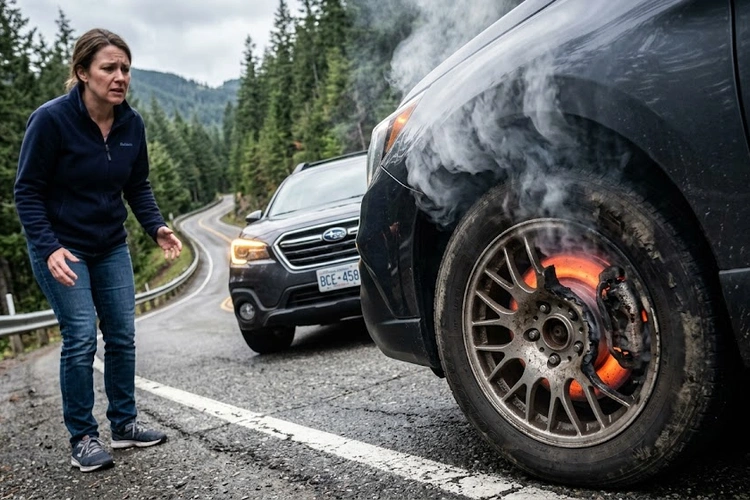
A driver pulls into a rest stop after descending a long mountain grade, steps out of the vehicle, and is immediately struck by a sharp, acrid odor rising from the wheel wells. The smell is unmistakable — something is burning. A burning smell from brakes is one of the most diagnostic signals a braking system produces, capable of revealing anything from a benign break-in condition to a mechanical failure that demands an immediate stop. Treating that odor with the seriousness it deserves, and understanding its underlying cause, is the difference between a routine service appointment and a preventable accident.
Brake systems are among the most safety-critical components on any vehicle. Drivers who also notice brake lights not working alongside a burning odor should treat the two symptoms as a combined warning, since both can point to underlying issues within the brake circuit. The maintenance guides available across CarCareTotal's car care section provide detailed coverage of the full braking system and the components connected to it.
Contents
Friction is the fundamental mechanism behind every modern braking system. When the driver depresses the brake pedal, hydraulic pressure forces the caliper pistons outward, clamping the brake pads against the rotating rotor. This friction converts kinetic energy into thermal energy. Under normal operating conditions, heat dissipates rapidly through the rotor mass, caliper body, and surrounding airflow. When heat generation outpaces heat dissipation — through prolonged braking, mechanical fault, or driver error — temperatures climb into ranges that chemically alter brake components and release the characteristic burning odor that serves as the system's primary distress signal.
Brake pads contain organic binders, resins, and friction materials that begin to off-gas at temperatures above approximately 300°F (149°C). Street-grade compounds are formulated to operate comfortably below this threshold during everyday urban driving. Aggressive mountain descents, repeated threshold stops, or mechanical failures that prevent pad retraction can push surface temperatures well beyond 400°F (204°C), where the odor becomes pronounced and the risk of brake fade — a dangerous reduction in hydraulic stopping power — increases substantially. Brake fade develops when the friction interface is overwhelmed by heat, and it can manifest without adequate warning during an active emergency stop.
After a brake pad replacement, a brief burning odor is expected and normal. New pads require a thermal break-in process — commonly called bedding-in — during which the friction material reaches its optimal operating state. The resin binders in the pad compound cure and bond uniformly to the rotor surface, establishing a consistent transfer film. This process produces a mild burning smell that typically dissipates after the first 20 to 30 moderate stops, or within approximately 200 miles of normal driving. The odor during break-in is generally faint and does not persist once the rotors cool to ambient temperature.
Vehicles parked for extended periods accumulate surface rust on the rotor faces. When the vehicle is driven again, this rust layer scrapes off under braking pressure, producing a grinding sensation and, in some cases, a mild metallic or burning odor for the first several miles. The condition resolves on its own once the rust is fully removed from the swept surface, and it presents no long-term concern provided the rust was superficial. A persistent odor that continues after the initial layer clears indicates a separate underlying problem requiring investigation rather than dismissal.
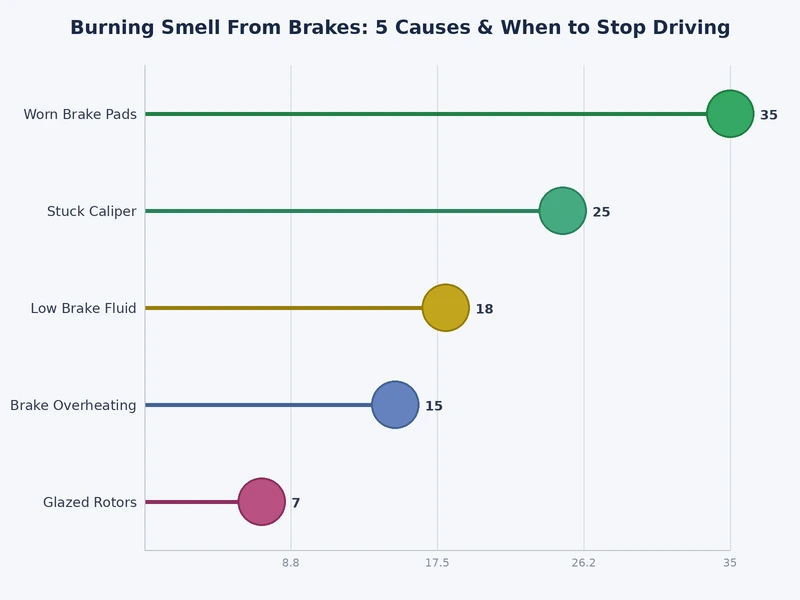
A seized caliper is the most common mechanical cause of a persistent burning smell from brakes. When a caliper piston corrodes or a slide pin seizes, the pad remains in continuous contact with the rotor after pedal release. The resulting uninterrupted friction generates extreme heat capable of warping rotors, boiling brake fluid, and destroying pad material within minutes of sustained highway driving. A vehicle with a seized caliper pulls consistently to one side during braking and displays dramatically uneven pad wear across the axle. After any moderate drive, one wheel will be measurably hotter than the others — a direct confirmation of the diagnosis. Caliper replacement, along with rotor and pad assessment, is the required corrective action for this condition.
Brake glazing occurs when pad material or rotor surfaces are subjected to sustained heat without an adequate cooldown period. The friction surface crystallizes into a hardened, glassy layer that reduces the effective friction coefficient and produces a distinctive sweet-burning odor. Glazed pads deliver spongy pedal feel and measurably reduced stopping performance. The condition is common after prolonged light pedal dragging — a situation where the pad applies just enough pressure to generate heat without completing a full stop. Mild glazing can be corrected by carefully scuffing the pad face and rotor surface with appropriate abrasive; severe cases require complete replacement of both components to restore full braking performance.
A partially engaged parking brake creates continuous friction between the rear brake shoes or pads and their contact surface. Drivers who depart without releasing the parking brake, or whose parking brake cable has seized in the applied position due to corrosion, subject the rear braking system to sustained, uninterrupted heat generation. The burning smell in this scenario is concentrated at the rear axle, and the vehicle exhibits resistance to free rolling even with the transmission in neutral. Parking brake cable inspection, adjustment, and replacement of seized components resolves most cases. Vehicles displaying this symptom alongside other unusual odors should also be evaluated for oil leaks, since contamination of brake friction material by lubricants presents its own distinct failure mode — a subject covered in detail in the guide to oil burning smell inside car causes.
Brake fluid is hygroscopic — it absorbs atmospheric moisture continuously over time. As water content rises, the fluid's boiling point drops below its rated specification. Under heavy braking loads, this degraded fluid can reach its boiling point, creating vapor bubbles in the hydraulic lines. This phenomenon, known as vapor lock, produces a sharp chemical or burning-plastic odor and causes the pedal to feel unusually soft, or to sink progressively toward the floor under constant pressure. According to the National Highway Traffic Safety Administration, hydraulic brake failure is a contributing factor in thousands of motor vehicle crashes annually, underscoring the importance of routine fluid condition monitoring as a proactive maintenance priority.
Brake pads worn below their minimum thickness expose the metal backing plate to direct rotor contact. Metal-on-metal friction generates intense, localized heat and a sharp, acrid burning smell that is distinctly harsher than the softer odor associated with glazed surfaces. This condition simultaneously destroys the rotor face at an accelerated rate, converting a straightforward pad replacement into a full rotor replacement job. Most pads include a hardened metal wear indicator that produces a high-pitched squeal when the pad approaches the replacement threshold. By the time a burning smell accompanies that squeal, the situation has moved past the warning stage and into active component destruction.
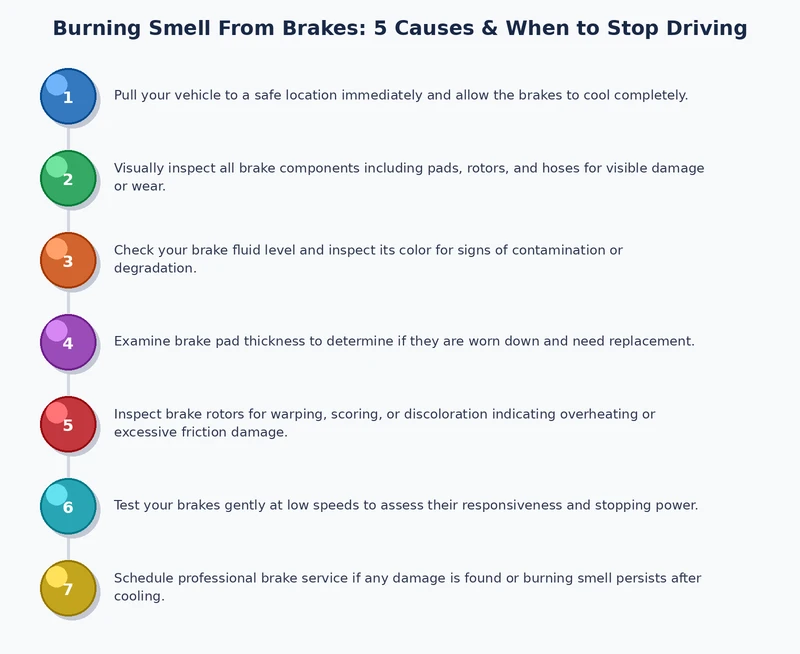
After a moderate drive of 10 to 15 minutes, park the vehicle safely and assess each wheel corner in sequence. An infrared thermometer provides an accurate, contact-free surface temperature reading for each rotor. A single rotor running 100°F or more above the others is a reliable indicator of localized heat generation — typically a seized caliper or dragging hardware at that specific corner. This test must be performed with care: even after brief normal use, brake components can exceed 300°F, and physical contact with an unprotected hand causes burns. The temperature differential method narrows the diagnosis to a specific corner immediately, reducing the inspection time required at the workshop.
Blue or dark discoloration on the rotor face confirms sustained overtemperature events and indicates that the rotor has been thermally stressed beyond its design operating range. Glazed pads display a shiny, reflective surface rather than the matte gray of serviceable friction material. Uneven pad thickness across the two pads of a single caliper — one significantly thinner than the other — confirms that the caliper is not releasing evenly on that side. For drivers who notice a simultaneous sulfurous odor accompanying the brake smell, the guide to car smells like rotten eggs clarifies the distinction between brake-related heat signatures and catalytic converter failure, which require a completely different diagnostic and repair pathway.
| Cause | Odor Character | Location | Severity | Continue Driving? | Typical Repair Cost |
|---|---|---|---|---|---|
| Seized Caliper | Sharp, acrid, persistent | Single wheel | High | No | $150–$400 per corner |
| Glazed Pads/Rotors | Sweet, mild burning | All wheels | Moderate | With caution | $80–$250 per axle |
| Dragging Parking Brake | Burning rubber, rear-biased | Rear axle | Moderate–High | No | $50–$200 (cable/adjust) |
| Overheated Brake Fluid | Sharp chemical, plastic | All wheels | High | No | $80–$150 (flush) |
| Worn Brake Pads | Sharp, metallic | One or both axles | Very High | No | $150–$350 per axle |
The most dangerous error a driver can make is dismissing a burning smell and continuing at highway speeds. Overheated brake fluid loses compressibility as vapor bubbles form in the hydraulic lines, and continued hard pedal application into a fade event can result in total loss of hydraulic braking force precisely when maximum stopping power is required. The correct technique when a burning smell develops during sustained downhill driving is to use engine braking by downshifting to a lower gear, reducing reliance on the friction brakes and allowing rotor temperatures to stabilize before committing to the next descent.
Installing new brake pads and immediately returning to aggressive driving skips the resin curing process entirely. Incomplete bedding-in produces uneven deposits of friction material across the rotor surface, creating disc thickness variation (DTV) that causes pedal pulsation and accelerates the onset of glazing. Most pad manufacturers specify a structured break-in sequence of moderate stops from progressively higher speeds — typically 10 stops from 30 mph and 10 stops from 50 mph — followed by a 10-minute cooling period before any hard brake application is performed. Adhering to this sequence prevents the majority of post-installation odor complaints.
Most vehicle manufacturers recommend brake fluid replacement on a two-year cycle regardless of mileage, because moisture absorption is time-dependent rather than distance-dependent. A brake fluid test strip or a dedicated conductivity tester measures copper ion content — a reliable proxy for moisture contamination and overall fluid degradation. Skipping fluid changes is one of the most consistent contributors to vapor lock events in high-mileage vehicles. The cost of a professional brake flush represents a fraction of the expense of a caliper rebuild or master cylinder replacement, both of which become more probable when fluid maintenance is deferred indefinitely.
Any burning smell from brakes combined with a soft, spongy, or sinking pedal requires a controlled, immediate stop. A pedal that travels progressively closer to the floor under steady pressure indicates vapor lock or a hydraulic fluid leak — both conditions in which continued driving creates a severe accident risk. Visible smoke rising from a wheel well is the most unambiguous sign that a component has reached or exceeded its thermal limit. In this situation, the vehicle should be moved safely off the road, the engine left running to power the hazard lights, and the parking brake left disengaged if the rear brakes are suspected as the heat source — applying a dragging parking brake to an already overheated rear assembly compounds the damage.
A mild, transient odor immediately after replacing brake pads, or following a single extended downhill section with an otherwise healthy braking system, does not constitute an emergency stop scenario. The pedal should feel firm and progressive, stopping distances should be normal, and the smell should diminish completely as rotor temperatures return to ambient. If the odor does not return after the system cools and full pedal feel is maintained, the episode was a benign thermal event. Any recurring odor — even a mild one — warrants a professional brake inspection before the next highway journey or mountainous route.
Not always. A mild burning odor is expected during the break-in period following new brake pad installation and after the first few stops following extended vehicle storage. However, a persistent, strong odor — particularly one accompanied by a spongy pedal, uneven vehicle pull during braking, or visible smoke from the wheel well — indicates a mechanical failure that must be diagnosed and corrected before further driving.
The break-in odor from new brake pads typically dissipates after the first 20 to 30 moderate stops or within the first 200 miles of normal driving. If the smell persists beyond this window or is accompanied by reduced braking performance, incomplete bedding-in or early-onset glazing is the most probable cause and warrants a follow-up inspection.
Yes. A parking brake dragging over any significant distance generates sufficient heat to glaze rear brake pads, score the rotor surface, and in severe cases, transfer damaging heat into the wheel bearing assembly. The longer the condition persists before correction, the greater the probability that components beyond the cable and adjuster mechanism will require full replacement rather than simple adjustment.
Overheated brake fluid produces a sharp chemical or burning-plastic odor, distinctly different from the sweet smell of glazed pads or the harsh metallic odor of worn pads in metal-on-metal contact. It is consistently accompanied by a pedal that feels unusually soft or that sinks progressively under constant pressure, which confirms that vapor has formed within the hydraulic lines and compromised fluid compressibility.
A seized brake caliper repair typically costs between $150 and $400 per corner, encompassing the replacement caliper, associated brake pads, and rotor resurfacing or replacement if heat damage is confirmed. Labor accounts for the majority of the total cost. Delaying the repair significantly increases the final bill, as continued operation on a seized caliper accelerates rotor destruction and can introduce thermal damage to the adjacent wheel bearing assembly.
A burning smell from brakes communicates the thermal state of the most critical safety system on the vehicle, and every driver benefits from knowing how to read it accurately. The most practical next step is to schedule a professional brake inspection at the first sign of a persistent or recurring odor — before the next highway drive, before the next mountain route, and long before a soft pedal or a smoking wheel well turns a manageable repair into an emergency. Proactive brake maintenance is consistently the least expensive option available.
 |
 |
 |
 |

About Sarah Whitfield
Sarah Whitfield is a diagnostics and troubleshooting specialist who spent ten years as an ASE-certified technician before joining the editorial team. She specializes in OBD-II analysis, electrical gremlins, and the kind of intermittent problems that make most owners give up.
Get some FREE car parts & gear.. Or check out the latest free automotive manuals and build guides here.
Disable your ad blocker to unlock all the hidden deals. Hit the button below 🚗
| | | |
