by Sarah Whitfield
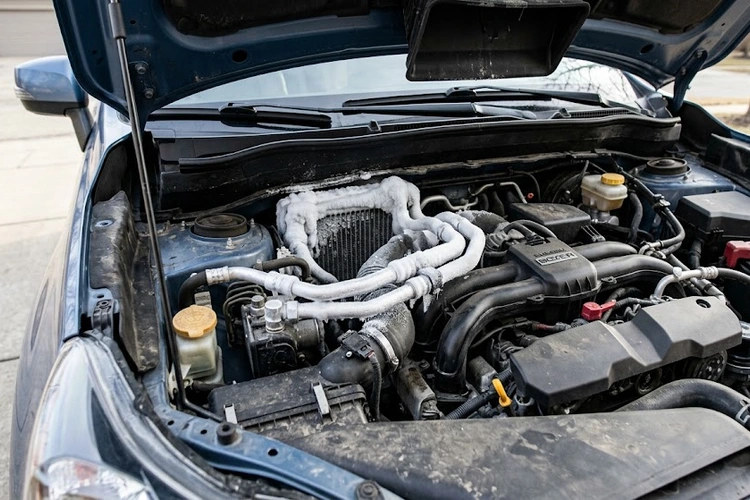
Ever cranked the car AC on a sweltering afternoon only to feel the airflow slowly die down to almost nothing — even though it was blowing ice cold just minutes earlier? Car AC freezing up is the culprit far more often than most drivers suspect. It sounds almost ironic: a cooling system that cools itself right into failure. But the causes are well understood, the fixes range from free to a few hundred dollars, and catching it early prevents a simple problem from becoming a compressor-killing one.
If the system is also struggling with cooling output beyond the freeze issue itself, the full guide on car AC not blowing cold air covers the broader picture of AC system failures and what drives them.
Contents
Before getting into diagnostics, a couple of immediate steps can stop a freeze-up in its tracks and restore airflow in under an hour. Start here.
This is the fastest and most important step. Switching off the AC compressor — while leaving the fan running — lets the ice on the evaporator coil melt naturally. Most freeze-ups clear within 30 minutes to 2 hours this way.
A clogged cabin air filter restricts airflow across the evaporator — and reduced airflow is one of the top causes of freezing. Checking it takes under five minutes on most vehicles, and a replacement filter costs $10–$25.
Pro tip: Replace the cabin air filter every 12,000–15,000 miles — or annually in dusty or high-pollen environments. A restricted filter doesn't just cause freezing; it drives up the workload on the blower motor and degrades air quality inside the cabin.
Most cases of car AC freezing up trace back to one of two root causes. Understanding the difference — and the trade-offs involved in fixing each — determines whether a simple DIY repair does the job or a certified tech is needed.
When refrigerant levels drop (almost always due to a slow leak somewhere in the system), pressure inside the AC circuit falls with it. Lower pressure means the refrigerant expands too aggressively at the evaporator, dropping coil temperatures well below 32°F and triggering ice formation.
The evaporator coil sits inside the HVAC housing and cycles refrigerant to absorb heat from the cabin air passing over it. Over time, dust, mold, and debris coat the coil's surface. This coating restricts airflow and prevents the coil from shedding cold efficiently — so it gets colder and colder until ice forms.
Pinpointing the cause before buying parts saves time and money. This systematic approach works for most drivers without specialized tools.
Warning: Never keep the AC compressor running once a freeze-up is confirmed — continued operation under those conditions strains the compressor and risks liquid refrigerant returning to it, which causes catastrophic mechanical damage.
Not every fix requires a shop visit. Drawing the right line between what's safe to DIY and what needs a certified technician prevents both wasted money and expensive mistakes.
Repair costs span a wide range depending on the root cause. The table below reflects realistic estimates at an independent shop — dealerships typically run 20–30% higher on labor.
| Repair | DIY Part Cost | Shop Labor | Total Estimated Cost |
|---|---|---|---|
| Cabin air filter replacement | $10–$25 | $0–$20 | $10–$45 |
| Evaporator coil cleaning (spray) | $15–$30 | $80–$200 | $95–$230 |
| Blower motor resistor replacement | $20–$60 | $80–$150 | $100–$210 |
| Refrigerant recharge (R-134a) | $30–$60 (kit) | $100–$200 | $130–$260 |
| Refrigerant leak detection + repair | Not advisable | $150–$400 | $150–$400 |
| Expansion valve replacement | $30–$100 (part) | $200–$400 | $230–$500 |
| Evaporator coil replacement | Not advisable | $600–$1,200 | $600–$1,200 |
| AC compressor replacement | $150–$500 (part) | $400–$800 | $550–$1,300 |
The vast majority of car AC freezing up cases — a clogged filter or low refrigerant — land well under $250 to resolve. The high end of this table only applies when a freeze-up is ignored long enough to damage the evaporator coil or compressor, which is exactly why early diagnosis matters.
Preventing freeze-ups is far cheaper than repairing them. These habits keep the AC system healthy and ice-free across every season.
A handful of persistent misconceptions lead drivers to waste money on the wrong fix — or to ignore early warning signs until a minor problem becomes expensive.
Adding refrigerant without addressing the underlying leak is a temporary fix at best. The refrigerant level drops again — within weeks or a few months — and the same freeze-up pattern returns. The correct sequence is: find the leak, repair it, then recharge to manufacturer spec.
This is backwards. Freeze-ups actually occur more readily in mild weather — 55–70°F — than in extreme heat. When ambient temperatures are moderate, the evaporator can drop below freezing more easily because the system isn't working as hard to maintain a temperature differential. Vehicles with a failed low-pressure cutoff switch are especially vulnerable during cool mornings.
A system in the early stages of freezing up often blows cold air — right up until airflow drops to nearly nothing as ice fully blocks the evaporator. Monitoring airflow strength over time, not just output temperature, is the real diagnostic signal. A gradual reduction in airflow over 20–30 minutes of operation is the clearest early warning sign.
DIY recharge kits work for small top-offs on R-134a systems and nothing more. They cannot locate or seal a leak, they are incompatible with R-1234yf systems (the standard on most post-2015 vehicles), and overcharging with them creates high-side pressure problems — including, ironically, freeze-ups caused by excess refrigerant flooding the evaporator.
The clearest early sign is a gradual reduction in airflow from the vents while the air coming out is still cold. As ice builds up on the evaporator coil, it physically restricts airflow. Other signals include excessive water dripping from under the dashboard, frost visible near the evaporator housing behind the glove box, or a musty odor that appears as the ice begins to thaw. A progressive pattern — strong airflow at startup, weak airflow after 20–30 minutes — is the most reliable diagnostic indicator.
Yes, and it's one of the more expensive outcomes of an untreated freeze-up. When the compressor continues running against a frozen evaporator, liquid refrigerant can be drawn back into the compressor — a condition called liquid slugging. Compressors are designed to compress gas, not liquid; the result is mechanical damage to the pistons, valves, and bearings. Turning the compressor off at the first sign of freeze-up prevents this outcome entirely.
With the AC compressor switched off and the blower fan set to medium or high, most freeze-ups clear within 30 minutes to 2 hours. Severe cases with heavy ice accumulation can take longer. Running the fan on warm or neutral air speeds the process. The system is ready to restart once airflow feels fully normal again — not just slightly improved.
Intermittent freeze-ups almost always point to an airflow issue that varies with operating conditions — most commonly a failing blower motor resistor. When the resistor is degraded, the fan may work normally at high speeds but drop out at medium or low speeds, creating just enough of an airflow restriction to trigger freezing under certain conditions. Reviewing common blower motor resistor symptoms is a practical first step when freeze-ups happen inconsistently rather than on every use.
Driving with the compressor off is safe — just switch to fan-only mode and let the system thaw. What's not safe is continuing to run the compressor while the evaporator is frozen. Beyond the compressor damage risk, a frozen system eliminates defrost capability, which can affect windshield visibility in humid or rainy conditions. The practical approach is to turn off the compressor, drive normally with the fan running, and diagnose the cause before using the AC again.
Refrigerant doesn't deplete under normal conditions — the AC system is sealed and the same refrigerant circulates indefinitely. If refrigerant levels are low, it means there's a leak somewhere in the system. Most technicians recommend having AC pressure checked annually as part of routine vehicle service, not on a fixed recharge schedule. Any system that requires a refrigerant top-off more than once every several years has an unresolved leak that needs proper attention.
A frozen car AC is never the real problem — it's always the symptom of something the system has been trying to signal for weeks.
 |
 |
 |
 |

About Sarah Whitfield
Sarah Whitfield is a diagnostics and troubleshooting specialist who spent ten years as an ASE-certified technician before joining the editorial team. She specializes in OBD-II analysis, electrical gremlins, and the kind of intermittent problems that make most owners give up.
Get some FREE car parts & gear.. Or check out the latest free automotive manuals and build guides here.
Disable your ad blocker to unlock all the hidden deals. Hit the button below 🚗
| | | |
