by Sarah Whitfield
Roughly 80 percent of car AC failures trace back to just three root causes — yet most drivers spend weeks guessing before landing the right fix. When a car AC not blowing cold air becomes the daily reality on a sweltering commute, discomfort compounds fast. This guide covers all 8 common causes, from the completely free fixes to the repairs that belong on a shop lift, along with a straight comparison of costs and difficulty levels.
Cabin comfort involves more than temperature. Drivers addressing multiple comfort issues at once — including road noise — may also find value in resources like reducing wind noise in a car. But for now, the focus is cold air — or rather, the absence of it.
Contents
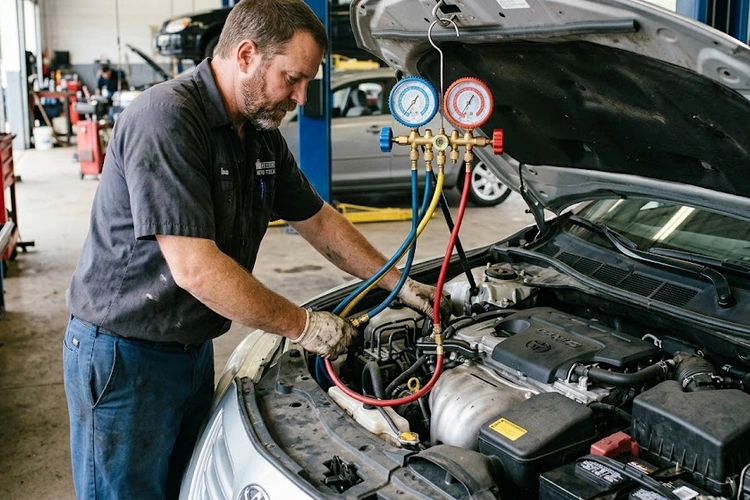
A car's air conditioning system doesn't generate cold — it removes heat. The system uses a chemical refrigerant (most modern vehicles use R-134a or the newer HFO-1234yf) to absorb heat from cabin air and expel it outside the vehicle. The cycle repeats continuously as long as the AC is running.
The basic sequence:
Every component in this loop is a potential failure point. When one goes, the car AC stops blowing cold air entirely — or cools the cabin only weakly.
These four causes account for the vast majority of AC complaints seen at service shops. Start here before moving to the less common issues.
1. Low Refrigerant Due to a Leak
The single most common reason for warm AC output. Refrigerant doesn't burn off on its own — low levels always signal a leak. Small leaks go undetected for months, with symptoms worsening gradually. A hissing sound near the AC lines is a telltale sign.
2. Faulty Compressor or Compressor Clutch
If the compressor clutch doesn't engage when the AC is switched on, the refrigeration cycle never starts. A grinding noise when AC is active points toward compressor failure. This is the most expensive component to replace — typically $500–$1,500 in parts and labor.
3. Blocked or Dirty Condenser
The condenser sits behind the front grille and collects road debris, bugs, and dirt. A clogged condenser can't shed heat efficiently, which leads to warm cabin air. This is one of the few causes visible with a flashlight and a basic inspection — and often fixable for free.
4. Failing Blower Motor or Fan
The blower motor pushes air across the evaporator and into the vents. If it runs slowly or fails entirely, airflow drops dramatically. The refrigerant system may be working perfectly — but drivers feel little or no air. A rattling or squealing noise from the dash often accompanies blower motor failure.
Pro Tip: Before assuming a refrigerant leak, always check the cabin air filter first. A severely clogged filter restricts airflow so heavily that the AC feels broken even when the refrigerant system is perfectly intact.
These causes are less frequent but routinely misdiagnosed. They tend to appear in vehicles with higher mileage or histories of deferred maintenance.
5. Failed Expansion Valve or Orifice Tube
The expansion valve controls how much refrigerant enters the evaporator. A stuck-open valve floods the evaporator; a stuck-closed valve starves it. Both result in warm or inconsistent cabin air. Diagnosis requires pressure testing — not a DIY procedure.
6. Leaking or Clogged Evaporator
The evaporator lives deep inside the dash, making it one of the hardest components to access. Leaks here are slow and often go undetected until refrigerant levels drop significantly. A persistent musty smell from the vents can indicate mold on the evaporator surface. Replacement typically runs $500–$1,200 in labor alone due to the dash removal required.
7. Electrical Faults — Fuses, Relays, and Wiring
The AC system depends on a chain of electrical signals. A blown fuse, failed relay, or damaged wiring can disable AC function entirely without any mechanical failure at all. Checking fuses is a free first step. Note that a bad alternator can also produce voltage irregularities that prevent the compressor clutch from engaging.
8. Engine Overheating Triggering AC Shutoff
Many vehicles automatically disable the AC when engine temperature exceeds a safe threshold — a built-in protection against further thermal stress. If the AC cuts out intermittently while the temperature gauge climbs, the AC system itself may not be the root issue. Problems like a failing thermostat or a blown head gasket commonly trigger this behavior.
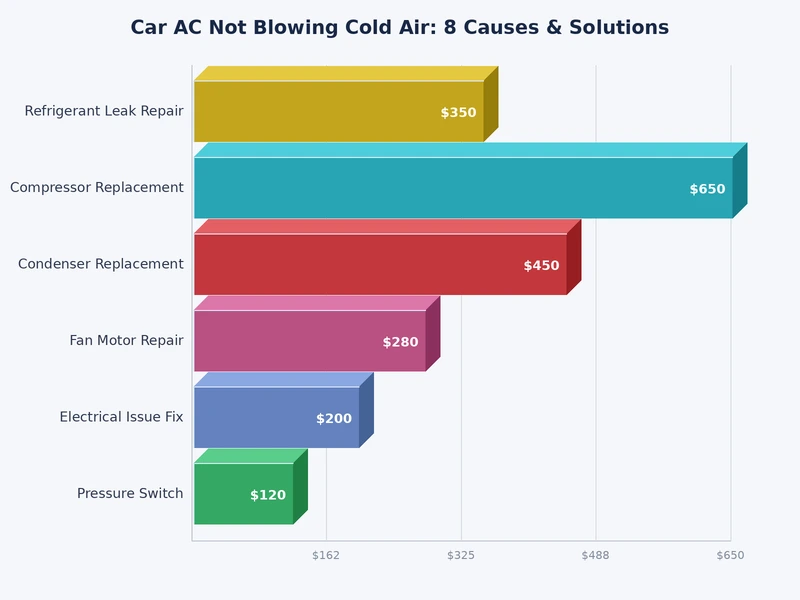
| # | Cause | DIY Fixable? | Estimated Repair Cost | Difficulty Level |
|---|---|---|---|---|
| 1 | Low refrigerant / leak | Partial (recharge only) | $100–$300 | Easy–Moderate |
| 2 | Faulty compressor | No | $500–$1,500 | Hard |
| 3 | Blocked condenser | Yes (cleaning) | $0–$200 | Easy |
| 4 | Blower motor failure | Partial | $150–$400 | Moderate |
| 5 | Failed expansion valve | No | $150–$350 | Hard |
| 6 | Leaking evaporator | No | $500–$1,200 | Very Hard |
| 7 | Electrical faults | Partial (fuses/relays) | $50–$500 | Easy–Hard |
| 8 | Engine overheating | Varies by root cause | $100–$2,000+ | Varies |
Several checks require zero tools and cost nothing. Running through this list before scheduling a shop visit can save $100–$200 in diagnostic fees.
For a broader look at what routine inspections should cover, this vehicle maintenance guide lays out the full spectrum of systems worth monitoring regularly.
Some repairs are legally off-limits for unlicensed individuals. In the United States, handling refrigerant requires an EPA Section 609 certification. Beyond legal requirements, certain AC repairs need specialized equipment that isn't found in a typical home garage:
Warning: Overcharging the AC system is just as damaging as undercharging — excess pressure cracks hoses, strains the compressor, and can void warranties. Always have system pressure verified by a professional before adding refrigerant.
These mistakes are common, often well-intentioned, and sometimes expensive:
Keeping a car's AC system healthy over many years requires minimal effort — but consistency matters.
Misconceptions about car AC are widespread — and they regularly lead drivers to spend money in the wrong place.
Myth: "AC needs recharging every year."
Reality: A properly sealed system holds refrigerant indefinitely. Needing a seasonal top-up means there's a leak — and topping up without fixing the leak is money wasted on repeat visits. The leak is always the real repair.
Myth: "The AC blows reasonably cold, so the system is fine."
Reality: An AC system can cool adequately while running 20–30% below peak efficiency due to a slow refrigerant leak. Fuel economy suffers and the compressor works harder than necessary. Marginally cool air is not the same as a healthy system.
Myth: "Car AC problems always mean expensive compressor work."
Reality: As the table above shows, causes like a dirty condenser, a blown fuse, or a clogged cabin filter cost next to nothing to address. Many car AC not blowing cold air complaints are resolved for under $50.
Myth: "Turning off AC always saves significant fuel."
Reality: At highway speeds, aerodynamic drag from open windows can actually consume more fuel than the AC compressor does. The fuel penalty is real but modest — roughly 5–25% depending on conditions. The calculation shifts at lower city speeds where drag is less of a factor.
Drivers dealing with broader vehicle health concerns alongside an AC problem can cross-reference related symptoms. For instance, unusual exhaust smoke colors can point toward engine conditions that directly stress the AC system.
When the fan runs but air is warm, the blower motor isn't the problem — the refrigerant system, compressor, or condenser is. The most common causes in this scenario are low refrigerant due to a leak, a failed compressor clutch, or a heavily blocked condenser. Start by checking the condenser for visible debris and then have refrigerant pressure tested at a shop.
DIY recharge kits sold at auto parts stores work only when the system is slightly low and holds pressure. They won't fix a mechanical failure, and they don't evacuate moisture before recharging — which can cause internal corrosion over time. For anything beyond a minor top-up, professional service is the more reliable and cost-effective path.
Costs range widely depending on the cause. A simple condenser cleaning or blown fuse may cost nothing. A refrigerant recharge runs $100–$300. A compressor replacement is typically $500–$1,500. Evaporator repairs — the most labor-intensive — can exceed $1,200 at a dealership. Getting an accurate diagnosis first prevents unnecessary part replacements.
The clearest sign is a compressor clutch that doesn't engage when the AC is switched on — the center hub of the compressor pulley should spin with the belt, not freewheel independently. A loud grinding or rattling noise from the compressor area when AC is active also signals internal failure. A shop can confirm with a pressure test and clutch inspection.
This pattern almost always points to a condenser cooling issue. At highway speed, airflow through the front grille helps the condenser shed heat efficiently. At idle, that airflow drops — and if the condenser is dirty or the cooling fan behind it isn't working, the system overheats and can't cool the refrigerant enough to produce cold air. Check the electric condenser fan first.
Yes — and it's more common than most drivers expect. A severely clogged cabin air filter restricts airflow through the evaporator so drastically that the air exiting the vents feels warm even when the refrigerant system is functioning correctly. Replacing a $20 cabin filter is always worth doing before pursuing more expensive repairs.
Most compressors last 8–12 years or 100,000–150,000 miles under normal use. Running the AC system with low refrigerant significantly shortens compressor life because refrigerant also carries the lubricating oil the compressor depends on. Keeping refrigerant at the correct level is the single most impactful thing drivers can do to extend compressor life.
In most cases, yes — a failing AC system doesn't affect core vehicle safety. The exception is when warm AC output is caused by engine overheating, which can lead to serious engine damage if ignored. If the temperature gauge is rising alongside AC failure, pull over and address the overheating issue before continuing to drive.
A car AC not blowing cold air is rarely a mystery once the right diagnostic steps are followed — most cases resolve to one of the eight causes above. Start with the free checks: cabin filter, fuses, and condenser condition. If those come up clean, book a professional pressure test before spending money on refrigerant or parts. Catching the real cause early keeps a $150 fix from snowballing into a $1,200 evaporator job.
 |
 |
 |
 |

About Sarah Whitfield
Sarah Whitfield is a diagnostics and troubleshooting specialist who spent ten years as an ASE-certified technician before joining the editorial team. She specializes in OBD-II analysis, electrical gremlins, and the kind of intermittent problems that make most owners give up.
Get some FREE car parts & gear.. Or check out the latest free automotive manuals and build guides here.
Disable your ad blocker to unlock all the hidden deals. Hit the button below 🚗
| | | |
