Car Care ›
by Diego Ramirez
What causes a car AC not blowing cold air on a sweltering afternoon, and is there a reliable way to diagnose the problem before an expensive shop visit? The answer, in most cases, traces to one of four well-understood failure categories: refrigerant loss, compressor malfunction, airflow obstruction, or electrical fault. Identifying which category applies makes the difference between a straightforward fix and a costly misdiagnosis. This guide walks through each cause in a logical sequence, covering diagnostic steps, common errors, cost comparisons, and the maintenance habits that prevent recurrence.
A vehicle's air conditioning system is an interconnected assembly of mechanical, electrical, and chemical components, each dependent on the others functioning within specification. When the car AC is not blowing cold air, a structured diagnostic approach produces faster and more cost-effective results than guesswork or reflexive refrigerant additions. Drivers who want to maximize their system's output beyond basic repairs will also benefit from the resource on how to make AC colder in a car, which covers optimization strategies applicable after any underlying issue is resolved.
Contents
Failures rarely appear without precursor symptoms. In a majority of cases, the car AC not blowing cold air is preceded by a gradual performance decline that attentive drivers can detect and act upon before complete failure disrupts daily operation.
Operating environment places significant and sustained demand on every component in the AC circuit. Certain conditions accelerate component degradation and increase the likelihood of sudden failure.
Component wear is inevitable over time, and the AC system accumulates degradation in ways that are not always visible. Vehicles with more than 100,000 miles face statistically higher rates of compressor seal failure, O-ring hardening, and condenser corrosion. Refrigerant does not deplete under normal operating conditions, but seal degradation allows slow migration that may not trigger an obvious symptom until the charge is significantly reduced.
Early indicators that should not be dismissed include:
A logical diagnostic sequence saves both time and money by addressing the most accessible and inexpensive checks before proceeding to more complex component testing. The following approach mirrors the methodology used by professional automotive technicians.
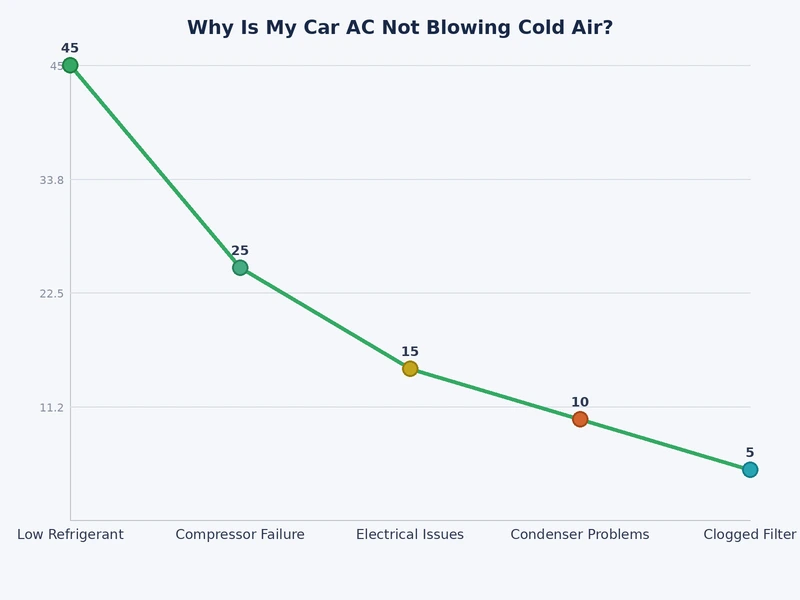
Refrigerant loss accounts for the largest single share of car AC not blowing cold air complaints. According to the Wikipedia overview of refrigerants, modern automotive systems use R-134a or the newer R-1234yf, both of which depend on a sealed, pressurized circuit to function correctly. Any leak path allows the charge to decline until cooling fails.
Drivers considering a refrigerant top-up should review the step-by-step instructions in the guide on how to recharge a car AC system to ensure correct procedure and avoid overcharge-related damage.
The compressor is the mechanical core of the AC circuit, and its failure produces some of the most recognizable symptoms across all car AC not blowing cold air scenarios.
The article on AC compressor clutch not engaging provides a thorough breakdown of electrical and mechanical clutch failure causes along with step-by-step repair guidance specific to this component.
Electrical faults are among the most commonly overlooked root causes when the car AC is not blowing cold air, yet many require no specialized equipment to diagnose.
Drivers beginning their diagnosis with fuse checks will find the systematic process outlined in how to find and replace a car fuse useful for locating the correct AC-related fuse positions across different vehicle platforms.
Several well-intentioned behaviors consistently amplify both the damage and cost associated with a car AC not blowing cold air situation, particularly when drivers attempt repairs without accurate pressure data to guide decision-making.
A compressor operating with insufficient refrigerant runs hotter and under greater mechanical stress than it was designed to sustain over extended periods. Allowing this condition to persist — even for a single warm season — dramatically increases the probability of total compressor failure, converting a modest recharge repair into a full compressor replacement that costs many times more. The principle of early intervention applies consistently across vehicle systems, much as it does with fluid maintenance schedules and other routine service items.
Pro tip: When vent temperatures decline gradually over several weeks rather than failing suddenly, a professional pressure test performed at the first sign of reduced output typically reveals a slow leak that can be sealed before the compressor sustains heat-related internal damage.
Consumer refrigerant canisters with integrated pressure gauges are widely available, and their accessibility encourages use without verifying whether refrigerant addition is actually required. Adding refrigerant to a system already at the correct charge — or one with a different underlying fault — creates a new set of problems that are often more expensive to resolve than the original condition.
Once a root cause is identified for the car AC not blowing cold air, selecting the appropriate repair path involves balancing cost, technical complexity, and the durability of the expected outcome. The table below compares the most common repair approaches across these dimensions.
| Repair Option | Est. Cost (USD) | Skill Required | Expected Outcome | Key Consideration |
|---|---|---|---|---|
| DIY Refrigerant Recharge | $25–$55 | Low | Temporary relief | Does not address the underlying leak source |
| Professional Recharge with Leak Test | $100–$200 | None (shop service) | Full charge + leak map | Best starting point for undiagnosed failures |
| Leak Seal Additive + Recharge | $150–$350 | Low–Moderate | Variable | Effective only on minor O-ring seepage |
| Compressor Replacement | $550–$1,300 | High | Full system restoration | Requires system flush and receiver-drier replacement |
| Condenser Replacement | $300–$750 | Moderate–High | Full restoration | Typically paired with a full refrigerant recharge |
| Blend Door Actuator Replacement | $200–$550 | Moderate | Correct air routing restored | Labor-intensive on many vehicle platforms |
| Cabin Air Filter Replacement | $15–$55 | Low | Improved evaporator airflow | First step — low cost to rule out as a contributor |
Visual inspections, cabin filter replacements, fuse verification, and external condenser cleaning represent legitimate first steps for vehicle owners with basic mechanical familiarity. However, any service that involves opening the refrigerant circuit requires EPA Section 609 certification in the United States, and improperly vented refrigerant carries both legal and environmental consequences. Vehicles that also exhibit engine stumbling or hesitation at the moment the AC system engages may have a related performance issue worth investigating in parallel; the article on car hesitates when AC is turned on explains the relationship between AC compressor load and engine management system behavior in detail.
Consistent preventive maintenance substantially reduces the probability of experiencing a car AC not blowing cold air situation during peak summer demand, when repair shop wait times are longest and the cost of discomfort is highest.
Before committing to extended AC use at the start of warm weather, a structured inspection routine catches developing problems while repair costs are still manageable.
Operational habits exert a measurable influence on how long AC system components retain their performance and structural integrity. Consistent application of a few practical behaviors throughout the year extends component service life and reduces the frequency of car AC not blowing cold air incidents.
The most reliable indicators of a failing AC compressor include grinding or rattling noises that begin precisely when the AC is switched on, a visible gap in the compressor clutch plate that does not close at AC engagement, and rapid on-off cycling triggered by the low-pressure cutout switch responding to an inadequate refrigerant charge. A professional manifold gauge test confirms whether the compressor is generating the correct pressure differential across its inlet and outlet ports, which rules out low refrigerant as the primary cause before replacement is considered.
Driving with a non-functioning AC system is generally safe for the vehicle mechanically, provided the compressor is not producing grinding or rattling noises that indicate internal failure and active debris circulation. If abnormal compressor sounds are present, switching off the AC entirely and avoiding its use until a repair is completed is the prudent course of action, since metal debris from a failing compressor can migrate downstream and damage the condenser and expansion valve if the system continues to operate.
Warm air at idle combined with adequate cooling while driving typically indicates either a condenser cooling fan failure or a borderline refrigerant charge that is sufficient only when vehicle-speed airflow provides passive condenser cooling. At idle, without forward motion driving air through the condenser, high-side pressure climbs until the pressure cutout switch disengages the compressor as a protective measure, halting the refrigeration cycle entirely until system pressure drops back within the acceptable operating range.
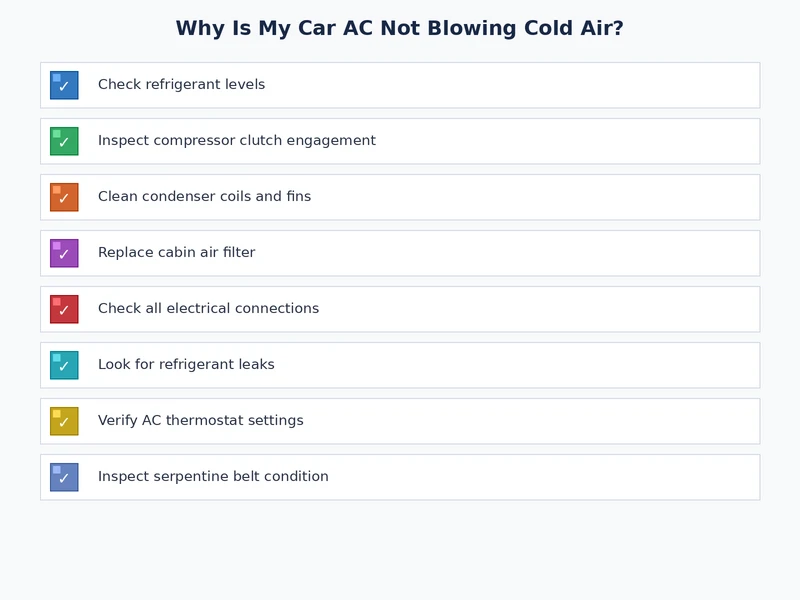
When the car AC is not blowing cold air, the most effective response is a systematic diagnostic sequence — beginning with refrigerant pressure, then compressor operation, then airflow, then electrical components — rather than a default refrigerant addition that treats symptoms instead of causes. Identifying the specific root failure leads to a durable repair at a fraction of the cost that trial-and-error parts replacement typically produces. Scheduling a professional pressure test at the first sign of reduced cooling, before seasonal demand peaks, consistently results in shorter repair timelines and lower total expenditure. Taking that step promptly is the single most impactful action toward restoring reliable, sustained cold air output.
 |
 |
 |
 |

About Diego Ramirez
Diego Ramirez has been wrenching on cars since his teenage years and has built a deep practical knowledge of automotive maintenance and paint protection through years of hands-on work. He specializes in fluid service intervals, preventive care routines, exterior protection products, and the consistent habits that extend a vehicle's lifespan well beyond average. At CarCareTotal, he covers car care guides, cleaning and detailing products, and exterior maintenance and protection reviews.
Get some FREE car parts & gear.. Or check out the latest free automotive manuals and build guides here.
Disable your ad blocker to unlock all the hidden deals. Hit the button below 🚗
| | | |
