by Sarah Whitfield
Roughly one in five vehicles on American roads carries an unresolved engine fault capable of triggering a sudden, explosive backfire — a loud pop or bang from the exhaust or intake manifold that signals a combustion breakdown. The most common car backfiring causes range from a rich air-fuel mixture to a damaged catalytic converter, and each one demands a distinct diagnostic approach. Identifying the precise cause quickly prevents a minor ignition fault from escalating into costly engine damage that requires machining or replacement.
A backfire occurs when unburned fuel ignites outside the combustion chamber. When ignition happens in the exhaust system, mechanics classify it as a true backfire; when it occurs in the intake manifold, it is technically an afterfire, though both terms are used interchangeably in everyday conversation. For a structured overview of this condition and its diagnostic pathways, the dedicated resource at car backfiring causes provides additional context on how each fault type presents differently across vehicle makes and model years.
Contents
Each of the seven causes below represents a distinct failure mode within the engine or its supporting systems. Understanding the mechanism behind each one allows for a more targeted diagnostic process and reduces the likelihood of replacing functional components unnecessarily.
When the engine receives too much fuel relative to the available air, unburned fuel passes through the combustion chamber and enters the exhaust system, where residual heat ignites it with a sharp pop. A faulty mass airflow (MAF) sensor, a stuck-open fuel injector, or a failing fuel pressure regulator are the most frequent contributors to a persistently rich mixture. Drivers often notice black smoke from the exhaust tailpipe alongside a persistent fuel odor — a symptom that also appears in other fuel system failures described in the guide on fuel smell inside the car.
The opposite condition — insufficient fuel or excess air — causes the combustion event to proceed slowly and incompletely. The flame front may still be active as the exhaust valve opens, driving burning gases backward into the intake manifold and producing a loud bang or series of pops. Vacuum leaks (cracks in rubber hoses that allow unmetered air into the intake), a clogged fuel filter, and a weak fuel pump rank among the primary causes of a lean-running engine.
Ignition timing describes the precise moment, measured in degrees of crankshaft rotation, at which the spark plug fires relative to piston position. When timing is retarded — meaning the plug fires later than it should — combustion continues as the exhaust valve opens, releasing burning gases into the exhaust pipe. Modern vehicles rely on the engine control unit (ECU) to manage timing dynamically, so a failing crankshaft position sensor or a corrupted ECU calibration often underlies timing-related backfiring events.
Spark plugs that are worn past their service life, coated with carbon deposits, or gapped beyond the specified tolerance produce a weak or inconsistent spark. When a plug misfires, the air-fuel mixture exits the cylinder unburned and detonates further downstream in the exhaust system. Replacement intervals vary from 30,000 miles for standard copper plugs to more than 100,000 miles for iridium or platinum types, depending on the manufacturer's specification.
The oxygen sensor (O2 sensor) measures the concentration of oxygen in exhaust gases and transmits real-time data to the ECU, which adjusts fuel injection quantities accordingly. A sensor that has degraded or failed sends inaccurate voltage readings, causing the ECU to miscalculate the mixture and create the conditions for repeated backfiring. A check engine light that illuminates without obvious drivability symptoms is frequently the earliest warning sign of a deteriorating O2 sensor.
A crack in the exhaust manifold or a loose pipe joint introduces fresh, oxygen-rich air into the exhaust stream before it reaches the catalytic converter. This additional oxygen reignites unburned hydrocarbons present in the exhaust flow, producing a sharp, repeating bang. Exhaust leaks also amplify backfiring sounds that would otherwise be dampened by the muffler, making the problem appear more severe than the underlying fault actually warrants.
The catalytic converter contains a ceramic honeycomb structure coated with precious metal catalysts that neutralize harmful exhaust emissions. When the converter becomes clogged with carbon buildup or is physically damaged from an impact, exhaust back-pressure rises throughout the system and disrupts normal combustion timing. A rattling noise from beneath the vehicle, combined with backfiring during acceleration and a sulfur-like odor from the exhaust, strongly indicates catalytic converter failure.
| Cause | Primary Symptom | Fault Code | Typical Repair Cost |
|---|---|---|---|
| Rich air-fuel mixture | Black exhaust smoke, fuel odor | P0172, P0175 | $50–$400 |
| Lean air-fuel mixture | Intake backfire, rough idle | P0171, P0174 | $30–$350 |
| Incorrect ignition timing | Deceleration pops, engine knock | P0016, P0017 | $80–$500 |
| Worn spark plugs | Misfires, reduced power | P0300–P0309 | $50–$250 |
| Faulty O2 sensor | Check engine light, poor fuel economy | P0136, P0141 | $150–$400 |
| Exhaust system leak | Loud popping, ticking sound | P0420 (secondary) | $100–$600 |
| Damaged catalytic converter | Rattle, sulfur smell, power loss | P0420, P0421 | $500–$2,500 |
Every vehicle manufactured after 1996 includes an OBD-II (on-board diagnostics, second generation) port, typically located beneath the dashboard on the driver's side. Connecting a scan tool to this port retrieves diagnostic trouble codes (DTCs) that identify the affected system with considerable precision. Codes in the P0300–P0309 range confirm cylinder-specific misfires; codes P0171 and P0172 flag lean and rich mixture conditions respectively. This single step narrows the list of probable car backfiring causes before any physical disassembly begins, saving both time and unnecessary parts costs.
After retrieving fault codes, a systematic visual inspection identifies mechanical damage that electronic diagnostics cannot detect independently. The inspection should cover spark plug wire condition, the integrity of all vacuum hoses, the cleanliness of the air filter, and any audible exhaust leaks detectable as a ticking or hissing sound with the engine running at idle. Performing a routine engine oil level check during this walkthrough also reveals whether oil consumption is contributing to fouled spark plugs or contaminated combustion chambers.
Accurate diagnosis requires specific instruments rather than guesswork. An OBD-II scanner is the most important single tool — professional-grade units display live sensor data alongside stored fault codes, enabling technicians to observe oxygen sensor voltage and fuel trim values in real time during a test drive. A digital multimeter tests sensor resistance and voltage output to confirm whether a component has failed or merely drifted outside specification. A vacuum gauge measures intake manifold vacuum pressure, which simultaneously reveals lean conditions and ignition timing irregularities. For physical repairs, a spark plug socket set with a torque wrench ensures correct plug installation without cracking the ceramic insulator or stripping the cylinder head threads.
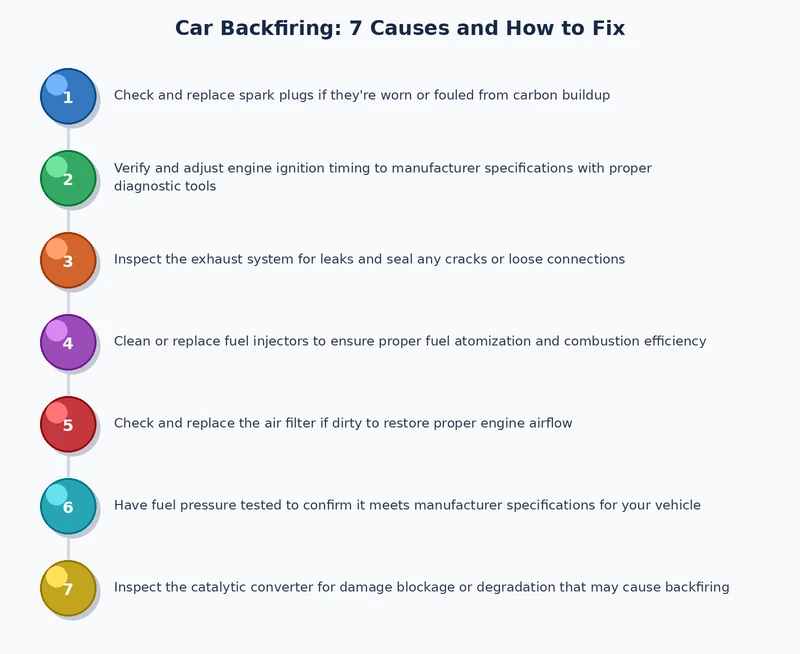
Correcting a rich or lean condition begins with the lowest-cost, highest-frequency maintenance items: the engine air filter and the fuel filter. Both restrict airflow or fuel delivery when clogged, and both cost relatively little to replace. If filter replacement does not resolve the stored codes, testing the MAF sensor with a multimeter and cleaning it with a dedicated MAF cleaner spray is the next logical step. Fuel injector cleaning — through a concentrated fuel system additive or a professional ultrasonic cleaning service — addresses stuck-open or partially clogged injectors without requiring replacement.
Worn spark plugs require replacement as a complete set, using the exact part number and gap specification listed in the vehicle's owner manual. Substituting a different heat range or plug type without manufacturer approval creates new combustion problems. Ignition coils and plug wires should be tested alongside the plugs using a multimeter, because a failing coil produces misfire fault codes identical to those generated by a bad plug, and replacing one without the other leaves the underlying cause unresolved.
A methodical sequence prevents technicians from replacing expensive components before ruling out inexpensive ones. Beginning with the air filter, spark plugs, and a vacuum hose inspection before moving to sensors and injectors conserves both time and budget. Allowing the engine to reach full operating temperature before initiating an OBD-II scan ensures that sensor readings reflect normal closed-loop conditions rather than cold-start enrichment calibrations, which would produce misleading fuel trim values. When backfiring occurs exclusively during deceleration with the throttle closed, the fault is almost always a vacuum leak producing a lean condition, which narrows the physical inspection to intake components and eliminates the fuel system from the initial search.
A persistent myth holds that a backfiring engine invariably signals severe internal damage requiring engine rebuilding or replacement. In practice, the majority of backfiring events originate from inexpensive maintenance items — spark plugs, air filters, and oxygen sensors — that fall well under $200 to replace at a reputable shop. A second common misconception is that only older or neglected vehicles backfire. Modern engines equipped with electronic fuel injection and adaptive ECU management backfire when sensors malfunction or software calibration drifts, and vehicle age or low mileage provides no immunity to sensor-related failures. According to Wikipedia's entry on engine backfire, the phenomenon has been documented since the earliest days of the internal combustion engine, and contemporary fuel management systems have reduced — but not eliminated — its occurrence.
Preventing backfiring is fundamentally a matter of adhering to manufacturer-specified service intervals. Spark plugs, fuel filters, air filters, and oxygen sensors all carry defined replacement schedules that vary by vehicle make, model, and engine type. Owners who maintain a documented service record and address stored fault codes promptly — before misfires become audible — rarely encounter serious or recurring backfiring events, because the underlying sensor and ignition faults that cause backfiring are resolved during routine maintenance rather than after they produce symptoms.
Between scheduled services, periodic visual inspection of the exhaust system for rust, cracks, and loose flange connections identifies exhaust leaks at an early stage when repair costs remain low. Fuel system cleaners added to the fuel tank at every 5,000 to 10,000 miles help sustain injector cleanliness and support consistent fuel atomization (the process of breaking liquid fuel into fine droplets for efficient combustion). Noting the precise driving conditions under which backfiring occurs — whether during cold starts, deceleration, hard acceleration, or sustained highway speeds — provides the next servicing technician with diagnostic information that significantly reduces labor time.
Deceleration backfiring is almost always caused by a lean air-fuel mixture reaching the exhaust system with the throttle closed. Vacuum leaks are the most common culprit, as unmetered air enters the intake manifold and leans out the mixture. Some performance exhaust systems with minimal back-pressure also allow unburned fuel to ignite during deceleration, producing a series of pops that are normal for that specific configuration.
Driving with occasional mild backfiring is possible for short distances, but it is not advisable as a long-term practice. Repeated backfiring can damage the catalytic converter, burn exhaust valves, and stress the oxygen sensor. If backfiring is frequent, accompanied by a check engine light, or occurs alongside power loss or black smoke, the vehicle should be inspected and repaired before extended driving continues.
Repair costs depend entirely on the underlying cause. Replacing spark plugs and an air filter typically costs between $50 and $250 at a shop. An oxygen sensor replacement ranges from $150 to $400. Catalytic converter replacement represents the most expensive repair, with costs typically falling between $500 and $2,500 depending on vehicle make and whether an OEM or aftermarket unit is used.
Yes. Worn, fouled, or incorrectly gapped spark plugs are among the most common causes of engine backfiring. A plug that fails to ignite the air-fuel mixture allows unburned fuel to travel into the exhaust system, where it ignites from residual heat. Replacing plugs at the manufacturer-recommended interval and using the specified part number eliminates this cause entirely.
A backfire technically refers to ignition occurring in the intake manifold — the system that delivers the air-fuel mixture to the combustion chamber. An afterfire refers to ignition occurring in the exhaust system after the mixture has passed through the cylinder. Both events share similar root causes and are commonly referred to as backfiring in everyday usage, though the distinction matters when diagnosing whether the fault is upstream or downstream of the combustion chamber.
Low engine oil does not directly cause backfiring, but it contributes to conditions that can lead to it. Insufficient oil pressure allows carbon deposits to accumulate on spark plugs and combustion chamber surfaces more rapidly, degrading ignition quality over time. Severe oil starvation can also cause engine knock and timing irregularities that indirectly produce backfiring events. Regular oil level monitoring remains an essential part of engine health.
 |
 |
 |
 |

About Sarah Whitfield
Sarah Whitfield is a diagnostics and troubleshooting specialist who spent ten years as an ASE-certified technician before joining the editorial team. She specializes in OBD-II analysis, electrical gremlins, and the kind of intermittent problems that make most owners give up.
Get some FREE car parts & gear.. Or check out the latest free automotive manuals and build guides here.
Disable your ad blocker to unlock all the hidden deals. Hit the button below 🚗
| | | |
