by Sarah Whitfield
A car battery keeps dying for eight documented reasons — and the fix is specific to whichever one applies. Our team has worked through hundreds of these diagnoses, and the outcome is nearly always the same: either something is pulling current while the car sits, the charging system has failed to restore capacity, or the battery's internal chemistry has degraded past the point of recovery. Understanding which of these three failure categories is at play cuts diagnostic time dramatically. The complete car battery keeps dying diagnostic framework addresses each scenario in order of likelihood.
Jump-starting the same battery twice in a week is not a solution — it is a symptom of a system that needs attention. Most people who reach that point are dealing with one of the eight causes laid out below.
Contents
Each cause has a distinct fingerprint. Identifying the right pattern eliminates guesswork and points directly to the correct repair.
Parasitic draw is the most common reason a battery dies overnight or after a few days sitting in a driveway. Every vehicle draws a small standby current — typically 20 to 50 milliamps — to maintain ECU memory, the clock, and anti-theft systems. When that draw climbs above 50 mA due to a stuck relay, a module that never enters sleep mode, or a faulty body control switch, the battery drains fully within 48 to 72 hours. An ammeter placed in series with the negative terminal, with fuses pulled one circuit at a time, isolates the offending circuit in under 30 minutes on most platforms.
The alternator is the battery's only charging source while the engine runs. A diode failure inside the alternator rectifier not only reduces charge output — it creates a reverse-current path that actively drains the battery when the engine is off. Our team has measured parasitic draws as high as 300 mA from a single failed alternator diode. Output voltage below 13.5 V at idle or above 14.8 V under load signals a regulation problem. The battery warning light is the most reliable early indicator, illuminating as soon as charge voltage drops outside the normal 13.5–14.8 V operating window.
Corrosion at the battery terminals introduces resistance into the charging circuit. Even a thin film of lead sulfate or copper oxide at the connection point creates a voltage drop large enough to prevent the alternator from delivering a full charge. Our team regularly encounters batteries that test healthy in isolation but read under 12.4 V after a 30-minute drive because terminal resistance is blocking charge transfer. The repair is mechanical: clean terminals with a wire brush and baking soda solution, torque the clamps to specification, and apply dielectric terminal protector spray.
Cold weather reduces a lead-acid battery's available cranking amps by as much as 50 percent at 0°F compared to performance at 80°F. A battery that passes a load test in summer may lack the CCA reserve needed to start the same engine on a cold winter morning. Heat creates the opposite problem — it accelerates electrolyte evaporation and internal plate corrosion, shortening projected service life from five years to two or three in consistently hot climates. Cold exposes hidden weakness; heat builds it.
Starting an engine demands a large burst of current — typically 150 to 400 CCA depending on displacement and compression ratio. The alternator requires approximately 15 to 30 minutes of steady driving to restore that charge. A vehicle used exclusively for 5-minute errands accumulates a charge deficit with every start. Over several weeks, that deficit deepens until the battery can no longer hold enough charge to crank the engine reliably. Most people in this situation report that the battery "died for no reason," when the cause is a predictable energy imbalance.
The average lead-acid battery lifespan is three to five years under normal operating conditions. As batteries age, lead sulfate crystals accumulate on the plates — a process called sulfation — reducing effective plate surface area and storage capacity. A battery that delivered 550 CCA when new may test at 280 CCA by the time it begins failing intermittently. No amount of recharging reverses advanced sulfation. Replacement is the only resolution.
On most modern vehicles, the voltage regulator is integrated directly into the alternator assembly. A regulator failure in the overcharge direction pushes output above 15 V, boiling electrolyte from non-sealed batteries and destroying cells in AGM units within weeks. A failure in the undercharge direction holds output at 12.0 to 12.8 V — insufficient to replenish the charge consumed during starting. Both failure modes produce a car battery keeps dying complaint, but with different downstream damage profiles that require distinct follow-up repairs.
Aftermarket audio amplifiers, remote start systems, GPS trackers, and dashcams are consistent culprits in parasitic drain cases. Many are wired directly to a constant 12 V source rather than to a switched ignition circuit. A single medium-power amplifier in standby mode draws 30 to 80 mA. Combined with two additional accessories on always-on circuits, total standby draw easily exceeds the 50 mA threshold — and does so silently, with no visible symptom until the battery is too depleted to start the engine.
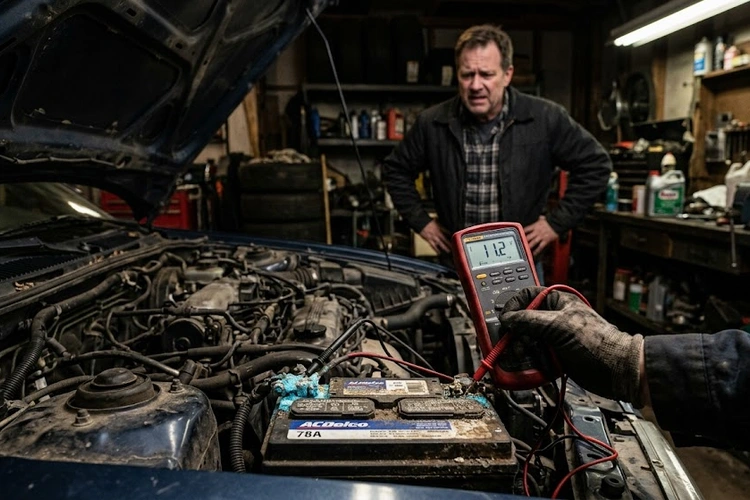
The first test is a resting voltage check. A fully charged 12 V lead-acid battery reads 12.6 to 12.8 V with the engine off and no load applied. A reading below 12.4 V after eight hours of rest confirms a charging or storage problem. A reading below 12.0 V indicates significant capacity loss or deep-discharge damage that may be irreversible.
Visual inspection covers terminal corrosion and obvious physical damage — swelling, cracking, or electrolyte leakage. A voltmeter check at idle with the engine running and no accessories active should read 13.5 to 14.8 V. Outside that range, the alternator or regulator is immediately implicated. Checking dashboard warning light meanings for battery or charging indicators takes ten seconds and often directs attention straight to the charging circuit without any additional testing.
Our team recommends keeping a basic multimeter in the glove box — it handles 80 percent of battery and charging diagnostics without requiring a shop visit.
A load test applies a controlled draw — typically half the battery's CCA rating — for 15 seconds while monitoring terminal voltage. A healthy battery holds above 9.6 V under load at 70°F. Below that threshold, internal resistance has climbed past the serviceable range. Carbon pile testers and electronic conductance testers (Midtronics is the industry standard brand) deliver quantified CCA readings that load testing alone cannot provide. For intermittent parasitic drain, a clamp-style DC current meter on the negative cable gives a live reading without breaking the circuit — a faster and safer approach than the ammeter-in-series method for initial screening.
The decision is a function of battery age and state of health, not just state of charge. Our team applies a consistent rule: a battery under three years old that discharged due to a clear external cause — a door left ajar, a known short circuit, an alternator that has since been replaced — is a candidate for a full slow recharge at 2 amps and retesting. A battery over four years old that has discharged once with no identifiable external cause is a replacement candidate regardless of how it tests after a surface charge is restored.
| Condition | Battery Age | Recommended Action | Notes |
|---|---|---|---|
| Discharged, known external cause | Under 3 years | Slow recharge + retest | Fix root cause before recharging |
| Discharged, no clear cause | Under 3 years | Full diagnostic before any action | Parasitic draw is the likely culprit |
| Any discharge pattern | 3–4 years | Recharge + conductance test | Replace if CCA is under 75% of rated |
| Any discharge pattern | Over 4 years | Replace | Sulfation is unlikely to be reversible |
| Resting voltage under 10.5 V | Any age | Replace immediately | Deep-discharge damage is permanent |
A battery deep-discharged below 10.5 V — especially repeatedly — has permanent sulfation damage. Jump-starting and recharging it restores surface charge but not cranking capacity. The battery industry's position aligns with our team's field experience: a single deep discharge below 10 V reduces serviceable life by 30 to 50 percent in AGM batteries and more in flooded units. Recovery attempts at that stage waste time and delay the actual solution.
The most persistent mistake our team observes is jump-starting a dead battery and immediately driving a short trip to "recharge it." A 10-minute urban drive following a deep discharge delivers perhaps 15 to 20 percent charge. The next morning, the battery sits at roughly 30 percent — still insufficient for reliable cold cranking. The correct procedure is a slow overnight charge on a smart charger before returning the vehicle to normal use.
Installing a higher-capacity battery than the vehicle's charging system is calibrated for is a common error in cold climates. Many modern vehicles with smart alternator management — designed to reduce fuel consumption by limiting charge output during steady cruising — will not fully charge an oversized battery during normal commuting cycles. The result is a chronically undercharged battery that tests below capacity within its first winter of service.
Warning: disconnecting the battery to "reset" electrical gremlins without addressing the root cause simply clears stored fault codes — it removes the diagnostic trail needed to identify the actual problem and solves nothing.
Wiring aftermarket accessories to always-on circuits rather than ignition-switched circuits is the other high-frequency installation error. When a check engine light or other warning indicator appears shortly after an accessory installation, the two events are almost always connected — dismissing those signals without investigation accelerates an already-compromised electrical system toward a more expensive repair.
The single highest-impact maintenance action is terminal cleaning once per year. Corrosion builds gradually and creates resistance that compounds faster than most people anticipate. Anti-corrosion washers applied at installation — a two-dollar component — demonstrably extend the interval between terminal service appointments and reduce charging circuit resistance over the battery's entire service life.
Vehicles that sit for more than two weeks — seasonal-use cars, collector vehicles, seldom-used second vehicles — benefit from a battery maintainer with float-mode capability connected continuously during storage. A smart maintainer holds the battery at 12.6 to 12.8 V without overcharging, preventing the self-discharge cycle that initiates sulfation during inactivity. Our team's standard recommendation is any smart maintainer with automatic float mode — not a conventional automotive charger left connected, which will overcharge a fully charged battery within 48 hours.
Annual conductance testing — available free at most chain auto parts stores — gives an accurate CCA reading that tracks degradation year over year. A battery showing 80 percent or more of rated CCA retains meaningful service life. A battery testing at 60 percent or below is exhibiting pre-failure patterns and warrants proactive replacement before a cold-weather failure event forces an emergency roadside situation.
In our shop experience, the most common scenario in late-model vehicles is the smart-alternator parasitic drain: a telematics module or infotainment unit that fails to enter sleep mode after the ignition is switched off. These cases present as batteries that are fully charged after one night but dead after three. The draw is real but intermittent, which makes it difficult to capture with a single overnight ammeter measurement — it requires consecutive nights of data logging to reproduce reliably.
The second most common pattern is the short-trip commuter. Our team sees this repeatedly in urban markets: a vehicle used for 3- to 5-mile daily commutes, often with significant electrical load from heated seats, rear defrost, and audio pulling current during the brief drive window. The battery tests healthy at full CCA — but it has been running at 70 percent state of charge for months, and one cold morning closes the window on that marginal reserve. The fix is one 30-minute highway drive per week or a monthly maintainer session overnight.
Extreme temperature failure is the most misdiagnosed pattern. Our team regularly encounters batteries blamed for starting failures that are actually cases of cold weather revealing a pre-existing weakness. The battery was borderline functional all summer. Cold simply closed the window on marginal CCA — it did not cause the underlying capacity loss.
For high-electrical-demand vehicles — those with aftermarket audio systems, winches, or auxiliary lighting — our team recommends a dual-battery setup with an isolator rather than simply upgrading to a higher-capacity single battery. An isolator ensures the start battery always receives priority charging while accessories run from the auxiliary unit. This eliminates the core conflict between high standby draw and reliable cranking, without the compromises that come from asking one battery to do both jobs.
AGM (absorbed glass mat) batteries handle deep cycling significantly better than flooded units. A flooded battery discharged below 50 percent capacity repeatedly will fail within 18 months of installation. An AGM battery rated for deep-cycle applications maintains performance through hundreds of partial discharge cycles. For vehicles with stop-start systems or high accessory loads, AGM is not a premium upgrade — it is the correct specification for the application, and installing a flooded battery in its place is a reliable path to a car battery keeps dying complaint within the first year.
When parasitic drain is intermittent and difficult to reproduce in a single shop visit, a data-logging voltmeter placed on the battery overnight for multiple consecutive nights captures discharge events precisely. Several inexpensive Bluetooth battery monitors log voltage at one-minute intervals and transmit the data wirelessly. Our team uses this approach to send a vehicle home with the owner and receive a complete voltage history — rather than relying on a single shop measurement that may not reproduce the fault condition.
Most lead-acid batteries have a three- to five-year service life under normal conditions. Annual conductance testing from year three onward is the most reliable method for catching degradation before a failure event rather than reacting to one after the fact.
A faulty alternator is one of the primary causes. A failed rectifier diode not only prevents proper charging — it creates a reverse-current path that actively discharges the battery when the engine is off. Output voltage below 13.5 V at idle with no load confirms a charging system problem.
Cold weather reduces available cranking amps by up to 50 percent at 0°F. A battery that passes load testing in warm conditions may lack the CCA reserve needed for cold cranking. Cold weather reveals pre-existing weakness in a marginal battery — it does not typically create that weakness from scratch.
A slow charge at 2 amps restores a deeply discharged battery in 12 to 24 hours. Fast charging at 10 to 15 amps completes the cycle in 2 to 4 hours but applies additional stress to the plates. Our team's consistent recommendation is a slow overnight charge following any deep discharge event before returning the vehicle to service.
Parasitic drain is current draw from the battery when the vehicle is off and all systems should be in sleep mode. Normal draw is 20 to 50 milliamps. Anything above 50 mA after the vehicle fully enters sleep mode — typically 20 to 30 minutes after shutoff — is abnormal. It is measured by placing an ammeter in series with the negative battery cable and pulling fuses one at a time to isolate the circuit.
Short trips are a genuine and well-documented cause. Each engine start draws 150 to 400 CCA of burst current. The alternator needs 15 to 30 minutes of driving to restore that charge. Vehicles used exclusively for 5-minute errands accumulate a charge deficit that deepens progressively until the battery can no longer reliably start the engine — typically within a few weeks in cold weather.
Occasional jump-starting does not damage a healthy battery. Repeated jump-starting of the same battery indicates an unresolved underlying cause that will not improve without diagnosis. Connecting jumper cables with reversed polarity causes immediate and permanent damage to the battery, alternator diodes, and ECU — polarity verification is non-negotiable before connecting cables.
A battery maintainer monitors terminal voltage and delivers small current pulses to hold the battery at full charge without overcharging. A conventional battery charger applies a fixed charge rate until manually disconnected. Leaving a standard charger connected to a fully charged battery overcharges it within 24 to 48 hours. For storage applications, a smart maintainer with automatic float mode is the correct tool.
A car battery keeps dying because something specific is wrong — and that something is always diagnosable with the right tools and sequence. Our team recommends starting with a resting voltage check, confirming alternator output at idle, and running a parasitic draw measurement before replacing any components. Anyone working through a repeat battery failure will find a step-by-step breakdown matched to each of the eight causes covered here at the full car battery keeps dying resource — start there, follow the sequence, and reach a permanent fix rather than another temporary jump-start.
 |
 |
 |
 |

About Sarah Whitfield
Sarah Whitfield is a diagnostics and troubleshooting specialist who spent ten years as an ASE-certified technician before joining the editorial team. She specializes in OBD-II analysis, electrical gremlins, and the kind of intermittent problems that make most owners give up.
Get some FREE car parts & gear.. Or check out the latest free automotive manuals and build guides here.
Disable your ad blocker to unlock all the hidden deals. Hit the button below 🚗
| | | |
