by Sarah Whitfield
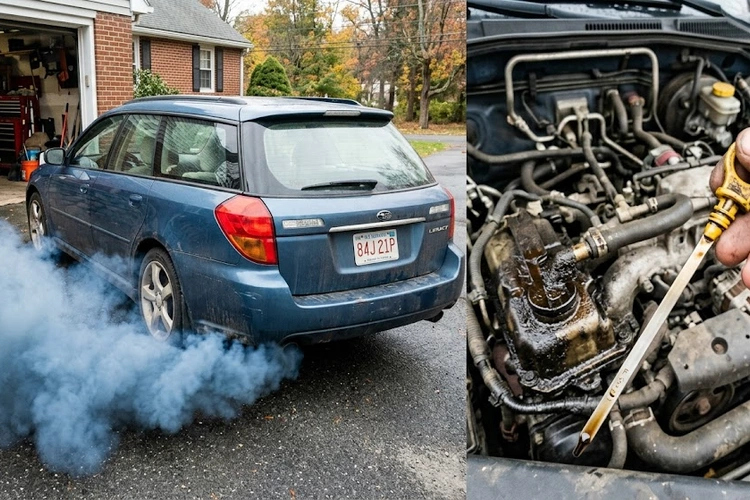
During a routine road test at our shop, a senior technician noticed a faint blue haze trailing a customer's sedan through the parking lot. The oil level had dropped nearly a quart in just three weeks, and no puddle appeared beneath the car. That experience pushed our team to document every car burning oil symptom that drivers overlook until serious engine damage has already begun.
Engine oil burning is more widespread than most people realize, and identifying car burning oil symptoms early separates a manageable repair from a catastrophic engine replacement. Our team has spent years cataloguing the warning signs that mechanics encounter most often in the shop, and this guide covers all seven of the most reliable indicators, along with the diagnostic steps and repair options connected to each one.
Several of these symptoms overlap with conditions covered in our guide on car oil leak causes, but burning oil carries its own distinct clues that point specifically to oil entering and igniting inside the combustion chamber rather than leaking externally onto hot surfaces.
Contents
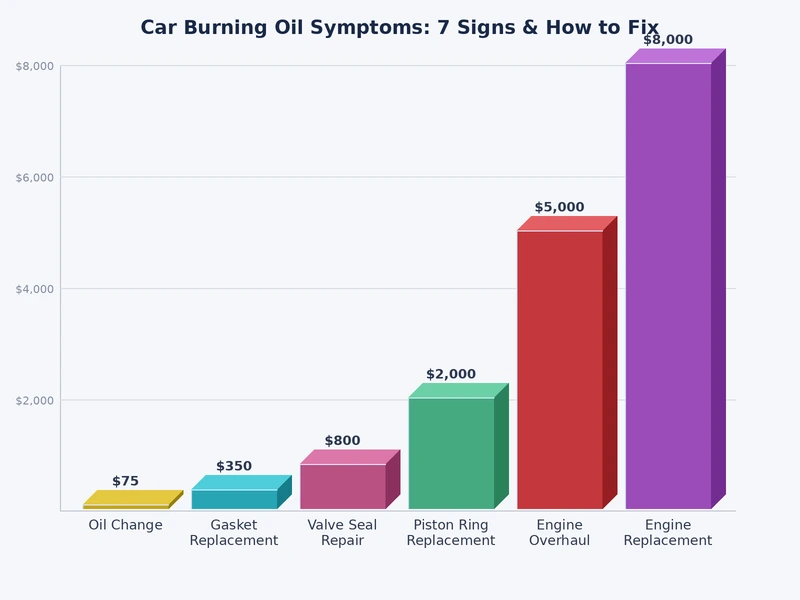
Motor oil serves as the lifeblood of any internal combustion engine, lubricating moving parts, reducing heat buildup, and forming a protective film between metal surfaces that would otherwise grind against each other. Under normal operation, oil stays entirely within the lubrication system and never contacts the combustion chamber directly. When components like valve stem seals — the small rubber caps that prevent oil from seeping into the intake and exhaust ports — or piston rings — the spring-like metal bands that seal the gap between each piston and the cylinder wall — wear down from age and heat exposure, oil slips past these barriers and enters the combustion chamber.
Once inside the combustion chamber, oil ignites alongside the air-fuel mixture and burns with the gasoline, producing the distinctive blue or gray smoke that mechanics recognize instantly. According to broadly documented automotive engineering standards, engine oil is not designed to withstand direct combustion temperatures, and repeated burning degrades both the oil's protective properties and the surrounding engine components. The cost of replacing bad valve seals is typically far lower than the repair bill that accumulates when the problem goes unaddressed for thousands of miles.
Our team notes that some oil consumption is inherent in any internal combustion engine, and most manufacturers consider a loss of one quart per 2,000 miles acceptable in high-mileage vehicles with significant wear. Newer vehicles should remain well below that threshold, and consumption exceeding one quart per 5,000 miles in a vehicle under 100,000 miles warrants immediate investigation. The distinction matters because catching the problem during the early-consumption stage makes repairs substantially less invasive and less expensive than waiting until blue smoke and misfires become routine daily occurrences.
1. Blue or Bluish-Gray Exhaust Smoke. This is the most universally recognized of all car burning oil symptoms, and our team considers it the clearest single indicator that oil is actively entering the combustion chamber. The smoke appears most clearly during cold starts, when seals are stiff and gaps are at their widest, and it carries a sharp, acrid smell that differs noticeably from normal exhaust.
2. Consistent Drop in Oil Level Between Changes. Most people who check their oil monthly and notice steady drops — without finding any oil puddles under the car and without a visible external leak — are almost certainly running an engine that consumes oil internally. A loss of more than half a quart in a single month is enough to justify a closer diagnostic examination of the seals and rings.
3. Oil-Fouled Spark Plugs. Mechanics frequently discover the problem while performing a routine tune-up, pulling out spark plugs coated in dark, wet, oily residue rather than the dry tan or gray color of a healthy plug. Our detailed guide on oil on spark plugs explains how this contamination builds up and what the residue pattern reveals about which internal component has failed.
4. Persistent Burning Smell Near or Inside the Cabin. When oil seeps onto a hot exhaust manifold or other high-temperature surface, it burns off and produces a sharp chemical smell that can infiltrate the cabin through the ventilation system, even in cases where no blue smoke is visible in the rearview mirror during driving.
5. Engine Misfires and Rough Idle. Oil residue coating the firing tip of a spark plug disrupts the consistent spark that smooth combustion depends on, causing misfires — brief, rhythmic stutters in engine behavior — and an uneven, shaky idle at low RPM. Our team's coverage of check engine light flashing vs. solid details how misfires trigger that warning light and what the associated fault codes reveal about which cylinders are affected.
6. Recurring Oil Pressure or Low Oil Level Warning Light. A dashboard warning light that illuminates before the normal service interval has elapsed is a practical, real-world indicator of excessive consumption rather than routine neglect. Our team treats a recurring low-oil warning as grounds for immediate inspection rather than a straightforward top-off.
7. Gradual Loss of Engine Power. As oil burns away and lubrication levels fall, internal friction increases steadily, robbing the engine of the mechanical efficiency needed to produce full power during acceleration and at higher engine speeds.
Our team recommends checking the oil level every 1,000 miles on any vehicle showing even one of these symptoms — running low is the fastest path to irreversible engine damage, and the dipstick takes thirty seconds to read.
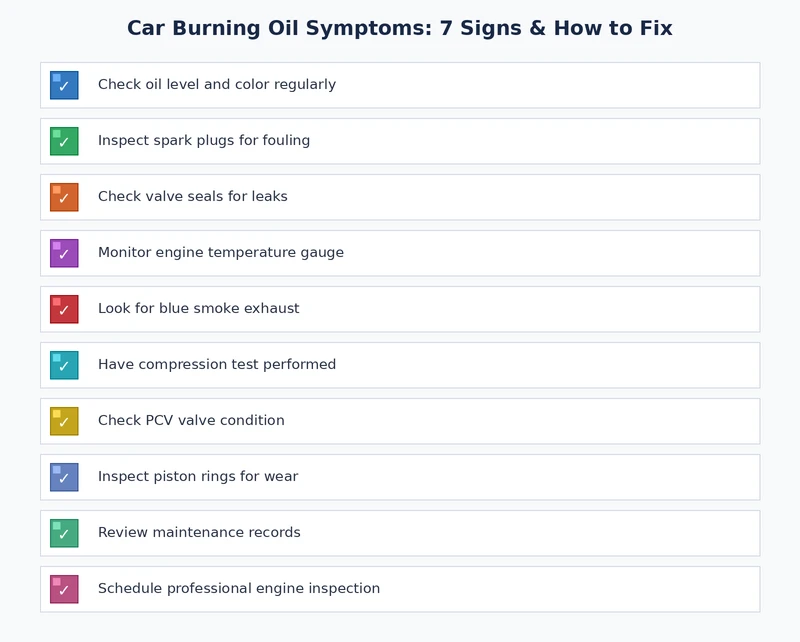
The first diagnostic step our team recommends is pulling the dipstick before the first cold start of the day, when the oil has fully drained back into the pan and the reading is most accurate. Running that same check weekly over three or four consecutive weeks, and recording the result each time, confirms whether consumption is occurring consistently rather than reflecting a single measurement error. Oil color matters as well — oil that darkens dramatically and becomes very thin within just a few hundred miles may indicate combustion byproducts contaminating the crankcase from above the piston rings, a condition known as blowby.
Removing the oil filler cap while the engine idles at operating temperature is another accessible home test. A steady puff of white or blue smoke rising from the filler opening confirms that combustion gases are escaping past the piston rings into the crankcase (blowby), which typically occurs alongside active oil burning in the chamber above.
Removing and inspecting the spark plugs is one of the most informative diagnostic steps available without specialized shop equipment. Plugs appearing wet with oil or coated in thick, black, oily carbon buildup identify the specific cylinders where infiltration is worst, giving the mechanic a starting point for isolating the failure. A pattern where only certain cylinders show contaminated plugs typically suggests worn valve stem seals, while a uniform pattern across all cylinders points more strongly toward worn piston rings, which is a considerably more expensive repair pathway to pursue.
Replacing valve stem seals on many overhead-valve engines falls within reach for a capable home mechanic equipped with a valve spring compressor and a source of compressed air to hold the valves in place during the swap. The job requires removing the valve cover and, on many engines, the intake manifold, and it can typically be completed over a weekend with careful attention to torque specifications during reassembly. Replacing a leaking valve cover gasket — which does not cause oil burning directly but can allow oil to drip onto hot exhaust components and create that distinctive burning smell — is an even more accessible repair that most home mechanics complete in under two hours.
Worn piston rings require a partial or full engine rebuild, involving engine removal from the vehicle and disassembly of the short block — the lower engine section housing the crankshaft, connecting rods, and pistons. This work falls firmly outside what most home mechanics can realistically attempt without access to a machine shop, precision measuring tools, and substantial hands-on engine experience. The following table summarizes where each symptom tends to land on the DIY-versus-professional spectrum.
| Symptom | Most Likely Cause | DIY or Pro? | Severity |
|---|---|---|---|
| Blue smoke on cold start only | Worn valve stem seals | DIY — intermediate | Moderate |
| Blue smoke throughout all driving | Worn piston rings | Professional required | High |
| Oil-fouled spark plugs | Valve seals or rings | Diagnose first | Moderate–High |
| Burning smell without visible smoke | Oil on exhaust manifold | DIY — easy | Low |
| Recurring low oil warning light | Multiple seal failures | Professional required | High |
| Misfires and rough idle | Oil-fouled spark plugs | DIY — easy | Moderate |
Switching to a high-mileage motor oil formula — typically marketed for vehicles exceeding 75,000 miles — can meaningfully reduce oil consumption in the short term, because these formulations contain seal-conditioning additives designed to swell and soften aging rubber seals and partially restore their original flexibility. Our team has observed measurable reductions in consumption rate after high-mileage oil was introduced in vehicles with early-stage valve seal wear, sometimes cutting the loss rate by close to half over a few thousand miles.
Dedicated oil stop-leak additives (chemical treatments added directly to the crankcase) offer temporary relief in vehicles where the cost of an immediate repair is prohibitive, but our team is clear that these treatments are a delay measure and not a cure for the underlying mechanical failure. Relying on additives alone while ignoring deteriorating seals accelerates wear on the surrounding components and ultimately makes the eventual repair more expensive.
Avoiding extended cold-idle warm-ups reduces the window during which cold, stiff seals allow the most oil infiltration into the combustion chamber. Our team recommends driving gently for the first few minutes after a cold start, rather than idling in place, because the engine reaches normal operating temperature faster under a light load and the seals expand to their functional dimensions more quickly. Keeping RPMs moderate during the warm-up phase — staying below 2,500 RPM until the temperature gauge reaches the normal band — also reduces the pressure differential that pushes oil past worn seals.
Our team documented a case involving a high-mileage sedan whose owner had noticed occasional blue smoke on cold starts for nearly eight months before bringing the vehicle in for a diagnosis. By the time the car arrived at the shop, three of the four cylinder walls showed scoring — shallow grooves cut into the cylinder surface by metal-on-metal contact — caused by chronically low lubrication. What began as a straightforward valve seal job had grown into a full engine rebuild estimate, costing roughly ten times the original repair cost because the early warning signs went unaddressed.
Turbocharged engines are especially vulnerable to oil burning from a failed turbocharger shaft seal, because the turbo's spinning shaft is continuously bathed in engine oil, and any seal failure allows that oil to enter the intake or exhaust stream directly. Our team inspected a turbocharged crossover whose owner believed the engine was simply "running rich" based on the dark exhaust output. The actual finding was a failed turbo oil seal that had been feeding oil into the intake manifold for thousands of miles, coating the intercooler and intake valves with a varnished oil residue — a finding that required a full intercooler flush and intake cleaning on top of the turbo replacement itself, because no one recognized the car burning oil symptoms early enough to act on them promptly.
A car that burns oil is sending a clear mechanical distress signal — the only real question is whether anyone acts on it before the engine does the answering.
 |
 |
 |
 |

About Sarah Whitfield
Sarah Whitfield is a diagnostics and troubleshooting specialist who spent ten years as an ASE-certified technician before joining the editorial team. She specializes in OBD-II analysis, electrical gremlins, and the kind of intermittent problems that make most owners give up.
Get some FREE car parts & gear.. Or check out the latest free automotive manuals and build guides here.
Disable your ad blocker to unlock all the hidden deals. Hit the button below 🚗
| | | |
