by Sarah Whitfield
Picture this: a driver turns the key on a Monday morning, hears the engine crank steadily with no hesitation, and watches the dashboard lights cycle normally — yet the engine refuses to fire. The battery is clearly not dead, the starter motor is engaging without complaint, and still nothing happens. The car cranks but wont start condition is one of automotive diagnosis's most deceptive presentations, because it eliminates only one portion of the fault tree while leaving nine credible causes still in play. Approaching it systematically — rather than replacing parts at random — is the only strategy that produces a reliable result.

Contents
When an engine cranks without starting, the starter motor, battery, and their connecting cables are performing adequately — that much is confirmed by the cranking action itself. What remains unresolved is whether the engine is receiving fuel, spark, compression, or the correct sensor signals needed to initiate combustion. According to the Wikipedia overview of internal combustion engines, all four elements — fuel, spark, compression, and timing — must converge simultaneously for ignition to occur. A healthy crank sound eliminates the starter circuit from suspicion and focuses attention on the combustion side of the system, which is a genuine diagnostic advantage when approached methodically.
Many drivers confuse a slow, labored crank with a proper crank, and that distinction matters enormously in the early diagnostic stages. A marginal battery produces sluggish, low-speed cranking that can still turn the engine over without ever achieving the compression events needed for ignition. Testing battery voltage with a multimeter — expecting 12.6 volts at rest and above 10.5 volts during cranking — eliminates this variable in under two minutes and costs nothing. Drivers who find their car battery keeps dying repeatedly after short drives should investigate the charging system before suspecting internal engine faults.
Fuel system problems account for a substantial share of cranking no-start complaints, and diagnosing them correctly depends on distinguishing between pressure generation, delivery volume, and filter restriction. Each of the three fuel-related causes below presents with subtly different symptoms, and misidentifying them leads directly to unnecessary parts replacement.
A dead fuel pump is one of the most definitive causes of the car cranks but wont start condition, because the engine receives zero fuel pressure regardless of how well every other system performs. The field test most technicians rely on is listening for a brief humming sound from beneath the rear of the vehicle when the ignition key is turned to "on" without cranking — a healthy pump primes the fuel rail within roughly two seconds. Silence during that priming window is a strong indicator of pump failure, and a fuel pressure gauge test at the Schrader valve will confirm zero PSI at the rail within moments. The bad fuel pump symptoms guide covers the full diagnostic progression, including how intermittent pressure drops differ from complete pump failure.
A severely restricted fuel filter produces the same cranking no-start symptom as a failed pump, because both conditions deny the engine the minimum pressure threshold required for injector operation. On any high-mileage vehicle with an unknown service history, the fuel filter should be replaced before condemning the pump — the filter costs a fraction of the pump and takes far less time to swap. Most manufacturers recommend replacement every 30,000 to 60,000 miles under normal driving conditions, yet it is among the most commonly neglected service items in the field. Reviewing the symptoms of a bad fuel filter before pulling the pump assembly can prevent a costly misdiagnosis.
Pro tip: Before condemning a fuel pump on a high-mileage vehicle, always replace the fuel filter first — a severely clogged filter causes identical symptoms and costs a fraction of the repair.
The ignition system and its associated sensors represent the second major category of cranking no-start causes, and these faults are frequently misdiagnosed in favor of the more commonly suspected fuel system. The table below summarizes all nine causes with their typical symptoms, diagnostic difficulty, and approximate repair cost to aid in prioritization.
| Cause | Key Symptom | DIY Difficulty | Est. Repair Cost |
|---|---|---|---|
| Failed fuel pump | No priming hum, zero fuel pressure | Moderate | $250–$600 |
| Clogged fuel filter | Low or erratic fuel pressure | Easy | $50–$150 |
| Worn spark plugs | Misfires before failure, then no-start | Easy | $60–$200 |
| CKP sensor failure | No RPM signal, no injector pulse | Moderate | $120–$300 |
| Faulty ignition coil | No spark at affected cylinders | Moderate | $100–$350 |
| Security/immobilizer lockout | Security light on, no injector pulse | Difficult | $0–$500+ |
| Flooded engine | Strong fuel smell, wet spark plugs | Easy | $0–$80 |
| Timing belt failure | Sudden power loss, possible bent valves | Difficult | $500–$2,000+ |
| Cracked distributor cap | Intermittent no-start, moisture sensitivity | Easy | $30–$100 |
Spark plugs rarely fail without warning — most degraded plugs announce themselves through rough idle, hesitation under load, and declining fuel economy long before they cause a complete no-start event. However, when electrode wear becomes severe enough, the gap widens past the ignition coil's ability to bridge it reliably under compression, and combustion becomes inconsistent or impossible. Replacing plugs at manufacturer-specified intervals eliminates this failure mode entirely, and the cost of a quality plug set is trivial compared to the diagnostic labor a no-start generates on a busy morning.
The crankshaft position sensor is one of the most underappreciated causes of a car cranks but wont start situation, because the engine management system uses its signal to time both fuel injection and ignition events. Without a valid CKP signal, most ECUs simply refuse to activate injectors or coils regardless of throttle input, producing a crank-with-no-start that mimics fuel system failure completely. A scan tool capable of reading live injector pulse data and RPM signal simultaneously will confirm CKP failure within minutes, but many basic code readers miss this fault if no diagnostic trouble code has been stored. Drivers who have been noticing subtle hesitation when accelerating in the weeks before a full no-start may have already been operating with a degrading sensor.
On modern coil-on-plug systems, a single failed coil disables one cylinder and typically produces a rough-running engine rather than a complete no-start, but simultaneous failure of multiple coils — which occurs on high-mileage direct ignition systems — can prevent the engine from sustaining combustion at all. Coil failures are best confirmed with a dedicated spark tester rather than visual inspection, because cracked coil towers often show no detectable external damage while failing internally under load. Swapping a suspect coil with an identical unit from an adjacent cylinder is a valid field test when a spark tester is unavailable.
The single most common diagnostic error when a car cranks but wont start is assuming the battery is the root cause simply because cranking sounds slightly slower than normal. This conflates two separate problems — a battery too weak to crank at full speed versus an engine that cranks normally but fails to fire — and replacing the battery in a genuine crank-no-start scenario accomplishes nothing while leaving the actual fault untouched. A proper diagnosis with a multimeter and a fuel pressure gauge takes under ten minutes and costs nothing, yet most drivers skip it entirely in favor of swapping the most accessible part first. The systematic approach always outperforms the random one.
Warning: Avoid repeated cranking attempts when the engine refuses to start — excessive cranking can foul spark plugs with raw fuel and compound the original fault with a secondary flooding problem that obscures the real cause.
Engine flooding — excess raw fuel saturating the spark plug electrodes — is a real cause of a cranking no-start, but it is far less common in modern fuel-injected vehicles than it was during the carburetor era. Most drivers over-diagnose flooding, and the attempted remedy of holding the throttle wide open while cranking can damage engine seals if fuel pressure happens to be normal. A genuinely flooded engine announces itself with a strong raw fuel smell at the tailpipe and visibly wet plug electrodes upon removal. If neither indicator is present, flooding is almost certainly not the cause, and further diagnosis should target the fuel pressure circuit and ignition system instead.
A triggered factory immobilizer or a failed transponder chip in the key fob can produce a perfect cranking no-start with no other symptoms — the engine turns over briskly, fuel pressure tests normal, and sparks are present, yet the injectors receive no pulse because the ECU has disabled them intentionally. The dashboard security light remaining illuminated after the key is turned to the "on" position is the primary indicator, and the remedy ranges from simply using the correct key to a full ECU relearn procedure at a dealership. This cause is disproportionately common on vehicles that have recently had their battery replaced, since some immobilizer systems require a relearn cycle after total power loss.
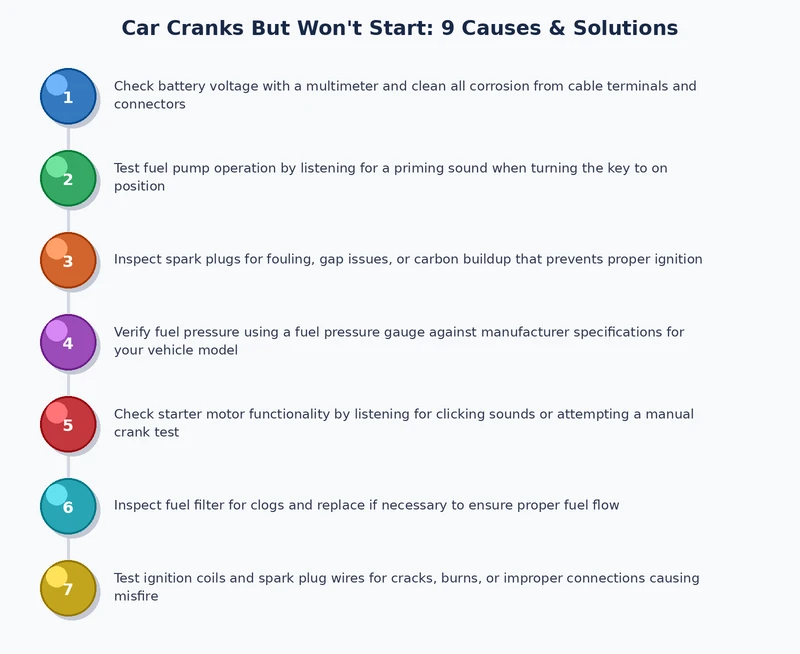
The majority of cranking no-start conditions are not sudden failures — they are the endpoint of a gradual degradation that generated detectable warning signs weeks or months earlier. Consistent maintenance and attentiveness to early symptoms eliminates most of these scenarios before they escalate to a roadside breakdown.
Maintaining the fuel system on a disciplined schedule is the single most effective preventive strategy against fuel-related no-start events. Fuel filter replacement, injector cleaning at 60,000-mile intervals, and periodic fuel pressure testing catch developing faults before they become stranding events. Drivers who have been noticing engine knocking noises should include a fuel pressure and injector flow test in their next service appointment, since poor combustion quality and delivery faults frequently share the same root cause. The inspection cost is negligible compared to emergency towing and expedited shop labor.
The most reliable early indicator of an impending crank-no-start failure is a pattern of extended cranking before the engine catches on the first start of the day, which typically signals low fuel pressure, a degrading CKP sensor, or aging spark plugs losing their cold-start reliability. Secondary indicators include rough idle at operating temperature, subtle hesitation under moderate load, and intermittent stalling at low speeds in traffic. A vehicle already showing sputtering when accelerating is statistically much closer to a no-start event than one running cleanly, and scheduling a diagnostic scan when those early symptoms appear costs significantly less than an emergency repair and the associated disruption to a workday.
Yes — a failed CKP sensor is one of the most common causes of a cranking no-start that is frequently misdiagnosed. The ECU relies on the CKP signal to time both fuel injection and ignition; without a valid signal, it disables both systems entirely, producing a crank with no combustion response regardless of fuel pressure or spark plug condition.
The fastest field test is to listen for a brief two-second priming hum from the rear of the vehicle when the ignition is turned to "on" without cranking. A silent fuel pump during that priming window strongly suggests pump failure. Confirming with a fuel pressure gauge at the Schrader valve — expecting the manufacturer's specified PSI — takes the diagnosis from likely to definitive.
Absolutely. A triggered factory immobilizer disables the fuel injectors while leaving the starter circuit fully functional, producing a normal-sounding crank with no combustion. The security or key warning light remaining illuminated after the ignition is turned on is the primary indicator. This issue is most common after battery replacement, key fob battery failure, or use of a non-programmed spare key.
Repeated cranking attempts without understanding the root cause can worsen the situation significantly. Each prolonged crank cycle pumps raw fuel into the cylinder bores, which can foul spark plugs, dilute engine oil on the cylinder walls, and in extreme cases cause hydraulic lock if a cooling system leak is also present. Three to four five-second attempts are reasonable; beyond that, diagnosis should precede further cranking.
Worn plugs typically cause progressively worsening misfires, rough idle, and hard starts before reaching the point of a complete no-start. Complete no-start due to plug failure alone is most common in high-mileage vehicles where plugs are significantly overdue for replacement. When plugs are found severely worn during a no-start diagnosis, they should be replaced as part of the repair even if another primary cause is also identified.
The correct first step is a quick battery and charging system check with a multimeter to confirm the crank is genuinely healthy rather than marginally weak. Once the battery is confirmed good, the next step is a fuel pressure test at the Schrader valve. These two tests together — taking under ten minutes combined — rule out or confirm the two most statistically common causes before any parts are purchased or replaced.
 |
 |
 |
 |

About Sarah Whitfield
Sarah Whitfield is a diagnostics and troubleshooting specialist who spent ten years as an ASE-certified technician before joining the editorial team. She specializes in OBD-II analysis, electrical gremlins, and the kind of intermittent problems that make most owners give up.
Get some FREE car parts & gear.. Or check out the latest free automotive manuals and build guides here.
Disable your ad blocker to unlock all the hidden deals. Hit the button below 🚗
| | | |
