by Sarah Whitfield
Around 40% of all vehicle electrical failures trace back to a fuse-related fault — and that number surprises most people who assume fuses are rarely the issue. When a car fuse keeps blowing repeatedly, the fuse itself isn't broken. It's working exactly as designed. Something in the circuit is drawing too much current, and the fuse is the messenger. Our team thinks of it as the car sending a signal that something bigger is wrong.
A fuse is a small sacrificial component — a thin metal strip inside a plastic housing — that melts when current exceeds a safe level. Its job is to protect wiring, sensors, and control modules from heat damage or fire. The moment a replacement fuse blows just as fast as the first one, that's confirmation: the root cause is still live and waiting to be found.
Electrical faults often show up in clusters. Our team has found that when a fuse in the instrument panel circuit keeps failing, it frequently connects to problems like all dashboard gauges not working at once — making the real source harder to spot without a systematic approach.

Contents
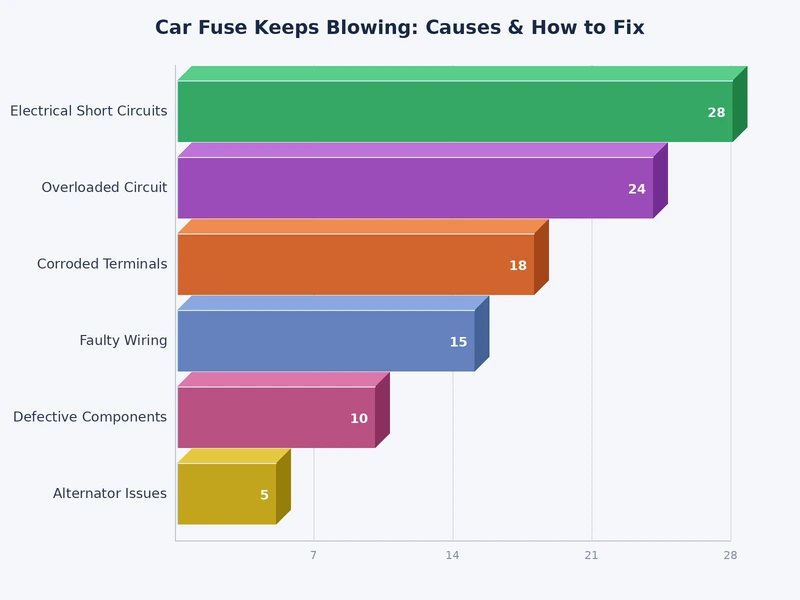
There's no single answer here. In our experience, the cause almost always falls into one of four categories: a short circuit somewhere in the wiring, a failed component drawing too much current, an overloaded circuit, or simply the wrong fuse installed to begin with. Each one looks a little different in practice.
A short circuit (when bare wiring contacts a metal surface) sends a sudden current spike through the circuit. The fuse blows immediately and keeps blowing the moment a fresh one goes in. This usually means insulation has worn away, a connector has corroded, or an animal has chewed through a wire in the harness. A component failure — like a window motor, fuel pump, or blower fan drawing more current than its rated spec — tends to let the replacement fuse survive briefly before it blows again under load.
According to Wikipedia's overview of electrical fuses, a fuse's amperage rating must match the circuit it protects — not just be "close enough." Installing the wrong rating is one of the most common errors our team sees, and it creates a predictable loop of blown fuses that never resolves.
| Root Cause | Blowing Pattern | Repeats? | DIY Fixable? |
|---|---|---|---|
| Short circuit (bare wire on metal) | Blows immediately on replace | Every time | Sometimes — depends on location |
| Failed component (motor, pump, fan) | Works briefly, then blows again | Frequently | Yes, with component swap |
| Overloaded circuit (add-on accessories) | Blows under heavy electrical load | Intermittent | Yes — redistribute accessories |
| Wrong amperage fuse installed | Blows during normal operation | Every time | Yes — match OEM rating |
| Corroded or damaged wiring | Intermittent or immediate | Variable | Requires visual inspection |
Most vehicles carry two fuse boxes. The interior box — typically on the driver's side under the dashboard — handles lower-current accessories like the radio, interior lighting, power windows, and climate controls. The under-hood box, usually mounted near the battery, handles high-current circuits: the cooling fan, fuel pump, ABS, and starter relay.
Our team always starts with the interior box for the majority of common complaints. The cover usually pops off with finger pressure. The fuse diagram is printed on the inside of the lid, or it's detailed in the owner's manual — both list every slot by name and amperage.
Standard blade fuses are color-coded by amperage. Tan is 5A, brown is 7.5A, red is 10A, blue is 15A, and yellow is 20A. Pulling the suspect fuse and holding it up to light usually reveals a broken or melted metal strip inside the clear housing. If the strip looks intact but the circuit still doesn't work, confirm with a multimeter or test light — fuses can fail internally without visible damage.
Pro tip from our team: A fuse that looks intact can still have zero continuity. Always verify with a test light or multimeter set to continuity mode — don't rely on visual inspection alone.
Diagnosing a car fuse keeps blowing situation doesn't require a full shop setup. Our team recommends keeping at least these three items in every vehicle:
The fuse puller deserves a mention. Most people skip it and use fingers or pliers — and end up bending the fuse slot contacts over time. The plastic puller tool is usually clipped inside the fuse box lid and takes seconds to use correctly.
When the basic swap-and-check doesn't point to an obvious culprit, a circuit tracer becomes useful. This tone-based tool sends a signal along a wire and lets a probe follow it through a harness — saving hours of guesswork when the short is buried behind a door panel or under carpet. A vehicle-specific wiring diagram, available through service manual subscriptions or manufacturer portals, is equally valuable. Our team has also found that most national auto parts chains loan out OBD-II scanners for free, which can surface electrical fault codes that point directly to the failing circuit.
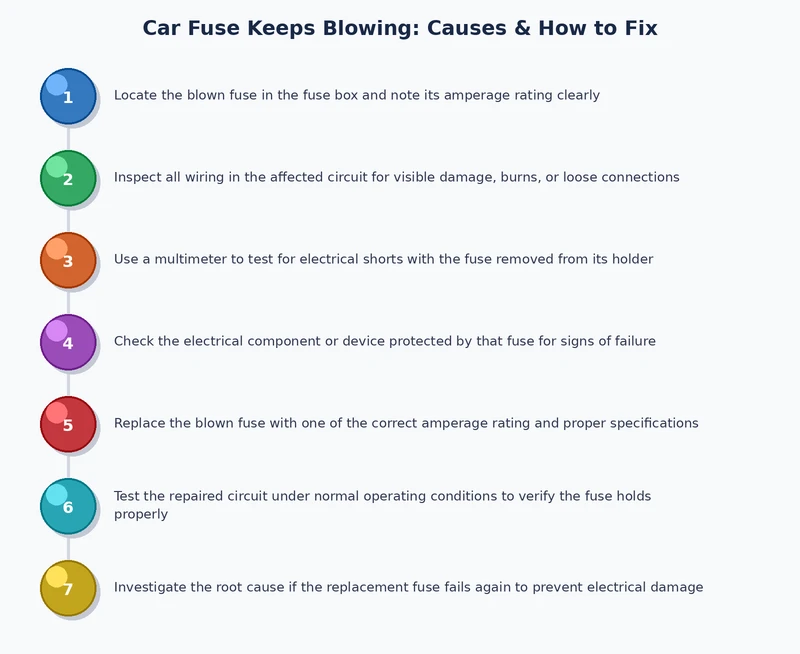
Replacing a blown fuse is one of the most accessible car repairs anyone can do without mechanical experience. Pulling the fuse, checking it, and pressing a new one in takes under two minutes. The more involved step — identifying what caused the blow — is still manageable for most people if the failed component is obvious. A dead radio, a window that stopped working, or a single headlight that went dark all point to specific circuits that are easy to trace.
Our team has seen that a failed headlight, for example, often traces back to more than just a bulb. Reviewing a resource like our one headlight not working guide before heading to a shop can confirm whether the fuse, the socket, or the bulb itself is the actual problem — and save an unnecessary service appointment.
Safety-critical circuits are a different matter entirely. When a fuse keeps blowing in the ABS, airbag, or ignition system, our team does not recommend DIY diagnosis. The wiring in these systems is complex and the consequences of getting it wrong are serious. The same logic applies when the short is hidden deep inside a wiring harness behind the dashboard or under the carpet — tracing it without proper equipment risks causing additional damage.
It's also worth noting that irregular voltage from a failing charging system can stress fuses across multiple circuits. Electrical faults that seem unrelated sometimes point to alternator symptoms like voltage spikes that push current beyond fuse ratings. A shop can test charging output in minutes and rule it out early.
Important warning: Never install a higher-amperage fuse to stop the blowing — this removes the circuit's only protection and creates a genuine fire risk in the wiring harness.
This is the mistake our team sees most often. The thinking goes: if a 15A fuse keeps blowing, swap in a 20A and the problem stops. It does stop — but only because the circuit's protection is now gone. Wiring is rated to carry a specific current load. Exceeding that load causes heat buildup in the harness, which eventually melts insulation and creates the exact short circuit that started the whole problem. Always match the amperage on the original fuse exactly.
Replacing a fuse without investigating why it blew is a bit like silencing a smoke alarm without looking for smoke. Our team has watched this approach lead to burned wiring harnesses costing several hundred dollars — all because a failing window motor or a pinched wire was left unchecked for weeks. Every repeated fuse failure in the same circuit deserves at least a ten-minute inspection of the component it serves before dropping in a new fuse and calling it done.
Most electrical issues are preventable with a little routine attention. Our team recommends keeping aftermarket accessories — dash cams, phone chargers, LED light bars — on dedicated circuits with their own inline fuses rather than tapping into factory circuits that weren't designed for the extra load. Inspecting wiring near high-movement areas (door hinges, engine mounts, firewall pass-throughs) once a season catches chafed insulation before it becomes a short. Keeping a small fuse assortment in the glove box means a roadside fix is always possible while a more complete diagnosis waits for the shop.
A fuse that blows the moment it's replaced signals an active short — something is touching ground right now. That circuit should stay open until the fault is found. A burning smell near the fuse box is a more urgent version of the same warning. And when multiple fuses across different circuits start failing at the same time, the problem likely isn't in any single circuit. The main power feed, the ground bus, or the charging system itself may be the source — and that warrants immediate professional attention.
An immediate repeat blow almost always means there's an active short circuit — bare wiring is touching a metal surface right now, causing a current spike the moment power is restored. Our team recommends disconnecting the components on that circuit one at a time to isolate the fault before installing another fuse. Running a test light across each section of wiring can also reveal where the short is located.
Yes, a corroded or loose ground strap can create uneven current flow that repeatedly stresses a fuse past its rating. Our team sees this most often on older vehicles where the body-to-chassis ground points have corroded over time. Cleaning the ground connection with a wire brush and verifying tight contact is a quick check worth doing before moving on to more complex diagnosis.
If the blown fuse controls something non-critical — a radio, a single power window, or heated seats — most people can drive for a short time without immediate safety risk. That said, our team cautions against ignoring it for long. A persistent electrical fault can allow wiring damage to spread, and what starts as a minor inconvenience can eventually affect more critical systems nearby in the harness.
A fuse is a one-time protection device that physically melts to stop excessive current. A relay is an electromechanical switch that opens or closes a circuit based on a control signal — it can fail stuck open or stuck closed, but it doesn't blow like a fuse. Both live in the same fuse box and both can cause similar symptoms like a dead circuit, which is why our team always checks both when diagnosing an unresponsive electrical component.
The fuse box lid usually has a printed diagram on the reverse side mapping every slot to its circuit name and amperage rating. The owner's manual carries the same information in more detail. For older vehicles where the labels have faded, a vehicle-specific wiring diagram from a service manual or an online subscription database is the most reliable source. Our team has found that many manufacturer websites also offer free downloadable fuse diagrams for older models.
In some cases, yes. A failing alternator can generate voltage spikes that push irregular current through circuits, stressing fuses beyond their rated amperage in ways that seem unrelated. Our team has seen this pattern in high-mileage vehicles where multiple unrelated fuses start blowing around the same time with no obvious component failures. If the battery warning light is also on, having the charging system tested is a logical first step before chasing individual circuit faults.
When a car fuse keeps blowing, the fix is rarely the fuse itself — it's finding what the fuse is trying to protect the car from. Our team recommends working through the most common causes in order: confirm the correct amperage, check the component on that circuit, inspect the wiring near high-wear areas, and test charging system output if multiple circuits are affected. Anyone ready to go deeper into automotive electrical health will find our bad alternator symptoms guide a useful companion read — catching charging problems early prevents a whole category of repeat electrical faults before they start.
 |
 |
 |
 |

About Sarah Whitfield
Sarah Whitfield is a diagnostics and troubleshooting specialist who spent ten years as an ASE-certified technician before joining the editorial team. She specializes in OBD-II analysis, electrical gremlins, and the kind of intermittent problems that make most owners give up.
Get some FREE car parts & gear.. Or check out the latest free automotive manuals and build guides here.
Disable your ad blocker to unlock all the hidden deals. Hit the button below 🚗
| | | |
