by Joshua Thomas
A grinding noise when turning is most commonly caused by a worn CV (constant-velocity) joint or a failing wheel bearing — two components that sit close to the wheels and degrade steadily over time. When you hear a car grinding noise when turning, the sound is a direct mechanical signal that something in the steering or suspension system needs attention. This guide explains the five most frequent causes, how to diagnose which one is affecting your vehicle, and the steps you can take to resolve the problem before it becomes significantly more expensive. For a complete reference on this symptom, including cost estimates and repair timelines, visit the dedicated resource at car grinding noise when turning.
The causes range from straightforward fluid issues you can address yourself in minutes to structural failures that require a professional lift and specialized tools. Understanding the distinction will save you both time and money.
Contents
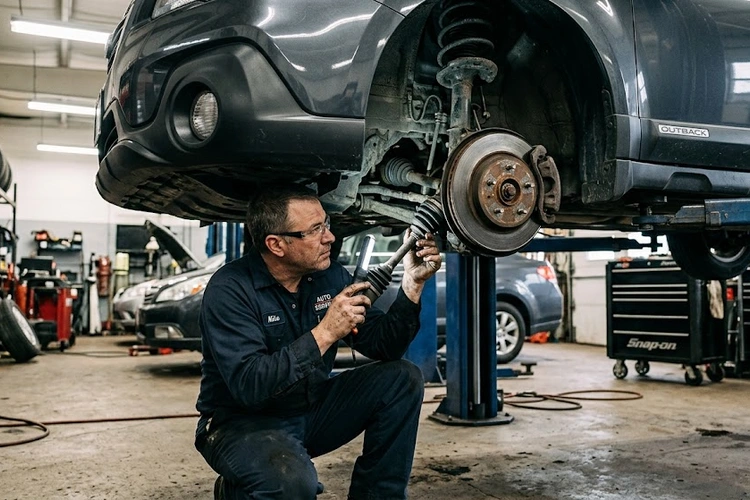
Each cause produces a subtly different sound under specific driving conditions. Paying close attention to when the noise occurs — and under what circumstances — is the most effective first step toward an accurate diagnosis.
CV joints connect the transmission to the drive wheels and allow the driveshaft to flex as the suspension travels up and down. Each joint is protected by a rubber boot filled with grease. When that boot cracks or tears, the grease leaks out and road debris enters the joint. The internal bearings and races (the grooved rings that guide them) begin to wear unevenly, producing a clicking or grinding sound that is most pronounced during slow, tight turns — the precise situation that places maximum stress on the joint.
According to Wikipedia's overview of constant-velocity joints, these components are a standard feature on virtually all front-wheel-drive vehicles and are subject to significant angular stress during cornering. A damaged outer CV joint is the single most common source of a grinding or clicking sound specifically during turning.
A wheel bearing is a set of steel balls or rollers held inside a metal ring that allows the wheel hub to rotate smoothly. Over time, heat, road vibration, and moisture degrade the internal lubrication and cause the bearing surfaces to pit and roughen. The resulting sound is typically a grinding, humming, or rumbling that changes pitch as the vehicle turns and weight shifts toward or away from the affected side.
A useful rule of thumb: if the noise intensifies when you steer right, the left-side bearing is likely failing. If it grows louder when steering left, suspect the right side. This happens because weight transfers to the opposite side during a turn, loading the damaged bearing more heavily.
To confirm a suspect wheel bearing without lifting the vehicle, drive at a steady speed on an empty road and gently swerve left and right. A grinding tone that rises and falls in direct response to steering direction is a strong indicator of bearing wear.
Power steering fluid transmits hydraulic pressure from the pump to the steering rack, reducing the manual effort required to turn the wheel. When fluid levels drop — due to a small leak or gradual evaporation from a deteriorating hose — the pump must work harder to maintain pressure. This strain produces a whining or grinding sound, typically most audible at low speeds or when the wheel is held at full lock (turned as far as it can travel in one direction). Contaminated fluid — dark brown in color or thick in consistency — causes the same symptoms by increasing internal pump wear.
Brake pads contain a built-in metal wear indicator designed to produce a squealing sound when the friction material runs low. If that warning is ignored, the metal backing plate eventually contacts the bare rotor (the disc the pads clamp against), creating a harsh grinding noise. During a turn, the vehicle's weight shifts forward and to one side, which can amplify this contact noise. A loose caliper bracket — the hardware that holds the caliper assembly in place — can shift under lateral load and produce a similar metallic scraping sound exclusively during turns. For a thorough look at related brake system symptoms, the guide at Brake Fluid Leak: 5 Symptoms, Causes and What to Do covers overlapping warning signs in detail.
Ball joints are spherical pivot points that connect the steering knuckle to the control arm, allowing the wheel to steer while also moving vertically with the suspension. Tie rod ends perform a similar function at the outer edge of the steering rack. When either component develops internal wear and looseness (known as play), the resulting grinding or clunking sound is most noticeable during turns and over uneven pavement. Unlike a worn CV joint or bearing, a severely worn ball joint can separate without warning — a condition that results in immediate loss of steering control and makes this one of the highest-urgency items on the list.
The conditions under which you hear the noise carry the most useful diagnostic information. A grinding or clicking sound present only during slow, sharp turns — such as pulling into a parking space or executing a U-turn — points strongly to a CV joint. A humming or rumbling that changes pitch during gradual high-speed lane changes is more consistent with a wheel bearing. A scraping sound that appears specifically when braking while turning narrows the field to brake components. If the noise accompanies a clunk when navigating potholes or speed bumps, steering or suspension pivot points are the more likely source. For a comparison of noise patterns related to suspension movement rather than steering, the article on Knocking Noise When Going Over Bumps: 7 Causes and Fixes addresses overlapping symptoms.
After identifying the general sound type, vary your driving conditions deliberately to isolate the cause. Find an empty parking lot and drive slowly in tight circles to the left and then to the right. A noise that appears in one direction but not the other suggests the problem is side-specific. A noise present in both directions during tight turns, but absent during straight driving, is more consistent with a CV joint than a bearing. Note whether the sound changes when you press the brake pedal lightly — brake-related grinding will often intensify or shift in character under even minor braking force.
Warning: A grinding sound accompanied by vibration in the steering wheel or a pulling sensation to one side during braking is a serious indicator. These symptoms together suggest a structural problem — do not defer diagnosis if either is present alongside the noise.
Park on a level surface, engage the parking brake, and turn the wheel to full lock so the CV joint is more accessible from the wheel well. Use a flashlight to examine the rubber boot at both ends of the driveshaft. A healthy boot is smooth, pliable, and free of cracks. A damaged boot will be visibly split, torn, or collapsed — and you will often see grease splattered on the inside of the wheel rim or on the driveshaft itself. A torn boot does not always mean the joint has failed, but continued driving without a repair accelerates wear rapidly.
Support the vehicle safely on a floor jack and rated jack stands — never work under a vehicle supported only by a scissor jack. Grip the tire at the 12 o'clock and 6 o'clock positions and push and pull with firm, steady force. Any detectable movement between the hub and the knuckle indicates bearing wear. Repeat the test with hands at 9 o'clock and 3 o'clock to check for play in the tie rod ends rather than the bearing. Spin the wheel by hand and listen for roughness or a gritty, uneven feel — a well-functioning bearing rotates smoothly and quietly.
With the vehicle still raised, use a pry bar placed carefully under the tire and observe whether the wheel moves vertically relative to the control arm. Any upward movement indicates a ball joint that has lost its internal preload and requires replacement. For tie rod ends, grasp the steering linkage at the outer joint and attempt to move it horizontally while a helper holds the steering wheel steady. Looseness in the linkage that is not mirrored by movement at the steering wheel confirms tie rod end wear. For related issues involving creaking or popping sounds during suspension travel, the guide at Suspension Creaking Noise: 7 Causes and How to Fix covers those symptoms in complementary detail.
Several of the causes described above present genuine safety risks if ignored. A ball joint with vertical play can separate at speed, causing the wheel to drop out from under the vehicle and eliminating steering control instantly. A brake pad that has worn through to bare metal will compromise stopping distance and can warp or score a rotor in a matter of days, turning a pad replacement into a full rotor resurfacing or replacement job. A wheel bearing that has reached the grinding stage is also near the end of its service life — if it seizes while the vehicle is moving, the result can be a locked wheel and loss of directional control. In any of these situations, driving should be limited to reaching a repair facility as directly as possible.
A power steering fluid leak that produces occasional noise only at full lock — and where the fluid level remains adequate and steering feel is otherwise normal — is a lower-priority situation than a failing ball joint. Similarly, a torn CV boot where the joint itself remains quiet is technically driveable for a short period, since the joint functions normally until contamination and grease depletion progress. In both cases, "a short wait" means days, not weeks. Allowing either condition to persist beyond a week without repair increases the probability of a costlier failure.
A torn CV boot with no noise yet is not a repair you can schedule for next month — it is a repair you schedule for this week, before the joint it protects becomes the repair you cannot afford to delay.
The table below summarizes the key distinguishing characteristics of each cause to help you prioritize your diagnosis and approach the repair with accurate expectations.
| Cause | Sound Type | When You Hear It | Urgency | Typical Repair Cost |
|---|---|---|---|---|
| Worn CV Joint | Clicking / grinding | Low-speed sharp turns | Moderate | $200–$400 per side |
| Failing Wheel Bearing | Grinding / humming | Gradual turns at speed | High | $150–$400 per wheel |
| Low / Contaminated PS Fluid | Whining / grinding | Slow turns / full lock | Low–Moderate | $10–$200 (fluid + leak repair) |
| Worn Brake Components | Scraping / grinding | Braking while turning | High | $150–$500 per axle |
| Ball Joint / Tie Rod End | Clunking / grinding | Any turn, worsens over bumps | High | $200–$600 per side |
The fastest and lowest-cost item to verify is the power steering fluid level. Locate the reservoir — typically a small translucent container near the engine bay labeled with a steering wheel icon — and check the fluid against the MIN and MAX lines marked on the side. If the level is low, add the fluid type specified in your owner's manual. Do not mix fluid types, as doing so can damage the pump seals. This check requires no tools, takes under two minutes, and can eliminate one cause from your list immediately. If the noise quiets after topping off the fluid, investigate where the level dropped from — a small leak in a hose or the reservoir cap is the most common culprit.
Run your hand firmly across the tread surface of each front tire. If the inner or outer shoulder feels noticeably more worn than the center — scalloped, feathered, or smooth where the center remains grippy — the vehicle may have an alignment or suspension problem that is both generating noise and accelerating tire wear. Uneven wear does not directly cause a grinding sound, but it is frequently present alongside suspension wear and can confirm that a component failure has been progressing for some time. Address the underlying cause before replacing the tires, or the replacement set will wear unevenly for the same reason.
If the self-checks above do not isolate the cause — or if you are not comfortable working under a raised vehicle — schedule a professional inspection. A qualified mechanic can place the vehicle on a lift, rotate each wheel by hand, check for bearing play, and evaluate the condition of boots, ball joints, and tie rod ends in a fraction of the time a DIY inspection would require. The diagnostic fee is typically modest and is often credited toward the repair cost at the same shop. Providing a clear description of when the noise occurs — which direction of turn, which speed range, and whether it changes under braking — will help the technician reproduce the symptom efficiently and confirm the diagnosis without unnecessary disassembly.
It depends on the cause. A low power steering fluid level or a torn CV boot with a quiet joint can be driven on briefly with caution. However, a failed wheel bearing, a worn ball joint with vertical play, or brake components ground down to bare metal all present genuine safety risks and should be addressed before further driving. When in doubt, have the vehicle inspected before continuing to use it normally.
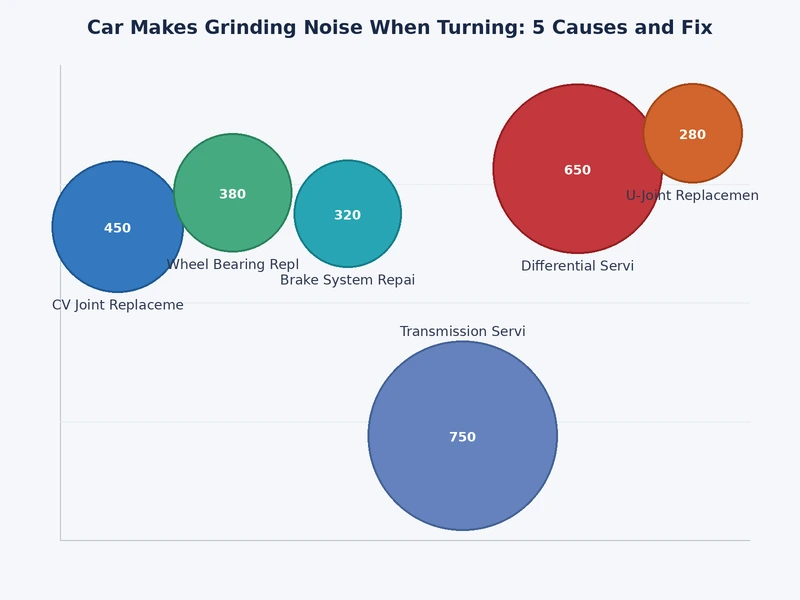
Repair costs vary widely by cause. Power steering fluid is the least expensive fix at roughly $10 to $30 for the fluid itself, plus any labor to trace and seal a leak. A CV axle shaft replacement typically runs $200 to $400 per side including parts and labor. Wheel bearing replacement ranges from $150 to $400 per wheel. Ball joint or tie rod end replacement can cost $200 to $600 per side depending on the vehicle and labor rates in your area.
Low tire pressure is more likely to produce a thumping, sluggish, or uneven ride feel than a true grinding sound. However, severely underinflated tires can cause the sidewall to flex excessively, which may generate a rubbing or scraping noise if the tire contacts the wheel well during tight turns. Check tire pressure first to rule it out, but a persistent grinding or metallic sound during turning points to a mechanical component rather than tire pressure alone.
The most reliable distinction is the speed and sharpness of the turn that triggers the noise. A worn CV joint produces its characteristic clicking or grinding primarily during slow, tight turns — parking maneuvers and sharp corners. A failing wheel bearing is more likely to generate a humming or grinding sound during gradual, high-speed lane changes, and the pitch will change noticeably as you swerve left and right at a steady speed. If both symptoms are present, it is possible that both components need attention, particularly on a high-mileage vehicle.
A grinding noise when turning is never simply an inconvenience — it is a mechanical signal that a component is failing, and how quickly you respond is the single greatest factor in determining whether the repair costs you one hundred dollars or one thousand.
 |
 |
 |
 |

About Joshua Thomas
Joshua Thomas just simply loves cars and willing to work on them whenever there's chance... sometimes for free.
He started CarCareTotal back in 2017 from the advices of total strangers who witnessed his amazing skills in car repairs here and there.
His goal with this creation is to help car owners better learn how to maintain and repair their cars; as such, the site would cover alot of areas: troubleshooting, product recommendations, tips & tricks.
Joshua received Bachelor of Science in Mechanical Engineering at San Diego State University.
Get some FREE car parts & gear.. Or check out the latest free automotive manuals and build guides here.
Disable your ad blocker to unlock all the hidden deals. Hit the button below 🚗
| | | |
