by Sarah Whitfield
Why does a car get so hard to start when cold temperatures arrive, even after running without a single complaint the evening before? The answer almost always comes down to one of eight specific failures — and identifying the right one makes the fix far faster and less expensive than guessing.
Cold weather puts every major vehicle system under strain at the same time. The battery's chemical reaction slows, engine oil thickens and resists flowing through tight passages, and fuel delivery systems struggle to maintain proper pressure. When any one component can't meet that demand, that slow, labored crank on a frosty morning is the predictable result. Drivers who also notice the starter not engaging reliably should read the guide on how to start a car with a bad starter for the full overlap between starter failure and cold-start symptoms.
Contents
A successful cold start requires the battery, starter motor, fuel system, and engine management computer to all perform within specification at the same moment. According to automotive cold start documentation, engines need a richer-than-normal fuel mixture at low temperatures because cold air is denser and fuel vaporizes far less efficiently. When any one part in this sequence falls short, the engine either cranks endlessly without firing or refuses to turn over at all.
Lead-acid batteries rely on an electrochemical reaction between lead plates and sulfuric acid, and that reaction slows noticeably below 0°C (32°F). A battery that delivers full cranking amps in mild weather can lose 35–40% of that capacity during a hard freeze, leaving the starter barely enough power to spin the engine. Most batteries have a useful lifespan of three to five years, and older packs are always the first to fail when temperatures drop hard.
Engine oil is rated on a viscosity scale, and the "W" in a grade like 5W-30 stands for "winter," indicating flow behavior at cold temperatures. Thicker oil creates measurably more internal resistance, forcing the starter motor to work harder and draw more current from an already-strained battery. Using the wrong oil grade — one rated for warmer climates — compounds every other cold-start problem already present in the vehicle.
The table below summarizes each cause alongside its most common symptom and the typical repair needed.
| # | Cause | Cold-Start Symptom | Typical Fix |
|---|---|---|---|
| 1 | Weak or dead battery | Slow or no crank, clicking | Load test, replace if failed |
| 2 | Wrong oil viscosity | Labored, sluggish cranking | Switch to correct grade |
| 3 | Failing fuel system | Long crank, sputters then dies | Test pressure, replace pump/relay |
| 4 | Bad spark plugs or coils | Extended crank, rough idle after start | Replace plugs, test coils |
| 5 | Faulty MAF sensor | Hard start, rough idle, poor economy | Clean or replace sensor |
| 6 | Dirty fuel injectors | Hesitation, lean misfire during crank | Ultrasonic cleaning or replacement |
| 7 | Bad coolant temp sensor | Hard cold start, black exhaust smoke | Replace CTS |
| 8 | Worn starter motor | Single loud click, very slow rotation | Rebuild or replace starter |
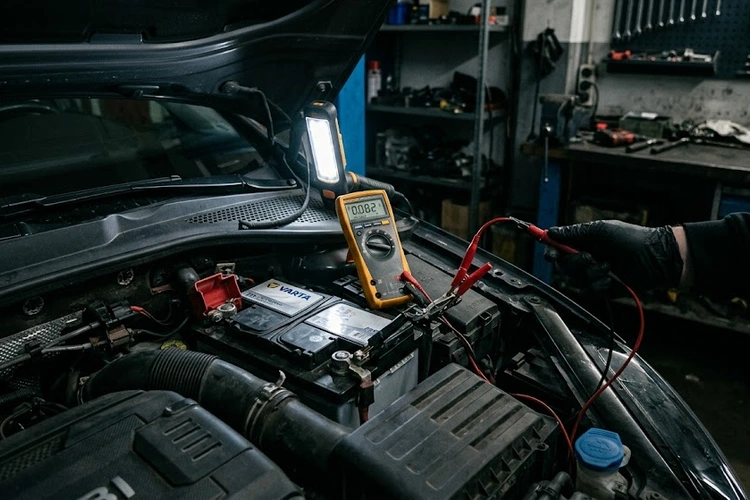
The battery is the most common reason a car becomes hard to start when cold. Cold temperatures reduce the chemical reaction inside the cells, cutting available cranking amps just when the starter motor needs the most help. A battery load test at any auto parts store — usually free — confirms whether the pack still delivers adequate power, and replacement typically eliminates the cold-start problem immediately if the battery fails.
Oil with too high a cold-weather rating thickens significantly at freezing temperatures, adding internal resistance the starter has to push through on every crank attempt. The owner's manual specifies the correct viscosity grade — most modern engines call for 0W or 5W oil in cold climates — and matching that specification removes this variable from the diagnostic picture entirely. Switching to the correct grade before the cold season is one of the cheapest prevention steps available.
A weak fuel pump that can't build adequate rail pressure before cranking forces the engine to turn over for several seconds before enough fuel reaches the injectors to support ignition. Drivers who notice prolonged cranking before the engine fires, or a faint whining from beneath the rear seat area, should investigate the fuel pump relay first. The complete testing procedure is covered in the guide on where the fuel pump relay is located.
Worn spark plugs have wider electrode gaps and carbon-fouled tips that misfire inconsistently even in mild conditions — cold temperatures make the problem noticeably harder to overlook. Failing ignition coils produce nearly identical symptoms: extended cranking followed by a rough idle that takes several minutes to smooth out. The full diagnostic path for bad ignition coil symptoms covers how to pinpoint which coil is failing before replacing the entire set.
The MAF sensor (mass air flow sensor) measures the volume and density of incoming air so the ECU (engine control unit) can calculate the correct cold-start fuel mixture. A dirty or failing MAF sends inaccurate data, causing the engine to run too lean or too rich during cranking, making startup unreliable and often triggering a rough idle that persists for several minutes after the engine finally fires. Cleaning the sensor with MAF-safe spray solves the problem roughly half the time before replacement becomes necessary.
Carbon deposits accumulate on injector tips over time and restrict the finely atomized fuel spray that cold starts depend on for reliable ignition. A partially clogged injector causes lean misfires during cranking, while a stuck-closed injector means one cylinder contributes nothing to the start sequence at all. Professional ultrasonic cleaning or a set of replacement injectors typically resolves the problem without removing major engine components.
The coolant temperature sensor (CTS) reports engine temperature to the ECU, which uses that reading to calculate the enriched fuel mixture a cold engine needs to start and run smoothly. A faulty CTS that tells the ECU the engine is already warm — when it's actually near freezing — causes a dangerously lean mixture during cranking, making the car nearly impossible to cold-start. CTS replacement is inexpensive on most vehicles, and the sensor is usually accessible without removing other major components.
A starter motor nearing the end of its service life draws excessive current and rotates below spec, which becomes dramatically more apparent in cold weather when the battery is already under strain. Common signs include a single loud click with no rotation, very slow grinding cranking, or intermittent engagement that works on some mornings but not others. The guide on how to start a car with a bad starter covers both temporary workarounds and the permanent repair path.
Before reaching for a phone, a few simple techniques can coax a stubborn cold-weather start:
Cranking for more than 10 consecutive seconds without a start risks flooding the engine with unburned fuel and overheating the starter motor windings. When the engine won't catch after two or three short attempts, waiting two to three minutes lets flooded cylinders clear and gives the starter time to cool before the next try. Patience here prevents a minor cold-start issue from becoming a starter rebuild.
An OBD-II scanner — available under $30 at most auto parts stores — reads stored fault codes that point directly to the failing system. Common cold-start diagnostic trouble codes include:
After pulling any stored codes, a methodical physical check catches problems that don't always trigger a fault code:

Pro tip: Never crank the engine for more than 10 consecutive seconds — the heat generated damages starter motor windings and can turn a simple cold-start problem into a costly rebuild.
Building a consistent pre-winter routine removes most cold-start surprises before they happen. The most effective steps are:
Some cold-start conditions require professional diagnosis, particularly when multiple fault codes appear together or the starter motor itself is failing. Symptoms like a single loud click with no rotation, grinding during crank attempts, or complete electrical shutdown point to starter or charging system problems that are difficult to test without proper equipment. Checking the car won't start, no click guide first helps confirm whether the problem sits with the starter, battery, or the wiring between them before committing to a shop visit.
This pattern almost always points to a component that only struggles at low temperatures — most commonly a weak battery, the wrong oil viscosity, or a coolant temperature sensor sending incorrect data to the ECU during the cold-start enrichment phase. Once the engine reaches operating temperature, oil thins out, battery chemistry partially recovers, and sensors stabilize, masking the underlying problem until the next cold morning. A battery load test and OBD-II scan together identify the culprit in most cases.
A properly maintained vehicle with a healthy battery and fresh oil should start within one to three seconds of cranking, even in sub-freezing temperatures. Extended cranking of five seconds or more — especially when combined with a rough idle after starting — is a clear signal that at least one of the eight causes above needs investigation. Ignoring prolonged crank times typically leads to a complete no-start failure within a season or two.
A brief warm-up period of one to two minutes in moderate cold allows oil to circulate and reach proper operating viscosity before placing load on the engine, which meaningfully reduces wear during the first few miles. However, extended idling of five or more minutes is unnecessary on modern fuel-injected engines and actually increases fuel consumption and carbon buildup on intake valves. The better long-term solution is addressing the root cause rather than relying on extended idling to compensate for failing components.
A car that's hard to start when cold is almost always pointing to one specific failing component, and the eight causes covered above give a complete starting point for any diagnosis. The most productive next step is a free battery load test at a local auto parts store combined with an OBD-II scan — two quick checks that eliminate or confirm the most common culprits before spending a dollar on parts. From there, working through the physical inspection checklist and committing to a pre-winter maintenance routine keeps cold-start problems from becoming a recurring annual headache.
 |
 |
 |
 |

About Sarah Whitfield
Sarah Whitfield is a diagnostics and troubleshooting specialist who spent ten years as an ASE-certified technician before joining the editorial team. She specializes in OBD-II analysis, electrical gremlins, and the kind of intermittent problems that make most owners give up.
Get some FREE car parts & gear.. Or check out the latest free automotive manuals and build guides here.
Disable your ad blocker to unlock all the hidden deals. Hit the button below 🚗
| | | |
