by Sarah Whitfield
Picture this: you merge onto the highway, press the gas to get up to speed, and your car stumbles. For a full second it does nothing — then it lurches forward like it finally remembered what it's supposed to do. That jolt isn't random. When your car hesitates at highway speeds, something specific is breaking down, and it will not fix itself on its own.
Highway hesitation is different from city driving hesitation. At sustained speed, your engine is under continuous load, your fuel system is working hard, and your transmission is locked into a high gear. Any weakness in fuel delivery, ignition, or the drivetrain gets amplified. If you're also seeing hesitation during everyday acceleration, our overview on why your car hesitates when accelerating covers the broader picture across all driving conditions.
This guide covers every major cause of highway speed hesitation, walks you through how to diagnose it yourself, and gives you clear fixes — from simple DIY jobs to knowing exactly what to tell a mechanic.
Contents
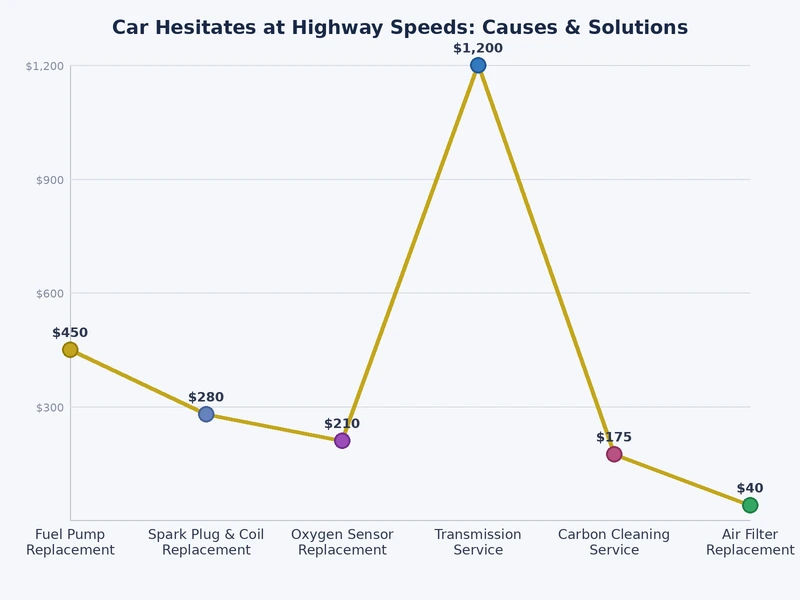
Highway hesitation rarely appears without warning. Your car has been giving small hints for weeks — a slight stumble here, a slow throttle response there — before it becomes impossible to ignore at 70 mph. There are four main systems responsible when this problem develops.
Your engine needs a steady, pressurized supply of fuel to maintain speed on the highway. In city traffic, demand is intermittent. On the highway, it's constant. When the fuel system can't keep up with sustained demand, you get hesitation, surging, or a noticeable loss of power when climbing grades or passing at full throttle.
The most common fuel-related causes of highway hesitation are:
Fuel pressure is the first measurement to take when highway hesitation appears. Acceptable pressure for most fuel-injected engines runs between 30 and 80 PSI — your owner's manual lists the exact specification. A shop can perform this test in 15 minutes, and many auto parts stores rent fuel pressure gauge kits for free.
Worn spark plugs are one of the most overlooked causes of hesitation at speed. In city traffic, a plug that's working "well enough" fires reliably at low RPM and light load. On the highway, with the engine under sustained load at higher RPM, that marginal plug fails to ignite the fuel-air mixture every single cycle. The result is a misfire — and repeated misfires at speed feel like a hard stumble or shudder through the entire car.
If your check engine light is on alongside the hesitation, scan for codes before doing anything else. A P0300 random misfire code points directly at an ignition problem. Codes P0301 through P0308 identify individual cylinder misfires, which can help you pinpoint which plug or coil has failed.
Beyond spark plugs, check these ignition components:
When the transmission is the culprit, highway hesitation has a different character — less like a stumble and more like a jerk or unexpected surge caused by a gear change. A slipping transmission can't hold the engine in the proper gear under sustained load, so power delivery becomes choppy and unpredictable.
Torque converter lockup is another common source of highway hesitation. The torque converter (the fluid coupling between your engine and transmission) has a lockup clutch that connects them directly at cruising speed to improve fuel economy. When this clutch shudders or fails to lock cleanly, you feel a rhythmic vibration or surge at highway speeds — often between 40 and 60 mph. If your car also struggles to hold a lower gear when slowing down, read our article on automatic transmission that won't downshift — the two problems often share a root cause.
Start by checking transmission fluid level and condition. Healthy ATF (automatic transmission fluid) is red or light pink with no burnt smell. Dark brown, burnt-smelling fluid means the transmission has been running hot and needs service immediately.
Modern cars rely on a network of sensors to manage fuel delivery, ignition timing, and throttle response in real time. A single bad sensor sends wrong data to the ECU (engine control unit), and the ECU makes poor decisions as a result — causing hesitation, poor fuel economy, and erratic performance.
Pro tip: A dirty throttle body can mimic expensive sensor failures. Before replacing any sensor, spend 20 minutes and $8 cleaning the throttle body — it solves a surprising number of hesitation complaints. See our full breakdown of dirty throttle body symptoms to know what to look for.
You don't need a fully equipped shop to figure out why your car hesitates at highway speeds. A few targeted tools will get you 80% of the way there without spending money on parts you may not need.
An OBD-II scanner plugs into the diagnostic port under your dashboard — usually within a foot of the steering column — and reads fault codes stored by the car's computer. Any vehicle built after 1996 has this port. Entry-level scanners cost $20 to $30 and are worth every dollar. Many auto parts chains like AutoZone and O'Reilly will scan your car for free at the counter.
When diagnosing highway hesitation, look for codes in these ranges:
| Code Range | System | What It Points To | DIY Difficulty |
|---|---|---|---|
| P0300–P0308 | Ignition | Random or cylinder-specific misfires | Easy–Medium |
| P0171 / P0174 | Fuel / Air | Engine running lean — too much air, not enough fuel | Medium |
| P0087 | Fuel System | Fuel rail pressure too low — suspect pump or filter | Medium |
| P0101–P0103 | MAF Sensor | Mass airflow sensor reading out of expected range | Easy |
| P0120–P0124 | TPS | Throttle position sensor circuit malfunction | Easy–Medium |
| P0740–P0744 | Transmission | Torque converter clutch circuit issue | Hard — shop recommended |
No codes doesn't mean no problem. Some sensor failures stay below the threshold that triggers a stored fault. Always combine scanner data with your real-world symptoms. A code gives you a direction — it rarely gives you the full answer on its own.
A fuel pressure regulator and gauge kit lets you measure fuel system pressure directly at the fuel rail. The Schrader valve on the rail is the same type used on tires, so the gauge threads on without any disassembly. With the engine running, the reading tells you immediately whether your fuel pump is producing adequate pressure. A pump that reads 10 to 15 PSI below specification under load is failing.
The most useful version of this test happens on the road. If your car hesitates at idle but not at speed, you likely have a different problem. If hesitation appears only at highway speeds, do a road test with the gauge attached and monitor the reading during hard acceleration. A pressure drop at high throttle demand confirms a weak pump — no guessing required.
The fix depends entirely on the cause. Always work cheapest to most expensive. Replacing a fuel pump before confirming low pressure is exactly the kind of mistake that costs $400 and solves nothing.
If you're also noticing the accelerator pedal feels physically sluggish or resistant before the hesitation kicks in — not just delayed power, but actual resistance at the pedal — our article on gas pedal sticking causes is worth reading before you dig further. A stuck throttle cable or a dirty throttle bore compounds any underlying hesitation problem.
Some fixes require specialized equipment or carry safety risk that makes them unsuitable for a driveway repair. These are the ones worth paying a shop for:
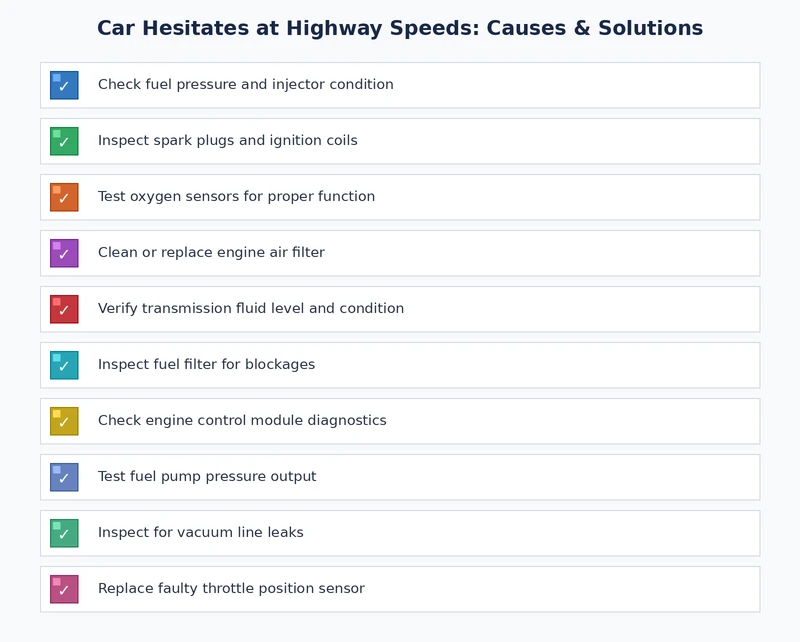
The best repair for highway hesitation is not letting it develop in the first place. These maintenance habits directly address the most common root causes before they become highway emergencies.
Spark plugs wear slowly enough that you won't notice the daily decline. By the time hesitation appears at highway speed, they're usually well past their service interval. Replace them proactively before they cause problems:
Inspect ignition coil boots for cracks each time you replace plugs. Replace the engine air filter annually or every 15,000 to 20,000 miles — a clogged air filter throws off the air-fuel ratio (the proportion of air to gasoline the engine burns) and can mimic a fuel delivery problem exactly. Clean the MAF sensor at the same time. It takes five minutes and costs almost nothing.
Warning: If your car hesitates at speed and the speedometer is also acting erratic, you may have an electrical or sensor problem affecting multiple systems simultaneously. Our article on erratic speedometer causes covers issues that share a root cause with hesitation — don’t treat them as unrelated symptoms.
Bad information leads to wasted money. These are the most common myths drivers believe about highway hesitation — and what the evidence actually shows.
Premium fuel has a higher octane rating, which resists pre-ignition (also called engine knock) in high-compression engines. If your car requires regular 87-octane fuel, switching to premium does nothing to address hesitation — it won't clean your injectors, raise your fuel pressure, or fix a worn spark plug. It costs more per fill and solves nothing.
The one real exception: if your car's manufacturer specifies premium fuel and you've been running regular, engine knock and hesitation can result from the timing system not compensating fast enough. In that specific case, the fix is using the correct fuel — not replacing a component. But for the vast majority of drivers, premium gas is not the answer.
Transmission failures are dramatic and memorable, so they get blamed for a lot. In reality, fuel system and ignition problems cause far more cases of highway hesitation than transmission issues do. A transmission problem has a distinct feel: a harsh jerk, a sudden RPM spike with no corresponding acceleration, or a gear that refuses to engage. That's different from the stumble-and-surge pattern of a fuel or ignition issue.
Start with the simple diagnostics — a code scan, a spark plug inspection, a fuel filter check. Most highway hesitation is resolved without touching the transmission. If you're also noticing shaking at particular speeds alongside the hesitation, read our article on why your car vibrates at a specific speed. Wheel balance issues and worn CV axles get misdiagnosed as drivetrain hesitation more often than you'd expect.
Once hesitation starts, the wrong response can damage components that are still working fine. These are the mistakes that routinely turn a $150 repair into a $1,500 one.
Throwing parts at a hesitation problem without scanning for codes or testing fuel pressure is the most expensive mistake you can make. Replacing the fuel pump when the actual cause is a dirty MAF sensor costs $400 and leaves the original problem completely unsolved. Spend $30 on a scanner or visit an auto parts store for a free code read before you buy a single part.
Pay attention to symptoms beyond the hesitation itself. If your car hesitates at speed and you also notice the oil pressure gauge behaving oddly, that combination warrants immediate attention. Our article on oil pressure gauge fluctuating covers what those combined symptoms can indicate — including engine conditions serious enough that continued highway driving causes real damage.
Installing the wrong spark plug type or a no-name MAF sensor can produce worse hesitation than the part it replaced. The ECU is calibrated to work with specific sensor tolerances and plug heat ranges. Mismatched parts throw off the calibration and create new driveability problems.
Saving $15 on a discount spark plug set that doesn't match the OEM specification is a false economy. You'll spend more diagnosing the new problem it creates than you saved on the parts.
 |
 |
 |
 |

About Sarah Whitfield
Sarah Whitfield is a diagnostics and troubleshooting specialist who spent ten years as an ASE-certified technician before joining the editorial team. She specializes in OBD-II analysis, electrical gremlins, and the kind of intermittent problems that make most owners give up.
Get some FREE car parts & gear.. Or check out the latest free automotive manuals and build guides here.
Disable your ad blocker to unlock all the hidden deals. Hit the button below 🚗
| | | |
