by Sarah Whitfield
Does your engine stumble the instant you switch on the air conditioning? If your car hesitates when AC is on, you are dealing with one of the most common driveability complaints mechanics encounter. The short answer: your engine is struggling to absorb the sudden parasitic load the AC compressor places on the crankshaft. Several underlying problems can amplify that struggle far beyond what is normal. The U.S. Environmental Protection Agency reports that AC use can reduce fuel economy by up to 25 percent in some driving conditions — a figure that shows just how significant that compressor load really is. This guide breaks down every probable cause, from idle speed calibration to failing sensors, and tells you precisely what to do about each one. If you also notice stumbling at speed, the guide on car hesitation at highway speeds covers related acceleration problems worth reviewing alongside this one.
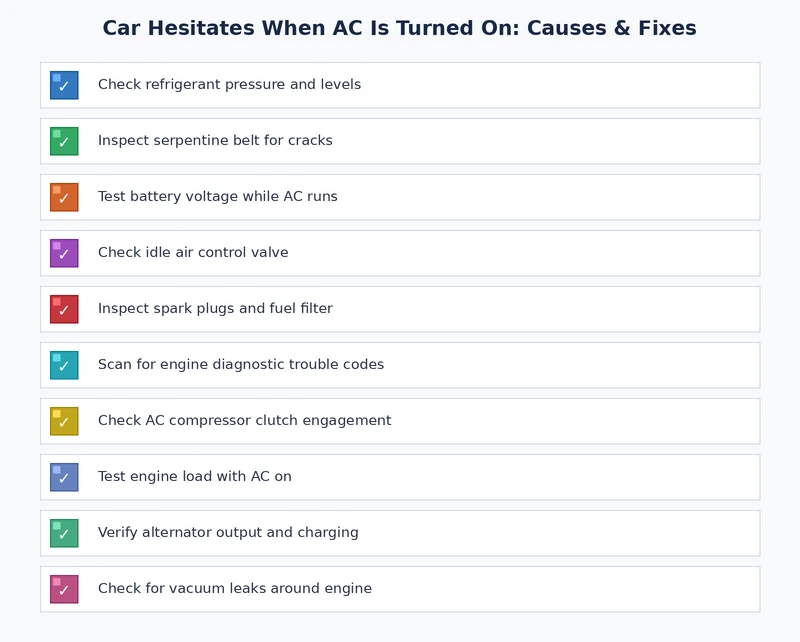
Contents
Your vehicle's AC system is driven by the engine through a belt-and-clutch arrangement. The moment you press the AC button, the compressor clutch closes, and the engine must immediately produce additional torque to keep that compressor spinning. On a typical four-cylinder engine, that parasitic load can range from 5 to 10 horsepower — a meaningful demand the powertrain control module (PCM) must address almost instantly. When that compensation fails or lags, the engine stumbles, bogs, or briefly stalls. That is the core symptom you are experiencing, and it is always a sign that something is interfering with the engine's ability to adapt.
The PCM monitors the AC request signal before the clutch even closes, giving itself a fraction of a second to raise idle speed and adjust fuel delivery in advance. When key sensors feeding that loop — the idle air control (IAC) valve, mass airflow (MAF) sensor, or throttle position sensor (TPS) — are dirty or degraded, the pre-compensation routine breaks down. A car that already hesitates when accelerating for unrelated reasons will hesitate far more dramatically once AC compressor load is layered on top of those existing deficiencies.
The hesitation is almost always worst at a standstill or in slow-moving traffic, because the engine produces minimum torque at idle and has the least margin to absorb sudden loads. Common observations include:
If your engine also stalls in other low-load conditions, the guide on car stalling in cold weather covers IAC valve and fuel system faults that overlap significantly with this symptom.
Some drivers report that the hesitation occurs not at idle, but when pulling away from a stop with AC running. In these cases, compressor load combines with the already elevated fuel demand of acceleration, exposing weak injectors, a clogged air filter, or a lean fuel trim condition that would otherwise go unnoticed at steady cruise speed. If acceleration hesitation persists even with the AC off, that points to a separate fuel or ignition fault entirely.
Pro tip: When merging onto a highway or climbing a steep incline, briefly toggle the AC off until you reach cruising speed — then re-engage it to eliminate compressor load during the most demanding phase of acceleration.
Start here before spending any money on diagnostics. A dirty throttle body is one of the most frequent causes of AC-related hesitation and costs nothing to address at home.
Also inspect the idle air control valve on vehicles equipped with one. A sticking IAC valve cannot raise idle speed fast enough when the compressor clutch closes. Cleaning or replacing it is typically a one-hour job at modest cost.
An undercharged or overcharged AC system causes the compressor to work harder than designed, drawing more power from the engine. If your system is low on refrigerant, the compressor cycles more frequently and for longer durations to achieve cooling — and each engagement spike is more abrupt than it would be with a correctly charged system. A manifold gauge reading — or a visit to a shop with a dedicated AC machine — will confirm whether your charge is within manufacturer specification.
Warning: Never add refrigerant blindly with a DIY can if you do not know your current charge level — overcharging can damage the compressor and make hesitation significantly worse, not better.
This pattern — a brief stumble followed by a recovered idle — typically points to a slow PCM response rather than a catastrophic component failure. The PCM eventually raises idle speed and corrects fuel trim, but the initial lag is noticeable. Causes typically include:
A random misfire code — particularly a P0300 random misfire stored in the ECU — often accompanies this pattern and gives you a concrete, verified starting point for your diagnosis.
When the rough idle does not smooth out, or the engine hesitates continuously while the AC runs, the underlying causes are typically more serious than a dirty sensor. Possible explanations include:
An engine that also runs rough after rain — as explored in the guide on engine running rough after rain — may carry moisture-related ignition faults that compound AC hesitation symptoms in humid climates throughout the year.
Deciding whether to diagnose this yourself or hand it off to a shop depends on the tools you have and how complex your symptom pattern is. The table below outlines the key trade-offs between each approach.
| Approach | Best For | Tools Required | Typical Cost | Key Limitation |
|---|---|---|---|---|
| DIY visual inspection | Throttle body, air filter, obvious vacuum leaks | Flashlight, throttle cleaner | $0–$15 | Cannot test sensors or fuel pressure |
| DIY OBD-II scan | Reading fault codes, viewing live MAF and TPS data | OBD-II reader ($25–$80) | $25–$80 one-time | Codes do not always pinpoint root cause |
| General shop diagnostic | Fuel pressure, injector balance, compressor amp draw | Shop equipment | $90–$160 per hour | Higher cost; quality varies by technician |
| AC specialist | Refrigerant charge, compressor health, evaporator leaks | AC recovery machine, manifold gauges | $100–$200 diagnostic fee | Focused on AC system only, not engine faults |
If your scanner shows no codes but the hesitation persists, the fault is likely mechanical or involves sensor drift that has not yet crossed the ECU's fault threshold. In those cases, a technician with live data logging equipment is far more efficient than continued guessing. An alternator whining noise heard alongside AC hesitation can also indicate that the charging system is underperforming — a separate but related problem worth investigating at the same time.
Most AC hesitation problems are preventable through consistent, scheduled maintenance. The following practices reduce your risk of encountering this symptom over the life of the vehicle.
If hesitation is accompanied by a generally sluggish throttle response even without AC engaged, the guide on gas pedal sticking causes covers electronic throttle body and cable faults that may be contributing to the combined symptom you are experiencing.
Repair costs vary considerably depending on the root cause. The following ranges represent national averages for parts and labor at an independent shop, which typically runs 20–40 percent less than dealership pricing for the same work.
Start with the lowest-cost items first — throttle body cleaning and an OBD-II scan — before committing to expensive repairs. In many cases, a $15 can of throttle body cleaner and 20 minutes of work resolves the problem completely. If the hesitation feels more like a transmission lag than an engine stumble, the guide on automatic transmission not downshifting explains how to distinguish transmission response faults from engine load symptoms under AC engagement.
A brief RPM dip of 100–200 when the compressor engages is considered normal in most vehicles. The PCM needs a fraction of a second to raise idle speed and compensate for the added load. However, a dip exceeding 300–400 RPM — or one that causes a visible shudder or stall — points to an underlying problem that requires attention.
Yes — an undercharged system forces the compressor to work harder and cycle more frequently to achieve cooling. That increases both the mechanical load on the engine and the electrical demand on the alternator. Both factors contribute to the hesitation you notice at idle or during light acceleration with AC running.
At idle and low speed, the engine produces minimum torque and has the least reserve power available to absorb compressor load. Any existing weakness — dirty throttle body, weak IAC valve, or marginal spark plugs — becomes noticeable under those combined low-speed conditions. Engine speeds above 1,500 RPM typically mask those same underlying deficiencies.
Turning the AC off confirms that the compressor is the load trigger, but it is not a long-term fix. The correct approach is to identify and repair the root cause — whether a sensor fault, dirty throttle body, or failing component. Your vehicle should operate normally with the AC running at any speed or temperature.
 |
 |
 |
 |

About Sarah Whitfield
Sarah Whitfield is a diagnostics and troubleshooting specialist who spent ten years as an ASE-certified technician before joining the editorial team. She specializes in OBD-II analysis, electrical gremlins, and the kind of intermittent problems that make most owners give up.
Get some FREE car parts & gear.. Or check out the latest free automotive manuals and build guides here.
Disable your ad blocker to unlock all the hidden deals. Hit the button below 🚗
| | | |
