by Sarah Whitfield
If your car overheats with AC on, the most likely culprits are a failing cooling fan, low coolant, or a clogged AC condenser. These are all fixable — but they will not fix themselves, and ignoring them risks serious engine damage.
The AC puts real extra load on your engine. Your cooling system is built to handle that load. But when something in that system is already weak, the added strain from the AC tips it over the edge. Knowing the five main causes helps you find the problem fast and act before things get expensive.
Start by watching your temperature gauge. If it climbs every time you flip on the AC, your cooling system is already struggling — and it needs attention now.
Contents
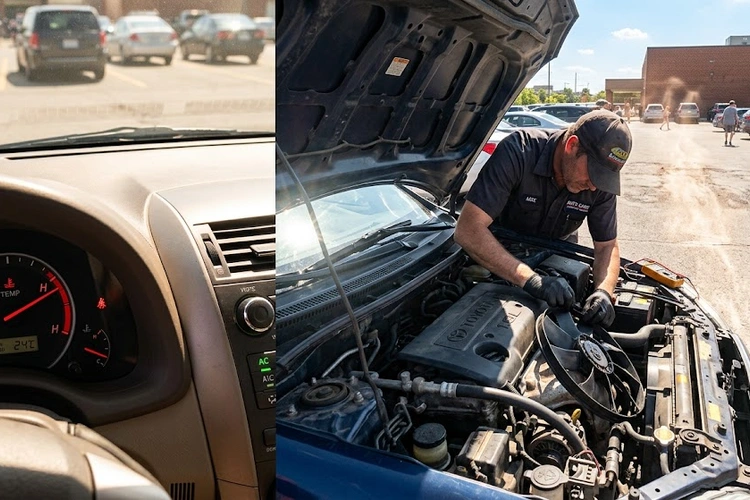
Not every hot engine is a crisis. Cars run warmer in summer, in traffic, and when towing. Knowing the difference between a car that is warm and a car that is overheating helps you respond correctly — not panic unnecessarily, and not ignore a real problem.
Watch for these signs. Any single one of them means you need to take action right now:
Most engines run happily between 195°F and 220°F (90°C–104°C). That is the normal operating window. Once you hit 240°F (115°C), you are in danger territory. Above 250°F (121°C), head gasket failure becomes a real risk.
Here is the important thing to understand: if your car overheats specifically with AC on but stays cool without it, the problem is in your cooling system — not your engine itself. The AC is revealing a weakness that was already there. That is actually useful information. It narrows the diagnosis down considerably.
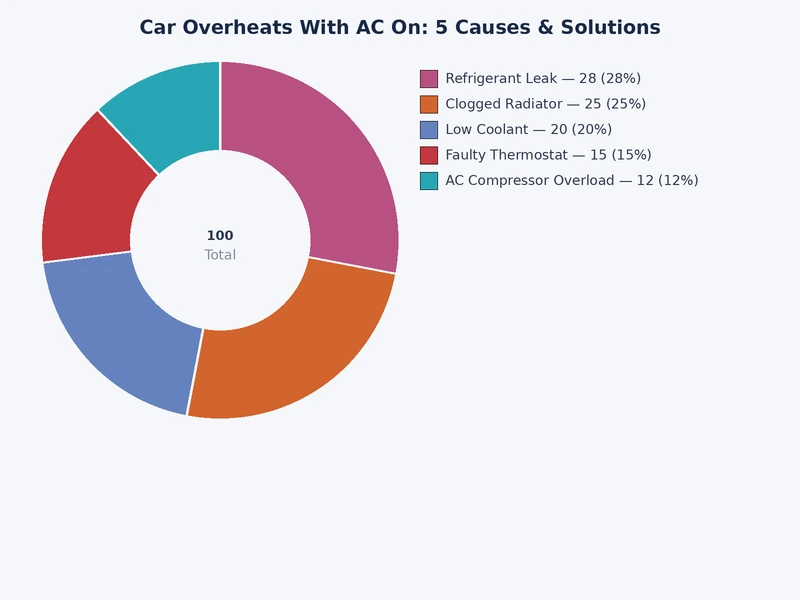
The AC compressor adds roughly 5–10 horsepower worth of mechanical load to your engine. Your cooling system is designed to absorb that extra heat. But when one component in that system is failing, the AC load is enough to push the whole thing past its limit. Here are the five causes you should check first.
Coolant (antifreeze) is what pulls heat away from your engine and transfers it out through the radiator. When coolant levels drop — even slightly — the system cannot transfer heat fast enough. Add the AC load, and the engine cooks.
Signs you have low coolant or a leak:
Fix: Top up the coolant first using the correct type for your vehicle (check your owner's manual — do not mix types). Then find and fix the leak. Common sources include cracked radiator hoses, a leaking radiator, a failed water pump gasket, and a weeping heater core.
Your car has one or two electric fans mounted behind the radiator. They kick on when the engine gets hot — but they also run whenever the AC is on, because the AC condenser (the heat exchanger at the front of the car) needs constant airflow to do its job. A dead or weak cooling fan is one of the most common reasons a car overheats with AC on, especially at low speeds and in traffic.
Signs of a bad cooling fan:
Fix: Turn on the AC with the hood open and watch the fans. Both should be spinning. If they are not, check the fan fuse first — it is the cheapest and easiest fix. Then test the relay. If both check out, the fan motor itself has likely failed. A replacement fan motor typically costs $80–$200 in parts.
The AC condenser sits directly in front of your radiator. Its job is to release heat from the refrigerant before it cycles back through the system. When bugs, leaves, or road debris pack into the condenser fins, airflow to the radiator drops sharply. The radiator cannot shed heat, and the engine temperature climbs — especially with the AC demanding even more cooling capacity.
Signs of a blocked condenser:
Fix: Spray the condenser gently with a garden hose from behind — working from the engine side, pushing debris forward. Never use a pressure washer; it bends the delicate aluminum fins and makes the blockage worse. This is a five-minute job that solves the problem surprisingly often.
The thermostat is a valve that controls when coolant flows to the radiator. While the engine is cold, it stays closed so the engine warms up faster. Once the engine reaches operating temperature, it opens and lets coolant circulate. If the thermostat sticks closed, coolant cannot reach the radiator at all. The engine heats up fast — and the extra load from the AC makes it overheat even faster.
Signs of a bad thermostat:
Fix: Thermostats cost $15–$50 in parts. On most vehicles it is a beginner-friendly DIY job that takes under an hour. A shop will charge $150–$350 total. Also check your coolant temperature sensor while you are in there — a faulty sensor can trick the ECU into thinking the engine is cooler than it really is, keeping the thermostat closed too long.
The water pump circulates coolant through the engine, radiator, and heater core. A worn impeller (the spinning blade inside the pump) or a failing bearing reduces coolant flow — especially at low RPM like idle. At highway speed the pump spins fast enough to compensate. But at idle with the AC running, a weak pump simply cannot move enough coolant to keep up with the heat load.
Signs of a failing water pump:
Fix: Water pump replacement costs $300–$700 at most shops. It is a bigger job because the pump is often buried under the timing belt or timing chain components. Many mechanics recommend doing both at the same time to avoid paying double labor.
| Cause | Most Common Symptom | DIY Part Cost | Shop Total Cost | DIY-Friendly? |
|---|---|---|---|---|
| Low Coolant / Leak | Sweet smell, puddle under car | $10–$25 | $100–$600+ | Yes (top-up only) |
| Failing Cooling Fan | Overheats at idle, fine at speed | $80–$200 | $200–$450 | Yes |
| Blocked Condenser | Warm AC + engine overheats | $0 (cleaning) | $0–$150 | Yes |
| Faulty Thermostat | Rapid overheat from cold start | $15–$50 | $150–$350 | Yes |
| Failing Water Pump | Overheats at idle, weep hole leak | $50–$150 | $300–$700 | Intermediate |
When your car overheats with AC on and the temperature gauge starts climbing into dangerous territory, every decision you make in the next few minutes matters. Here is exactly what to do — in order.
Driving even one mile on a fully overheating engine can warp the cylinder head — a repair that easily costs $1,500 to $3,000. Pull over first, diagnose later.
Do not try to "make it home" in any of these situations:
In any of these cases, call a tow truck. Pushing a severely overheating engine almost always turns a $300 repair into a $3,000 one.
You do not need a professional to find the problem in most cases. Start with the free checks before spending any money. Most people find the cause within ten minutes of looking.
For basic diagnosis, you need very little:
Always start with the visual checks: look at the coolant level in the reservoir, inspect the condenser for blockage, and watch the cooling fans with the engine idling and the AC on. These three checks are free and catch the most common causes in under ten minutes.
If the basics check out, run an OBD2 scan. Engine management faults — including issues that cause abnormal idle speed — can affect how the engine handles heat under load. A scanner will tell you immediately if the ECU has flagged anything temperature-related.
Here is where to draw the line between doing it yourself and calling a shop:
Repairs you can do yourself:
Leave these to a professional:
Your car overheats with AC on when the cooling system is already working near its limit. Good maintenance keeps that margin wide enough to handle the extra AC demand without breaking a sweat. These habits prevent most cooling failures before they happen.
According to the Wikipedia overview of engine cooling radiators, modern cooling systems are designed to maintain precise temperature windows. Even small disruptions in coolant flow, fan operation, or heat exchanger efficiency can quickly push an engine out of its safe operating range — particularly under extra load like the AC compressor.
You can find more guides on keeping your car running reliably in our car care and maintenance library.
The AC compressor adds extra mechanical load to your engine, which generates more heat. When your cooling system is already close to its limit — due to a weak fan, low coolant, or a partially blocked condenser — that extra AC load is what tips it into overheating. Without the AC, the system can barely keep up; with it on, the system fails. The AC is not the cause — it is exposing a weakness that was already there.
Turning off the AC removes extra engine load and can bring the temperature down enough to drive carefully to a shop. But this is a short-term measure only. If the gauge stays elevated even with the AC off, pull over immediately. Driving on an overheating engine — with or without AC — risks permanent engine damage. Get the underlying problem fixed before using the AC again.
It depends entirely on the cause. Cleaning a blocked condenser costs nothing. Replacing a thermostat runs $150–$350 at a shop. A cooling fan motor is $200–$450. A water pump replacement is typically $300–$700. If the overheating has already damaged the head gasket, you are looking at $1,500–$3,000 or more. Finding and fixing the cause early is always dramatically cheaper than waiting.
Yes, but it is uncommon. A seized or failing AC compressor can put excessive drag on the engine, which generates extra heat. More often, the compressor itself is fine but the cooling system cannot handle the normal load it creates. If the AC compressor is making unusual noises or causing the engine to run rough when engaged, have it inspected — a locked-up compressor can also damage the serpentine belt.
Start the engine and turn the AC on. Open the hood and look at the fan or fans behind the radiator — they should both be spinning. If they are not, check the fan fuse first (it is the quickest fix). Then test the relay by swapping it with an identical relay from another slot in the fuse box. If the fuse and relay are fine and the fan still does not spin, the fan motor has failed and needs replacement.
The damage escalates quickly. First you will warp the cylinder head, which causes coolant and oil to mix — a repair costing $1,500–$3,000. Keep driving past that, and you risk a cracked engine block or complete engine seizure, which means a full engine replacement at $4,000–$8,000 or more. No AC comfort is worth that. Address the problem as soon as the gauge starts climbing.
 |
 |
 |
 |

About Sarah Whitfield
Sarah Whitfield is a diagnostics and troubleshooting specialist who spent ten years as an ASE-certified technician before joining the editorial team. She specializes in OBD-II analysis, electrical gremlins, and the kind of intermittent problems that make most owners give up.
Get some FREE car parts & gear.. Or check out the latest free automotive manuals and build guides here.
Disable your ad blocker to unlock all the hidden deals. Hit the button below 🚗
| | | |
