by Sarah Whitfield
A car that shakes when put in drive has a mechanical fault — not a minor quirk. The six most common causes are worn CV joints, failing motor or transmission mounts, damaged driveshaft U-joints, degraded transmission fluid, fuel system faults, and a stuck brake caliper.
The vibration pattern is the first diagnostic clue. Shaking only at initial engagement — then smoothing out — points to motor mounts or a CV axle. Persistent vibration across all driving conditions suggests a fuel or brake issue. Drivers with connected drivability problems should review the full troubleshooting guide for related faults.

Contents
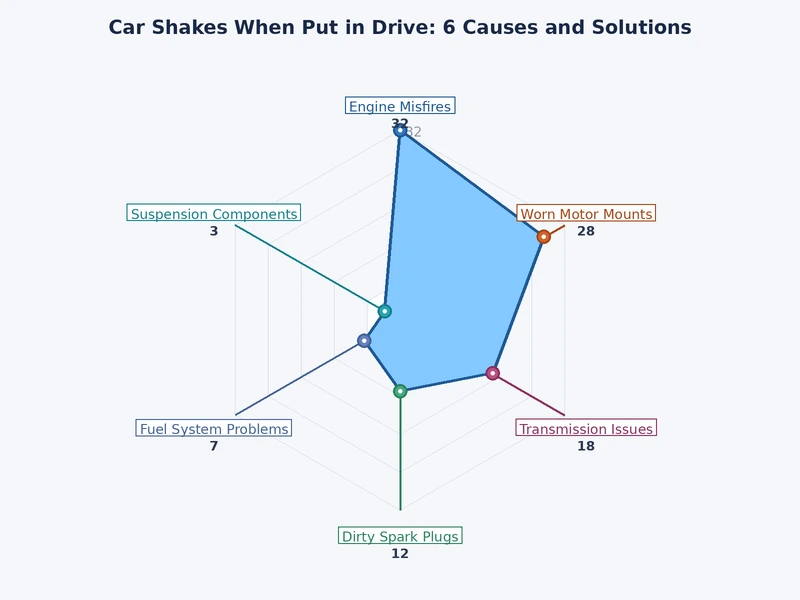
The table below summarizes each cause, its distinguishing symptom, severity rating, and typical repair cost range for parts and labor.
| # | Cause | Key Symptom | Severity | Repair Cost (USD) |
|---|---|---|---|---|
| 1 | Worn CV joint / axle shaft | Clicking on turns; vibration at engagement | High | $300–$800 |
| 2 | Failing motor or transmission mount | Thud when shifting; visible engine rocking | High | $200–$600 |
| 3 | Damaged driveshaft U-joint | Clunk under load; vibration increases with speed | High | $150–$500 |
| 4 | Low or degraded transmission fluid | Delayed engagement; shudder at low speed | Medium | $100–$300 |
| 5 | Fuel system fault (injectors / vacuum leak) | Rough idle; stumble under load | Medium | $150–$500 |
| 6 | Stuck brake caliper | Pulling to one side; heat from one wheel | Medium–High | $200–$600 |
CV joints are the most common source when a car shakes when put in drive. A worn outer CV joint loses its ability to transmit torque smoothly at the steep angles required during initial vehicle movement from rest.
Per Wikipedia's constant-velocity joint overview, inner CV joints operate at lower angles but sustain higher torque loads — making them susceptible to shudder before outright mechanical failure. For a thorough inspection procedure, see How to Inspect a CV Axle for Wear and Damage.
Engine and transmission mounts isolate powertrain torque reaction from the chassis. When a mount fails, that torque transfers directly as vibration through the body structure.
Universal joints connect driveshaft sections on rear-wheel-drive and four-wheel-drive platforms. A worn U-joint creates vibration under torque load — precisely when the transmission engages Drive from a standstill.
Automatic transmission fluid (ATF) lubricates clutch packs, the torque converter, and the valve body. Degraded ATF causes torque converter clutch shudder during engagement — producing the characteristic shake when the selector is placed in Drive.
Fluid change intervals vary significantly by manufacturer and application. Review How Often Should You Change Transmission Fluid for interval data and fluid type guidance by vehicle type.
A rough idle caused by clogged fuel injectors, a vacuum leak, or a failing mass airflow (MAF) sensor amplifies into a perceptible shake when the drivetrain loads the engine during Drive engagement.
Drivers who notice the shake paired with hesitation under acceleration should consult Engine Stalls When Accelerating: 7 Causes and How to Fix for overlapping fuel system diagnostics. A degraded catalytic converter can also disrupt exhaust backpressure and amplify idle instability — 6 Signs of a Bad Catalytic Converter covers that scenario in full.
Warning: A persistent misfire under load accelerates catalytic converter damage. Address fuel system faults before they compound into a secondary, more expensive repair.
A seized caliper applies constant friction to the rotor even when the brake pedal is fully released. The resistance is most apparent at low speeds immediately after the vehicle moves from rest into Drive.
Systematic diagnosis eliminates guesswork. Follow these steps in order before purchasing any parts.
Pro tip: Replace CV axle shafts in pairs on FWD vehicles — the opposing axle has identical mileage and wear history, and replacing both prevents a repeat job within months.
Several errors consistently escalate repair costs beyond what the original fault requires:
Preventive maintenance eliminates the majority of these failure modes before symptoms develop:
Vibration that disappears after initial engagement typically indicates a motor or transmission mount issue. The mount absorbs the torque spike at gear engagement but holds adequately once the vehicle is in motion. A worn inner CV joint on FWD vehicles produces the same pattern, particularly during cold starts when lubricant viscosity is highest.
Yes. Low ATF reduces hydraulic pressure inside the valve body, causing delayed or harsh clutch pack engagement. The result is a shudder or vibration when shifting from Park to Drive, most noticeable at low speeds during a cold start before the fluid reaches operating temperature.
Brief use to reach a repair facility is generally acceptable, but continued driving with a failed CV joint, U-joint, or motor mount risks a secondary failure. A CV axle that separates at speed, or an engine that shifts dramatically off its mounts under hard acceleration, presents a direct safety hazard.
Motor mount failure produces a thud or clunk specifically at the moment of gear engagement, with visible engine rocking under the hood. CV joint failure creates a vibration that correlates with vehicle speed and intensifies on tight turns. Mount-related shaking typically diminishes after engagement; CV joint shaking persists during acceleration.
If the cause is a fuel system fault — clogged injectors, fouled spark plugs, or a vacuum leak — a tune-up directly addresses the shake. A tune-up has no effect on mechanical faults such as worn CV joints, failed mounts, or a seized caliper. An OBD-II scan confirms whether the root cause is engine-based before any service is performed.
Not necessarily. Internal transmission failure typically manifests as torque converter shudder under light throttle at highway speeds, slipping between gears, or complete loss of engagement — not a simple vibration at low-speed drive engagement. Most cases of shaking when put in drive trace to external drivetrain components: CV axles, mounts, or U-joints.
Cost depends entirely on the root cause. A transmission fluid service runs $100–$300. CV axle replacement ranges $300–$800 per axle with labor. Motor mount replacement is $200–$600 depending on the number of mounts and vehicle access. A stuck caliper repair costs $200–$600 per corner. Fuel injector cleaning runs $150–$400 at a shop.
Wheel balance and tire problems produce vibration at specific road speeds — typically 55–70 mph — not at drive engagement from a standstill. If the shake is strictly at initial Drive engagement and disappears at speed, tires and wheels are unlikely culprits. Persistent vibration across all speeds warrants a tire and wheel balance inspection as a parallel check.
 |
 |
 |
 |

About Sarah Whitfield
Sarah Whitfield is a diagnostics and troubleshooting specialist who spent ten years as an ASE-certified technician before joining the editorial team. She specializes in OBD-II analysis, electrical gremlins, and the kind of intermittent problems that make most owners give up.
Get some FREE car parts & gear.. Or check out the latest free automotive manuals and build guides here.
Disable your ad blocker to unlock all the hidden deals. Hit the button below 🚗
| | | |
