by Sarah Whitfield
According to the National Fire Protection Association, U.S. fire departments respond to roughly 173,000 highway vehicle fires every year — and when your car smells like burning plastic, it is frequently the earliest warning before a serious problem escalates. That odor is not something to rationalize away or blame on a passing truck. It is a signal from your vehicle, and it demands a direct response.
Five causes account for the vast majority of cases. Some are harmless and resolve on their own within minutes. Others require you to stop the vehicle immediately. Understanding which situation you are in — and acting accordingly — is the core skill this guide develops. Strong car care habits begin with reading the warning signals your vehicle sends you and responding before a manageable problem becomes a costly one.
Contents
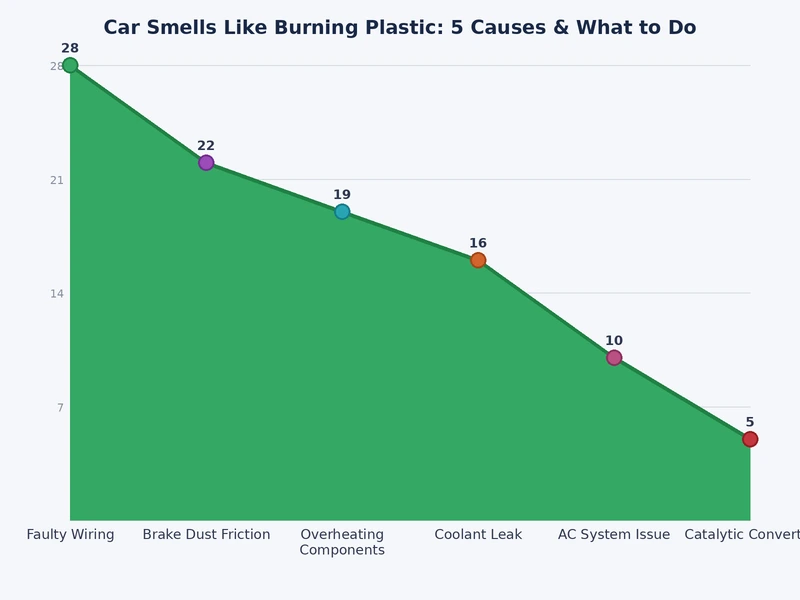
These five causes cover the overwhelming majority of burning plastic odors that drivers encounter. Use the table below to orient yourself quickly, then read each cause in detail to identify your situation accurately.
| Cause | Location of Smell | Urgency | Typical Repair Cost |
|---|---|---|---|
| Foreign object on exhaust | Rear / underside of vehicle | Low | $0–$100 |
| Electrical fault or short circuit | Cabin / under dashboard | High | $150–$1,200+ |
| Heater core or HVAC issue | Dashboard / HVAC vents | Medium | $600–$1,200 |
| Stuck brake caliper | One specific wheel well | High | $250–$800 |
| Melting engine components | Engine compartment / front | Medium–High | $100–$500+ |
A plastic bag, grocery bag, or piece of roadside debris caught on your exhaust pipe or catalytic converter (the emissions control device that converts harmful gases before they exit the tailpipe) will burn off and produce a sharp plastic odor. This is the most benign cause on the list. The smell is typically brief — lasting only a few minutes — and disappears entirely once the object burns away.
This is the most dangerous cause on this list. When electrical wiring overheats or a short circuit (unintended electrical contact that generates excess heat) develops, the plastic insulation surrounding the wires melts and produces a sharp, acrid chemical smell. You may also notice blown fuses, flickering interior lights, or non-functioning accessories alongside the odor.
Warning: A burning plastic smell combined with flickering dashboard lights is a potential fire hazard. Stop driving, turn off the ignition, exit the vehicle, and call for a tow immediately.
The heater core is a small radiator-like component inside the dashboard that warms the air delivered to the cabin. When it leaks coolant (the fluid that regulates engine temperature), that coolant drips onto hot internal surfaces and burns, creating a sweet, slightly plastic odor. A greasy film forming on the inside of your windshield is a reliable secondary symptom. If your vehicle also overheats when the AC is running, a compromised cooling system may be contributing to both problems simultaneously.
A stuck brake caliper (the hydraulic clamp that presses brake pads against the spinning rotor to slow the vehicle) causes continuous friction on one wheel even when you are not pressing the brake pedal. That sustained heat scorches brake pad material, superheats the wheel, and melts any plastic components nearby inside the wheel well. The smell is localized — strongest near one corner of the vehicle. For a full breakdown of brake-related odors, read our detailed guide on burning smell from brakes, which explains exactly what each brake smell signals and when you must stop driving.
Plastic components inside the engine bay — including coolant reservoir tanks, vacuum hoses, wiring conduits, and heat shields (thin metal covers that protect nearby parts from exhaust heat) — can contact hot metal surfaces and melt if they are displaced from their correct positions. This often occurs after engine bay work when a component is not properly repositioned. It can also indicate an overheating engine pushing excessive heat into areas that should remain cooler under normal conditions.
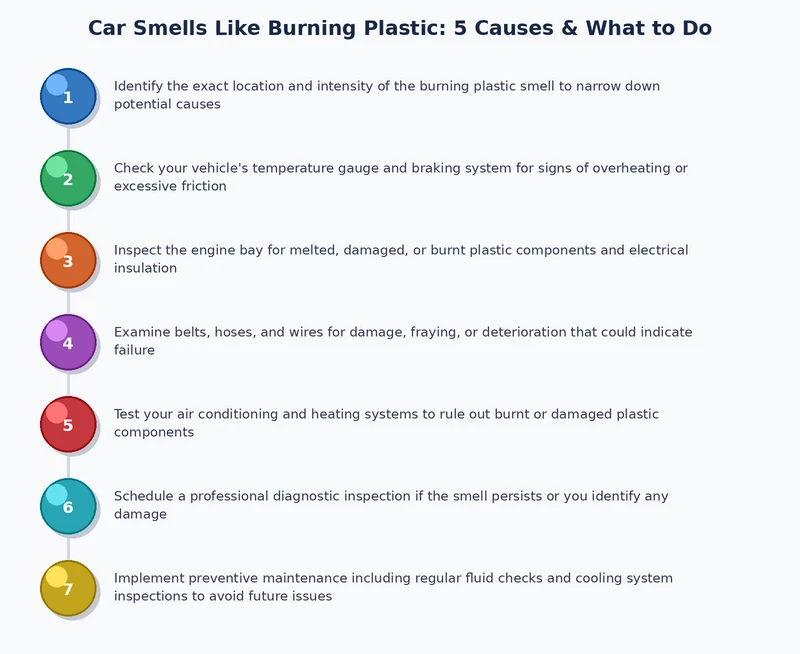
Systematic inspection eliminates guesswork. Follow these steps in order before contacting a shop — your observations will speed up diagnosis and potentially save you a diagnostic fee.
Pro Tip: If the burning smell appears only when the heater or air conditioning runs, check the HVAC system before the exhaust or brakes — the heater core or blower motor is almost certainly the source.
Repair costs vary by vehicle make, model, region, and shop labor rate. The figures below reflect typical independent shop pricing. Dealership rates generally run 20–30% higher.
If you are also detecting an oil burning smell inside the car alongside the plastic odor, budget for multiple concurrent issues. An oil leak dripping onto hot exhaust components frequently accompanies failing gaskets or seals that also compromise nearby plastic parts.
In these situations: pull off the road safely, shut off the ignition, exit the vehicle, and move a safe distance away. Do not open the hood if you see or smell smoke — introducing oxygen can accelerate a developing fire. Call roadside assistance and do not re-enter the vehicle until it is confirmed safe.
Even in lower-urgency scenarios, do not delay beyond 48 hours. A burning smell that seems minor is almost always a problem in early progression. Waiting weeks converts a straightforward repair into a complex one.
New vehicles do produce brief odors as factory coatings and lubricants cure during initial use. That process completes within the first few drives and smells faintly of warm paint or lacquer — not sharp burning plastic. If your new car smells like burning plastic after the first week of ownership, report it to the dealership immediately and request a documented warranty inspection. Do not accept a dismissive "it is normal" without evidence.
Dashboard warning lights detect specific sensor failures. They do not detect a plastic bag burning on the exhaust, wire insulation melting from an electrical fault, or a brake pad scorching from a stuck caliper. Your nose is a more sensitive diagnostic instrument than your dashboard for these failure modes. The absence of warning lights is not clearance to ignore a burning plastic smell.
Exactly one cause on this list — a foreign object on the exhaust — resolves without intervention. Electrical faults do not self-repair. Stuck calipers do not free themselves. Leaking heater cores do not reseal. A smell that persists across more than one drive cycle requires professional diagnosis. There is no version of this problem that improves through inaction.
A vehicle can accelerate, steer, and brake normally while a caliper drags, an electrical fault develops, or a heater core leaks. Smooth drivability is not a safety indicator in this context. Evaluate a burning plastic smell on its own terms — not by how the car feels to drive.
Modern vehicles contain complex wiring harnesses (bundled groups of wires routed throughout the vehicle), multiple fuse arrays, and computer control modules. An incorrect repair attempt can create additional short circuits, disable safety systems, or introduce new fire risks. Electrical burning smells belong in a shop equipped with proper diagnostic tools. This is not a home garage repair.
A dragging caliper will grind a brake pad completely through to bare metal. By the time braking performance degrades noticeably to the driver, the rotor is already scored and the repair cost has multiplied significantly. Act on the smell and the heat from the wheel — not on how the pedal feels underfoot. Your brake system does not announce failure until it is already failing.
Placing an air freshener in the cabin to cover a burning plastic smell eliminates the signal while leaving the underlying cause completely untouched. This is a reliable way to convert a $200 repair into a $1,200 repair — or worse. Never silence a diagnostic signal. Investigate it.
It depends on the cause. If the smell is brief, originates from the rear of the vehicle, and disappears completely within a few minutes, a foreign object on the exhaust is the likely culprit and the vehicle is safe to drive. If the smell is inside the cabin, intensifying, or accompanied by smoke, flickering lights, or a rising temperature gauge, stop the vehicle immediately. Do not attempt to drive to a shop under those conditions — call a tow.
The risk is low but not zero. The exhaust system operates at temperatures between 400°F and 1,200°F depending on the location — hot enough to fully combust most plastics. Roadside debris typically burns off quickly without igniting surrounding components. However, if the material is trapped near the catalytic converter and does not clear, the sustained heat can pose a fire risk. If the smell does not resolve within a few minutes of driving, pull over and inspect the undercarriage.
Three indicators point clearly to the brakes. First, the smell will be strongest near one specific wheel — not distributed evenly across the vehicle. Second, if you carefully hold your palm near each wheel center after driving (without touching the rotor), one wheel will feel dramatically hotter than the others. Third, the vehicle may pull to one side while braking or in motion. If all three indicators are present, a stuck caliper is the most probable cause. Stop driving and arrange a tow to a brake specialist.
A burning plastic odor that appears specifically when the heater is operating almost always points to the HVAC system — either the heater core, the blower motor, or a component in the ductwork. A leaking heater core drips coolant onto hot interior surfaces, producing the smell. A failing blower motor can overheat and melt nearby plastic housing material. In both cases, the smell intensifies when demand on those components increases. Turn off the heater, note whether the smell subsides, and schedule a diagnostic appointment with a mechanic familiar with HVAC systems.
A burning smell is not an inconvenience to manage — it is an instruction to act.
 |
 |
 |
 |

About Sarah Whitfield
Sarah Whitfield is a diagnostics and troubleshooting specialist who spent ten years as an ASE-certified technician before joining the editorial team. She specializes in OBD-II analysis, electrical gremlins, and the kind of intermittent problems that make most owners give up.
Get some FREE car parts & gear.. Or check out the latest free automotive manuals and build guides here.
Disable your ad blocker to unlock all the hidden deals. Hit the button below 🚗
| | | |
