by Sarah Whitfield
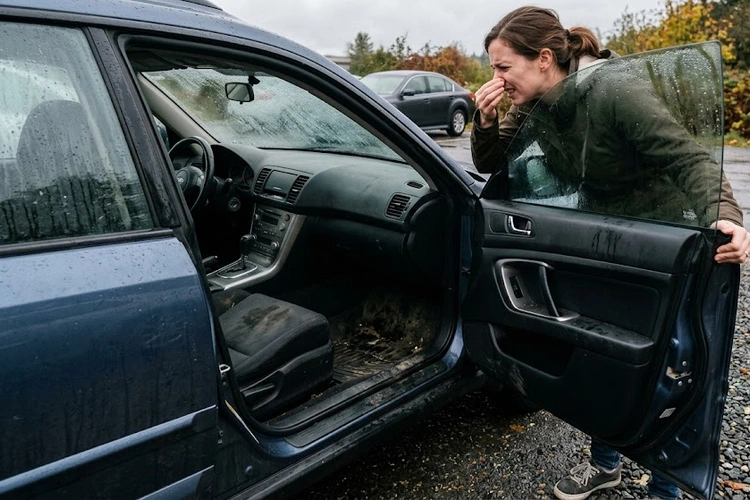
When a car smells like mildew, moisture is almost always the root cause — trapped inside carpet fibers, the HVAC (heating, ventilation, and air conditioning) system, or seat foam. The fix is straightforward once the source is identified, but treating the odor alone without finding what feeds it means the smell returns within days.
Our team has diagnosed this problem across a wide range of vehicles, from compact sedans to full-size trucks. The musty, damp odor — similar to a sealed wet gym bag — comes from mold and mildew colonies consuming organic debris in a warm, humid environment. Spores are present in every vehicle at all times; they only need a persistently damp surface to establish a colony. What looks dry on the surface can conceal active growth under floor mats or deep inside dashboard ducting.
Anyone dealing with persistent interior odors may also find useful crossover techniques in our guide on how to get smoke smell out of a car, since thorough interior cleaning is the foundation of both treatments.
Contents
Mold and mildew need three things to survive: a food source (dust, skin cells, fabric fibers), warmth, and moisture. Vehicle interiors provide all three in abundance. The question is always where the moisture originates, because that answer determines the cleaning approach and whether the problem will return. Our team consistently finds the most common sources fall into three categories.
The AC evaporator is the component our team identifies as the culprit most often. This fin-based heat exchanger sits inside the dashboard, pulling heat out of cabin air. Condensation collects on its surface continuously, and a drain tube carries that water out beneath the vehicle. When the drain tube clogs with leaf debris or dust, water pools around the evaporator instead. The warm, dark, perpetually damp space inside the dashboard becomes a thriving mold habitat. The odor is usually strongest when the fan first starts blowing after the vehicle has sat in direct sun.
Evaporator problems share symptoms with other cooling-side failures. Our breakdown of bad AC condenser symptoms explains how to distinguish between the condenser and evaporator before beginning any teardown work.
Rain entering through a faulty door seal, a damaged sunroof gasket, or a degraded windshield perimeter seal is another frequent source. Our team has found water pooled silently under rear seat cushions after a single heavy rain, completely invisible to a surface check. A sunroof that does not seal correctly is a particularly deceptive entry point — water travels down drainage channels and, when those channels are blocked, saturates the headliner or A-pillar trim before reaching the carpet below. Our detailed guide on what happens when a sunroof won't close covers gasket and motor diagnostics before water damage becomes significant.
Worn door weatherstripping (the rubber seal lining door frames) is worth a close look as well. In cold climates, frozen car door locks are sometimes an early sign that weatherstripping has separated from its channel — water infiltration through that same gap often follows within a season.
Spilled drinks, damp umbrellas, and wet shoes tracking rain onto carpet all introduce moisture that upholstery absorbs quickly. The deceptive part is that carpet dries on the surface long before the foam padding underneath does. Most people assume the car is dry within a day, but the foam layer can hold meaningful moisture for well over a week depending on airflow and humidity. By that point, mold has established a colony in the padding where no surface inspection reveals anything unusual.
Pro tip: Our team uses an inexpensive moisture meter — available at hardware stores for under $20 — to confirm carpet is genuinely dry before closing up the interior. Surface dryness is almost always misleading when the underlying foam has been saturated.
Removing mildew smell permanently requires addressing both the moisture source and the existing mold growth. Doing either one without the other produces only temporary results. Our team follows a consistent three-step sequence that applies regardless of odor severity or how long it has been present.
The investigation always comes before cleaning. Practical diagnostic methods include pouring water over door and window seals while watching the interior for drips, probing sunroof drain channels with a thin flexible wire, and pressing firmly on carpet near the firewall and under rear seats to feel for hidden wetness. Damp carpet near the firewall often points to a heater core leak or failed HVAC housing seal. A sweet-smelling dampness in the same area can trace back to a cracked coolant reservoir — coolant steam absorbed by carpet breaks down over time and develops a secondary mildew-like odor as it reacts with organic debris.
Once the entry point is confirmed and repaired, drying begins — ideally with doors open on a low-humidity day, with fans or a wet/dry vacuum assisting over the carpet surface.
Our team recommends removing floor mats and pulling the front seats where practical to access the full carpet surface. An enzyme-based cleaner — one that breaks down organic material at the molecular level, eliminating the food source rather than masking the odor — outperforms standard carpet shampoo for mildew by a wide margin. The cleaner should be worked into the carpet with a stiff brush, left to dwell for the time listed on the label, then extracted thoroughly with a wet/dry vacuum.
Upholstery foam presents a greater challenge. For saturated seat foam, a steam cleaner followed by a portable dehumidifier left inside the closed car overnight can pull deep moisture. Headliner fabric is fragile — aggressive scrubbing causes delamination and sagging — so a light enzyme spray with careful blotting is the safer method.
The HVAC system requires its own treatment pass even if the evaporator was not the primary source. A can of AC evaporator cleaner, directed through the intake vent with the fan running on recirculate, reaches the evaporator coils and kills surface mold. These sprays are widely available at auto parts retailers for $8 to $15. Running the AC on maximum cold with windows down for ten minutes afterward flushes treated residue out through the drain tube.
EPA research on mold and indoor health confirms that HVAC systems are among the most significant pathways for occupant mold exposure — vehicle HVAC systems follow the same biological principles as residential units, making this step non-negotiable for a complete treatment.
Warning: Never run an ozone generator inside a car and immediately re-enter. At concentrations effective for odor elimination, ozone is harmful to inhale — our team recommends a minimum of two hours of open-door ventilation before occupying the vehicle again.
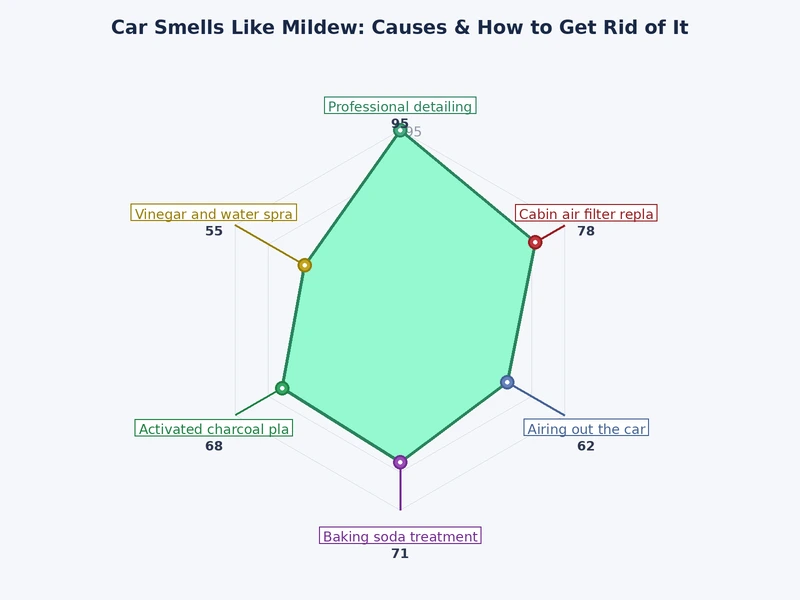
No shortage of products are marketed for mildew odors, and our team has worked through most of the major categories. Results vary considerably by severity and application method. The table below compares the main approaches by effectiveness, approximate cost, and practical fit for anyone working without professional shop equipment.
| Product Type | How It Works | Effectiveness | Approx. Cost | Best For |
|---|---|---|---|---|
| Enzyme cleaner | Destroys organic matter mold feeds on | High | $10–$20 | Carpet and upholstery, mild to moderate cases |
| AC evaporator spray | Kills mold on evaporator coil surface | High (HVAC source) | $8–$15 | HVAC-origin odors |
| Ozone treatment | Oxidizes odor molecules throughout cabin | Very high | $50–$150 (rental) | Severe or widespread mold |
| Antimicrobial fogger | Disperses biocide throughout cabin air | High | $15–$30 | Post-cleaning preventive step |
| Baking soda | Absorbs airborne odor molecules | Low (temporary) | Under $5 | Minor odor maintenance only |
| Air freshener | Masks odor with fragrance | Very low | $3–$10 | Not a mildew treatment |
For severe cases — visible mold on carpet backing, heavy growth inside HVAC ducts, or odor that persists after two full DIY treatment cycles — professional detailing with an ozone machine or antimicrobial fogging is often the most cost-effective path. Shops can pull trim panels and seat track covers to reach areas home users cannot safely access. Our broader experience with moisture-related vehicle damage also underscores the value of checking adjacent systems: a milky appearance on the oil dipstick can indicate coolant intrusion into the engine — a separate but related moisture problem worth addressing at the same time.
Persistent misconceptions lead most people to repeat the same ineffective steps. Our team has collected the three myths encountered most often in the field.
Air fresheners layer a new scent over the existing odor. Within days, as the fragrance fades, the mildew smell returns unchanged because the mold colony is still active, still consuming organic material, and still producing the volatile organic compounds (VOCs) that create the odor. The approach does not just fail — it can delay proper treatment by creating a temporary impression that the problem is resolved. The only permanent solution involves eliminating the moisture source and the existing biological growth.
Heat accelerates surface evaporation, and sustained high temperatures do slow mold growth. However, heat alone rarely eliminates an established colony in carpet padding, where temperatures at the foam base stay well below what mold requires to die. Running the heater also circulates spores through the cabin air, potentially spreading them to areas that were originally clean. Heat is a useful supplementary drying tool, not a standalone mildew treatment.
Most mildew cases are fully reversible and have no effect on mechanical function. The odor does not indicate engine trouble, transmission faults, or structural damage. Our team does recommend checking adjacent systems while the interior is accessible — a damp firewall area can point to a windshield seal failure that may eventually affect wiring if left unaddressed — but the smell itself is a cabin hygiene problem, not a mechanical emergency.
Insider note: Vehicles that sit unused for extended periods — especially in enclosed garages — are far more prone to mildew than daily drivers, because stagnant cabin air allows humidity to accumulate unchecked over days or weeks with no ventilation.
Even with the right products on hand, common errors either neutralize the treatment or actively worsen the problem. Our team sees these mistakes repeatedly across vehicles of all types and ages.
This is the most consequential mistake. Interior surfaces cleaned and dried while the moisture entry point remains open will smell of mildew again within 48 hours of the next rain. The correct sequence is non-negotiable: identify the source, repair it, allow complete drying, and only then clean and treat. Any other order wastes materials and time without producing a durable result.
Applying enzyme cleaner too liberally and scrubbing with a soaked brush can introduce more moisture into the padding than was originally present — the opposite of the intended outcome. The correct technique involves dampening the surface evenly, agitating with moderate pressure, and extracting immediately and thoroughly. Multiple controlled passes consistently outperform a single heavy-handed application.
Some people clean the carpet and seats thoroughly but skip the HVAC system entirely. If the evaporator contributed to the problem, the odor returns every time the fan runs — even inside a freshly detailed interior. The HVAC step is not an optional finish. It is required any time there is reasonable suspicion the air conditioning system played any role in producing or spreading the mildew smell.
Baking soda is a legitimate deodorizer that absorbs airborne odor molecules — it does not kill mold. Spreading it over carpet and vacuuming it up reduces surface odor temporarily while the colony underneath remains fully intact. Our team uses baking soda as a finishing pass after enzyme treatment and confirmed full drying, never as a primary treatment strategy for active mildew growth.
For mild cases where the moisture source is fixed promptly, a full treatment cycle — cleaning, HVAC spray, and complete drying — typically resolves the odor within two to four days. Severe cases with deep foam saturation or widespread mold can take a week or more, particularly when professional ozone treatment is part of the process.
Prolonged exposure to mold spores in an enclosed cabin can aggravate respiratory conditions, trigger allergic reactions, and cause throat and eye irritation in sensitive individuals. People with asthma or known mold allergies are especially susceptible and should treat the problem promptly rather than tolerating the odor long-term.
Enzyme-based cleaners consistently outperform other DIY options for carpet and upholstery because they destroy the organic material mold feeds on rather than masking the smell. For odors originating from the HVAC system, a dedicated AC evaporator spray is the most targeted solution. Severe widespread cases benefit most from ozone treatment.
Comprehensive auto insurance may cover mold damage resulting from a covered event such as flooding. Mold that develops from gradual neglect — a slow drip ignored over months — is typically classified as a maintenance issue and excluded. Reviewing the specific policy language and contacting the insurer directly is the most reliable way to confirm coverage.
The clearest indicator is timing: if the odor peaks during the first few minutes of fan operation after the vehicle has been sitting in heat, the evaporator is the likely culprit. Turning the AC off but leaving the fan running for the final few minutes of each drive helps dry the evaporator surface and reduces odor buildup over time.
Bleach is not recommended for vehicle interiors. It can discolor fabric and carpet, degrade rubber trim and seals, and produce fumes that are difficult to clear from an enclosed cabin. Enzyme-based cleaners and purpose-made automotive antimicrobial sprays accomplish the same biological outcome without the material compatibility risks bleach introduces.
Our team recommends checking the drain tube annually before the main cooling season begins. The check is simple — locate the drain outlet beneath the dashboard on the passenger side and confirm water drips freely when the AC runs. Vehicles parked under trees should be checked more frequently, since leaf litter and seeds accumulate in drain channels quickly.
Yes, if the original moisture source was not fully sealed or if a new water intrusion event occurs. A thorough treatment that addresses both the source and existing mold growth is highly effective, but any vehicle with a recurring leak, persistently blocked drain, or failed weatherstripping can redevelop the problem. Long-term prevention depends entirely on keeping every water entry point sealed.
 |
 |
 |
 |

About Sarah Whitfield
Sarah Whitfield is a diagnostics and troubleshooting specialist who spent ten years as an ASE-certified technician before joining the editorial team. She specializes in OBD-II analysis, electrical gremlins, and the kind of intermittent problems that make most owners give up.
Get some FREE car parts & gear.. Or check out the latest free automotive manuals and build guides here.
Disable your ad blocker to unlock all the hidden deals. Hit the button below 🚗
| | | |
