by Sarah Whitfield
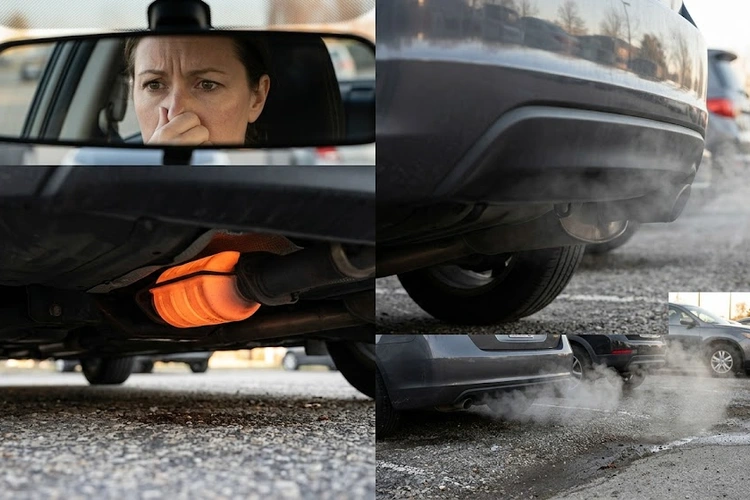
You park in the garage after a routine errand, cut the engine, and before you can even grab your bag, it hits you — that unmistakable sulfurous punch right at the back of your throat. At first you think it's the neighbor's trash bins. Then you realize the smell is coming from your car. If your car smells like rotten eggs, you're not dealing with a minor quirk — you're dealing with hydrogen sulfide (H₂S) gas escaping from your exhaust or engine bay, and it points to one of five specific mechanical problems, each with a clear fix.
The good news: most causes are diagnosable at home with basic observation and a cheap OBD-II scanner. The bad news: ignoring the smell routinely turns a $150 repair into a $1,500 one. This guide walks you through every cause, how to confirm which one you're dealing with, and what to do next. For a full library of car symptoms and fixes, browse the CarCareTotal maintenance guides.
If you're noticing other warning signs alongside the smell — like an oil burning smell inside the car — that adds another layer to diagnose, but the rotten egg odor has its own set of specific culprits we'll cover in order of likelihood.
Contents
The odor comes from hydrogen sulfide (H₂S) — a colorless gas produced when sulfur compounds in gasoline are incompletely processed. Under normal operating conditions, your catalytic converter (the emissions control device in your exhaust system) converts H₂S into sulfur dioxide (SO₂), an odorless gas. When something in that chain breaks down, raw H₂S escapes into the air around and inside your car.
The EPA regulates sulfur content in gasoline, but even compliant fuel contains enough sulfur to produce a noticeable smell when your exhaust system isn't processing it correctly. The system works silently when healthy — you only notice it when it fails.
Pinning down the location is your first diagnostic move. A smell strongest near the tailpipe points somewhere different than one that's worst when you open the hood — or one that follows you inside the car through the vents.
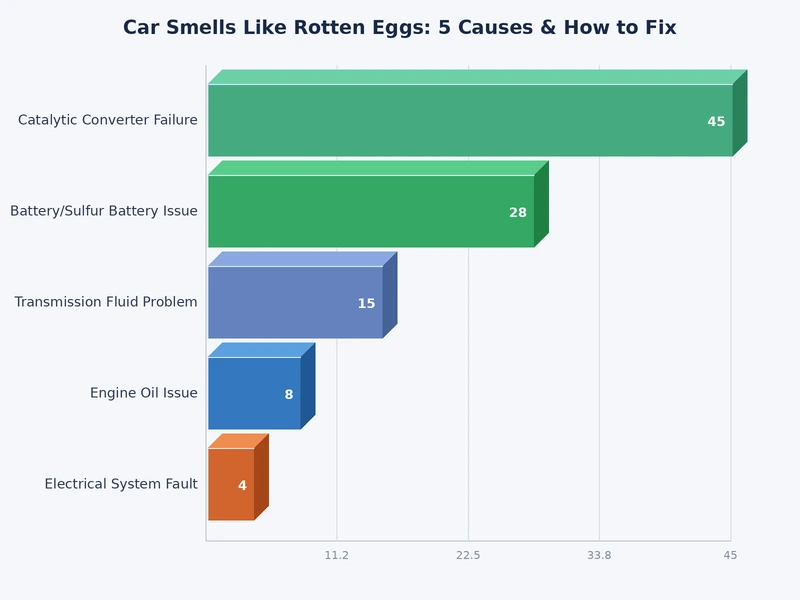
This is the most common cause by a wide margin — and the most expensive to fix. The catalytic converter's job is to process toxic exhaust gases before they leave the tailpipe. When it degrades, it can no longer efficiently convert H₂S, and you smell the difference immediately.
Signs it's the catalytic converter:
Fix: Catalytic converter replacement. Expect $800–$2,500 depending on your vehicle make and whether aftermarket or OEM parts are used. On mildly fouled converters, a fuel additive cleaner is worth trying first — but if the substrate (the ceramic honeycomb inside) is cracked, melted, or contaminated with coolant or oil, replacement is the only fix.
A "rich" air-fuel mixture means the engine is burning more fuel than it can completely combust. The leftover unburned fuel carries sulfur compounds through the exhaust before the catalytic converter has a chance to neutralize them.
Common causes of a rich mixture:
Fix: Scan for codes first — the ECU often flags the specific sensor at fault. Replacing a bad O2 sensor typically runs $150–$300 parts and labor. A clogged air filter is a $20–$30 DIY job that takes ten minutes. Fix the root cause, and the smell disappears.
Transmission fluid that's heavily degraded or leaking onto hot exhaust components produces a sulfurous smell that's easy to confuse with a catalytic converter problem. The difference: this smell typically radiates from the engine bay or the underside of the car, not the tailpipe.
How to tell it's transmission fluid:
Fix: If the fluid is simply old and degraded, a transmission fluid flush and filter replacement solves it — typically $100–$250 at a shop. If there's an active leak, find the source (pan gasket, cooler lines, or an axle seal) and repair it before the fluid level drops low enough to cause transmission damage.
Standard lead-acid batteries contain sulfuric acid. When they overcharge, overheat, or reach the end of their service life, they off-gas hydrogen sulfide. The smell is often strongest when you open the hood — sometimes confused with a food smell, but distinctly sharp and chemical.
Signs it's the battery:
Fix: Load-test the battery (free at most auto parts stores). A swollen, cracked, or leaking battery needs immediate replacement — $100–$300 depending on size and group. Also test charging voltage: healthy range is 13.5–14.5V at the battery with the engine running. Anything consistently above 14.8V means your alternator or voltage regulator is overcharging.
Safety warning: A gassing battery is both a health hazard and a fire risk — H₂S is flammable and toxic. If the battery case is swollen or you smell rotten eggs strongest near the battery with the hood open, do not start the car. Have it towed and the battery replaced before driving.
The fuel pressure regulator controls the amount of fuel pressure delivered to the injectors. When it fails in the "rich" direction — stuck open or leaking internally — it floods the engine with excess fuel, producing the same downstream effects as a bad O2 sensor or MAF sensor, but from a different source entirely.
Additional symptoms of a bad regulator:
Fix: Replace the fuel pressure regulator. Cost runs $150–$400 parts and labor. It's a moderately involved DIY on most vehicles — manageable if you're comfortable working around fuel lines, but any repair near pressurized fuel deserves careful attention to fire safety.
| Cause | Smell Location | Key Symptom | Avg. Repair Cost | DIY Friendly? |
|---|---|---|---|---|
| Failing Catalytic Converter | Rear / tailpipe | Check engine light (P0420/P0430), reduced power | $800–$2,500 | No |
| Rich Fuel Mixture | Exhaust / rear | Poor fuel economy, misfires, sensor codes | $20–$300 | Partially |
| Old Transmission Fluid | Engine bay / undercarriage | Rough shifts, reddish fluid leaks | $100–$250 | Yes (flush) |
| Failing Battery | Under hood / trunk area | Swollen case, dim lights, slow crank | $100–$300 | Yes |
| Bad Fuel Pressure Regulator | Exhaust / engine bay | Black exhaust smoke, raw fuel smell | $150–$400 | Partially |
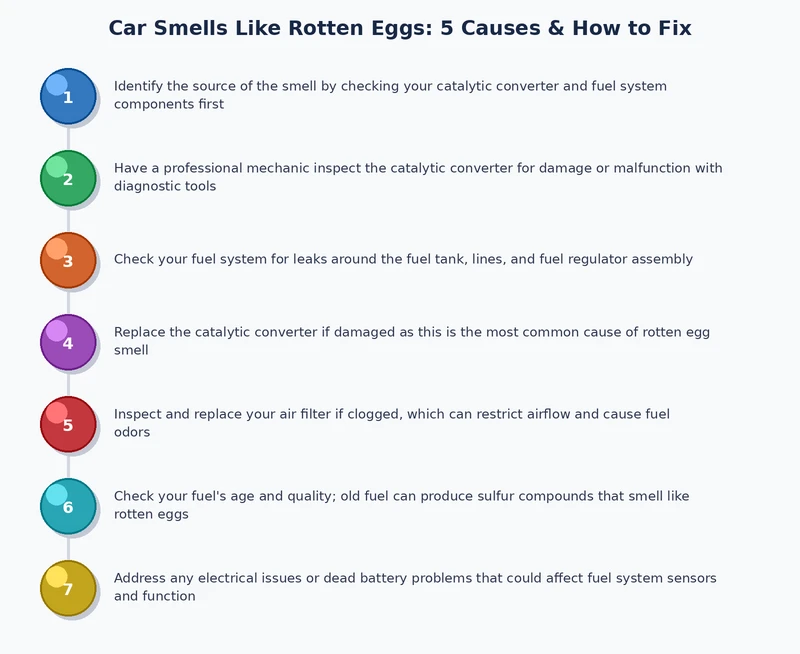
Don't guess. Work through this sequence in order before spending a dollar on repairs:
If your temperature gauge is also fluctuating alongside the rotten egg smell, treat coolant issues as a priority — engine overheating destroys catalytic converters fast by melting the internal substrate.
Even in these cases, keep your windows cracked and avoid sitting in a closed garage with the engine running. H₂S at low concentrations causes headaches before you realize what's happening.
Hydrogen sulfide affects the nervous system at concentrations that can build up quickly in an enclosed vehicle. Never dismiss physical symptoms as unrelated when this smell is present.
Low-quality gasoline does contain more sulfur, and that sulfur ends up in your exhaust. But a functioning catalytic converter handles it without any noticeable odor at all. If you're smelling rotten eggs, the fuel quality is a contributing variable at most — your exhaust system is no longer doing its job. Switching gas stations won't fix a failing converter or a bad O2 sensor.
Fuel additives marketed as converter cleaners can dissolve light carbon deposits on a mildly fouled converter. They don't repair a cracked ceramic substrate, a melted honeycomb, or a converter that's been contaminated by coolant or oil. If your scanner shows a P0420 code, don't spend $30 on additives expecting a cure. Get the converter's efficiency properly tested — that tells you whether it's salvageable or needs replacement.
Age doesn't normalize the rotten egg smell. An older car with a healthy exhaust system still processes H₂S efficiently. If your high-mileage vehicle smells like rotten eggs, something has degraded to the point of failure — not the natural consequence of age. Every car on the road is subject to emissions requirements, and a car producing H₂S at detectable levels is a car with a broken component. Full stop.
The most expensive mistake people make is paying for a catalytic converter replacement when a $150 O2 sensor was causing the rich mixture that destroyed it — only to have the new converter fail within a year from the same uncorrected root cause. Fix the underlying problem first. Replace the converter after. That order matters.
The catalytic converter is the most expensive component in this story, and most premature failures trace directly back to deferred maintenance elsewhere:
Your fuel, exhaust, and electrical systems don't operate in isolation — they affect each other constantly. A neglected fuel system overloads the catalytic converter. A failing alternator overcharges the battery. A dirty air filter forces a rich mixture that burns through both spark plugs and the converter simultaneously.
The most effective long-term approach is a once-a-year full-system review: spark plugs, O2 sensors, air filter, fuel filter, battery health check, and transmission fluid condition. Most of those inspections take under an hour. Catching a $25 air filter problem before it destroys a $1,500 catalytic converter is the entire game of preventive car ownership.
Build that habit, and the rotten egg smell becomes something you read about — not something you deal with.
It depends on the source and severity. A mild smell that appears only on cold starts and disappears within a few minutes is generally safe to drive with temporarily while you schedule a diagnosis. But if the smell enters the cabin through the vents, your battery case is visibly swollen, or you feel lightheaded or nauseous while driving, stop immediately. Hydrogen sulfide is toxic at concentrations that can build up in a closed vehicle cabin faster than most people expect.
The cost depends entirely on the cause. A clogged air filter is a $20–$30 DIY fix. Replacing an O2 sensor runs $150–$300. A full catalytic converter replacement — the most common and most expensive fix — costs $800–$2,500 depending on the vehicle. Always get a proper diagnosis before agreeing to any repair. Paying for a new catalytic converter when a $150 sensor is the actual culprit is one of the most common and costly mistakes in automotive repair.
Yes, indirectly. Worn spark plugs cause engine misfires, which send unburned fuel through the exhaust system. That excess unburned fuel overwhelms the catalytic converter, causing it to overheat and process sulfur compounds inefficiently — which produces the rotten egg odor. Replacing spark plugs on schedule is one of the most cost-effective ways to protect an expensive catalytic converter from premature failure.
Hard acceleration places the exhaust system under its heaviest load. If your catalytic converter is borderline — still functioning at light throttle but losing efficiency — it handles everyday driving but gets overwhelmed when you demand more power. That's exactly when unprocessed H₂S gas escapes and you notice the smell. It's a reliable early warning sign that the converter is declining and worth having tested before it fails completely.
When your car smells like rotten eggs, the smell is never the problem — it's the warning. Find the source, fix the cause, and you turn a $30 air filter into the repair that saved you a $2,000 catalytic converter.
 |
 |
 |
 |

About Sarah Whitfield
Sarah Whitfield is a diagnostics and troubleshooting specialist who spent ten years as an ASE-certified technician before joining the editorial team. She specializes in OBD-II analysis, electrical gremlins, and the kind of intermittent problems that make most owners give up.
Get some FREE car parts & gear.. Or check out the latest free automotive manuals and build guides here.
Disable your ad blocker to unlock all the hidden deals. Hit the button below 🚗
| | | |
