by Sarah Whitfield
You press the accelerator to merge onto the freeway and the engine stumbles beneath you — a rhythmic shudder replacing the expected surge of power. The vehicle recovers briefly, then stumbles again at the next throttle input. Car sputtering when accelerating is one of the most frequently misdiagnosed complaints in independent repair shops, and the reason is straightforward: eight distinct causes share nearly identical surface symptoms but demand entirely different repair paths. This guide gives you both the diagnostic logic and the repair sequence for each one. For a full topical overview, visit the car sputtering when accelerating resource page.
Contents
Your engine operates on a precise triangle of air, fuel, and spark — each leg timed to thousandths of a second. When you press the accelerator, the throttle body opens, the MAP or MAF sensor signals the ECU to increase fuel delivery, and the ignition system must fire each cylinder under greater compression load than it handled at idle. Any disruption to one element in that sequence produces an incomplete combustion event. You feel it as a stumble, hesitation, or rhythmic shudder through the drivetrain — all variations of the same root failure.
The failure is never random. A misfire on a single cylinder differs fundamentally from a lean condition across all cylinders. Your job is to identify the pattern: which RPM range the sputter occupies, whether it worsens at full load versus partial throttle, and whether your Check Engine light is illuminated or flashing. A flashing CEL indicates an active misfire severe enough to damage your catalytic converter. According to EPA on-board diagnostics guidance, a flashing malfunction indicator lamp requires immediate attention to avoid converter destruction.
Your engine control module tracks misfire counters per cylinder using crankshaft position sensor data. A P030X fault code — where X identifies the cylinder — tells you precisely where the failure originates. Once misfire thresholds are crossed, the ECM retards ignition timing and, in severe cases, cuts fuel delivery to the affected cylinder to protect the catalyst. This protective response is why a single failed coil can feel like a broad power loss across the entire engine. Pull all stored and pending codes before you touch a single component.
In the majority of sputtering cases, your vehicle is trying to tell you one of three things: the ignition hardware is worn, the fuel delivery system is restricted, or both. Work through these checks in order — highest probability and lowest cost first — before moving to more complex diagnostics.
Never replace parts without confirming the fault code implicates them. Installing fresh coils and plugs on a vehicle with a cracked vacuum hose or contaminated MAF sensor solves nothing and costs you time and money you will not recover.
Worn spark plugs are the leading cause of acceleration sputtering on vehicles with more than 60,000 miles on the original ignition hardware. A plug with an eroded center electrode requires elevated secondary voltage to fire — voltage your coil may supply adequately at idle but cannot sustain under the higher cylinder pressure produced during hard acceleration. Pull one plug and inspect the gap against the factory specification stamped on your emissions label. If the electrode shows wear, carbon fouling, or oil contamination, replace the full set.
On coil-on-plug systems, your fastest diagnostic move is swapping the suspect coil with a coil from an adjacent cylinder. If the P030X misfire code follows the coil to its new position, the coil is your confirmed failure. Replace only that unit unless your vehicle exceeds 100,000 miles — at that mileage, replacing the complete set during a single service visit is the more economical long-term decision.
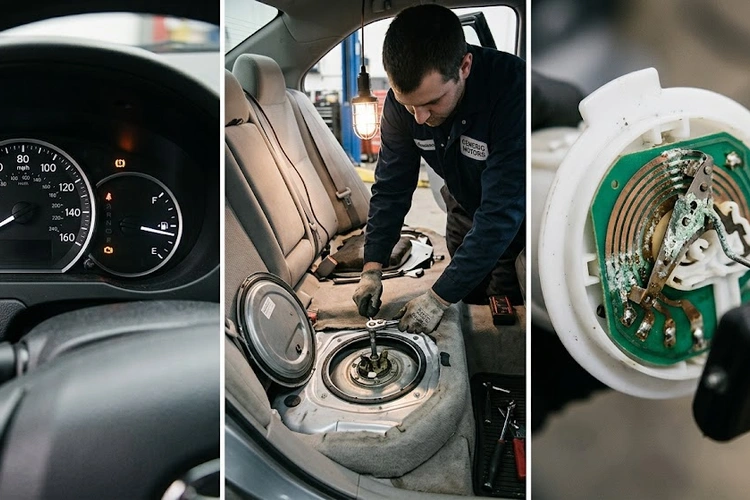
A partially clogged fuel filter passes adequate flow at idle but cannot sustain the volume your injectors demand at wide-open throttle. The pressure drop across the restriction leans the mixture precisely when your engine needs richness most. If your idle quality seems acceptable, do not dismiss the filter as a suspect — review the full failure progression in the bad fuel filter symptoms guide before concluding the filter is clear. A weak fuel pump follows the same pattern: pressure holds at rest but collapses under the flow demand of acceleration, producing an unmistakable stumble that worsens the harder you press the pedal.
Guessing wastes money. Your diagnostic toolkit needs at minimum an OBD-II scanner that displays live data — not merely reads codes — a digital multimeter, and a fuel pressure gauge. A quality scan tool in the $80–$200 range gives you access to short-term fuel trim (STFT), long-term fuel trim (LTFT), MAP sensor output, and oxygen sensor switching in real time. These live parameters reveal lean or rich conditions, vacuum leaks, and MAF sensor faults before you remove a single bolt.
Watch your fuel trims while replicating the sputter on a road test. STFT values swinging beyond ±10% under load point directly to a fueling or air metering problem. Stable codes with normal fuel trims shift your attention to the ignition system. A smoke machine accelerates vacuum leak detection considerably but is not required for initial triage on most naturally aspirated engines.
Work through these steps before purchasing any replacement parts:
The table below summarizes each cause of car sputtering when accelerating alongside its primary diagnostic indicator and the typical professional repair cost range. Use it as a triage reference after you have pulled your fault codes and live data.
| # | Cause | Primary Diagnostic Indicator | Typical Repair Cost |
|---|---|---|---|
| 1 | Worn spark plugs | P030X code, eroded electrode on inspection | $60–$200 (full set) |
| 2 | Failed ignition coil | P030X migrates with coil swap | $80–$300 per coil |
| 3 | Clogged fuel filter | Low fuel pressure at wide-open throttle | $50–$150 |
| 4 | Weak fuel pump | Pressure drops under load, holds at idle | $250–$600 |
| 5 | Dirty or failed MAF sensor | STFT/LTFT lean bias, P0101 or P0102 | $100–$400 |
| 6 | Vacuum leak | STFT lean, audible hiss, rough idle | $75–$250 |
| 7 | Clogged fuel injectors | Cylinder-specific lean, P0300 random misfire | $150–$500 (professional flush) |
| 8 | Failing catalytic converter | P0420/P0430, sulfur smell, power loss at speed | $900–$2,500 |
Contaminated fuel can cause sputtering, but it is the exception, not the rule. Fuel from major-brand stations in regulated markets meets ASTM D4814 specifications for octane rating, reid vapor pressure, and ethanol content. If your vehicle has run on the same fuel supply for years without incident and suddenly sputters, the pump is not your first suspect. Investigate your ignition hardware and fuel delivery components before attributing the problem to the station down the street.
Fuel system additives have a legitimate place in a maintenance schedule, but they will not restore a mechanically failed MAF sensor, seal a cracked vacuum hose, or repair a coil with a degraded primary winding. If your vehicle is experiencing car sputtering when accelerating alongside cold-start hesitation, the car hesitation when accelerating diagnostic guide covers the overlapping repair trees in detail — many of the root causes are identical and the diagnostic sequence is the same. Pour the cleaner in as maintenance; diagnose with data first.
The vehicles that never sputter are maintained on schedule rather than repaired after failure. Two maintenance disciplines eliminate the majority of acceleration sputtering before it begins: strict adherence to ignition service intervals and consistent attention to air intake components.
Replace copper spark plugs at 30,000-mile intervals without exception. Replace iridium and platinum plugs at 90,000–100,000 miles regardless of visual appearance — electrode wear at that mileage is not always visible to the naked eye, but firing voltage requirements have risen enough to cause intermittent misfires under load. Replace the fuel filter at 30,000-mile intervals on older returnless fuel systems. On modern direct-injection vehicles, the filter integrates into the pump module and requires attention only when pump pressure tests fall below specification.
Ignition coils carry no fixed replacement interval, but any vehicle past 80,000 miles that develops a confirmed coil failure should have the full set inspected during the same repair visit. Replacing a single coil on a high-mileage engine frequently means returning to the shop within a few months for the next one.
Your MAF sensor is the most consistently overlooked maintenance item in a fuel injection system. Clean the sensor element with dedicated MAF cleaner spray every 30,000 miles or at each air filter replacement. Carburetor cleaner and brake cleaner both leave residue that permanently damages the hot-wire element — use only products labeled specifically for MAF sensors. Inspect all intake boot connections and vacuum hoses for cracks at every oil service interval. A two-minute visual check prevents the lean misfire that follows an undetected vacuum leak.
Worn spark plugs are the single most common cause. A plug with an eroded electrode cannot fire reliably under the higher cylinder pressure produced during acceleration, generating intermittent misfires that register as sputtering or stumbling through the drivetrain.
Yes. A contaminated mass airflow sensor under-reports intake air volume, causing the ECU to deliver less fuel than the engine requires. At idle, fuel trim corrections can compensate. Under acceleration, the airflow demand exceeds the ECU's correction range and the resulting lean condition triggers a misfire.
It depends on severity. Intermittent sputtering from worn spark plugs is manageable for short distances. A flashing Check Engine light indicates an active misfire damaging your catalytic converter — limit driving immediately and schedule a repair. Driving with a flashing CEL risks a converter replacement bill that dwarfs the original ignition repair.
Yes. A small vacuum leak can be masked at idle because the ECU's fuel trim corrections are sufficient to compensate for the unmetered air. Under acceleration, the airflow increase overwhelms those corrections, the mixture goes lean, and the engine misfires under load while appearing to idle normally.
Connect a fuel pressure gauge to the Schrader valve on your fuel rail. Record pressure at idle, then perform a snap-throttle test and record the reading under load. If pressure holds steady at idle but drops significantly during acceleration, your pump is failing to sustain flow under demand. Compare both readings against the manufacturer's specification for your vehicle.
If a single cylinder misfire is confirmed by fault codes and verified by the coil swap test, replacing that coil resolves the sputtering. On vehicles with more than 80,000 miles, replacing the full coil set during the same service visit is the more cost-effective approach — remaining coils at that mileage are close to the same failure threshold.
Repair costs range from under $100 for a spark plug set to over $2,500 for catalytic converter replacement. The median repair — an ignition coil or fuel filter — falls between $150 and $400 including labor at an independent shop. Accurate diagnosis before parts replacement is the single most effective cost control available to you.
The engine tells you exactly what is wrong every single time — the only variable is whether you read the data before reaching for parts or after wasting money on the wrong ones.
 |
 |
 |
 |

About Sarah Whitfield
Sarah Whitfield is a diagnostics and troubleshooting specialist who spent ten years as an ASE-certified technician before joining the editorial team. She specializes in OBD-II analysis, electrical gremlins, and the kind of intermittent problems that make most owners give up.
Get some FREE car parts & gear.. Or check out the latest free automotive manuals and build guides here.
Disable your ad blocker to unlock all the hidden deals. Hit the button below 🚗
| | | |
